
Design Travel · New York
Reading time: 7 minOn the edge of SoHo and Chinatown, a former Holiday Inn has been reborn as one of Manhattan’s most quietly assured design hotels — a marriage of Danish restraint, Anda Andrei’s theatrical eye and a founding belief that a hotel should give as much as it takes.
New York is a city of energy and appetite, alive to the loud, the tall and the new, and its hotels have long risen to the occasion with spectacle and scale. 11 Howard adds another register to that chorus. Tucked onto a quiet street where SoHo blurs into Chinatown, it makes its case by whispering: in soothing natural hues, in beautifully made furniture, in the calm that settles over you the moment the door closes on the energy of lower Manhattan. It is a hotel that infuses Scandinavian quality and design into one of the city’s most iconic neighbourhoods, and in doing so offers a genuine sense of retreat alongside its luxury.

11 Howard offers far more than a beautiful, pared-back room with a view. From the outset it was conceived around a guiding principle its founders call “conscious hospitality”, a conviction that a hotel should contribute to the community and environment around it. The result is a property that is as thoughtful about its values as it is about its veneers, and one that rewards a closer look.
A Danish sensibility on Howard Street
The building itself has a rich New York past. The structure at 11 Howard Street began life as a 1970s Holiday Inn, a solid piece of mid-block Manhattan with real potential in its frame. When the developer Aby Rosen acquired it, he saw exactly that potential, and set about a transformation that would open, after a comprehensive overhaul, as 11 Howard in the spring of 2016.

To shape the interiors, Rosen turned to an inspired pairing. The Copenhagen studio Space Copenhagen — the duo of Signe Bindslev Henriksen and Peter Bundgaard Rützou, best known for the warm, tactile interiors of the world-famous restaurant Noma — was brought in to bring authentic Danish sensibility to the project, working alongside the creative director Anda Andrei, a veteran of Ian Schrager’s most influential hotels. It was a meeting of two design cultures: the Nordic instinct for natural materials, honest craft and quiet good taste, and Andrei’s more theatrical, distinctly New York feel for atmosphere and drama. The tension between the two gives the hotel its particular character — Danish calm with a Manhattan pulse.
The architecture practice Beyer Blinder Belle, long associated with sensitive New York restorations, handled the conversion of the bones, coaxing a generous, light-filled hotel out of the existing block. The setting helps, too. Howard Street sits at the seam where the boutiques and cast-iron of SoHo give way to the markets and energy of Chinatown, a genuinely characterful stretch of downtown that keeps the hotel rooted in a lively working neighbourhood. It is a location that flatters the building’s low-key confidence.

Crucially, this was always intended to be a hotel for the long term. Andrei has spoken of wanting a building that would “look better, not worse, in five years”, and that ambition runs through every material decision. Everything is chosen to age gracefully, to soften and deepen with use. It is a refreshingly long-sighted way to build. It is also, in its way, a sustainable one: a hotel designed to last is a hotel that goes on giving season after season.
The aim, in Anda Andrei’s words, was a hotel that would “look better, not worse, in five years” — designed to endure and even to improve with time.
Arrival: stone, wood and a moment of calm
That philosophy announces itself the instant you step inside. Arriving guests are enveloped in soothing natural tones, vibrant floral arrangements and striking artworks arranged through the reception, lobby and lounge — a deliberate and immediate contrast to the bustle of the streets just beyond the glass. The city is loud; 11 Howard is not.
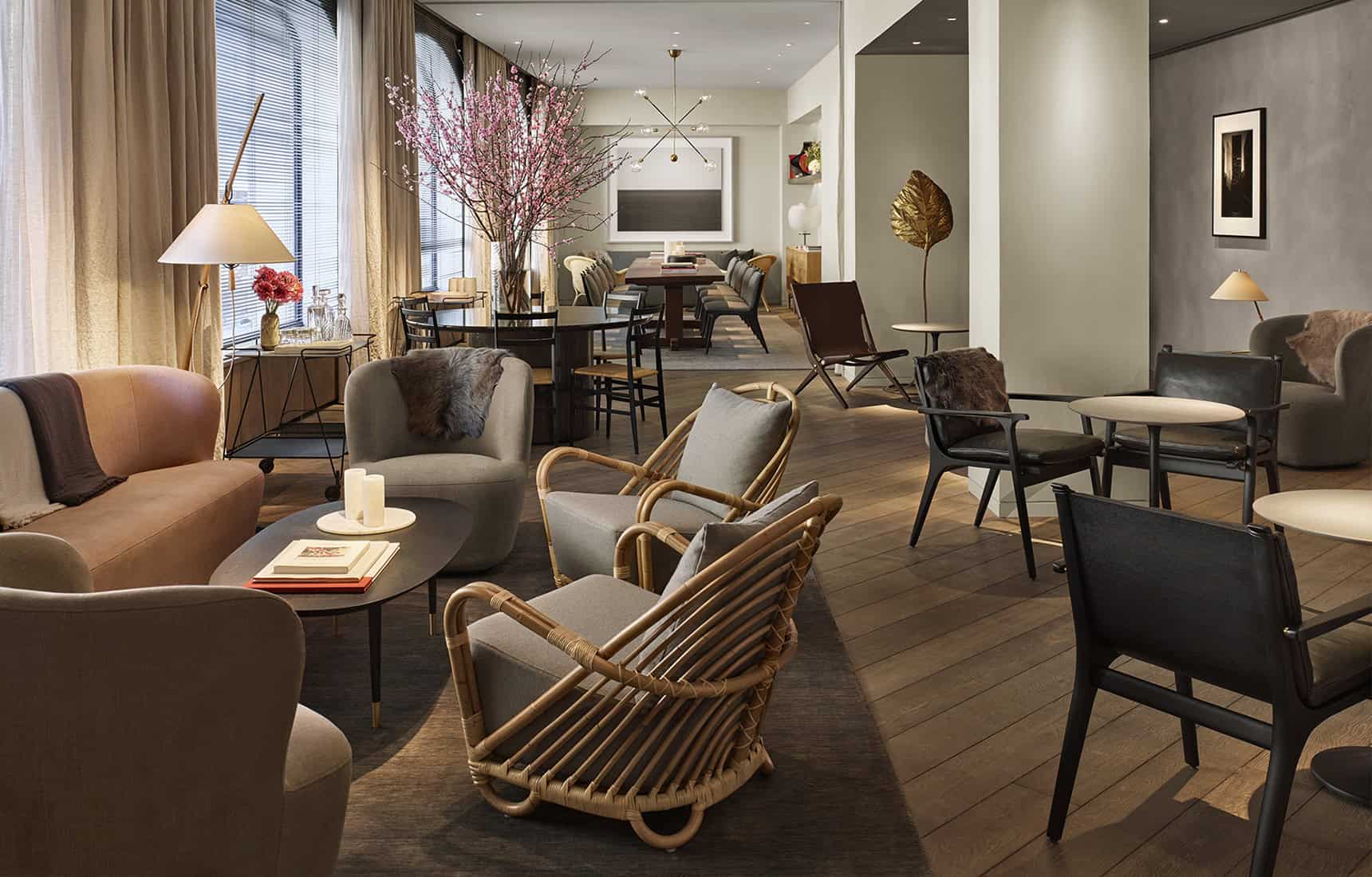
What is clever is how the mood shifts subtly from room to room. The lobby leans minimalist and cool, pairing luxurious stone surfaces and rich textures with contemporary art installations suspended from the ceiling, so that the space reads as gallery as much as reception. Move through into the lounge, however, and the hard materials give way to softer ones — wood, fabric and generous upholstery — creating a warmer, more enveloping environment for guests in search of respite from the relentless energy of the city outside. It is a considered piece of choreography, easing you from the pavement to a place of stillness by degrees rather than all at once.

Colour, conviviality and a very good dinner
If the lobby and lounge are exercises in restraint, the hotel’s food and drink spaces are where a little colour is allowed to bloom. The blond-toned bar and restaurant, framed by expansive arched windows that look out over Howard Street, mark the beginning of a gentle infusion of colour through the ground floor. It arrives not in overwhelming washes but in carefully placed focal points — a vivid artwork here, a floral arrangement there, a run of boldly upholstered lounge seating — each lending energy and character to a space built for socialising and slowing down. The atmosphere is a shape-shifter, moving from the bright clarity of morning light to the warm, low glow of evening, the mood adjusting to suit the hour.

The hotel’s culinary anchor is Le Coucou, the acclaimed modern French restaurant from the restaurateur Stephen Starr, which quickly became one of the most talked-about dining rooms in the city and helped put 11 Howard on the map for New Yorkers who might never book a bedroom. For a nightcap there is The Blond, an intimate cocktail lounge that lends the property a dash of after-dark glamour. Between them, they ensure that 11 Howard functions not as a sealed-off enclave but as a genuine part of neighbourhood life — a place locals come to, not just a place guests stay in.
Rooms shaped by Danish craft
Upstairs, across its 221 rooms and suites, the hotel offers eleven distinct categories, so that there is a size and shape to suit every kind of guest, from the compact city bolthole to the full-blown residence. Whatever the scale, the language is consistent: an embrace of Danish design principles, of quality craftsmanship and the quiet allure of natural materials. The palette is soft and calming: pale pink pastels set against crisp white bedlinen, harmonised with luxurious gold accents and deep blue drapes, a scheme that feels restful and quietly characterful.

The showpiece is the Terrace Suite, and it earns its billing. French doors open onto a private terrace with spectacular views across the New York skyline, while inside there is a separate bedroom with two bathrooms, a spacious living area, a fully equipped kitchen and a dining room, a proper home away from home in every sense. It is the kind of space that makes you want to cancel your plans and simply stay in, watching the city glitter from a perch high above.
Conscious hospitality, meant sincerely
Alongside the beauty of its rooms, what distinguishes 11 Howard among Manhattan design hotels is the sincerity of its founding idea. The hotel operates, as it says, under the guiding principle of conscious hospitality, and it is genuinely heartening to see a property that considers its contribution to the neighbourhood and the wider world as carefully as it considers its own comfort. Every element, from its location to its amenities and services, has been weighed for the benefit it can offer beyond the guest experience alone.

In practice, that has meant looking outward: engaging with the local community, championing a kind of socially conscious hyperlocalism, and supporting charitable organisations that help local people and those in need. The hotel has aligned itself with causes aimed at tackling poverty and inequality, folding a sense of purpose into the everyday business of hospitality. It is a model that treats guests not merely as customers to be served but as participants in something a little larger — and it feels all the more convincing for being woven into the fabric of the place rather than bolted on as an afterthought.

That, ultimately, is the quiet triumph of 11 Howard. Its creators set out to make a handsome Scandinavian hotel in SoHo, and then went further still. They built something with a conscience as well as a look: a place designed to endure, to improve with age, and to leave its corner of Manhattan a little better than it found it. In a city that celebrates luxury in every form, 11 Howard makes its own persuasive argument: that the most desirable thing of all is a hotel that knows exactly what it stands for.


Leave a Reply