
Art & Culture · Miami
Reading time: 7 minFor its third Miami edition, Alcova took over the city’s oldest hotel and turned it into one of the highlights of Art Week: a verdant, low-slung labyrinth of experimental design where more than forty studios put material, craft and genuine curiosity centre stage.
There is a particular kind of pleasure in the Miami Art Week calendar, and Alcova supplies one of its most restorative stops. After a morning among the fair tents and the convention halls, the champagne queues and the buzz of the see-and-be-seen, arriving at the Miami River Inn feels like exhaling. Alcova has always understood this instinctively, and in December 2025 the nomadic design platform returned to East Little Havana for its third Miami outing, transforming the city’s oldest hotel into a shaded, contemplative oasis where design could be encountered slowly, on its own terms.

Founded in Milan in 2018 by curators Valentina Ciuffi and Joseph Grima, Alcova has grown into one of the most quietly influential cross-disciplinary platforms in international design, an itinerant enterprise that has now spotlighted well over 500 designers and institutions, always in buildings with a story to tell. That instinct is the whole point. Alcova Miami unfolded across a cluster of pastel-clad Victorian buildings, timber corridors and courtyards planted thick with greenery, the visual identity shaped by Ciuffi’s Studio Vedèt and the spatial choreography handled by Grima’s Space Caviar. The result was a spatial narrative in its own right: a place designed for wandering, doubling back, and discovering.


From 2 to 7 December, more than forty international designers and studios threaded installations and site-specific projects through the Inn’s rooms and outdoor spaces. The works ranged from material investigations and architectural interventions to sculptural seating and immersive environments, each responding to the venue’s layered character while probing deeper questions about craft, experimentation and the future of making. Anchoring the grounds was The Garden Game, a collaboration between Alcova’s principal partner Haworth and the Milanese architect Patricia Urquiola — an outdoor gathering space laid over a painted check matrix in Alcova’s signature pink, scattered with design icons including Cassina’s Utrecht Chair and Cappellini’s Thinking Man’s Chair. It set the tone perfectly: playful, considered, and in no hurry. What follows is an edit of the presentations that lingered longest.
Kayam Studio — The Skin Collection: “Wrinkled”


Few presentations commanded attention quite so insistently as Kayam Studio’s The Skin Collection: “Wrinkled”, a body of work that trades in quiet intensity and an unsettling sort of beauty. Rooted in an exploration of skin as both physical and psychological boundary, the collection considers how a surface can function as a vessel of identity, carrying its markers of status, age, care and neglect. Skinny or fat, young or old, tended or weathered — these things are read instinctively through skin, shaping perception long before language has a chance to intervene.
The objects themselves hold a tension that feels intrinsic to their making, hovering between attraction and repulsion. Their restrained, near-minimalist forms deliberately direct the eye towards texture and presence, so that wrinkles, folds and irregularities become the primary language. What makes Wrinkled so compelling is how far the investigation reaches beyond the human body: Kayam frames skin as a broader idea, applicable to plants, animals, materials and objects alike, blurring the line between the organic and the constructed. The effect oscillates between discomfort and fascination — familiar surfaces, profoundly recontextualised, that prove impossible to look away from.
Berto Sánchez — Facetas

Berto Sánchez arrived with Facetas, a set of five functional sculptures that blur the boundary between art and design with real grace. Taking the classic Tiffany lamp as a starting point, the series reinterprets the stained-glass tradition through a distinctly contemporary lens, marrying precise geometry to an evocative play of light. The name nods to the richness of the Tiffany method itself — a process that assembles many pieces of glass into a single luminous object — and Sánchez leans into that layered construction, treating light not merely as illumination but as a defining material in its own right.
As light passes through the faceted surfaces, the pieces reveal shifting textures, tonal depth and subtle variation that reward prolonged looking. It was among the most alluring presentations of the fair, precisely because of the balance it strikes: sculptural presence and everyday function held in equilibrium, neither allowed to overshadow the other. Facetas occupies that compelling in-between space where material, light and form converge to produce objects that feel intimate, tactile and quietly timeless.
Casa AnKan — OASIS


Casa AnKan’s debut exhibition, OASIS, emerged as one of the edition’s most resonant moments — a sensory refuge that invited pause, reflection and tactile engagement. Developed in dialogue with the fair’s curatorial direction, in collaboration with FKTR Group and Otto Tiles, it reframed design as a place of return. Here materials were protagonists rather than components: stone, glass, plaster, wood and light composed with quiet intention, craftsmanship turned poetic and contemplative. Every object felt grounded yet expressive, a vessel for both imagination and material honesty.
The furniture and sculptural works stood out above all for their extraordinary tactility — visually striking, yet so deeply rooted in craft that each piece functioned as an artwork in its own right, rewarding close inspection through surface, texture and construction. That balance of sculptural beauty and material intelligence gave the presentation its completeness. OASIS brought together a considered group of makers from the United States and beyond, with limited-edition works by Amorph, Eloa – Unique Lights, Esther Knopfler, Alia Vitæ, JT. Pfeiffer, Sanaa Design and Monolith forming a cohesive yet varied dialogue around Casa AnKan’s evolving narrative of collectable design. It felt less like a display than an experience — one that lingered long after leaving the room.
Palaty Gallery — GRUZ by Irina Razumovskaya


Palaty Gallery presented GRUZ, a deeply contemplative project by Irina Razumovskaya exploring the meaning of home in an age of displacement and migration. The series reflects on the emotional landscape of those who have left Russia — a community suspended between nostalgia and estrangement, where home exists at once as a cherished memory and an elusive abstraction.
Razumovskaya’s sculptural works hover elegantly between architecture and object, function and symbolism. Inspired by the monumental forms of early Soviet constructivism, they carry thick, grounded bodies that evoke the weight of attachment — buildings that cannot be carried, yet objects that will go on inhabiting new homes. In that subtle gesture, sculpture becomes quietly useful again, art performing alongside life rather than apart from it. What makes GRUZ so affecting is the way it holds permanence and transience together, speaking to heaviness and rootedness while acknowledging adaptability and movement, and suggesting that belonging may attach not to a single place but to the ongoing life that surrounds it.
ERM Studio — Ciénaga Vidrio


The Mexico-based ERM Studio extended the experimental spirit of its Ciénaga series into glass with Ciénaga Vidrio, a collection of modular luminaires and a credenza that explores the material’s fluidity and luminosity through the “ladling” technique — a process in which molten glass is poured with a careful balance of control and intuition, each gesture captured and solidified into forms that feel alive yet frozen in time. Steel moulds imprint delicate textures onto the surfaces, shaping how light refracts and scatters through the surrounding space.
The interplay of reflection, shadow and optical distortion turns each piece into a dynamic participant in its environment rather than a static object. Illuminated, the works are mesmerising: light dances across the surfaces, drawing out curves, textures and the finest variations of the poured glass, every caught moment radiating an almost hypnotic effect. Ciénaga Vidrio is a fine example of ERM’s commitment to the dialogue between process, material and form, technical mastery meeting a strikingly organic presence.
Dace Sūna — sky, sea and elemental forces


The Latvian designer Dace Sūna offered one of the fair’s most poetic explorations of space, light and the natural world, merging scientific observation with something close to reverence. Her practice draws on the elemental forces of gas, fire, water, earth and plasma, translating them into works that are as contemplative as they are visually captivating.
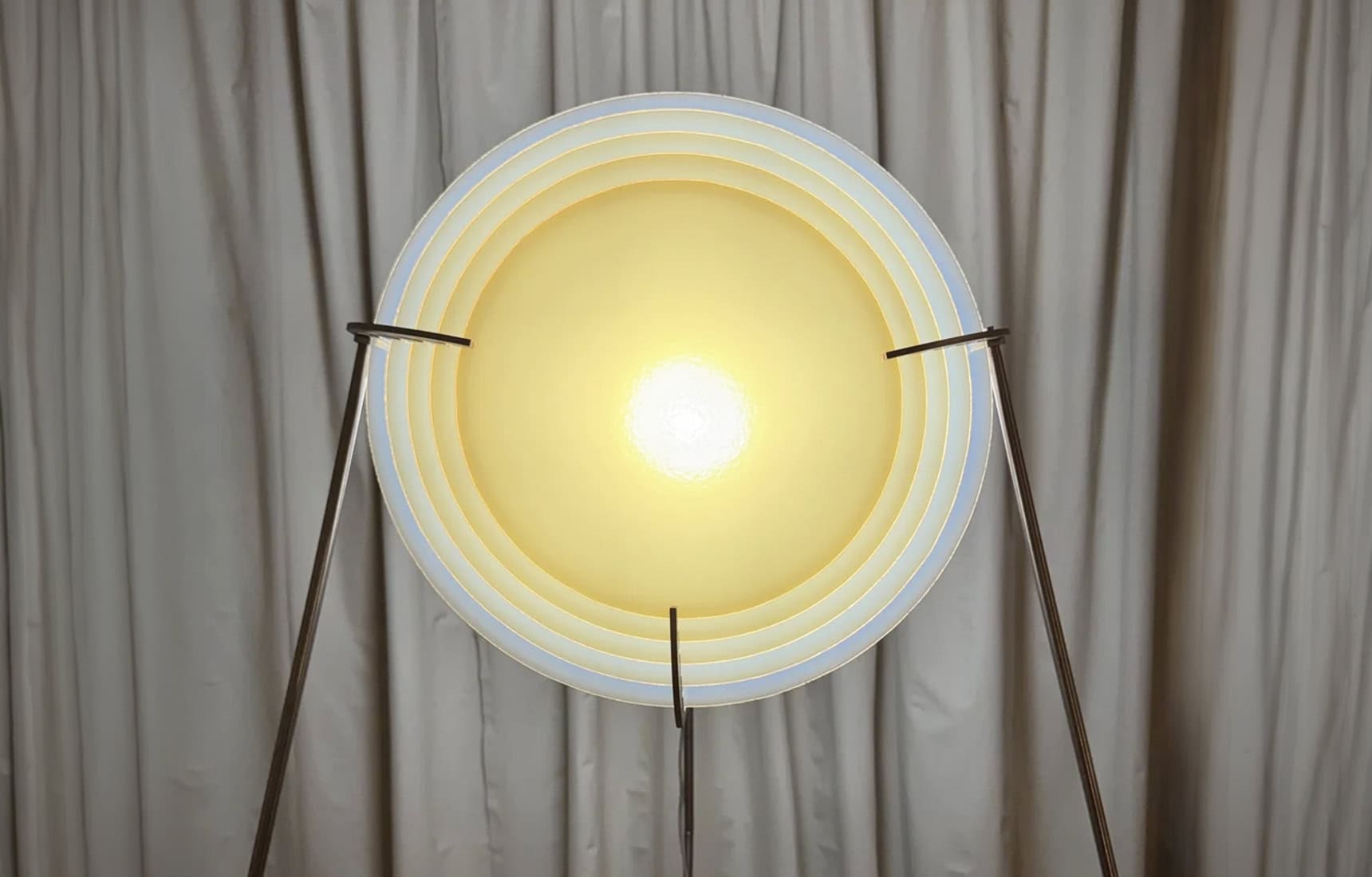
Chief among them was SKY-SET, a layered opalescent glass light that captures the shifting colours of the sky — from cool blues to sunset reds — through a process inspired by Rayleigh scattering, its circular form referencing dendrochronology and the tree rings that trace time and environmental change. Alongside it, the ONDARA Mirror used a slumped-glass technique with recycled glass that settles naturally into fluid, wave-like forms, its silhouette evoking the glide of a manta ray, drawn from Sūna’s diving in the Pacific. A vacuum silver coating lends an iridescent, light-breaking surface that shifts with the viewer’s position. Each mirror is one of a kind, an immersive reflection of nature’s rhythms and a quiet demonstration of Sūna’s command of material and form.
LCD Textile — Luc Druez


Returning with a new presentation, LCD Textile again made the case for the poetic potential of material-led experimentation, unveiling a multicoloured sculptural work that shifted fabric away from its functional associations and into the realm of contemporary art. The Belgian-born textile research consultant Luc Druez has long operated at the intersection of industry and artistry, exploring how natural and technical fibres respond to light, with an emphasis on texture, translucency and chromatic depth. Since 1992 he has developed his personal LcD Collection — a handmade body of work in which fishing line, raffia, rubber, copper and even horsehair are woven together through a distinctive jacquard process, their industrial origins elevated through craft and precision. At Alcova, the pleasure lay in seeing familiar materials recontextualised into something sculptural and expressive, an invitation to see textile itself anew: immersive, unexpected and richly dimensional.
AB+AC — Alma Mater


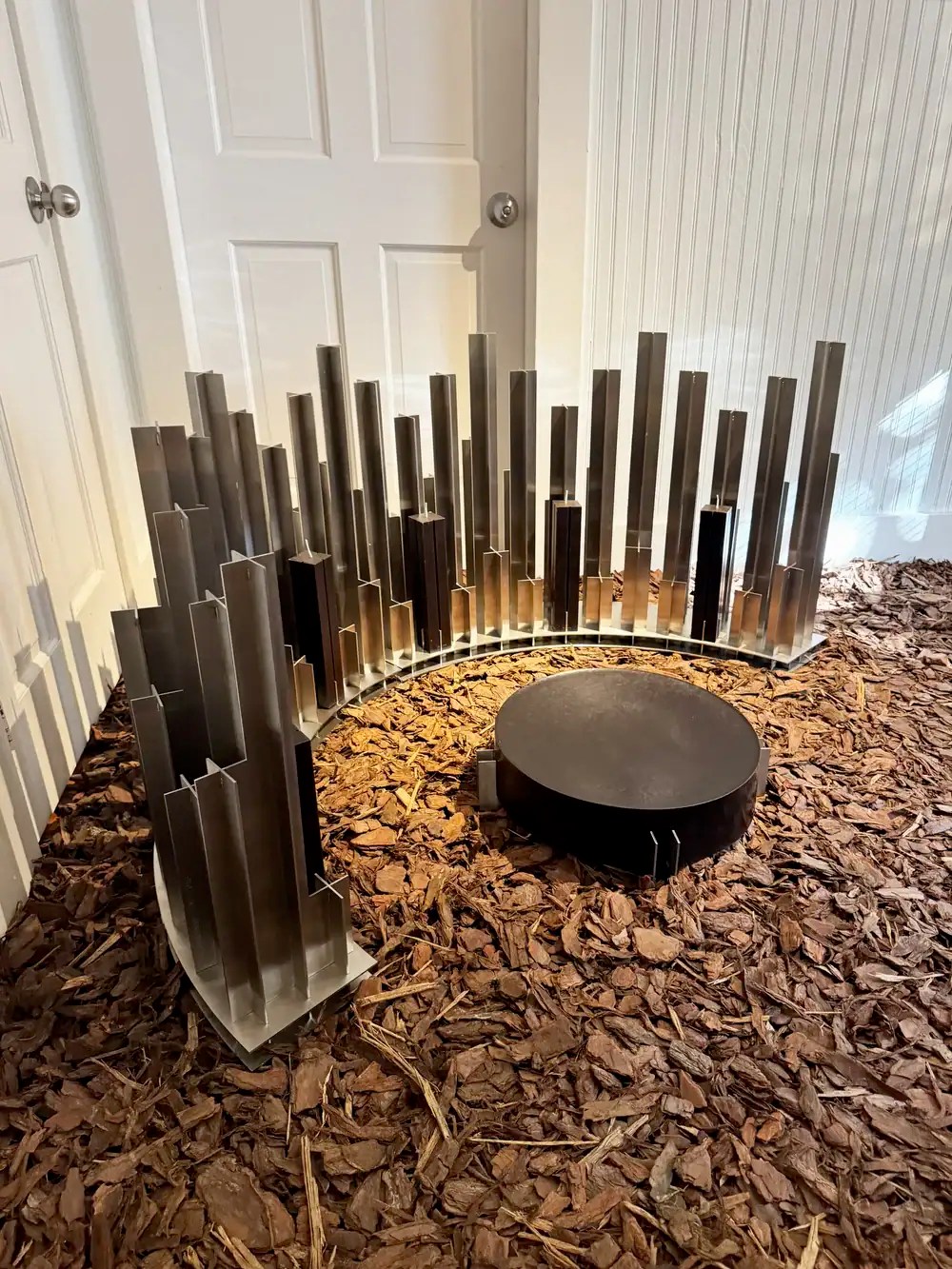
Finally, AB+AC presented Alma Mater, a collection of limited-edition objects conceived for ritual, mindfulness and quiet contemplation, produced with Italian and Portuguese artisans and shaped by a deeply architectural approach to scale and material. Stainless steel provides structural clarity and weight, while hand-engraved beeswax candles introduce warmth, scent and tactility. The six objects each carry a considered message: Totem, a sculptural candle holder balancing permanence and ephemerality; Daybed, a beeswax therapy bed for reflection; Dome, a playful three-dimensional mirror; Ring and Stool I, reframing prayer and meditation as a sensual, performative act; and Line, a small candle holder for everyday ritual. There is something quietly satisfying about watching architects turn to furniture and accessory design — their work tends to carry a distinct presence, informed by spatial thinking, proportion and restraint — and Alma Mater embodies that sensibility with real intention, shaping atmospheres as much as objects.
Why it matters
Alcova Miami 2025 proved, once again, why it remains one of the most inspiring platforms in contemporary design. Alongside established names, Alcova makes room for experimentation, material exploration and untested ideas, giving emerging and visionary designers alike a stage on which to challenge convention. That commitment to the new and the unexpected is precisely what makes it so compelling: from sculptural furniture to inventive lighting, from tactile materials to conceptual artistry, every installation invites discovery. For visitors and collectors, Alcova offers not simply objects to admire but a gateway to the next generation of design, and a reminder that innovation, craft and curiosity remain at the very heart of how we experience the spaces around us.
Alcova Miami 2025 was on view from 2 to 7 December 2025 at the Miami River Inn, 118 SW South River Drive, Miami, during Miami Art Week.


Leave a Reply