
ART & CULTURE · MIAMI
Reading time: 6 minA mushroom network. A bioplastic that changes colour when the sun hits it. A drawing folded, cast, and released as a table. For its first edition outside Milan, Alcova took over a motel on Biscayne Boulevard, a building type invented for people passing through, occupied by a fair that never stays anywhere twice.
Alcova has never had a home, and that is the point.
Since Valentina Ciuffi and Joseph Grima founded it in 2018, the Milan platform has occupied a different building every year: a panettone factory, a slaughterhouse, a military hospital, an abandoned villa, on the principle that a space is never neutral, and that the room you show design in is part of the argument you are making about it.
In December 2023, Alcova left Italy for the first time. Its first international edition landed in Miami, during Art Week, and it chose, with some wit, the Selina Gold Dust Motel on Biscayne Boulevard, in the MiMo district.
A motel. A building type invented for people who are not staying.
You could hardly design a better venue for a fair whose entire identity is impermanence.
Why the motel matters
MiMo — Miami Modern — is the architecture of post-war American optimism: the low-slung motels that went up along Biscayne Boulevard in the 1950s for a country that had just discovered the road trip. Neon, breeze blocks, boomerang angles, a swimming pool in the middle. Built for arrival and departure.
That strip’s steady restoration is one of the quieter good news stories in Miami, and it has been gathering pace for years. Putting an international design fair inside one is, among other things, an act of advocacy.


Atelier001 – Made In London
But the real payoff is structural. A motel is not a hall. It is a collection of rooms, entered individually from an outdoor walkway, each with a bed and a bathroom and a window. Which means every studio at Alcova Miami got something rare and valuable: a room that already knows how to be lived in.
You did not walk a floor. You opened doors. And the work you found on the other side was standing in a domestic space rather than a commercial one — which, for design intended to be lived with, is an enormous and under-appreciated advantage.
What the objects knew
The strongest thread running through the debut edition was not a material or a style. It was an idea: that an object can carry information.
Studio Mary Lennox with JOV — MSHWY04
The most conceptually elegant work in the motel took its name from a fungus.
MSHWY stands for Mycorrhizal Super Highway — the network of fungal threads through which trees and plants exchange nutrients and, in a meaningful sense, communicate. Ecologists call it the Wood Wide Web, and it is one of the genuinely astonishing discoveries of recent decades: a forest is not a collection of individual trees but a connected system, talking underground.
Studio Mary Lennox, working with JOV, took that as the model for a collaboration — and then looked closely at the oyster mushroom as a form: its textures, its folds, its strange soft geometry.
A collection about collaboration, named after nature’s own collaborative network, made by a collaboration. The idea is carried at every level of the work, which is a rare thing.


crafting plastics! studio — Senseables
The Bratislava studio brought bioplastic furniture that visualises UV radiation.
Read that again. These are objects made from NUATAN®, the studio’s own biodegradable material, engineered so that the piece responds to sunlight — 3D-printed vases from Collection 12, and the experimental room divider Sensbiom 2.1.
A material that reports its environment. The object is not just made of something; it is telling you something, continuously, for as long as the light falls on it.
(Worth noting: crafting plastics! returned to Alcova Miami in 2024, and to Alcova Milan. They are among the most consistently interesting people working in this space.)


Adarsh Nellore — Unobjects™
Adarsh Nellore pushed the same idea to its logical extreme, and slightly further.
His argument is that we increasingly value the data describing an object more than the object itself — the render more than the chair, the scan more than the body. He calls the result an unobject.
Using generative algorithms, photogrammetry and additive manufacturing, he then makes physical things whose forms are derived from that data — furniture and human anatomies abstracted by machine perception rather than human judgement.
It is a clever, quietly thrilling proposition: design in which the data comes first and the object arrives as its trace.


Zachary A. Design — It’s Not Paper
And here is the counter-argument, and it is beautiful.
Zachary A. Design begins with a drawing on paper. The paper is folded — creased, crumpled, worked — until the two-dimensional drawing becomes a three-dimensional form. That folded drawing is then used as a mould. A cast is taken from the inside, so that every crinkle survives and the graphite lines of the original drawing embed themselves into the surface of the finished piece. Finally the paper mould is cracked away, piece by piece, and destroyed.
What remains is a functional object with a drawing inside its skin. The artist’s hand, the aggression of the mark, the accident of the fold — all of it preserved, in cast form, in a table.
Set that beside Nellore’s Unobjects and you have the whole argument of contemporary design in two rooms of a Biscayne Boulevard motel. One says the data is the truth and the object is its shadow. The other says the object remembers the hand.


Objects to hold
Hannah Lim
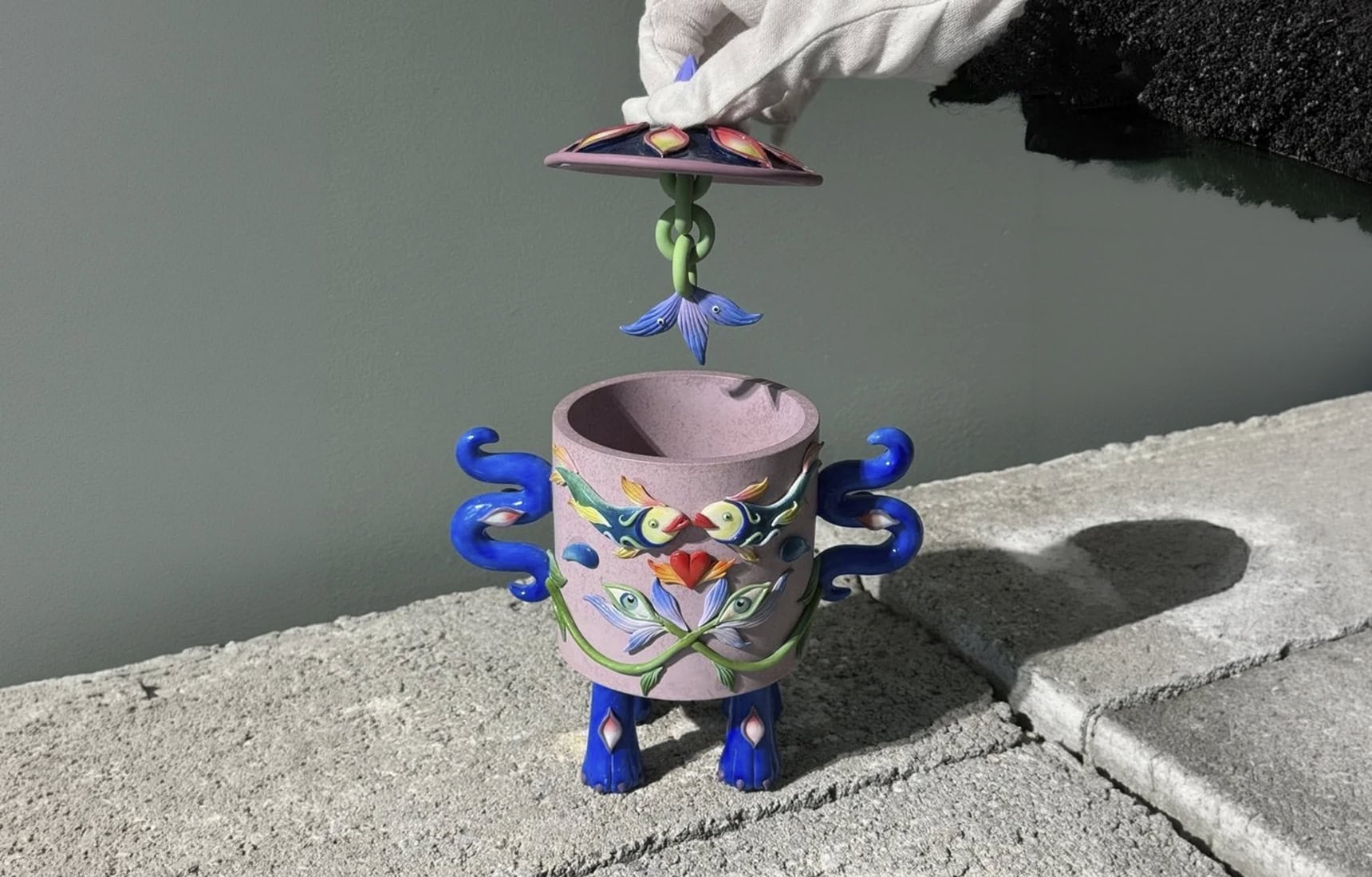
Hannah Lim’s works are described as snuff bottles, and they are, except that they are gloriously oversized, frequently have no stopper, and are often strikingly anthropomorphic.
The snuff bottle is a deeply personal object: it is made to sit in the palm, and its tactile quality matters as much as its decoration. Lim keeps that intimacy and then loads it with autobiography. Her pieces carry her namesake chop, clay copies of her grandmother’s jade pendants, and are topped with the orchid, Singapore’s national flower.
It is an object made to be held, holding a family. In a fair full of work about networks and data, Lim’s was the one about inheritance — and it was, quietly, the most moving thing in the building.


Richard Aybar — Rubberworks
Richard Aybar cast a rocking chair, lamps, vases and a love-seat table in rubber: glowing amber, resolutely tactile, the forms elementary and historicised, the surfaces sumptuous and quietly arresting.
Aybar’s word for his material is primordial ooze, and the pieces earn it: they look less manufactured than congealed. Rubber is a substance we normally hide inside things, and seeing it made proud and golden and load-bearing is a genuine jolt.
(Aybar returned to Alcova Miami in 2024 with the same body of work, a rare instance of a studio being invited back so that a wider audience could spend more time with it.)


The rooms
Elsewhere in the motel:
Bieke Casteleyn’s Out of Line — dining tables, coffee tables, desks, consoles and benches in soft organic contours, the product of the Belgian designer’s research into how the shape of a table changes the conversation around it. Furniture designed for the gathering, not just the room.


Bieke Casteleyn – Out Of Line
Jialun Xiong’s Before the Eclipse: a solo presentation of celestial light fixtures that appear to float, architectural furnishings and ceramic tableware, all in her signature black-and-white gradients. Xiong strips out colour deliberately, so that texture and craft carry the whole argument and get to speak. (She returned in 2024 to curate Something Last*, on exactly the same principle.)*


Jialun Xiong – Before The Eclipse
Uncharted — a six-studio group show (Caleb Ferris, Forma Rosa Studio, NJ Roseti, Studio Sam Klemick, Tristan Louis Marsh, Wallpaper Projects) working across wood, ceramics, metal and textiles, each pushing at the edge of their own practice.
Atelier001 — lighting and furniture made in London, each piece finished by hand and carrying the mark of the artisan who made it.


Final thoughts
Alcova’s first step outside Italy was as adventurous as every edition that came before it. The thinking started with the building.
It took a fifty-year-old motel on a boulevard Miami has been steadily restoring, opened the doors of the rooms, and filled them with mushroom networks, sun-reading plastic, machine-derived furniture and a drawing cast inside a table.
The building did what Alcova’s buildings always do: it made you notice where you were standing. A motel is a place where nobody stays and everybody passes through — which is exactly what a design fair is, and exactly what Alcova has always been honest enough to admit.
Three editions in Miami followed. It started here, with a key and a walkway and a door that opened onto something you did not expect. Since then, Alcova has taken that same idea further afield, including a first edition in Mexico City.


Leave a Reply