
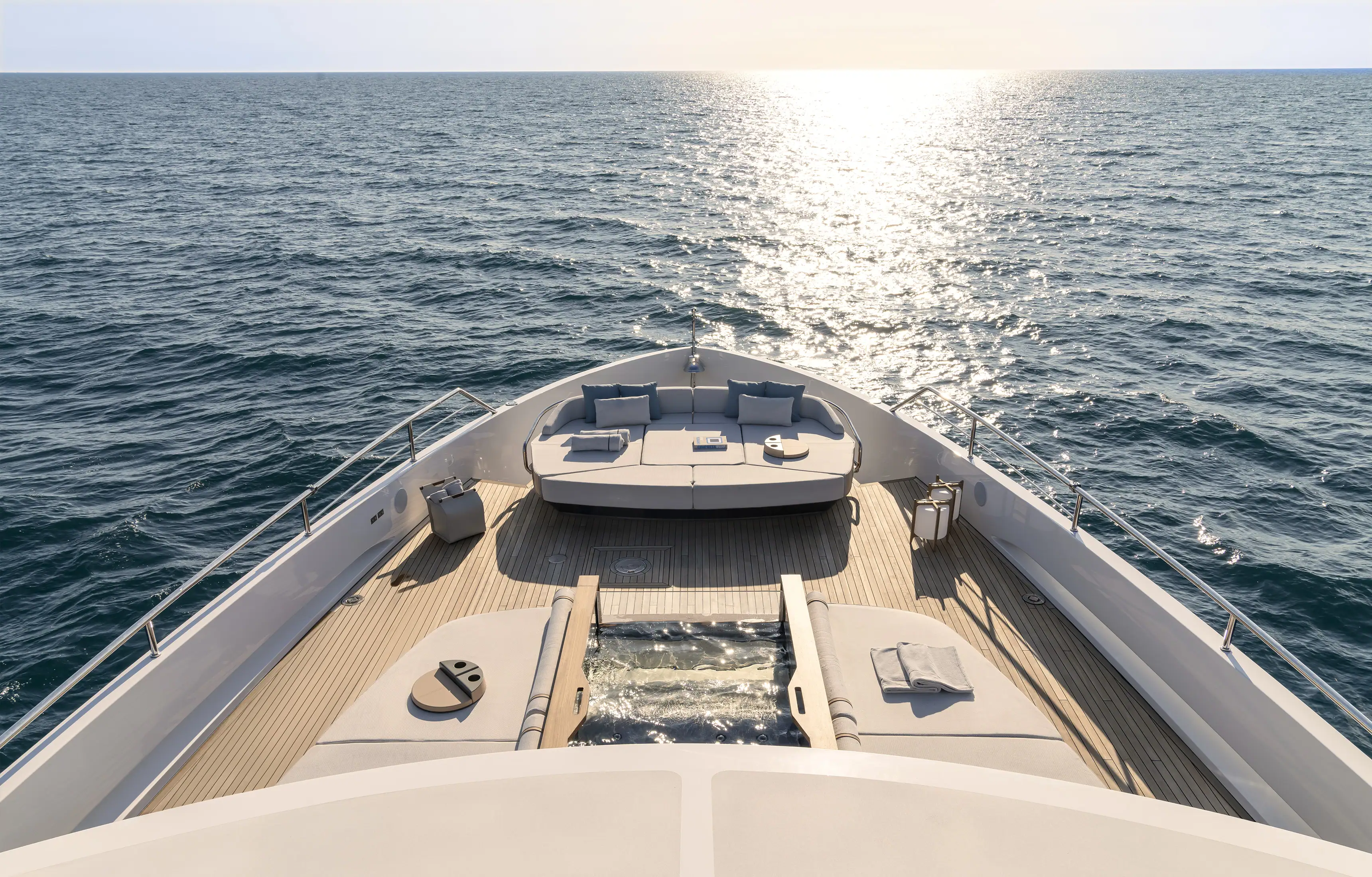
Two Milan architects who came to yachts by way of fashion and private aviation have spent the last three years replacing Achille Salvagni as Azimut’s interior design partner, one Grande model at a time. The Grande Trideck is where that change is easiest to see: a wall that swallows a television, a pool cut into the foredeck like a skylight, and a philosophy called barefoot luxury that treats restraint as the real indulgence. By the time Azimut launched its new 44-metre flagship this July, m2atelier’s interiors were no longer the exception on the Grande range. They were the standard.
Introduction
Azimut brought a new Grande Trideck to the Cannes Yachting Festival in September 2025, the third generation of its 38.22-metre flagship and the first with an entirely different interior authorship. The exterior is again by Alberto Mancini, whose cascading terrace profile has defined the Grande range’s largest yachts for years. The interior belongs to m2atelier, the Milan studio founded by Marijana Radović and Marco Bonelli, who took over the Grande series’ interior architecture from Achille Salvagni in a partnership Azimut announced at Cannes in 2023.

That handover is the real story. A single yacht reveal is routine news in a market that produces dozens of them every autumn. A shipyard quietly replacing the designer of its flagship range, then extending that replacement across five separate models in three years, is not. The Grande Trideck is simply the clearest place to see what m2atelier’s version of a Grande interior actually looks like, and what changed when Salvagni’s more classical, jewellery-adjacent language gave way to a studio that calls its own approach barefoot luxury.
Two things anchor that argument in this piece: what m2atelier physically built into the Trideck, and the wider pattern that building sits inside, in which the same studio also designed the interiors of a Miami tower carrying the Dolce & Gabbana name. The connection is not accidental. It says something about what kind of design authority m2atelier has built in a short time, across two entirely different scales of luxury.

What m2atelier actually built inside the Trideck
The Grande Trideck’s signature piece is what m2atelier calls the Unveiling Wall: a run of vertical slats on a custom sliding mechanism that opens to reveal a television and closes to read as pure surface. It appears twice. In the main saloon, a second version is built from contrasting materials chosen so that natural light casts a different shadow pattern across it through the day, paired with a pleated curtain, styled after theatre drapery, that conceals a second screen. The point of both is the same: a room built around a screen usually announces the screen. m2atelier’s version hides it inside craft, so the room reads as architecture first and entertainment second.

The Sky Lounge does the opposite job for a different problem. It has to seat twelve for formal dining one evening and work as a casual lounge the next, so m2atelier gave it fabric ceiling panels, chosen to read as a floating veranda rather than a fixed room, and custom trapezoidal tables that convert the space between uses. The Owner’s Suite, full beam on the main deck, is built around invisible doors and glass partitions rather than solid walls, so the layout stays legible as one continuous space while still separating sleeping, dressing and lounging areas. A sculpted chaise longue runs alongside the suite’s sweeping windows, put there specifically to keep the owner’s sightline on the water rather than the room.
Outside, the foredeck carries a recessed pool with an integrated chaise and a pivoting sunpad backrest, a detail that turns a single deck fitting into two different pieces of furniture depending on the hour. Furniture throughout is custom-made by Giorgetti, the Italian manufacturer, built to m2atelier’s own designs rather than drawn from a catalogue. None of this is expensive in the way superyacht interiors are usually expensive, with heavy stone, gilt trim or visible ornament. The cost sits in engineering: a wall that slides silently, a pool that becomes a sofa, a ceiling that reads as fabric rather than composite.

The designer m2atelier replaced
Achille Salvagni designed Azimut’s Grande flagships through the previous decade, including the first-generation Grande Trideck, delivered to its first owner in June 2023. His version of the same yacht type ran toward a more classical vocabulary: cast detailing, a jewellery-influenced sensibility in the fittings, and interiors built around discrete, formally separated rooms. Azimut announced the switch to m2atelier at the 2023 Cannes Yachting Festival, ending what Boat International, reporting on the transition, called a long-standing collaboration. Federico Lantero, Azimut’s head of product design, has described the studios differently rather than ranking them: where Salvagni built rooms, he says m2atelier mixes modernity, linearity and classic elements around natural light and a sense of ease.

The distinction that matters for a reader deciding whether this is worth caring about is not which studio is better. It is that Azimut made a deliberate, structural change to how its most expensive yachts are designed, at a moment when the brand was also expanding the Grande range downward to smaller lengths and upward to a new flagship. m2atelier’s brief was never just the Trideck. It was the language for an entire family of yachts still being built.

Two architects who came to yachts from fashion and aviation
m2atelier’s name is built from its founders’ initials. Marco Bonelli trained as an architect with experience across fashion, retail and residential work before turning to yacht interiors. Marijana Radović holds specialised training in yacht design specifically, alongside architecture, and has described designing for the sea as part of the studio’s identity from the start rather than a later addition to an architecture practice. That combination, architectural training paired with a designer who actually studied boats, is unusual in a discipline where interior architects more often arrive at yachts after building houses and hotels, and then have to learn the constraints of a hull from scratch.

The studio’s guiding phrase, less is enough, predates the Grande Trideck by several years and has been applied consistently across very different commissions: a members’ club in New York, a hotel in Norway, private houses in Italy, and now a range of superyachts. Bonelli has described the underlying method as fluidity, essentiality and continuity, three principles aimed at making a space feel like one continuous experience rather than a sequence of separately decorated rooms. On the Trideck, that shows up as the invisible doors in the Owner’s Suite and the deliberate absence of a hard line between the Sky Lounge’s interior and exterior zones. The philosophy is not abstract. It is the reason specific junctions in the boat were built the way they were.

Why light, not marble, carries the argument
Bonelli has put the studio’s priority in direct terms: light is not an accessory, it is the force that gives form to space, reveals the texture of a material and carries the emotional register of a room. On the Trideck, that principle is doing more structural work than it might appear. The saloon’s second Unveiling Wall is built specifically so that natural light changes its shadow pattern through the day, which means the wall was designed as a light instrument first and a television housing second. The glass partitions in the Owner’s Suite exist to keep daylight moving through a room that would otherwise be broken into smaller, darker compartments by solid walls. Even the recessed foredeck pool works partly as a light feature, since a sunken pool set flush with the deck reflects sky rather than interrupting the sightline the way a raised one would.

This is the clearest evidence that barefoot luxury is a working method rather than a marketing phrase. A studio chasing visible richness reaches for stone, brass and pattern. m2atelier’s most expensive decisions on the Trideck are largely invisible ones: the mechanism inside a sliding wall, the glazing specification behind a partition, the precise angle that lets a pool read as a piece of sculpture rather than a hole in the deck.

One partnership, five yachts
The Grande Trideck was never the whole commission. By the time it reached Cannes in 2025, m2atelier had already designed the interiors of the Grande 26M and Grande 30M, both already in service, and the Grande 36M, since described as multi-award-winning. In July 2026, Azimut launched the Grande 44M in Viareggio, a 43.6-metre yacht that became the shipyard’s new flagship and its largest yacht to date, again with m2atelier’s interior architecture and Alberto Mancini’s exterior. The 44M is built with more than half its structure in carbon fibre, part of an effort Azimut has linked to lower emissions across the range, and it is due to make its full public debut at the Cannes Yachting Festival in September 2026.

Five interiors in three years, across a size range running from 26 to 44 metres, is a materially different commission from a single flagship reveal. It means m2atelier has had to solve the same design problem, how a barefoot luxury interior scales, at five different volumes, with five different structural constraints. The Grande Trideck sits roughly in the middle of that range, which is part of why it reads as the most legible example of the studio’s language rather than the most extreme one.

The connection nobody else has drawn
m2atelier’s other current commission is not on the water at all. The studio is credited with the interiors of 888 Brickell, Dolce & Gabbana’s first real estate project, a 1,049-foot residential tower rising in Miami with architecture by Studio Sofield and a creative vision from Domenico Dolce and Stefano Gabbana, expected to complete in 2028. It is a strange pair of commissions to hold at once: a 38-metre yacht built around restraint, and a fashion house’s branded skyscraper built to project maximalist glamour into a skyline. Both are, in their own registers, luxury real estate that has to perform for an audience the owner never meets in person.

What the pairing actually shows is that m2atelier’s barefoot luxury method is not tied to yachts specifically. It is a way of handling scale, light and material discipline that the studio is applying to a tower with the same rigour it applies to a saloon wall. A shipyard replacing its flagship designer is one kind of story. A single studio being trusted with both a superyacht range and a fashion house’s first tower, inside the same three years, is the more interesting one.

Frequently asked questions
What is the Azimut Grande Trideck?
It is the flagship of Azimut’s Grande series, a 38.22-metre motor yacht with exterior design by Alberto Mancini. The current generation, unveiled in 2025, has interior architecture by the Milan studio m2atelier, replacing previous designer Achille Salvagni.
Who designed the Grande Trideck’s interior?
m2atelier, the Milan-based studio founded by Marijana Radović and Marco Bonelli. The studio has designed interiors across Azimut’s Grande range since 2023 and also works in architecture, hospitality and residential design.
What is barefoot luxury?
It is m2atelier’s term for interiors built on restraint, natural light and tactile materials rather than visible opulence. On the Grande Trideck it shows up as concealed technology, fluid room divisions and furniture designed to convert between uses.
What is the Unveiling Wall?
A custom sliding wall of vertical slats, built into both the main saloon and another cabin, that opens to reveal a television and closes to read as a plain architectural surface.
Which other Azimut yachts has m2atelier designed?
The Grande 26M, Grande 30M and Grande 36M, all already in service, and the Grande 44M, launched in July 2026 as Azimut’s new flagship and its largest yacht to date.
Has m2atelier designed anything besides yachts?
Yes. The studio’s other current commissions include CORE Club in New York, a hotel in Norway, and the interiors of 888 Brickell, a Dolce & Gabbana branded residential tower in Miami due for completion in 2028.
When does the Grande 44M make its public debut?
It is scheduled to debut fully at the Cannes Yachting Festival in September 2026, following its launch in Viareggio in July 2026.

Final thoughts
It would be easy to read the Grande Trideck as one more superyacht reveal in a season that produces dozens of them, distinguished mainly by a striking sliding wall and a pool with a good Instagram angle. That undersells what actually happened. Azimut replaced the designer of its most important range, then kept that new studio on for four more yachts in three years, ending with the largest boat the shipyard has ever built. That is not a decoration choice. It is a bet on a specific design method, tested repeatedly rather than once.

The method itself, restraint that costs more to engineer than ornament would, is consistent whether m2atelier is fitting a 26-metre yacht or laying out a Miami tower for a fashion house. The Grande Trideck is simply the version of that method built at a scale where you can walk through every room in an afternoon and see the whole argument at once: light doing the work marble usually does, and a studio that has spent three years proving it can do that at any size Azimut asks for.

Leave a Reply