British Airways, Airbus A380
Reading time: 12 minBritish Airways has unveiled new First, Club World, World Traveller Plus and World Traveller cabins for its retrofitted A380s, with the whole upper deck given over to one business class cabin. Look past the seat counts and there is a single pattern doing the work in all four, and it did not start on a long haul aircraft at all.
The British Airways A380 is being taken apart and put back together. All twelve aircraft are going through a retrofit that involves more than thirty five thousand individual parts each, with new seats in every cabin, redesigned galleys and stairways, and the first completed aircraft due back in the air in the coming months. The airline has now shown all four cabins.
Sean Doyle, the airline’s Chairman and Chief Executive, describes it as one of the most significant transformations the airline has undertaken on any aircraft.
The numbers that matter to a designer are the ones about floor area, and they are unusually interesting. But the more telling decision is a pattern, repeated at four different prices and in four different materials, and carried out of the aircraft into the buildings on the ground.
What the British Airways A380 gives up to gain space
The current aircraft carries 469 people: fourteen in First, ninety seven in Club World, fifty five in World Traveller Plus and three hundred and three in World Traveller. The retrofitted aircraft carries 417: twelve, one hundred and six, eighty four and two hundred and fifteen.
Read that again as floor area rather than as revenue. Eighty eight economy seats come out of the main deck. Premium economy grows by twenty nine. Business grows by nine and takes the entire upper deck. The aircraft carries fifty two fewer people in total, around a tenth of its capacity, and every one of those removals turns into space for somebody still on board.
That is the whole design brief in one line. Everything else follows from it: the 2-4-2 premium economy at thirty eight inches of pitch, the four separate zones in business, the dwell areas and Club Kitchens that only exist because there is room for them. An aircraft interior is a volume problem before it is a styling problem, and this retrofit solves the volume first.
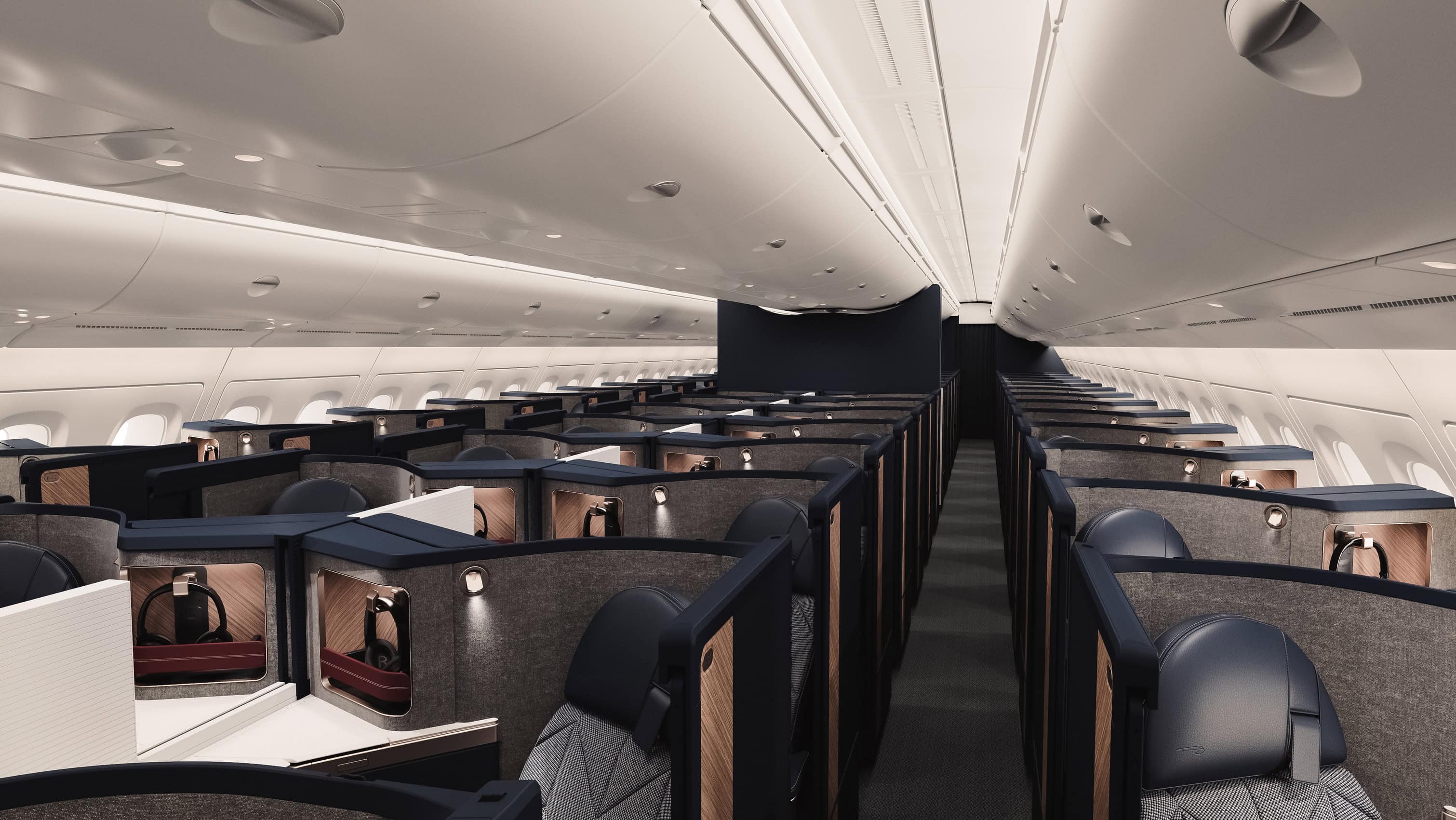
The upper deck is the clearest result. One hundred and six Club Suite seats run from the front of the deck to the back, which British Airways expects to be the largest business class cabin in the world. A deck given to a single cabin is a rare thing on a commercial aircraft, and it lets the designers do something they almost never get to do, which is compose a long room rather than fit seats into a leftover.
The herringbone started on a short haul bulkhead
In 2024 British Airways introduced a new short haul interior on its A320neo fleet, built around Collins Meridian seats. Two details in that cabin are worth remembering. The rear bulkhead was finished in blue stained wood laid in a herringbone, and the seat backs carried a large parallelogram pattern that read as the same herringbone drawn in one line.
That cabin was the test. The long haul interiors now take the idea and run it through every class on the aircraft.
In World Traveller the pattern is the wall: a deep navy panel of chevrons closing the cabin, with the seat fabric woven in a fine blue herringbone and the new pillows and blankets printed in the same figure. In World Traveller Plus it is a timber chevron panel set into the navy bulkhead, with the seat backs quilted in a chevron over a slate blue tweed. In Club World it becomes stitching, a broad chevron quilted across a grey woven cloth, with a navy leather headrest above it carrying the Speedmarque in thread. In First it is the woven day blanket.

Four cabins, four prices, four completely different manufacturing processes, one figure. Printing, weaving, quilting and timber veneer are not interchangeable, and getting a pattern to survive translation between them without losing its character is a harder exercise than it sounds.

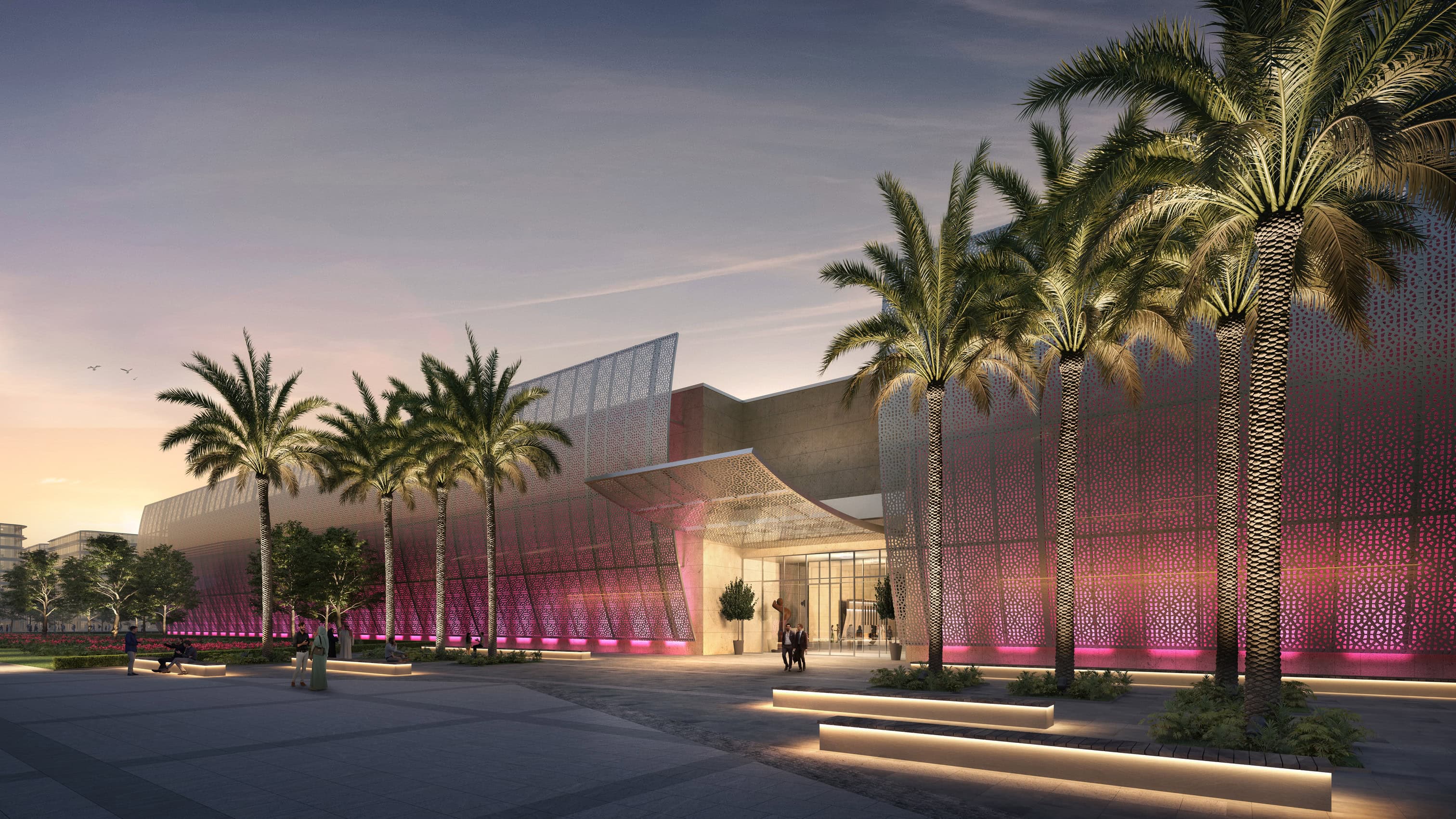
Then it leaves the aircraft. The new British Airways lounges at Heathrow announced in the same week are floored in herringbone and marquetry, in the Terminal 5 C Gates lounge, the rebuilt Arrivals lounge and the Terminal 3 First check in. Walk the full sequence and the same pattern is under your feet at check in, under your feet again in the lounge, and then on the blanket across your knees at thirty five thousand feet.
That is a house style working at four scales, from a parquet floor to a pillowcase. Airlines talk about consistency constantly. Very few of them pick one thing and actually carry it the whole way.
An upper deck given over to one cabin
The Club Suite is an evolution rather than a replacement. It sits on the Collins Aerospace Super Diamond platform the airline has used since 2019, which gives every seat a door and direct aisle access, and the work here has gone into the surfaces and the storage.

The shell is navy, matt and hard edged, with a panel of grey felt set into its inner face and a strip of figured timber running down the outside like an inlay. The ledge beside the seat is a pale stone effect with a bronze lip. Open the stowage and the inside is lined in a deep burgundy, which is the one piece of colour in an otherwise cool composition and the reason the whole thing does not read as corporate. A ten inch tablet controls the suite.

The cabin is divided into four zones, which is what makes a hundred and six seats bearable as a room. Between them sit the dwell areas and the Club Kitchens, and the Club Kitchen is the most interesting piece of joinery on the aircraft: a rounded rectangular aperture lined in warm timber, cut into a navy wall, with reeded dark glass behind the shelves, a tambour shutter that rolls across the lower half and a brass edge around the opening.
It looks like a drinks cabinet in a members’ club, which is precisely the point. The floor around it is finished in a wood effect rather than carpet, so the social spaces read as different ground from the seating.

Twelve suites, and a wall at sixty inches
First has twelve suites, with privacy walls at sixty inches and a fully flat bed of six feet seven inches. The suite was designed by Tangerine and unveiled in 2024, and the airline cites Concorde as the reference point for its proportions.
What the photography shows is a room assembled from three materials. The wall behind the seat is a cream fluted panel, vertical and closely spaced, with a Speedmarque backlit in blue set into it. The ledge and the panel beside the screen are figured walnut, bookmatched and warm. Everything structural is navy, with hand stitched leather on the surfaces you touch and a brushed bronze trim wherever two materials meet. The seat itself is upholstered in a grey bouclé, with a navy cushion carrying the Speedmarque drawn in a single gold line.

The functional additions are the ones regular passengers will notice: a wardrobe, bespoke mood lighting and a mini bar built into the seat, stocked with snacks and still and sparkling water so that the first hour of a flight does not depend on a trolley. For the centre pair, the divider opens into a shared lounge and stowable tables allow two people to eat facing each other.
The new sleepwear is navy, cut in a cool touch fabric and carrying the airline’s official tartan, with slippers to match. It is on board from 1 October, alongside a woven day blanket in the herringbone and a navy cushion.

The fluted wall is worth pausing on, because it is the same move as the fluted panels in the lounges and the same move Universal Design Studio made at the First Wing in 2017. The airline has three design languages that could have diverged and has instead kept them speaking to one another.
The same vocabulary in premium economy and economy
World Traveller Plus is laid out 2-4-2 at thirty eight inches of pitch, with privacy wings on the seat backs and a larger screen. The fabric is the giveaway: a slate blue tweed, quilted in the chevron, with navy leather headrests piped in red and bronze caps on the armrests. The airline describes the cloth as British tweed inspired, and in the photography it behaves like tweed, with a visible weave rather than a flat woven polyester.

The new amenity kit for the cabin is a reusable tote rather than a pouch, intended to be carried onwards, with a Dr.PAWPAW balm, a dental kit, socks and an eye mask inside.
World Traveller gets wider seats, adjustable headrests, twelve inch HD screens with Bluetooth and USB-C, and the bedding that carries the argument. The new pillow is filled more deeply and printed in the herringbone. The blanket is the airline’s blue with a red Speedmarque worked into it.

The seat backs are quilted in the same chevron used in Club World, over a blue woven cloth, with navy headrests edged in a deep red. It is the same drawing, executed in a cheaper process, and it holds.

Putting the same pattern and the same palette into the cheapest seat on the aircraft is a choice, and not a universal one. It costs more than running a plain fabric and it makes the cabin read as one aircraft rather than as three products stacked on top of each other. It is the same instinct behind cabin work elsewhere, where one seat platform is being made to serve two classes.
The makers of the small things
The objects are where the British craftsmanship claim either holds up or does not, and here it holds up, because every one of them has a name attached.
The First amenity kit is by Swaine, established in 1750 as whip and saddlery makers and now the only British heritage house still handcrafting in Mayfair. The group includes Brigg umbrellas, founded in 1836, and Herbert Johnson, hatters since 1889, appointed to Edward VII in 1901 and responsible for the fedora Harrison Ford wore in Raiders of the Lost Ark. The kit is a navy leather case with gold corner caps, and the corner cap is the whole idea: it is the fitting from a travelling trunk, shrunk to the size of something that fits in a seat pocket. It comes in royal blue and cream, and from 2 November Swaine will also make a limited edition Oxford holdall to order in the Mayfair workshop.

Inside the kit are six formulations by Wildsmith, the skincare house named after William Wildsmith, the nineteenth century botanist who made the arboretum at the Heckfield Estate in Hampshire. The set is built around circadian rhythm, running from a face mist and a hand and body lotion through to a ceramide multi balm and an overnight mask.
The cutlery is by Studio William, founded in 2005 by William Welch. Welch is the son of Robert Welch, one of the defining British silversmiths of the post war decades, and trained at the Royal College of Art before working as a junior designer at Pentagram under Kenneth Grange. There is a direct line from British mid century metalwork to the knife and fork on the tray.
The wine glasses are from Richard Brendon, developed with the wine writer Jancis Robinson. Their 2018 collection replaced the usual rack of shapes with a single universal glass, mouth blown in Bohemia, lead free and thin walled with a deliberately sturdier stem. A single glass is an unusually sensible thing to put on an aircraft, where every extra shape is another item to stow.
Club World gets amenity kits by the London apothecary anatomē in four designs by British artists, commissioned through the art platform Rise Art: Amelia Coward, Charlotte Roseberry, Kit Boyd and Naomi Edmondson, working across laser cut wood collage, abstract painting, hand carved prints and typographic murals. The Coward design is a roll top pouch in a dense multicoloured stripe, the brightest object anywhere on the aircraft.

The dining that surrounds all of this is new across the whole long haul fleet from 1 October. A grill section lets First customers build a plate from British rack of lamb, grilled salmon and a choice of sides and sauces, served on stoneware and fine bone china with pinch pots, a dual purpose afternoon tea stand and a signature tray. The list runs to Bollinger La Grande Année, a gin selection and a Showerings triple vintage cider. Crew delivering it are going through the airline’s First Service Specialist programme, which is being rolled out to all First trained cabin crew.

Frequently asked questions
When will the new British Airways A380 cabins enter service?
The first retrofitted A380 is expected to enter service in the coming months, with the rest of the twelve aircraft fleet following. Each aircraft takes more than thirty five thousand individual parts.
How many seats will the retrofitted British Airways A380 have?
417 in total: twelve in First, one hundred and six in Club World, eighty four in World Traveller Plus and two hundred and fifteen in World Traveller. The current aircraft carries 469.
Why is the Club World cabin on the A380 significant?
All one hundred and six Club Suite seats sit on the upper deck, which British Airways expects to be the largest business class cabin in the world. It is divided into four zones with dwell areas and Club Kitchens between them.
What is new in World Traveller Plus on the A380?
A 2-4-2 layout at thirty eight inches of pitch, privacy wings, larger screens, quilted seats in a British tweed inspired cloth, new bedding, and a reusable amenity kit designed as a tote bag.
Who makes the new British Airways First amenity kit?
Swaine, the British house established in 1750 and still handcrafting in Mayfair, with six skincare formulations by Wildsmith inside. It is available on board from 6 October.
What has changed in First on the A380?
Twelve suites with sixty inch privacy walls, a six foot seven inch flat bed, a wardrobe, bespoke mood lighting and an in suite mini bar. The centre pair can open the divider to share a lounge and dine together.
Final thoughts
A cabin reveal is usually read as a list of features, and this one gives you plenty: a mini bar, a tablet, a tambour shutter, a glass developed with a wine writer, a fedora maker’s corner cap on a wash bag.
The thing holding them together is less obvious and more impressive. British Airways has chosen a pattern, proved it on a short haul bulkhead, translated it into printed cotton, woven tweed, quilted stitching, timber veneer and a parquet floor, and then put it everywhere a customer looks between the kerb at Heathrow and the seat at altitude. It costs more to do that than to let each cabin and each terminal be designed on its own terms.
Eighty eight seats came out of the back of the aeroplane to make the room. One pattern went through all of it to make it feel like one thing. Those are the two decisions, and everything else on this aircraft is downstream of them.