
DESIGN TRAVEL · DUBAI
Reading time: 5 minIn a city celebrated for building newer and taller, Bab Al Shams took a different route. Dubai’s original design-led desert resort, open since 2004, was not knocked down and replaced but carefully restored, its fort-like architecture kept intact and its interiors quietly reimagined by LW Design. The result is a rare thing in the Emirates: a luxury resort whose greatest asset is its age.
Less than an hour from Downtown Dubai, where the roads run out and the dunes take over, sits Bab Al Shams Desert Resort & Spa. Its name translates as “Gateway to the Sun,” and it has been a fixture of the Emirates for two decades, opening in 2004 as the region’s first genuinely design-led desert escape and remaining the longest-running one in the UAE. That history matters, because it shapes everything interesting about the place today.


In February 2023, after a ten-month renovation led by Kerzner International and designed by the Dubai studio LW Design, Bab Al Shams reopened as the first property in Rare Finds, Kerzner’s new collection of heritage hotels. The telling detail is what the refurbishment did not do. It did not gut the resort or chase a shinier idea of luxury. It restored and refined what was already there, even bringing back some of the original contractors to do it. In a market that prizes the brand-new, Bab Al Shams makes the quietly radical case that the most luxurious thing a desert resort can offer is authenticity, carefully kept.


Architecture rooted in the fort
The design intent announces itself the moment you pass through the resort’s fort-like gates. Bab Al Shams is built in the language of the traditional Arabian village and desert fort, all low-slung sand-toned walls, shaded courtyards and winding passageways, spread across sixteen two-storey buildings that read as an extension of the dunes rather than an imposition on them. The plan is deliberately labyrinthine, so that every turn reveals a new courtyard, a shaded archway or a quiet alcove, and arrival becomes a slow act of discovery rather than a grand reveal.


What lifts this above pastiche is that the fort typology is not just cultural homage, it is climate intelligence. Sand-toned plaster walls, timber beams and carefully placed openings are the accumulated wisdom of centuries of desert building, designed to shade, to catch a breeze and to keep the heat at bay long before air conditioning existed. LW Design has honoured that logic and updated it with energy-efficient lighting, sustainable materials and open spaces that maximise natural ventilation, so the architecture is authentically vernacular and genuinely sustainable at the same time. The building does not fight the desert. It works with it.


Interiors: earthy minimalism, subtle luxury
Inside, LW Design continues the conversation with the landscape rather than breaking from it. The palette is drawn straight from the dunes, ochres, muted browns and sandy neutrals, lifted by the occasional deep teal or mustard accent. Walls are finished in smooth plaster, floors in patterned stone, ceilings punctuated by exposed timber beams. The effect is earthy and grounded, and quietly luxurious in a way that never tips into gilded excess.


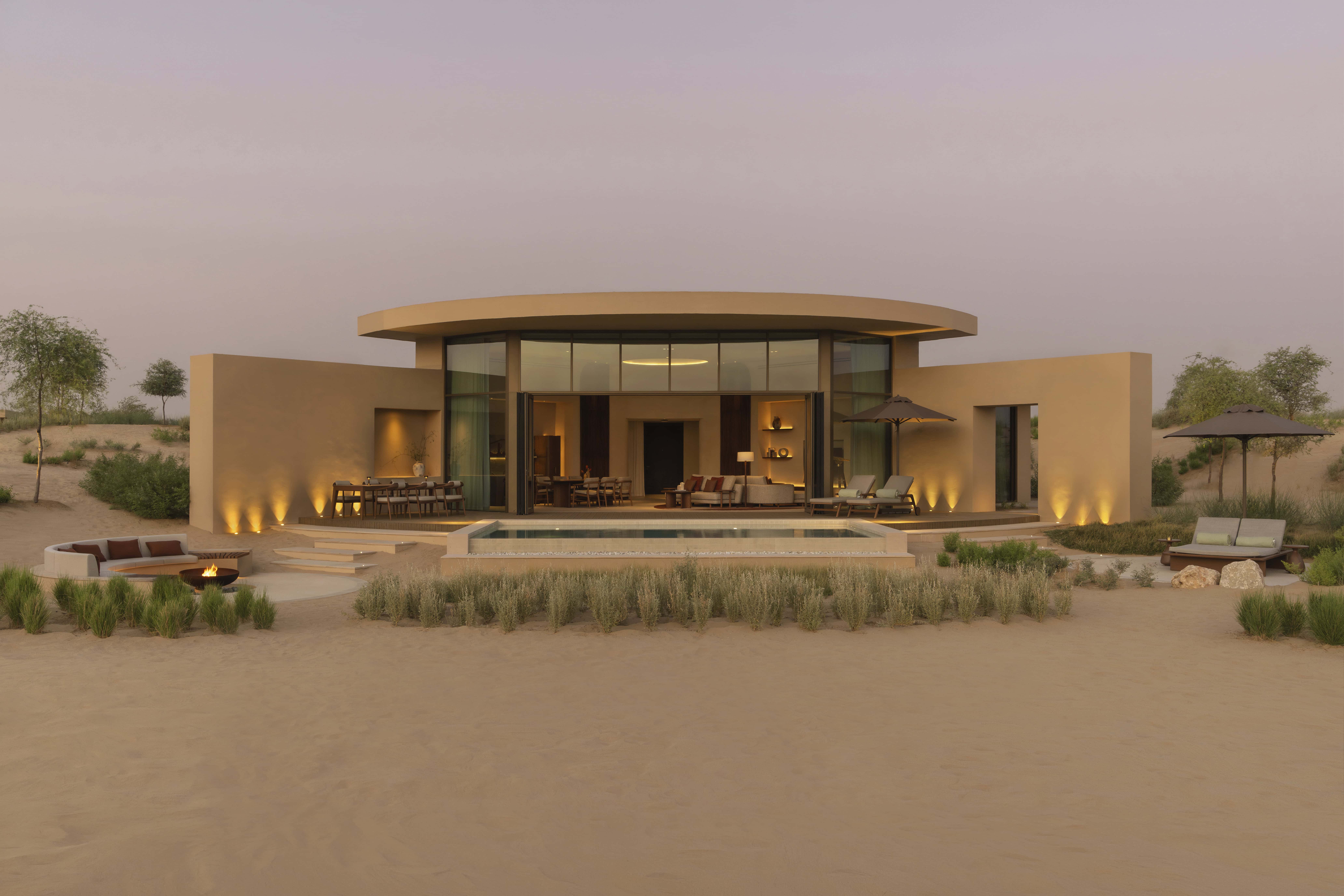
The guest rooms and five signature suites carry that restraint through, offering a refined simplicity that feels both contemporary and timeless, with bathrooms of marble mosaic, oversized mirrors and amenities scented with Arabic oud, presented as refillable, PETA-approved products in keeping with the resort’s sustainable ethos. The showpiece of the redesign, though, is the new collection of Desert Pool Villas. Circular in form and inspired by the Bedouin tent, they lean into organic architecture, combining walnut, alabaster, travertine and quartzite with fluid, dune-like shapes that echo the sands outside. Open-air showers, private courtyards and clerestory windows blur the line between indoors and desert until the two feel like one continuous space. They are the clearest expression of the whole idea: shelter shaped by, and open to, its setting.


Dining as theatre
Food at Bab Al Shams is staged as much as it is served, with each venue given its own design identity. The most iconic is Al Hadheerah, an open-air spectacle where guests dine under the stars amid live music, dancers and fire displays, an architectural stage set for Middle Eastern storytelling. Zala offers a brighter, airier counterpoint, its elegant, light-filled interiors framing a Mediterranean menu of regional flavours, from basil hummus to freshly baked manakish. The forthcoming Anwā Rooftop Lounge promises panoramic desert views and a cleaner, modern design paired with Pan-Asian cuisine, an elevated space built as much for contemplation as for dining. And the smaller venues each hold their own character, from the cigar-friendly intimacy of Ya Hala to the easy informality of the Pool Bar, where the sunset does the decorating.


Wellness, and the desert itself
The spa reinforces the resort’s design philosophy of understated serenity, offering hammam rituals, massages and facials in calm spaces of stone and wood, part of a standalone wellness building with two hammams, five treatment rooms, a gym and a yoga deck. Here wellness is treated as a matter of environment as much as treatment, the design creating the conditions for restoration.


Beyond the spa, the resort turns outward to the landscape that defines it. Falconry displays, camel rides, pony treks and nature walks recall Bedouin tradition, while fat-bike tours and guided desert drives offer more contemporary ways in. Guests can venture out to the nearby Al Marmoom Desert Conservation Reserve, Al Qudra Lakes and the much-photographed Love Lake, all of which place the resort within Dubai’s wider ecological and cultural story rather than sealing it off from it.


Sustainability as heritage
What makes Bab Al Shams’s environmental credentials feel sincere rather than bolted-on is that they flow from the architecture itself. Upcycled furnishings, refillable amenities and locally inspired materials sit alongside the deeper strategy of shaded courtyards and natural ventilation, which is simply vernacular desert design doing what it has always done. This is the resort’s quiet lesson: heritage and sustainability are not opposites but allies, and the old ways of building for the desert were low-impact long before anyone called them that.


Final thoughts
Where much of Dubai reaches for scale and spectacle, Bab Al Shams impresses through intimacy and context, choosing to whisper rather than shout. Its success lies in restraint, in treating the desert as both backdrop and protagonist, and in an authenticity that connects the region’s past to its present. It offers a slower, more reflective version of Dubai, a place to watch the light shift over the dunes, share a meal beneath the stars, or retreat to a villa that feels carved from the sand itself.


That it does all this as a restoration rather than a new build is the point. LW Design and Kerzner have proved that a twenty-year-old resort, thoughtfully renewed, can feel more contemporary than something built from scratch, precisely because it has roots. For design enthusiasts and travellers alike, Bab Al Shams is a rare chance to experience Dubai through a different lens: not the newest or the tallest, but the most deeply of its place. It is not simply a stay. It is an immersion in the artistry of the desert.


Leave a Reply