
Interiors · Miami
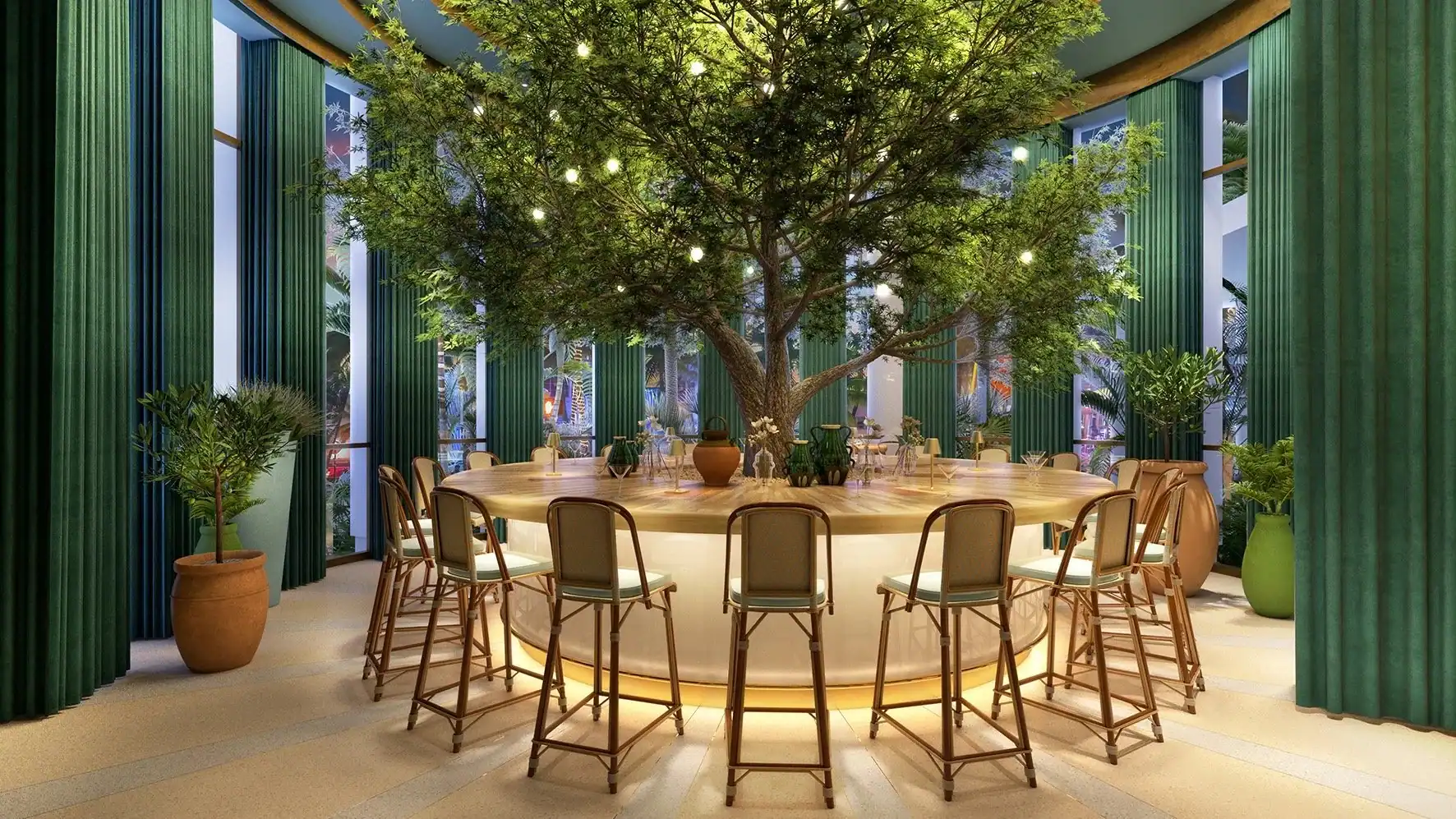
Reading time: 6 minWithin a historic Art Deco landmark at The Ritz-Carlton, South Beach, French designer Sam Baron has shaped Bagatelle’s new 200-seat Miami restaurant; a study in muted greens, brass and rattan, crowned by an illuminated olive tree rising from a circular bar.
Few dining brands understand the theatre of a good evening quite like Bagatelle. Born of the French Mediterranean tradition of long lunches that slide, unapologetically, into longer nights, the group has spent years exporting its particular brand of joie de vivre to the world’s most glamorous postcodes. Its latest arrival feels almost inevitable: a 200-seat restaurant in Miami’s South Beach, a district famed for its glamorous day scene, vibrant nightlife and picture-postcard surroundings. If ever a brand and a neighbourhood were destined to meet, it is this one.
What gives the project its particular weight is where it sits and who has shaped it. The restaurant occupies part of The Ritz-Carlton, one of the roughly 800 historic Art Deco landmarks that give Miami Beach its architectural identity, and its interiors are the work of Sam Baron, the French designer whose portfolio moves fluently between product, craft and interiors. The result is a space that takes its cues from three sources at once: the original Art Deco architecture, the local environment, and the brand’s own core values.

An Art Deco Landmark as the Starting Point
Miami Beach’s Art Deco district is one of the great architectural ensembles of the twentieth century, and designing within it is a privilege Baron has clearly relished. His approach treats the building as a collaborator, drawing from its geometry and detailing while allowing the restaurant to speak with a contemporary voice.
That conversation begins overhead. In the lobby and lounge, intricate period panelling survives on the ceiling, its grid design providing the starting point for one of the project’s most elegant gestures: a bespoke rug designed by Baron, which mirrors the ceiling’s geometry underfoot. It is a simple idea, beautifully executed — the room reflected in itself, past and present holding each other’s gaze — and its aesthetic ripples outward through the whole scheme, connecting aspects of the building’s history with its new life.
This is the kind of detail that defines thoughtful hospitality design. Baron has extracted an identity from the fabric of the building itself and translated it into something guests can walk across.
Baron himself is an inspired choice for the commission. Trained in France and long associated with some of Europe’s most respected design houses, he belongs to that rare category of designer equally at ease with a glass vase, a furniture collection or a full interior. That breadth shows here. The restaurant reads as an accumulation of beautifully judged objects and surfaces, rugs, lights, joinery, textiles, each considered on its own terms, all speaking the same language. It is the sensibility of a product designer applied to a room, and it rewards close attention at every turn.
“South Beach supplies the energy; Baron’s interior supplies the manners.”
A Palette Drawn from the Coast
Throughout the restaurant, a gentle colour palette of muted greens and blues carries the design narrative — tones that belong equally to the Mediterranean and to Miami’s own coastal light. The venue unfolds across a conservatory, a bar, a main dining room and an intimate sixteen-seat private dining space, and the palette holds them together, shifting in weight and intensity from room to room without ever breaking character.
The materials give the scheme its depth. Natural woods, rattan, marble and brass are thoughtfully curated throughout, refining both the design and the guest experience. In the bar and lounge, a woven rattan ceiling framed in brass hovers above a bar top of richly veined green marble, while arched, illuminated shelving glows against deep green walls. Seating in soft teals and warm ochres gathers around green marble tables, and shell-inspired wall lights add a discreet coastal wink.
The choice of curved forms and fine textiles — luxurious French velvets, elegant linens — nods deliberately to the heritage of French design. Nothing here is angular or aggressive; the room is built from sweeps and arcs, upholstered in fabrics that ask to be touched. It is a Riviera sensibility, transplanted with unusual care.

The Main Dining Room
The main dining room is where the project’s Art Deco inheritance and French instincts meet most theatrically. Dramatic floor-to-ceiling curtains frame the space, while striking brass chandeliers — some candelabra-like, others bursting into constellations of glowing spheres — highlight the soaring ceilings. Below, cane-backed chairs and crisp white tablecloths strike a classic note, grounded by pale parquet and soft mint panelling.
Around the room’s edges, a series of alcoves picked out in soft blues and greens offers cosier territory. Each is adorned with pieces from a vibrant collection of art by Pascal Lièvre, adding character and charm while giving guests intimate corners in which to settle for the evening. The alcoves are a clever piece of spatial rhythm: they break the scale of a 200-seat room into human moments, so that grandeur and intimacy are felt in equal measure.
It is worth noting how disciplined the lighting is throughout. The chandeliers do the sparkling while the perimeter stays soft, layering brightness and shadow so that the room flatters everyone in it. That, too, is a very French instinct.
The art programme deserves its own mention. Lièvre’s works do more than dress the walls; their saturated greens and blues thread the room’s palette through the alcoves, so that even the most intimate corners remain part of the larger composition. In a restaurant of this scale, that kind of chromatic continuity is what keeps the experience coherent from the first table to the last.
An Olive Tree Above the Bar
Nature and greenery shape the restaurant’s décor at every turn, influencing the colour scheme and material choices while echoing Miami’s tropical climate, vibrancy and rich heritage — the very qualities that draw so many visitors to the city. Guests are welcomed by an entrance lush with planting, an opening statement that establishes the tone for everything that follows.
That narrative reaches its crescendo in the conservatory, home to the venue’s most celebrated feature: a large, illuminated olive tree stretching its canopy over a circular bar. Wrapped in deep green velvet curtains and ringed with rattan bar stools, the space evokes the essence of Mediterranean outdoor dining — a courtyard under the stars, conjured indoors. Fairy lights glimmer through the branches; terracotta pots and potted olives complete the picture.
It is, unashamedly, a moment designed to be remembered and photographed, and the olive tree earns its place in the story. It gathers the scheme’s threads, nature, the Mediterranean, conviviality, into a single image, and it gives the room a heart around which the evening can revolve. The circular bar beneath it reinforces the point: there is no head of this table, no privileged seat. Everyone gathers around the tree, as people have gathered around olive trees for several thousand years.

Riviera Manners, Miami Energy
What makes Bagatelle Miami persuasive as a piece of design is the balance it strikes. South Beach supplies the energy: the glamour, the nightlife, the sense of occasion. Baron’s interior supplies the manners: the restraint of the palette, the quality of the materials, the respect for the Art Deco bones of the building. Neither dominates, and the restaurant is better for it.
There is also a lesson here about brand and place. Bagatelle arrives in Miami with a strong identity of its own, and the design gives that identity a distinctly local accent. By rooting the scheme in the building’s period detail and the city’s tropical character, Baron has produced something site-specific: a Bagatelle that could only exist here, in this landmark, two streets from this ocean.
The timing feels right, too. Miami’s dining scene has matured dramatically in recent years, with the city now attracting the calibre of chefs, operators and designers once reserved for New York or Los Angeles. In that flourishing landscape, interiors have become a genuine draw, and the most celebrated newcomers are those that offer a fully realised world. Bagatelle Miami understands this completely: from the greenery at the threshold to the last flicker of light in the olive branches, it is conceived as a single, continuous experience.
In a city whose dining rooms thrive on invention, Bagatelle Miami offers something wonderfully durable: a space built on heritage, craft and a palette borrowed from the coastline itself. The tables will be booked for the atmosphere; the design is why guests will linger. And somewhere above the circular bar, an olive tree glitters, a little piece of the Mediterranean, thriving beautifully in the Florida night.


Leave a Reply