Design Travel · London
Reading Time: 8 minutes
Most coverage of British Airways’ new First Class suite has led with the numbers: a 36.5 inch wide seat, a 79 inch bed, a 60 inch privacy wall. The more interesting fact sits one layer back, in the design studio’s own history. Tangerine, the London consultancy behind the new cabin, is the studio where Jony Ive began his career in 1990, four years before Apple hired him directly. The same studio also designed the flat bed that changed business class travel twenty five years ago. This is not British Airways’ first attempt at reinventing a cabin. It is one studio’s third.
Introduction
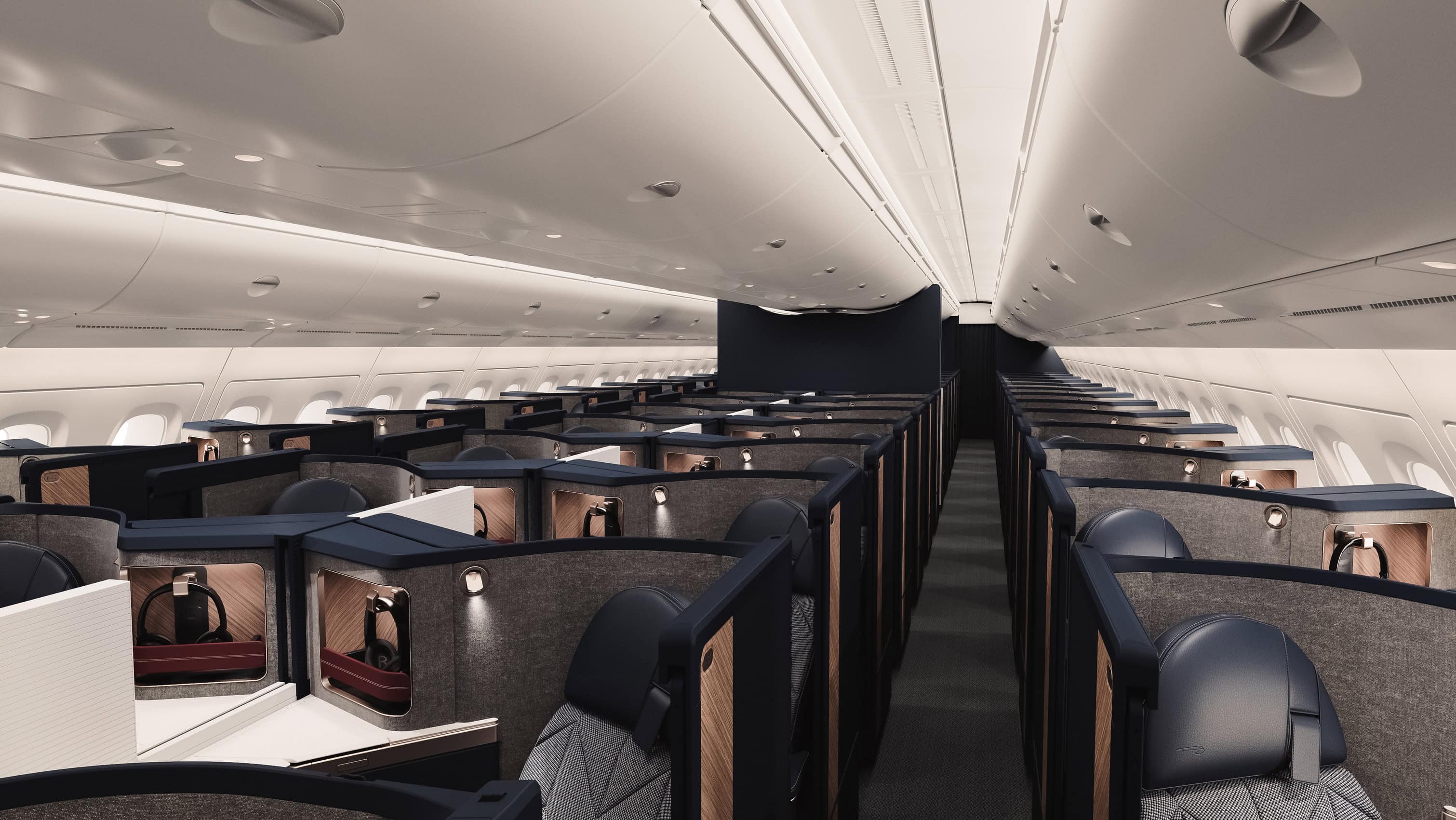
British Airways has unveiled a new First Class suite, designed for the retrofitted Airbus A380 fleet and due to enter service in mid-2026, as part of the airline’s wider £7 billion transformation programme, which has already delivered more than 120 separate customer experience changes. The suite is built around a 36.5 inch wide seat, a fully rectangular 79 inch bed, a 32 inch 4K screen, and a 60 inch curved privacy wall enclosing what British Airways is calling a private suite rather than a seat. Ambient lighting cycles through relax, dine and cinema settings, controlled from a wireless tablet that also operates a do not disturb function and the electric blinds across each suite’s three windows.

The seat was developed by Tangerine, the London design consultancy, working with Collins Aerospace, the aerospace manufacturer that will build it. Most coverage of the launch has treated Tangerine as a credit line. It is worth treating it as the actual subject, because this is not the first time the studio has redesigned a British Airways cabin, and the story of what it built the first time is a large part of why this one is worth taking seriously.

The studio that gave Jony Ive his start
Jony Ive joined Tangerine in 1990, four years before Apple hired him and more than a decade before he became the designer most associated with the iPhone, the iMac and three decades of Apple’s industrial design language. At Tangerine, working alongside the consultancy’s founder Martin Darbyshire and fellow designer Clive Grinyer, Ive contributed to Project Juggernaut, a strategic study for Apple on the future of portable computing, among other client work for the studio. Darbyshire has described it plainly: “Jonathan joined tangerine in 1990 and worked alongside myself and Clive Grinyer on a strategic project for Apple called Project Juggernaut before moving to join the company.”

That history matters here because Tangerine is not a studio brought in for a one-off cabin refresh. It is the consultancy that, in 2000, designed British Airways’ Club World seat, the world’s first fully lie-flat business class bed, built around a yin-yang paired seating layout that let passengers sleep flat for the first time on a commercial aircraft while research showed travellers wanted the freedom to move rather than sit fixed in place. That seat generated a reported £200 million return within its first twelve months in service, was substantially upgraded in 2006 with roughly 25 per cent more passenger space added to the same basic layout, and stayed in use in one form or another for more than two decades, a working lifespan almost unheard of in an industry that typically refreshes cabin products every seven to ten years. British Airways is not experimenting with a new design partner for its most expensive cabin. It has gone back to the studio with the best evidence of what a Tangerine seat is actually worth over time.

What British Airways’ new suite actually changes
The new First Class suite is built for retrofitted A380 aircraft, replacing the existing First cabin with a design that draws its curved surfaces from the aerodynamic profile of Concorde’s wings, and uses ambient lighting to nod to the aircraft’s association with speed rather than to Concorde’s interior directly. Functionally, the brief reads as a response to specific, gathered customer feedback rather than a stylistic refresh: the bed is now fully rectangular, addressing a shape complaint common to angled beds on other airlines’ first class products, and the suite includes dedicated luggage storage and a stowable table alongside the ottoman, addressing the more mundane but frequently cited problem of where to put things during a long-haul flight.

The suite is also getting smaller in number even as it grows in footprint. British Airways operates twelve A380s, and the retrofit programme, expected to begin entering service later in 2026 and complete by the end of 2027, reduces First Class to 12 suites per aircraft, down from 14 on the current configuration. Business class grows in the opposite direction, from 97 Club World seats to 110 Club Suites occupying the entire upper deck, and premium economy expands from 55 to 84 seats, while total seat count falls from 469 to 421 as economy shrinks from 303 seats to 215. Read together, the retrofit is not simply adding luxury at the top of the cabin. It is redrawing the whole aircraft around where British Airways believes the actual demand now sits, and First Class getting smaller while getting more expensive per suite to build is as much a part of that story as the suite specification itself.

Two features stand out as genuine design decisions rather than specification upgrades. The first is buddy dining: a sliding central divider between paired suites that lets travelling companions open up a shared space for a meal, then close it again for privacy, solving a problem enclosed suites created for themselves the moment they became fully private. The second is the three-window control system, which gives a single suite individual button control over three separate windows rather than the one or two most business and first class seats are built around, a specification that only matters on an aircraft the size of an A380, where a forward suite can plausibly span three window bays.

The provenance test: naming the hands
For a product built on a claim of craft, the honest test is whether the people who actually made it can be named, and the new suite’s supply chain answers that test more completely than most. Collins Aerospace builds and engineers the seat itself in Kilkeel, Northern Ireland. Muirhead, in Glasgow, supplies the premium leather used across the headrest, seat surround, ottoman and cupboard interiors. Replin and Hainsworth, both based in West Yorkshire, weave the high-performance fabrics used on the wardrobe and forward wall. Amann Group provides the sewing and embroidery threads. Trimite Global Coatings, working across Redditch and Belfast, powder-coats the trim details. MGR Foamtex, in Thame, Oxfordshire, builds the soft acoustic wall panelling. Botany Weaving, in Dublin, supplies the wool carpets.
Read as a list, that is a working map of British and Irish manufacturing specialisms, a leather house in Scotland, textile mills in Yorkshire, a coatings firm split across the Midlands and Northern Ireland, a carpet weaver in Dublin, brought together around a single seat designed in London and engineered in Northern Ireland. It is also a specific, checkable answer to a question most luxury product coverage never bothers to ask, which is where a claimed craft object was actually made and by whom. Northern Ireland recurs in premium cabins: the seat platform beneath Etihad’s new First and Business cabins is a Thompson Aero VantageXL, made in Portadown.

What the design argument actually is
Strip away the launch date and the spec sheet, and the new British Airways First Class suite is making a continuity argument rather than a novelty one. Tangerine is not proposing an unproven idea about how passengers should fly; it is returning to a design relationship that already produced the most commercially successful business class seat in the airline’s history, and applying the same research-led method, gathered customer feedback shaping the fully rectangular bed and the added storage, to a harder, more expensive brief. Shrinking First Class to twelve suites while expanding Club Suite and premium economy tells the same story from the business side: British Airways is not defending First Class by making more of it, but by making each remaining suite justify its place through the same evidence-led design process that kept Club World in service for twenty years. The studio doing the work is the same one that gave one of the most significant industrial designers of the last thirty years his start, and the same one that proved, over two decades of Club World service, that a seat designed properly the first time does not need reinventing every few years. This suite is being asked to do the same thing on a bigger, more scrutinised stage.

Frequently asked questions
Who designed British Airways’ new First Class suite?
Tangerine, a London design consultancy, developed the design working with Collins Aerospace, which is engineering and manufacturing the seat.
When does the new First Class suite launch?
Mid-2026, on British Airways’ retrofitted Airbus A380 fleet, as part of the airline’s wider £7 billion transformation programme.
What are the seat’s key specifications?
A 36.5 inch wide seat, a fully rectangular 79 inch bed, a 32 inch 4K screen, a 60 inch curved privacy wall, adjustable mood lighting, individually controlled windows and a wireless tablet with a do not disturb function.
Has Tangerine designed for British Airways before?
Yes. Tangerine designed British Airways’ original Club World flat bed in 2000, the first fully lie-flat seat in business class, which remained in service for more than twenty years.
Is there a connection between this project and Apple’s Jony Ive?
Jony Ive began his design career at Tangerine in 1990, four years before joining Apple, working alongside founder Martin Darbyshire and designer Clive Grinyer on a strategic project for Apple called Project Juggernaut.
Where is the new suite manufactured?
Across the UK and Ireland: seat engineering and manufacturing by Collins Aerospace in Kilkeel, Northern Ireland, with leather from Glasgow, fabrics from West Yorkshire, coatings from Redditch and Belfast, soft panelling from Oxfordshire, and carpets from Dublin.

Final thoughts
British Airways did not simply commission a new First Class seat. It went back to the design studio that already proved, over more than two decades of Club World service, what happens when a cabin is designed around research rather than trend, and asked it to do the same thing again at the top of the airline’s range. That studio’s own history includes giving Jony Ive his start four years before Apple did, which is a coincidence of timing rather than a design credential, but it says something about the kind of studio British Airways chose to trust twice with its most valuable seat. The new suite still has to prove itself in service the way Club World did. The design lineage behind it already has.
Project Credits
Go further from here
Add to calendar
Google CalendarApple or OutlookRead next
British Airways is rebuilding every lounge at Heathrow, starting with a new room at Terminal 5 C Gates, and the design lineage behind it runs back to 1932.
London