
Design Travel · Mexico City
Reading time: 8 minGrupo Habita’s twelfth hotel strips a nineteenth-century building back to its bones, drawing on Shaker restraint and Mexican craft to create one of the most considered boutique stays in the Centro Histórico.
There is a particular kind of luxury that announces nothing at all. It does not glitter, it does not perform, and it certainly does not shout. Instead, it settles quietly around you — in the weight of a hand-planed ash-wood door, in the cool of a basalt floor underfoot, in the slow shift of light falling through a skylight onto a bare plaster wall. This is the luxury of Círculo Mexicano, a twenty-five-room boutique hotel tucked into the dense, layered fabric of Mexico City’s downtown, and it is one of the most thoughtful pieces of hospitality design to have emerged from the Mexican capital in years.

The hotel is the twelfth venture from Grupo Habita, the pioneering hospitality group that has spent more than two decades redrawing the map of Mexican design hotels, from the glass-and-steel modernism of Mexico City’s Hotel Habita to the coastal sprawl of Hotel Escondido on the Oaxacan coast. For Círculo Mexicano, the group turned to Ambrosi | Etchegaray, the Mexico City architecture and art studio led by Jorge Ambrosi and Gabriela Etchegaray, whose work is defined by an almost archaeological respect for place. The result is a hotel that feels less like a new build imposed upon the city and more like a careful uncovering of something that was already there.

A building with a story worth telling
To understand Círculo Mexicano, it helps to understand where it sits. This is the Centro Histórico, the beating civic heart of Mexico City, where the pre-Hispanic ruins of the Templo Mayor sit within a stone’s throw of the National Palace and the Metropolitan Cathedral — the first cathedral built in the Americas. Few urban settings in the world carry this much history in so few square metres, and the nineteenth-century building that houses the hotel is woven into that story more intimately than most.
It was here, on this very site, that the celebrated Mexican photographer Manuel Álvarez Bravo was born in 1902, and here that he would later shoot one of his most enduring images in the building’s inner courtyard. That lineage is carried through the hotel with real care. Working in collaboration with the Manuel Álvarez Bravo Foundation, Grupo Habita has hung a selection of the photographer’s works throughout the guest rooms and public spaces, so that the building’s most famous former resident remains present in the walls he once called home. It is a graceful gesture, and a telling one: at Círculo Mexicano, the past is the foundation.

Ambrosi | Etchegaray’s central architectural move was, in a sense, an act of subtraction. Rather than layering the building with new finishes and grand gestures, the studio stripped the interiors back to reveal the structure’s original character — the brick barrel ceilings, the exposed beams, the wooden shuttered windows. The ground floor was reimagined as a contemporary marketplace, a public threshold that keeps the building rooted in the daily life of the neighbourhood, while the sophisticated boutique hotel occupies the second and third floors above. This layering of public and private is deliberate. It allows the hotel to remain porous, connected to the city rather than sealed off from it.

Shaker discipline, Mexican soul
The interior language of Círculo Mexicano is where the project becomes genuinely quietly radical. The rooms are characterised by a restraint that owes an explicit debt to the Shakers — the nineteenth-century American religious community whose furniture and architecture remain a byword for honest craftsmanship and spiritual economy. Ambrosi and Etchegaray were drawn to the Shakers not as a stylistic reference to be copied, but as a philosophy to be absorbed: a community that understood the value of working patiently and beautifully with wood, and that found dignity in the plain and the functional.

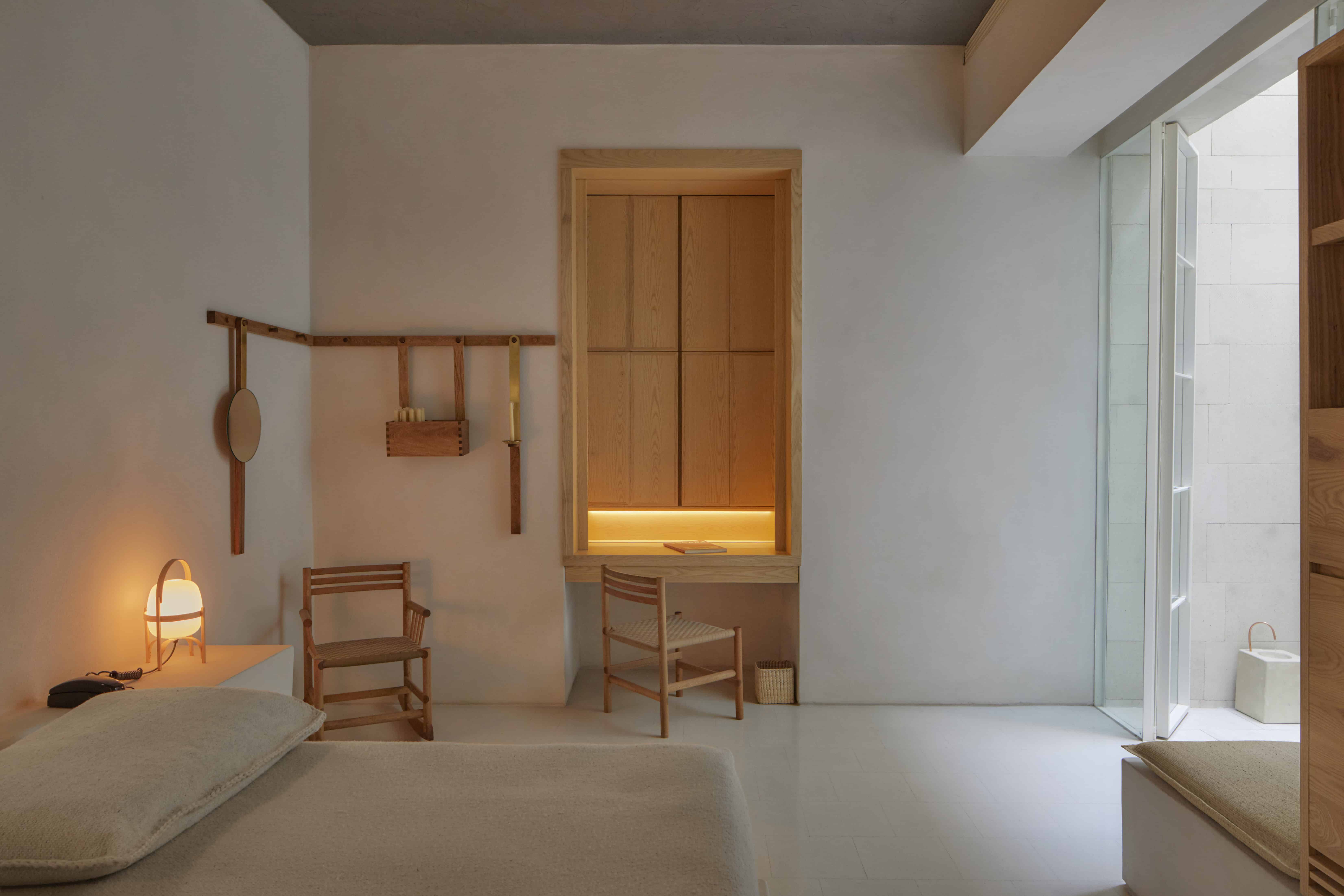
That sensibility runs through every room. The custom furniture, made by the Mexico City studio La Metropolitana, is spare, upright and quietly confident, its Shaker-inflected forms rendered in warm native timber. Peg rails, simple joinery and unadorned surfaces speak to a design vocabulary in which nothing is superfluous. And yet the effect is anything but austere. There is a warmth here that is unmistakably Mexican, carried through in the Oaxacan textiles draped across beds and benches, and in the woven palm elements that recur throughout the property, each one a nod to the craft traditions of the country beyond the capital.
“The design studio thoughtfully uncovers the building’s core by stripping back the interiors, creating a minimalist ambience that fosters a personal connection for every guest.”
Materials do a great deal of the storytelling. The floors of the central patios are finished in basalt, the same dark volcanic stone that underpins the Centro Histórico and the ring of volcanoes that cradles the Valley of Mexico — a quiet geological thread connecting the hotel to the very ground it stands on. The interior walls are plastered in muted, chalky tones chosen to complement the natural stone, forming a pristine backdrop that is then softened by the pale ash wood used for furniture, doors and fixtures. It is a palette of earth and ash, of stone and grain, and it lends the rooms an atmosphere of profound calm.

Twenty-five rooms, arranged around light
The hotel’s plan takes its cue from the way many of Mexico City’s grand historic residences evolved over time. Once-vast family homes were frequently subdivided into smaller dwellings for multiple households, organised around a shared central courtyard. Ambrosi | Etchegaray preserved this patio-centric logic, using it to strike the balance that gives an urban hotel its poise: privacy for the individual, and a sense of community for the whole.

Each of the twenty-five rooms and suites is designed as a serene retreat from the clamour of the streets below. Eighteen of them are graced with private skylit courtyard patios — intimate open-air pockets that draw daylight deep into the plan and give even the most compact rooms a feeling of expansiveness and quiet. The remainder open onto balconies overlooking the historic streetscape. Distinctive architectural features distinguish one room from the next: a brick barrel ceiling here, a run of exposed beams there, a set of original wooden shutters folded back against a window. No two spaces feel quite the same, and that variation is part of the charm.
The overall impression is one of contemplative stillness. In a city as gloriously loud and kinetic as Mexico City, the ability to retreat into a room this composed feels less like a convenience and more like a genuine gift.

Life on the rooftop
If the rooms are about withdrawal, the rooftop is about gathering. Hidden above the third floor is a terrace that functions as the hotel’s communal heart, complete with a swimming pool, a bar and a restaurant, all framed by some of the finest views in the city. From here the panorama unfolds across downtown to take in the Metropolitan Cathedral, the National Palace and the ancient stones of the Templo Mayor — a living diagram of Mexican history laid out below.

Lush planting softens the edges of the terrace, threading greenery between the sunloungers and creating a sense of privacy without ever severing the connection to the streetscape beyond. Casual seating encourages guests to linger, whether over a morning coffee or an evening cocktail as the light drops behind the cathedral towers. The rooftop restaurant, ONA, has built a reputation for its rotating programme of pop-ups by visiting international chefs, layering global technique over exceptional Mexican produce. Down in the courtyard at ground level, Itacate del Mar offers a more relaxed counterpoint, serving coastal Mexican classics — tuna tostadas, ceviche, shrimp tacos — to hotel guests and passing city dwellers alike.

A model for hospitality in the historic city
What makes Círculo Mexicano so compelling is not any single flourish but the coherence of the whole. This is a hotel with a clear philosophical spine: a belief that good hospitality design should be of its place rather than merely near it. Every decision — the basalt drawn from the local ground, the furniture built by a local workshop, the photographs of a man born within these walls, the marketplace that keeps the ground floor open to the neighbourhood — reinforces the same idea. Luxury, here, is measured not in gilt and marble but in authenticity, craft and a deep sense of belonging.

For the design-minded traveller, it offers something precious: a stay that feels genuinely rooted in the culture that surrounds it, drawing its character from the streets on its doorstep. Ambrosi | Etchegaray and Grupo Habita have created a hotel that honours its building, its city and its craft traditions in equal measure, and in doing so they have made a quietly persuasive argument for what the future of hospitality in a historic city might look like. Sometimes the boldest move an architect can make is simply to listen to what a building is already telling them. At Círculo Mexicano, someone was clearly paying attention.



Leave a Reply