
ART & CULTURE · LONDON
Reading time: 7 minCollect’s 22nd edition filled Somerset House with forty galleries and roughly four hundred makers from more than fifty countries. Its new director spent the previous five years choosing which craft stories a magazine would tell rather than which objects a fair would sell, and one of the studios he selected is marking fifty years of the exact movement Collect exists to represent.
Introduction
Collect returned to Somerset House from 27 February to 1 March 2026, with a preview on 25 and 26 February, for its 22nd edition since the Crafts Council founded the fair in 2004. Forty specialist galleries, fourteen of them showing for the first time, brought roughly four hundred makers from more than fifty countries into the neoclassical rooms of the West Wing, spanning ceramics, glass, furniture, jewellery, metalwork, textiles, wood and sculpture, with prices running from around £500 to £50,000. The fair spent its first years at the V&A and then at Saatchi Gallery, including a 2018 edition at Saatchi Gallery that brought Ting-Ying Gallery, Piet Stockmans and Bishopsland Educational Trust together, before settling at Somerset House in 2020.


Zofia Sobolewska Ursic
It was the first edition run by TF Chan, who took over as director in 2025 after Isobel Dennis stepped down following seven years in the role. Chan’s background is not the fair circuit. He studied at Princeton, joined Wallpaper* as an intern and rose to lead its print edition from 2020 to 2023, then worked as a communications consultant for the architect David Chipperfield and wrote Louis Poulsen: First House of Light, a 2024 monograph on the Danish lighting manufacturer published by Phaidon. He has described the two jobs, editing a magazine and directing a fair, as closer than they first appear: “I was used to being given an embarrassment of riches and trying to make sense of them, drawing out themes, and envisioning it as a journey.” Chan has traced part of that instinct to specific conversations rather than to editing generally, citing formative exchanges with the ceramicist Magdalene Odundo and the artist Theaster Gates that deepened his appreciation for work requiring what he calls material intelligence and skill of the hand, the same quality Collect is built to showcase. Collect 2026 reads as that instinct applied to a building full of objects instead of a stack of copy.


Max Radford Gallery
Forty galleries, and the ones building something you can trace
Gallery FUMI, a Mayfair gallery built on pairing hand craft with experimental process, gave its stand over entirely to a solo presentation by the Ghanaian artist Kobina Adusah, whose large-scale terracotta sculptures, including a piece titled The Thermopotes, carry decorative patterns hand-inscribed directly into the clay. Max Radford Gallery, which works London-centred emerging talent between art and design, showed new work by EJR Barnes, a self-taught designer who learned furniture-making from YouTube videos while holding a day job, building pieces from frosted UV-bonded glass, sandcast aluminium and pear wood, and selling largely through Instagram rather than a showroom. Barnes has described his own approach plainly: “there is always a bit of a wry smile happening, without it looking like the whole thing is a joke.”


Gallery FUMI
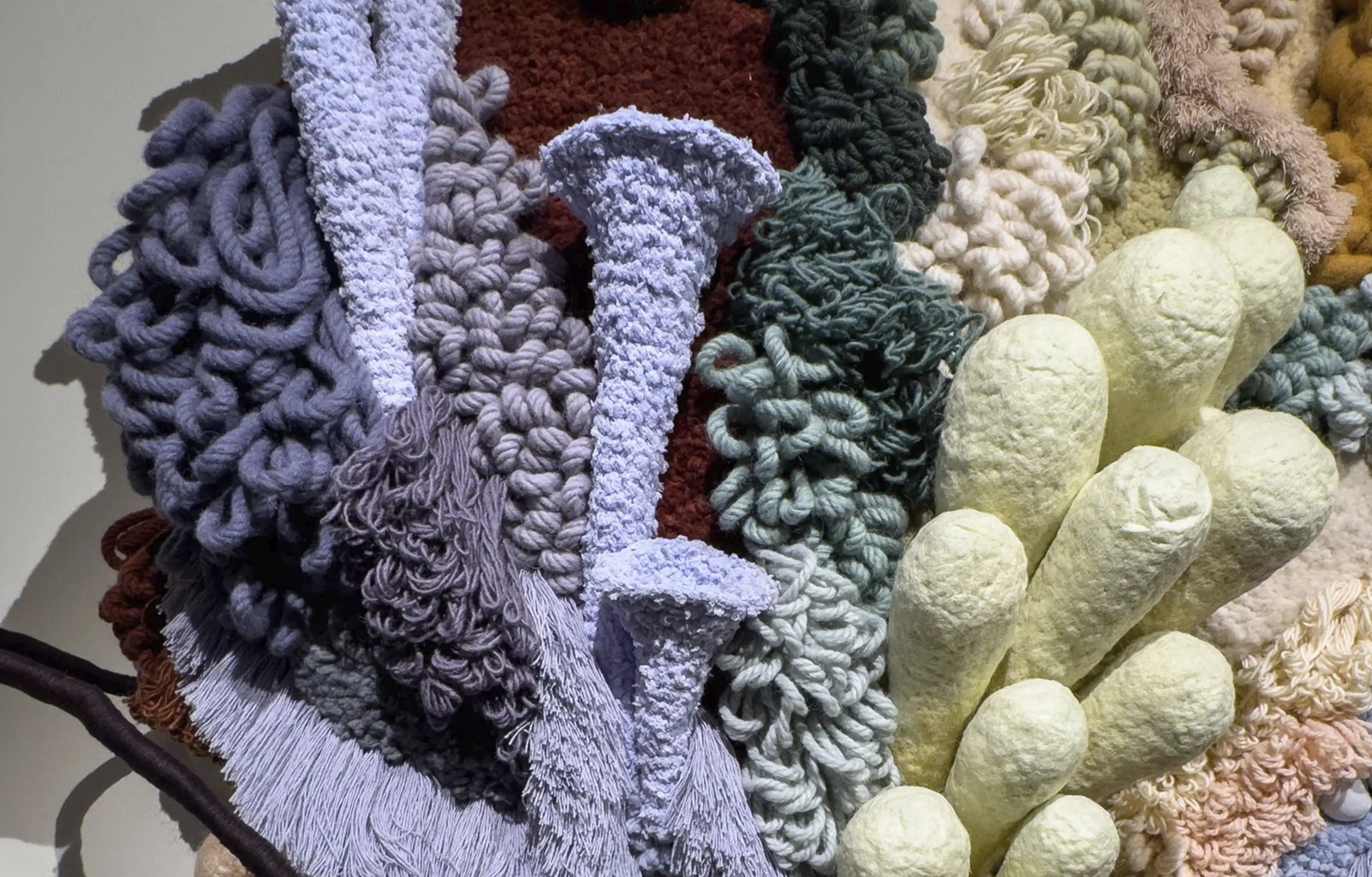
Fourteen new exhibitors included Craft from Poland, a nine-artist presentation curated by Poland’s Creative Industries Institute, appearing at Collect for the first time and anchored by Marcin Rusak‘s Flora Lamp II, a table light that suspends reclaimed flowers inside tinted resin. Ben Austin Projects, an independent curatorial platform, showed the Portuguese textile artist Vanessa Barragão, whose hand-tufted reliefs are built from upcycled yarn and offcuts into reef and coral forms addressing ocean ecology directly in the material itself rather than in a wall text beside it.


Ben Austin Projects
Siat Gallery, visiting from Seoul, specialises in contemporary Korean craft and art jewellery, nurturing artists working across leather, lacquer, paper and metal rather than confining a single national programme to one discipline. Florian Daguet-Bresson, a Paris gallery devoted to contemporary ceramics, paired nineteenth and twentieth-century masters of the form with living artists on the same stand, treating clay’s plasticity as a continuous argument running across a century rather than a historical footnote to newer work. County Hall Pottery, a ceramics hub on the South Bank launched during London Craft Week, brought its own programme of exhibitions, classes and artist residencies, a reminder that several of Collect’s exhibitors run teaching spaces and public programmes alongside their sales stands rather than existing purely as galleries.


Peter Layton & London Glassblowing
What actually qualifies a piece as “collectable”
Collect describes itself as the only annual fair on the UK and international circuit dedicated specifically to museum-quality contemporary craft and design, and the word contemporary carries a hard rule behind it: work has to have been made within the last five years to qualify for a stand. That single criterion is what keeps the fair’s programme genuinely current, and it is also what makes Chan’s editorial instinct relevant rather than decorative, since a five-year window has to be actively curated every year or the fair drifts. The organisers have put the fair’s own working definition plainly: craft is not a category, but a way of thinking about form, time and care, applied consistently whether the material is glass, porcelain, resin or reclaimed plastic. Prices across the 2026 edition ran from around £500 to £50,000, a range wide enough to put a first-time buyer and an institutional collector on the same gallery stand.


Florian Daguet‑Bresson
The studio marking fifty years the same season it exhibited
Peter Layton founded London Glassblowing in Rotherhithe in 1976, at a point when, in his own description, no market for studio glass in Britain existed yet, supporting the venture through part-time teaching and selling pieces directly from his van. The studio later moved through the Leathermarket before settling on Bermondsey Street, where it operates today as both a working hot shop and a gallery. It returned to Collect in 2026 in the same year it turns fifty, with an anniversary exhibition running from 12 June to 5 July inviting more than forty artists, its nine current resident makers alongside eighteen guest artists and legacy collaborators, plus retrospective work from three pioneering glassmakers who have since died, Sam Herman, Karen Lawrence and Jochen Ott, to mark what the studio calls five decades of British studio glass moving from an uncertain beginning to a collectable art form embraced worldwide.


Hanna Salomonsson
Nobody covering Collect 2026 appears to have set that anniversary against the fair’s own founding story. Collect exists specifically to give studio craft the market Layton could not find in 1976, and its 22nd edition landed in the same year the country’s longest-running studio glass gallery marks fifty years of having built one anyway. Layton’s own glass turns up twice at Collect 2026, once on his own stand and once again a short walk away, hand-picked for the fair’s Collectors’ Lounge, curated separately by Tola Ojuolape Studio as an immersive space built around exactly the kind of maker’s library London Glassblowing has spent half a century stocking.


Oriel Zinaburg
Collect Open, and the eleven pieces that are not for sale on a stand
Collect Open, the fair’s dedicated platform for ambitious, craft-led installation work, gave space to eleven artists working outside the standard gallery-stand format this year. Jihyun Kim, a London-based Korean ceramic artist, presented Salty Fairy Ring, a circular arrangement of slip-cast porcelain vessels set on grassy plinths, drawing together the ritual use of salt jars in Korean tradition with the folklore of the European fairy ring in a single immersive installation rather than a row of objects on plinths. Hanna Salomonsson, a Swedish ceramicist based in London, showed hand-built vessels that work memory and landscape through forms referencing Scandinavian folklore, while Oriel Zinaburg, an architect who moved into sculpture, presented large pressed-slab vessels that read as compressed desert geology, built to suggest temporal suspension rather than a fixed moment.


Contemporary Applied Arts
Kamilah Ahmed, a British Bangladeshi embroidery artist, combined hand-wrapped silk warps with digital embroidery to explore Dhaka’s layered cityscape, and Zofia Sobolewska Ursic reinterpreted straw marquetry, a technique more usually seen flat on furniture surfaces, as sculptural furniture in its own right, treating the raw material itself as a carrier of cultural memory rather than simply a decorative veneer. Eleven artists across a single platform, each working a different material toward a different reference, is a harder curatorial brief than a single themed exhibition, and it is the part of Collect that a gallery-stand walk-through alone would miss.


Cavaliero Finn
The platform sits alongside two of the fair’s longest-standing exhibitors, the Society of Designer Craftsmen, founded in 1887 as a body for technical range across disciplines rather than a single trade, and Contemporary Applied Arts, London’s original multi-disciplinary applied arts gallery, representing roughly two hundred British makers across ceramics, textiles, jewellery, glass, metal, wood and furniture since 1948. Both predate the Crafts Council itself, which was established in 1971 as the Crafts Advisory Committee more than three decades before it launched Collect, and both have exhibited at the fair since close to its founding, which makes them a kind of institutional memory inside an event that otherwise turns over a sizeable share of its exhibitor list every year. Between a body founded in the nineteenth century, a gallery approaching its eightieth year and a fair barely out of its second decade under its newest director, Collect’s own timeline is longer than any single edition lets on.


Thrown Gallery
Frequently asked questions
When and where was Collect 2026?
At Somerset House in London, with public days from 27 February to 1 March 2026 and a preview on 25 and 26 February.
Who directs Collect, and since when?
TF Chan, who was appointed director in 2025 after Isobel Dennis stepped down following seven years in the role. Collect 2026 was his first edition.
How many galleries and makers took part?
Forty specialist galleries, fourteen exhibiting for the first time, showing roughly four hundred makers from more than fifty countries.
What is Collect Open?
Collect’s platform for ambitious, craft-led installation work outside the standard gallery-stand format, featuring eleven artists in 2026, including Jihyun Kim’s ceramic installation Salty Fairy Ring.
What is the Collectors’ Lounge?
A dedicated lounge space at Collect 2026, curated by Tola Ojuolape Studio as an immersive maker’s library built around craft objects for visitors to sit with directly.
Who organises Collect, and how long has it run?
The Crafts Council, which founded Collect in 2004. The 2026 edition was its 22nd.


Society of Designer Craftsmen
Final thoughts
Collect 2026 was, on its own terms, a straightforward changing of the guard: a new director’s first edition, forty galleries, a familiar Somerset House address. Set against London Glassblowing’s own fifty years, though, the fair reads as something closer to a progress report on the market Peter Layton went looking for in a van in 1976 and could not find. A five-year eligibility rule keeps every edition current by design, which is exactly why the anniversary sitting quietly alongside it is worth naming: Collect exists to prove that recent work deserves the same seriousness as anything historic, and the studio marking fifty years this season is the proof that the argument has already been won once.


Siat Gallery
TF Chan spent five years choosing which craft stories a magazine would run. His first edition as director put him in charge of choosing the objects instead, and the strongest argument in the building was not on any single stand. It was the fifty-year gap between the fair’s founding and the studio that has now outlasted both of Collect’s own eras twice over.


Leave a Reply