
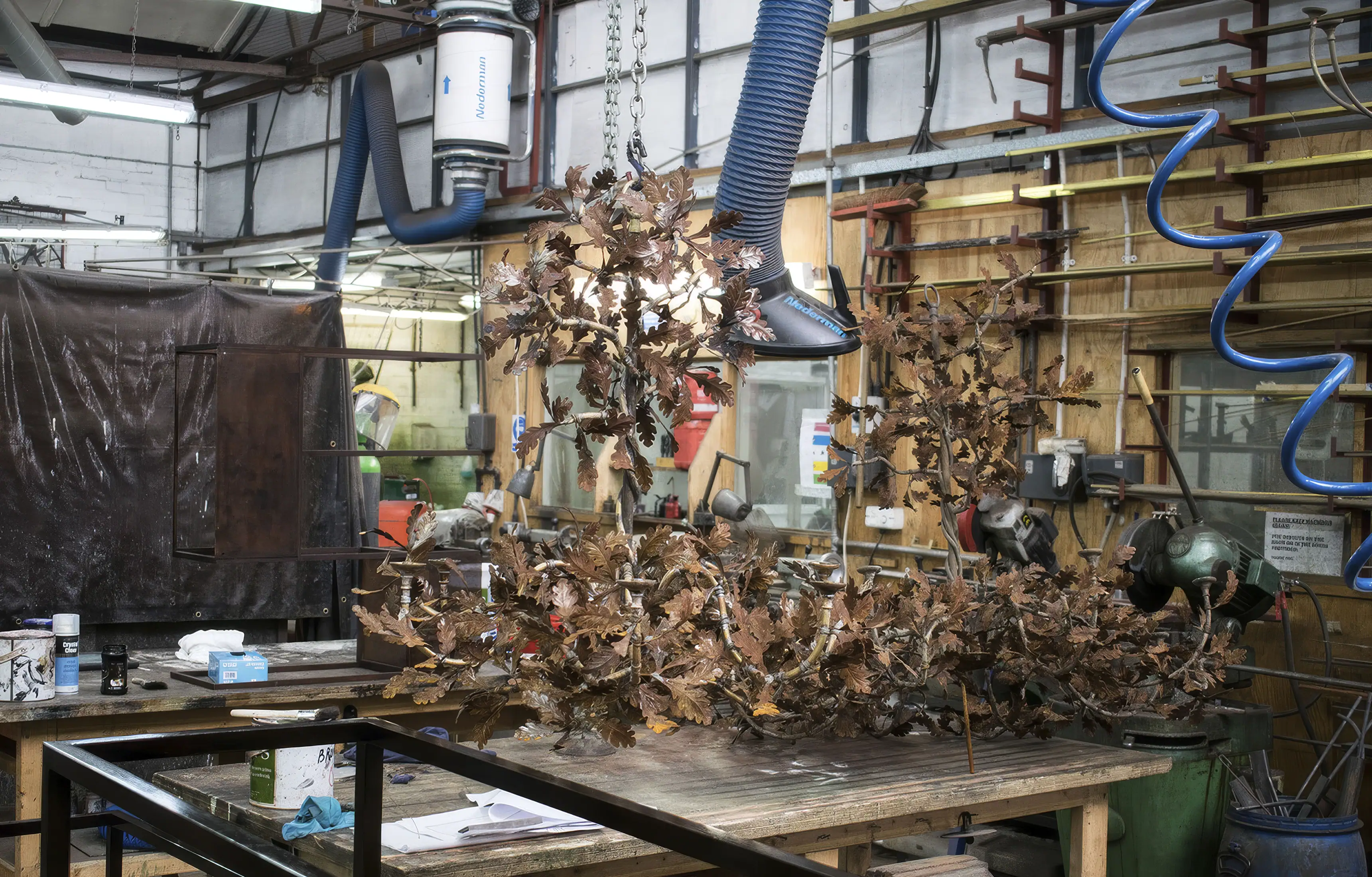
Christopher and Nicola Cox met studying sculpture at Wimbledon School of Art in the 1990s, and opened a studio in 2004 doing exactly the kind of work their training had prepared them for: restoring and fabricating other people’s metalwork. It took three years before Cox London made a piece that was entirely its own. The workshop that grew out of that decision, in Tottenham Hale, still runs on the two skills the founders brought to it separately.
Introduction
Cox London casts its own bronze on site, by hand, using a lost-wax process that has not fundamentally changed in two thousand years. The studio’s Caravaggio wall light is a useful example of what that actually involves: the light’s cast bronze hand, the fixture’s central form, exists first as a wax model, then as a mould, then as molten metal poured by someone standing next to the furnace, before it is finished by hand into something that looks, deliberately, like it could have been made a century ago. It is one of dozens of pieces to come out of an atelier in Tottenham Hale that now employs more than sixty-five makers and apprentices, part of a group of over a hundred people, most of whom will never sign a piece they helped make.
Cox London’s most publicly visible moment, a nine-piece commission for the Crafts Council’s Collect fair in 2020, has its own story, told in full elsewhere on this site. This is the story of the workshop behind it: how two sculptors who spent years working for other people ended up running one of London’s few functioning bronze foundries, and why the studio’s own designs still look like something that was found rather than made.
That last point is not an accident of style. A studio whose founders trained by restoring nineteenth-century originals inevitably absorbs the visual habits of the objects they repaired, the slight irregularity of a hand-forged joint, the uneven depth of an old casting, and those habits show up in work that was never meant to look old at all.


Two sculptors who learned the trade before they had a style
Christopher Cox and Nicola Cox met studying fine art sculpture at Wimbledon School of Art in the 1990s. Neither arrived at their own design language first. Christopher comes from a north London family with three generations of antique dealers, artists and restorers behind him, and trained under the metalwork restorer David Turner before working in London’s antique metalwork trade, learning to solder, polish, lacquer, patinate and gild pieces that were, in every case, someone else’s original design. Nicola, from New Zealand, trained in glass casting studios and in two separate bronze foundries, one in London and one in New Zealand, and it is there that she specialised in lost-wax bronze casting, the technique that still anchors the studio’s work today.
Between them, before Cox London existed as a name, the founders had already learned how old metalwork was actually made, one by taking it apart to repair it, the other by pouring the metal that made it in the first place.


The workshop that restored other people’s ideas for three years
Cox London dates its beginning to 2004, when Christopher and Nicola opened a studio doing restoration and metalwork commissions, work that drew directly on what they had each spent years training to do. It was not, at that point, a design studio in the sense the name now implies. For three years, the pair worked to other people’s briefs and other people’s designs, repairing, fabricating and finishing pieces that carried someone else’s name.
In 2007, they made a different decision: to stop taking commissioned restoration and fabrication work and start designing their own pieces instead. It is a smaller pivot to describe than it was to make. Restoration work is a known quantity, with a client, a reference object and a defined outcome. Original design has none of that, and the studio’s founders have since described the years since as a matter of ambition rather than comfort: “We’ve always been ambitious to make bigger and better pieces; we’ve never wanted to slow down.” The bronze and iron techniques did not change in 2007. What changed was who decided what got made.


From burnout to a business coach
What followed was not a straightforward rise. As Cox London grew from a two-person studio into a workshop with dozens of makers, Christopher and Nicola found themselves stretched between the sculpture they wanted to make and a business they had not been trained to run. They eventually brought in a professional coach, who introduced them to formal management systems and recommended a well-known small-business text, The E-Myth, built around the idea that a founder who is good at the craft is not automatically good at running the company the craft becomes.
The practical result was a leadership team built specifically to handle sales, client relations and data, the unglamorous scaffolding that let Christopher and Nicola return most of their working week to the studio floor rather than to spreadsheets. Today, the group they built runs to more than a hundred people, of whom over sixty-five are makers and apprentices working across the atelier’s departments. It is a specific, deliberate outcome of a decision the founders made about their own time: protect the making, and hire for everything the making does not need them personally to do.


A hand cast the way it has been for two thousand years
The technique behind a piece like the Caravaggio wall light is lost-wax casting, known by its French name, cire perdue, in which a wax model of the finished form is built, encased, then melted out to leave a cavity that molten bronze is poured into while the mould is still hot. It is the same principle goldsmiths and jewellers have used for millennia, applied here at the scale of furniture and lighting rather than a ring or a pendant. Iron is worked differently, heated and hand-forged rather than cast, and the two metals often appear on the same piece, doing different jobs: iron for structure, bronze for the passages of detail a client is meant to notice.
Finished surfaces at Cox London are available in as many as eighteen distinct patinations, from bright bronze through to deep, near-black finishes, each one a chemical and thermal process applied by hand rather than a single fixed formula. The studio treats departments, foundry, forge, wood and glass, as porous rather than separate, encouraging what the team describes as a constant cross-pollination of skills between makers who specialise in one material but understand enough of the others to know what is actually possible.


Restoration never really left the building
Even after 2007, Cox London kept a foot in the trade its founders started in. The studio still restores metalware, rewiring antique chandeliers and repairing damaged components, work that runs alongside its own collection rather than instead of it. Its garden benches, inspired by the cast-iron Coalbrookdale designs that defined Victorian outdoor furniture, are a direct, visible line back to Christopher’s early training: a maker who once repaired nineteenth-century ironwork now designs new pieces that borrow its logic rather than copying its catalogue.
The studio keeps what it calls a cabinet of curiosities on site, a working reference collection of objects, textures and forms that feed new designs, functioning as a physical alternative to a mood board. It is a small detail, but it says something specific about how the studio works: reference comes from handled objects rather than images on a screen, which is consistent with a founding pair who both learned their trade by working directly with materials rather than by studying them.


What a visit to the atelier actually looks like
Cox London opens its Tottenham Hale workshop to the public a handful of times a year, most visibly during London Craft Week, when visitors are given a guided route through the atelier rather than a curated showroom experience. A visit typically begins with a welcome from Christopher and Nicola Cox themselves in the studio’s private innovation space, before moving through the working floor: bronze poured while visitors watch, iron heated and beaten into shape at the forge, and surfaces taken from raw metal to a finished patination in front of them rather than described after the fact.
It is a deliberately unpolished thing to show people. A finished Cox London piece, sitting in a showroom on Pimlico Road, gives no obvious sign of the heat, noise and physical effort that produced it. The workshop tour exists specifically to close that gap, aimed at designers, students and anyone curious about what a genuinely hands-on British workshop still looks like in a market where most furniture at this level is no longer made this way, or made in Britain at all.


Training the next generation, on a wage
Cox London now runs a three-year, paid apprenticeship for young makers, structured around a City and Guilds qualification, with apprentices rotating through the studio’s core departments in their first year before choosing where to specialise. It is a formal version of exactly what happened to Christopher Cox informally, decades earlier, under a working restorer who taught him the trade on the job rather than in a classroom. The studio has partnered with the Crafts Council on wider education initiatives aimed at making craft careers visible to people who might not otherwise consider one, a concern Asprey, London’s own workshop-based silversmith and jeweller, has approached from a different angle, supporting the body responsible for training the next generation of British goldsmiths and silversmiths.
Christopher Cox has described making, in his own words, as “also a kind of therapy,” and said the studio wants some version of that available to everyone who comes through its doors, not just the two founders who built it. The apprenticeship programme is that idea turned into a functioning training pipeline, on a wage, rather than a sentiment.


Frequently asked questions
When was Cox London founded?
The studio dates its beginning to 2004, when Christopher and Nicola Cox opened a workshop for restoration and metalwork commissions, with the business formally established as Cox London the following year.
Who are the founders of Cox London?
Christopher and Nicola Cox, sculptors who met studying at Wimbledon School of Art in the 1990s. Christopher trained in antique metalwork restoration under David Turner; Nicola trained in glass casting and lost-wax bronze casting across two foundries, one in London and one in New Zealand.
Where is the Cox London workshop?
The studio’s atelier is in Tottenham Hale, north London, employing more than sixty-five makers and apprentices as part of a wider group of over a hundred people. The studio’s showroom is on Pimlico Road.
When did Cox London start designing its own pieces?
The studio spent its first three years, from 2004, taking on restoration and metalwork commissions to other people’s briefs. In 2007, Christopher and Nicola Cox made the decision to design and produce their own original pieces instead.
What is lost-wax casting?
Also known as cire perdue, it is a bronze-casting technique in which a wax model of a design is encased in a mould, then melted out to leave a cavity that molten bronze is poured into. Cox London uses the method for pieces including its Caravaggio wall light.
Does Cox London still do restoration work?
Yes. Alongside its own collection, the studio restores metalware, including rewiring antique chandeliers, work that connects directly to the trade its founders trained in before the studio began designing its own pieces.
Final thoughts
It would have been easy for Cox London’s own account of itself to skip the three years before 2007 and start the story with the studio’s first original design, the more flattering place to begin. The workshop is more interesting with those years left in, because they explain almost everything that followed: a founding pair who spent years learning to repair and cast other people’s work before they trusted themselves to invent their own, a business that nearly outgrew its founders before a business coach and a leadership team gave them back their working week, and an apprenticeship programme that formalises, for a new generation, the exact kind of informal training Christopher Cox once received from a working restorer with no classroom in sight. The bronze is still poured the way it was two thousand years ago. Who gets to decide what shape it takes is the part that changed in 2007.
Leave a Reply