
ART & CULTURE · STOCKHOLM
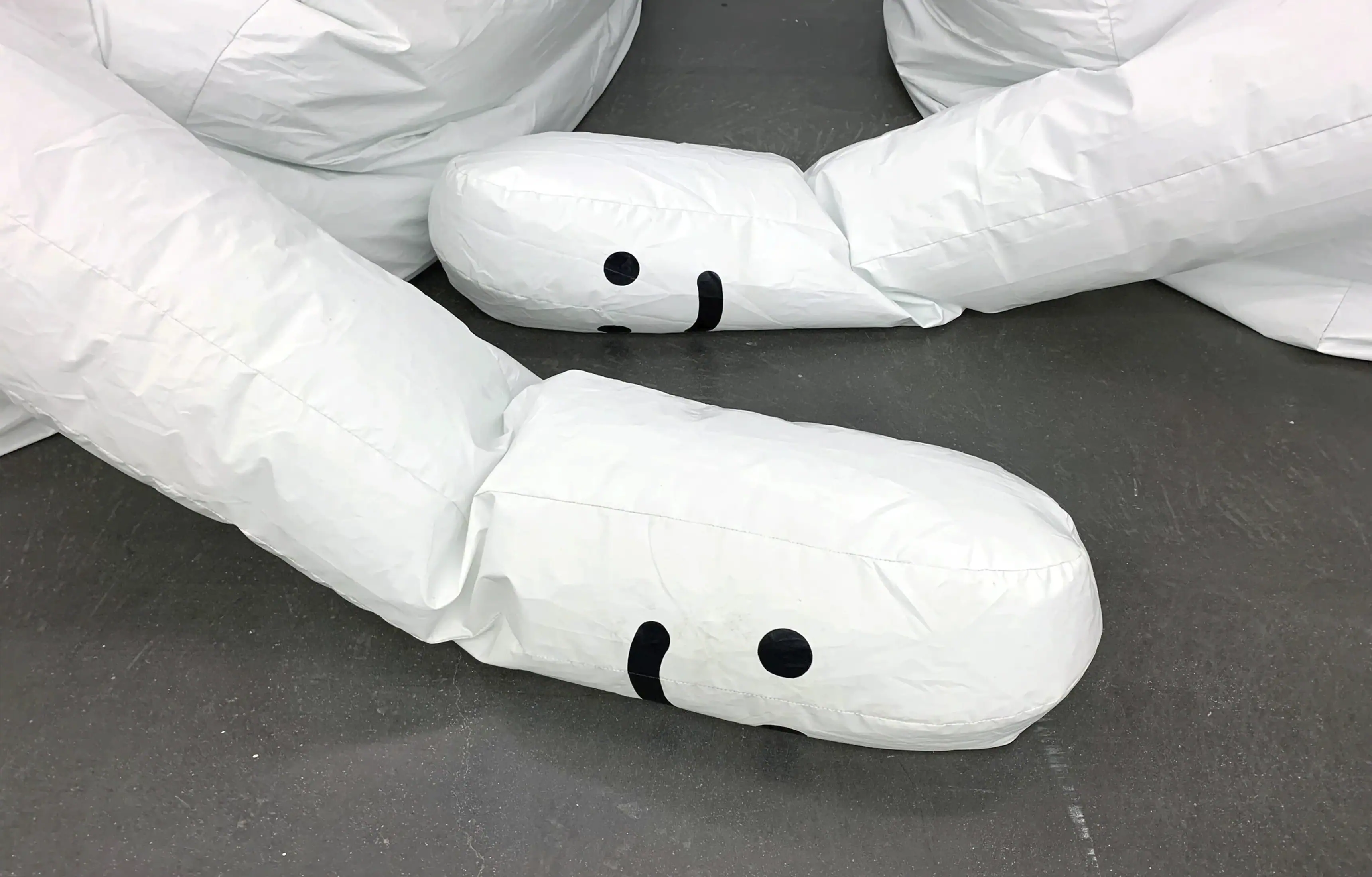
Reading time: 10 minTwelve inflatable swans rise, hold a smiling stance for four minutes, and then spend eight minutes sinking back into the floor, on a loop that never stops. David Shrigley built the installation for Stockholm’s Spritmuseum from a resin sculpture he made in 2000, working with the Melbourne company Third Drawer Down to translate a small, deadpan object into something the size of a room. The joke is structural, not decorative, and it is the same joke that put a giant thumbs-up on the Fourth Plinth.
David Shrigley filled a single gallery at Stockholm’s Spritmuseum with twelve giant inflatable swans, each one rising and collapsing on a repeating twelve-minute cycle, for an exhibition titled Exhibition of Giant Inflatable Swan-Things. It opened on 27 September 2018 and ran until 28 March 2019, the British artist’s first solo show in Sweden.
The premise sounds simple and is not. Shrigley had made a small polyurethane resin sculpture called Swan Thing in 2000: a swan with a straight, stick-like neck and a flat, cartoonish smile where an elegant curved head should be. Eighteen years later, working with the Australian company Third Drawer Down, that tabletop object became a room-sized, mechanised installation, twelve swans strong, breathing in and out on timers.
Spritmuseum is Sweden’s museum of spirits and drinking culture, on Djurgården in central Stockholm, and it permanently houses the Absolut Art Collection. Shrigley has a work in that collection, ABSOLUT SHRIGLEY, made in 1996, and the museum invited him to make new work for its annual solo exhibition slot for artists represented in the collection. Curator Mia Sundberg had wanted the show since the museum opened in 2012. What he gave her instead of a set of framed pieces was one continuous, breathing sculpture that fills the room and asks nothing else of it.
Twelve swans, and a cycle that never resolves
The installation is built around repetition rather than a single climactic moment. Each of the twelve swans inflates, holds its shape at something close to full height for around four minutes, and then spends roughly eight minutes deflating and folding back down to a flat rubber shape on the gallery floor, before the cycle begins again. The full sequence takes twelve minutes, and it runs continuously for as long as the exhibition is open, so no visitor sees the same room twice.
The design decision that carries the whole piece is the neck. A real swan’s neck is the animal’s signature: long, curved, held in an S that reads instantly as poise. Shrigley’s swans keep the length and drop the curve. The neck stands straight up, rigid as a post, and at the top of it sits a simple, flat, smiling face, drawn in the same blunt line that runs through his sketchbooks. The elegance is the entire joke: he has kept every proportion a swan needs to be recognisable and removed the one thing that makes a swan graceful.
Shrigley has been direct about which half of the cycle interests him more. “I really liked the deflation more than I liked the inflation,” he has said. “Watching something deflated in a gallery, it’s almost something stupid, like inviting someone to watch paint dry.” That is a fair description of the piece’s actual demand on a visitor: it asks you to watch nothing happen, slowly, in a room built for looking at things that already happened.

Why a swan, and not another animal
Shrigley’s choice of subject is not incidental. A swan carries more inherited meaning than almost any other bird available to an artist: grace, romance, royal ownership in Britain, the curved neck that appears in heraldry, ballet and wedding photography as shorthand for effortless elegance. It is also, entirely separately, the animal that has become the default shape of the inflatable pool float, a genre of object built for holiday photographs rather than for water safety or comfort, and one that by the mid-2010s had become one of the most photographed objects on social media.
Shrigley’s swans sit deliberately across both meanings at once. The straight neck and flat smile strip out the grace that the symbol is supposed to carry, while the scale and the material, rubber, air, a repeating mechanical cycle, borrow directly from the pool float’s own vocabulary of cheerful disposability. The joke is not simply that the swan looks silly. It is that the two associations, regal elegance and inflatable novelty, are being held in the same object at the same time, and neither one is allowed to win. That double reading is a more precise description of Shrigley’s practice generally than “silly drawings,” and it is what separates the installation from a straightforward pool toy scaled up for a laugh.
From a resin sculpture to a room-sized installation
Swan Thing, the 2000 sculpture the whole piece is built from, exists as a small polyurethane resin object, roughly the scale of a garden ornament, and has circulated in editions through galleries since. It is a self-contained joke on its own terms: a domestic-scale object doing the same deadpan trick the giant version does, just without the mechanism.
Third Drawer Down, the Melbourne company that turned the design into an inflatable, was founded in 2003 by Abigail Crompton on the idea that everyday objects, starting with the tea towel, could carry serious artists’ work into people’s homes rather than only their galleries. Shrigley’s own relationship with the company began years before the swans, with an email asking whether he would design a tea towel. “Third Drawer Down emailed me and asked if I wanted to do a tea towel years ago,” he has recalled. “And I said, ‘Alright then, yeah, I’ll do a tea towel.’” He has described the studio’s collaborations generally as the kind that “started with somebody emailing me out of the blue, and a beautiful friendship accrues from there.” Third Drawer Down has since worked with more than two hundred international artists on similar terms, among them Yayoi Kusama, Louise Bourgeois, Marina Abramović, Judy Chicago and Robert Rauschenberg.
The swan pool float grew out of that ongoing partnership, taking Shrigley’s deadpan resin sculpture and remaking it as an oversized inflatable, in the same register as the novelty pool floats that had become a fixture of holiday photography. For Spritmuseum, that pool-float scale was pushed further again, into gallery-sized sculptures rigged to inflate and deflate on a fixed timer rather than by hand, turning a beach object into a kinetic installation.

David Shrigley, from Glasgow sketchbooks to Trafalgar Square
Shrigley was born on 17 September 1968 in Macclesfield, Cheshire, and grew up mostly in Oadby, Leicestershire, before studying Environmental Art at Glasgow School of Art from 1988 to 1991. He stayed in Glasgow for the better part of three decades, building a career on drawings that look like doodles and behave like aphorisms, short, blunt, often very funny and often about death, before moving to Brighton in 2015. He is represented by Stephen Friedman Gallery in London.
His practice has always moved fluidly between drawing, sculpture, animation and public commission, and the swans sit comfortably inside that range. He was nominated for the Turner Prize in 2013. In 2016, his sculpture Really Good, a bronze thumbs-up with an elongated thumb standing more than seven metres tall, was unveiled on the Fourth Plinth in Trafalgar Square, where it stayed until 2018, making Shrigley’s blunt, cartoonish drawing style one of the most-photographed public sculptures in London during that period. He was appointed OBE in 2020. The swans at Spritmuseum share the same method as the plinth commission: take an ordinary, legible symbol, a thumbs-up, a swan, and push it just far enough out of true that the joke and the craftsmanship arrive at the same time.

The Absolut Art Collection, and where Shrigley actually sits in it
Spritmuseum’s connection to Shrigley predates the swans by more than two decades. The Absolut Art Collection began in 1985, when Andy Warhol became the first artist commissioned to make a portrait of the Absolut Vodka bottle, in a campaign that became one of the most widely recognised collaborations between a consumer brand and a working artist. Michael Roux, president of the company behind the brand, then asked Warhol to suggest other artists for the same commission. Warhol’s recommendations included Keith Haring and Ed Ruscha, both of whom went on to make their own Absolut works.
By 1988, Roux had changed the brief. Rather than continuing to rely on established names, he began commissioning less well-known artists, treating the campaign explicitly as a way to help launch careers rather than simply to borrow prestige from famous ones. More than 350 artists have taken part in the bottle campaign over its history, and the wider Absolut Art Collection, permanently housed at Spritmuseum, now comprises roughly 850 works by around 550 artists.
Shrigley’s contribution, ABSOLUT SHRIGLEY, was made in 1996, five years after he graduated from Glasgow School of Art and well before the Turner Prize nomination, the Fourth Plinth commission or the OBE. That timing is worth sitting with. The collection’s post-1988 strategy was built on backing artists before the wider art world had caught up with them, and Shrigley’s inclusion in 1996 is a working example of that strategy paying off exactly as intended: Spritmuseum’s own institutional memory of him runs back to a point in his career when almost none of his subsequent recognition existed yet. The museum was not hosting an established figure in 2018. It was finally getting around to the artist it had already backed twenty-two years earlier.
Spritmuseum’s annual solo exhibition slot for artists in the collection has previously featured Keith Haring, Frank Bowling, Beatrice Cussol and Bertil Vallien. Mia Sundberg, the curator who commissioned the swans, has described first encountering the concept as “a perfect miniature model of the room with the swans in it, small and cute,” and has called Shrigley “a huge presence in the art world, but equally so in the world of pop culture.” She has also put her finger on the specific quality that makes his work function as public art: “Part of what is so funny and ambivalent with his work is that it seems to say nothing; it seems like such a meaningless thing.”
What the room actually gives a visitor
The swans do not reward a single visit the way a painting does. A visitor who arrives mid-cycle sees something different from one who arrives a minute later, and the installation’s entire logic depends on staying in the room long enough to see at least one full rise and fall. That is an unusual demand to make of a museum visitor, and it is also precisely the point: the piece is built around duration rather than image, closer to watching weather than looking at a sculpture.
Spritmuseum has occupied Galärskjulen, a set of former naval galley sheds on Djurgården, since 2012, having moved there from an earlier home in central Stockholm’s Grönstedtska palace, where the museum first opened in 1967. Djurgården is the island given over largely to museums and parkland just east of Stockholm’s centre, home to institutions including the Vasa Museum and Skansen. A visitor who came for the swans would have arrived already inside a museum built around a permanent collection of drinking vessels, historic bottles and the Absolut Art Collection’s paintings and objects, so the swans functioned as the loudest, largest and least static thing in the building for the six months they were installed, a deliberate contrast to the cabinets of glass and print around them.
Shrigley returned to Spritmuseum on 14 and 15 March 2019, near the end of the run, for guided tours, appearances at the museum’s bar and informal tattoo sessions with visitors, extending the exhibition’s playful register into the kind of live event a static show could not offer. It was a fitting way to close a piece built on the idea that a gallery does not have to hold still to be taken seriously.

Final thoughts
It would be easy to describe Exhibition of Giant Inflatable Swan-Things as a novelty, a pool float blown up to gallery scale for a laugh. That undersells what Shrigley actually built. The installation takes a twenty-two-year-old joke about elegance and repeats it, mechanically, on a twelve-minute loop, for six months, in a museum that had been trying to get him in the door since it opened. The swans are funny because the craft behind them is exact: the proportions, the timing, the choice of exactly one straight line where a curve should be.
What makes the piece land is that none of it asks the visitor to work for the joke. A swan that inflates and deflates is a simple thing to watch, and Shrigley has always trusted simple things to carry serious ideas, the same trust that put a giant thumbs-up in Trafalgar Square and a stick-necked swan in a Stockholm museum built on a vodka company’s decision, more than three decades earlier, to bet on artists before anyone else did. The swans breathe, and hold, and collapse, and breathe again, and the room does not resolve. That is the work.
What was Exhibition of Giant Inflatable Swan-Things?
It was a solo installation by British artist David Shrigley at Spritmuseum in Stockholm, featuring twelve giant inflatable swan sculptures that inflated and deflated on a repeating twelve-minute cycle.
When and where did it take place?
The exhibition opened at Spritmuseum, on Djurgården in Stockholm, Sweden, on 27 September 2018, and closed on 28 March 2019.
What inspired the giant swans?
Shrigley based the installation on Swan Thing, a small polyurethane resin sculpture he made in 2000, featuring a straight neck and a flat, smiling face in place of a swan’s usual curved elegance.
Who built the inflatable swans?
Third Drawer Down, a Melbourne-based company founded by Abigail Crompton in 2003, worked with Shrigley to translate his resin sculpture into oversized inflatable form, in the same spirit as its long-running collaboration with the artist on homewares and everyday objects.
How did the inflate-deflate cycle work?
Each swan rose and held an upright, standing shape for roughly four minutes, then spent about eight minutes gradually deflating and collapsing, before the twelve-minute cycle repeated on a loop.
What is Spritmuseum, and why did Shrigley show there?
Spritmuseum is Sweden’s museum of spirits and drinking culture, and it permanently houses the Absolut Art Collection. Shrigley has a work in that collection, ABSOLUT SHRIGLEY, made in 1996, and the museum invited him to create new work for its annual solo exhibition slot for collection artists.
Is this connected to David Shrigley’s Fourth Plinth sculpture?
Not directly, but the two works share a method. Really Good, Shrigley’s bronze thumbs-up on Trafalgar Square’s Fourth Plinth from 2016 to 2018, and the Spritmuseum swans both take an instantly recognisable symbol and push it slightly out of true.


Leave a Reply