
[Section] · [Location]
Reading time: 5 minWhen I first visited Dubai Miracle Garden, I came for the sheer improbability of it: 150 million flowers in the desert. Returning years later, I found something I had underestimated the first time. The garden is not a fixed attraction at all. It is torn up and reimagined every single season, which makes it one of the most quietly radical design projects in the city, a spectacle designed to be temporary.
Some places you return to expecting them to be exactly as you left them. Dubai Miracle Garden is not one of them. Coming back after a few years away, I assumed I would recognise it, retrace the same paths, revisit the same installations. Instead I found a garden that had, in large part, reinvented itself, and it made me see the whole enterprise differently.
The headline facts are still gloriously the same: 150 million flowers across roughly 72,000 square metres, the Emirates aircraft dressed in half a million blooms, the record-breaking scale. But the second visit reframes the first. What looks, on a single trip, like a permanent wonderland is in fact a show that is dismantled and rebuilt from the soil up, season after season. That is the real story, and it is one you only notice on your return.

A garden designed to be temporary
Here is the thing I missed the first time. Because Dubai’s summer heat forces the garden to close for months, everything you see is essentially annual. Each new season, now the 14th, the beds are replanted, the layouts reworked, the displays refreshed, and new set pieces added. Nothing is meant to last, and everything is meant to change.
For a design writer, that is genuinely interesting. Most landmarks are built to endure; this one is built to be replaced. It is closer in spirit to a stage production or a seasonal exhibition than to a botanical garden, an enormous, living installation that exists only for its run and then vanishes until the next one. Seen that way, the maximalism reads as pure ambition: a team choosing, every year, to conjure and then surrender one of the largest floral spectacles on Earth. There is something almost poignant in that, a reminder that the flowers, for all their scale, are as fleeting as any bloom.

What is new this time
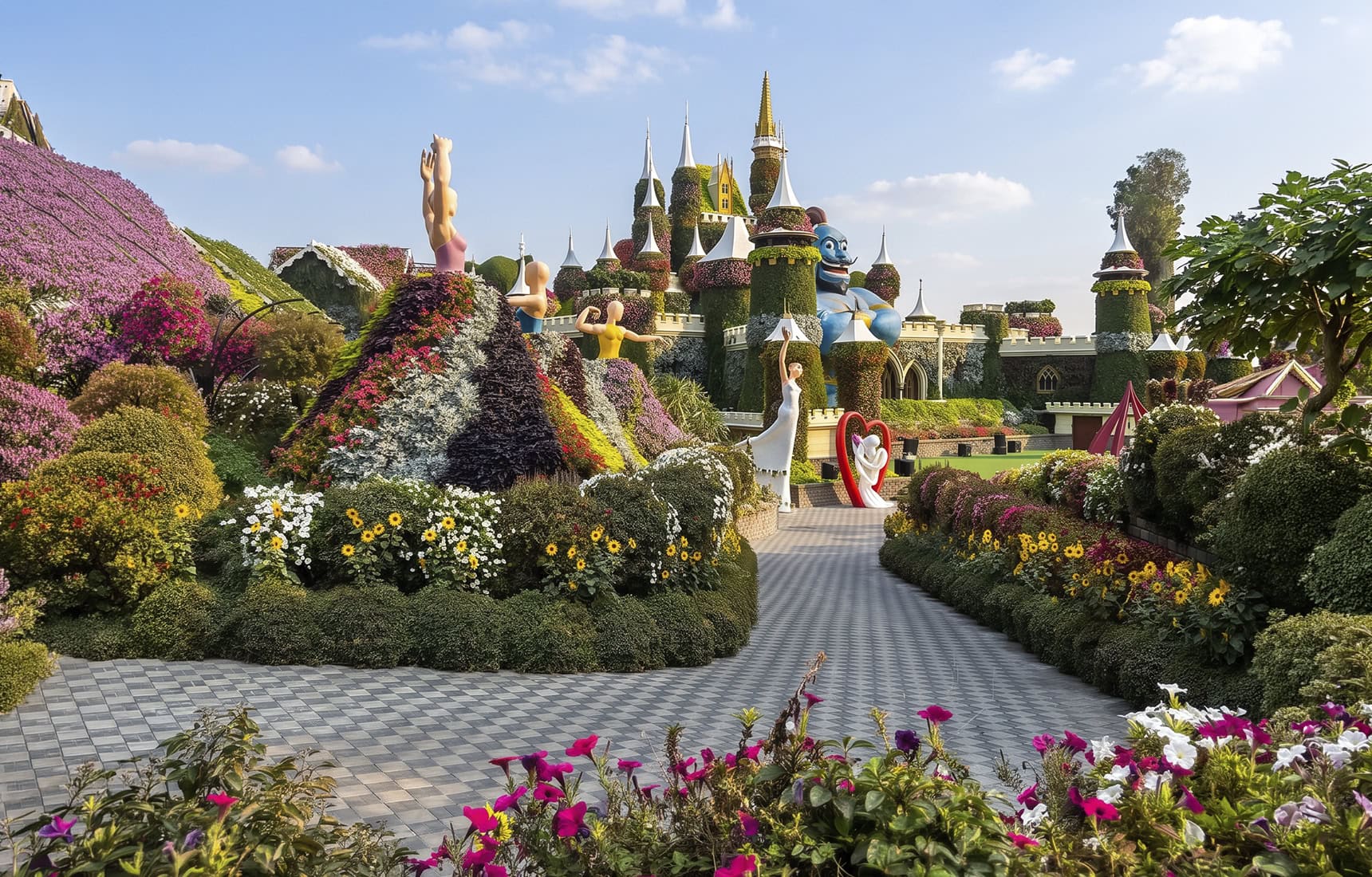
This season carries the theme “Blooming Wonders, Endless Memories,” and the refresh is real rather than cosmetic. The garden is showing more than 120 varieties of flower across some 50 displays, and it has leaned further into families than I remembered, with a new dedicated children’s zone, a rideable miniature train and bumper cars added to the mix. The old favourites remain, the Emirates A380 and its half-million blooms, the floating lady, the floral castle, the Smurfs village, the giant floral clock, but the balance of the place has shifted toward a full day out rather than a purely photographic one.
What struck me most on the return was how the garden has matured into an institution. It opened for its latest season in late September and runs through to the end of May, and it now feels less like a novelty and more like a fixture of Dubai’s winter calendar, the sort of place families measure the years by. The crowds are bigger, the programming is broader, and the ambition has, if anything, grown.

What the second visit reveals
A return visit also sharpens the eye, and what it sharpened for me was admiration. This is spectacle staged at a scale almost nothing else attempts, and the garden knows exactly what it is: generous, exuberant and built to delight. It has been true to that ambition since its first season, and it commits to it completely, which is why it works.
On its own terms, as joyful, temporary, large-scale floral theatre, it is stronger than ever, and in several ways better than I remembered. The annual reinvention keeps it fresh and surprising, and the new family attractions make it a genuine half-day rather than a quick loop with a camera. Coming back, I found I admired the discipline behind it as much as the spectacle in front of me, which is high praise indeed.

If you are planning a return, or a first visit
Practically, little has changed and all of it is easy. The garden runs seasonally, roughly late September to the end of May, closing for the summer. Current hours run to around 9pm on weekdays and later at weekends, though these shift, so check before you go. Allow two to three hours, more if you have children in tow given the new rides and zones, and aim for a weekday morning for the calmest experience and the best light.
If you have been before, go again in a different season and look for what has changed; that contrast is the most rewarding way to experience the place now. And if this is your first time, enjoy the spectacle, but know that the version you see is a one-season-only edition that will be gone and remade by the time you think to return. If this is a first visit, the earlier piece on Dubai Miracle Garden covers what the garden is, how it is built and what the records actually mean.

Final thoughts
I came back to Dubai Miracle Garden expecting a repeat and found a rethink. The flowers are as improbable and as photogenic as ever, but the deeper pleasure, second time around, is understanding what the garden actually is: not a monument but a performance, staged in petals, struck and rebuilt every year. In a city that loves permanence and record-breaking scale, there is something wonderful about a landmark that is proud to be temporary, and that quietly reinvents itself every time the temperature drops.


Leave a Reply