
Public Realm · Dubai
Reading time: 6 minGreat railway stations have always been horizontal, vast halls you move through sideways, from Grand Central to St Pancras. Dubai has decided to build one that goes up instead. At 74 metres it will be the world’s tallest train station, designed by the architects of the Burj Khalifa. In the city of the tower, even the station is conceived as a skyscraper.
Think of the world’s great train stations and you picture a room. The concourse at Grand Central, the great shed at St Pancras, the tiled canyons of Shinjuku. Stations are, almost by definition, horizontal buildings, generous halls that gather crowds and send them off sideways to the platforms.
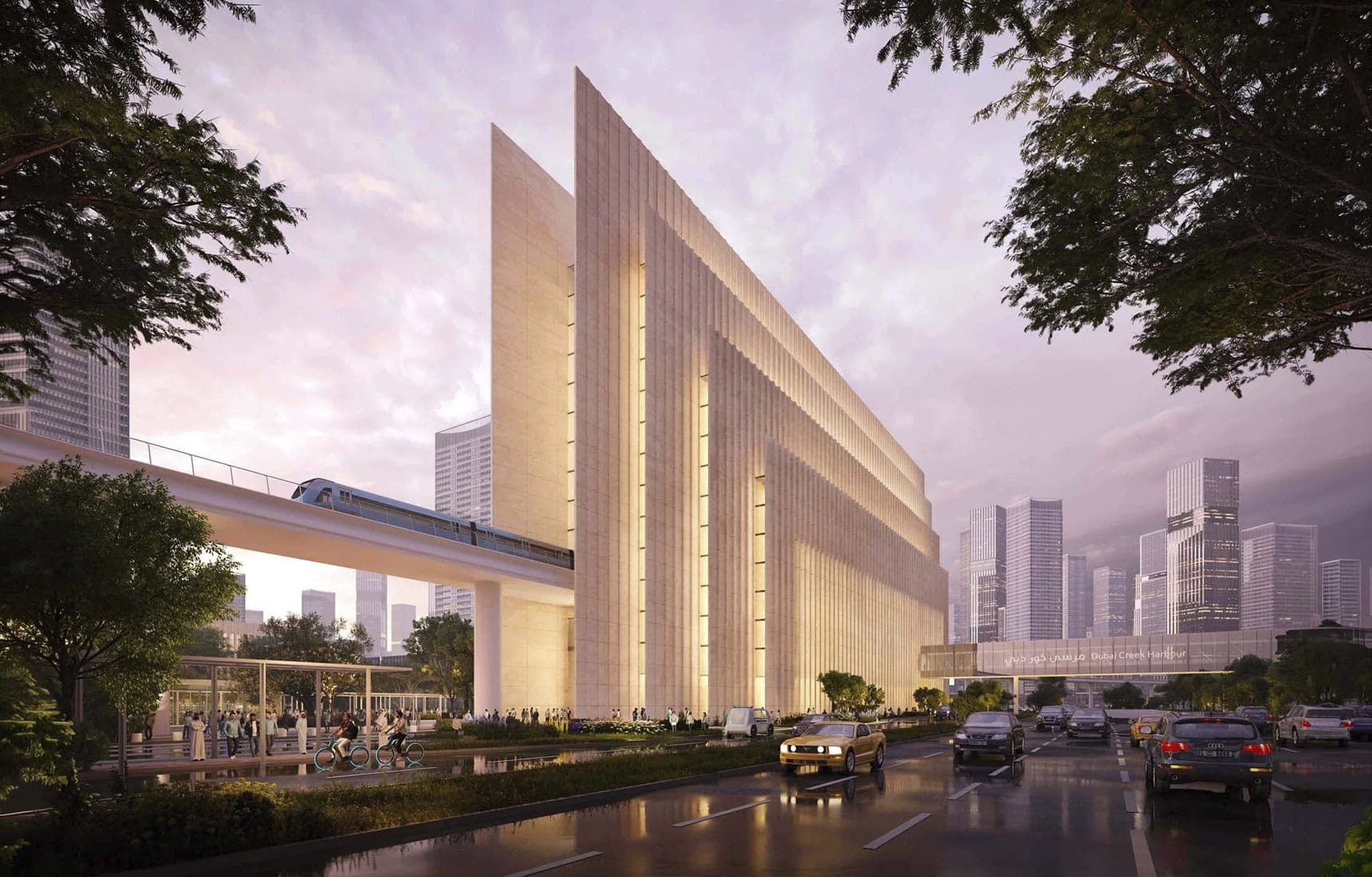
Dubai’s new Emaar Properties Station does something almost contrary. It goes up. At 74 metres, roughly the height of a 20-storey building, it is planned to be the tallest train station in the world, a record Dubai is the first city to claim. Designed by Skidmore, Owings & Merrill, the American firm behind the Burj Khalifa, and opening in 2029 as the centrepiece of the new Metro Blue Line, it takes the most horizontal building type in architecture and stands it on its end. That decision, bold and entirely characteristic of this city, is the most interesting thing about it, and it rewards a close look.

Why build a station tall?
The obvious question is the right one to start with. Why would a train station need to be 74 metres high?
The first answer is that this is Dubai, a city that has always understood a landmark as something you can see from a distance, and that measures ambition in height. The fuller answer is about place. The station sits at Dubai Creek Harbour, the emirate’s vast new waterfront district, and it is conceived as a “crossing gateway,” the front door to a whole new piece of city. A low, horizontal station would simply have disappeared among the towers around it. By rising, it becomes a marker visible across the district, a vertical sign that says here is the way in. In a landscape of skyscrapers, going tall is how a civic building holds its own and announces itself.
So the height does real work. It gives a piece of public infrastructure enough presence to function as a genuine landmark, which is a thoughtful idea and a generous one.

The right architects for a record
There is a neat logic to who was chosen, and it is worth spelling out.
Standing a building 74 metres tall and making it feel effortless is a specialised skill, and SOM may be the most experienced firm on earth at exactly that. This is the practice that designed the Burj Khalifa, the tallest building in the world, along with One World Trade Center and, decades ago, the Sears Tower in Chicago. Asking the architects of the world’s tallest building to design the world’s tallest station, in the very city where they built the former, has a pleasing rightness to it. The masters of the tall, back in Dubai, applying what they know to a new kind of record.
Their design centres on a 38-metre-wide portal of glass and stone, a great gateway that lets daylight pour into the station by day and glows like a beacon by night. The form takes its cue from the seashell, a nod to Dubai’s coastal and pearling past, and the interior is organised around the elemental language of earth, air, fire and water. The material palette is deliberately weighty and warm: Jura limestone, bronze-toned metal panels, granite floors and glass ceiling panels, chosen to soften the desert light and to age well rather than to dazzle and date. Across roughly 11,000 square metres, the station is designed to move up to 160,000 passengers a day while feeling like a place rather than a corridor.

Infrastructure treated as architecture
This is where the project earns real respect, beyond the record.
For most of the last century, public transport infrastructure was treated as pure function. A station was a machine for catching trains, and design was a luxury spent elsewhere. What Dubai is doing here, and it is doing it deliberately, is treating a metro station as a piece of architecture worth caring about, with the same seriousness usually reserved for a museum or a tower. The soaring interior, the tactile stone, the daylight channelled deep into the building to cut the need for artificial light, the careful attention to shade and comfort in a demanding climate, all of it says that the everyday act of catching a train deserves a beautiful room to do it in.
That instinct matters more than any height record. A city communicates its values through the buildings it bothers to make beautiful, and choosing to lavish design on a piece of shared public infrastructure, rather than only on private towers, is a genuinely civic gesture.

The line beneath the landmark
Beyond the tower stands the railway itself, and the Blue Line is the substance the station serves.
The new line runs about 30 kilometres and adds 14 stations, connecting districts that have grown up beyond the reach of the existing network, including Dubai International Airport, Academic City, Dubai Silicon Oasis and International City. A colossal interchange at International City, spanning some 44,000 square metres, will be the only point where multiple metro lines meet, a genuine hinge in the system. Taken together, the Blue Line is projected to carry hundreds of thousands of riders a day as the city’s population climbs towards nearly six million by 2040.
That is the serious purpose beneath the landmark. A city growing this fast invests heavily in mass transit, and the Blue Line is a decisive bet on the train over the car. Seen that way, the world’s tallest station is far more than a record. It is the most visible symbol of a much larger and very sensible commitment to moving millions of people without a car, which is the same instinct now shaping Dubai’s walkable new districts at Dubai Design District and Jebel Ali.
One very modern detail is worth noting. The station is called Emaar Properties Station because the developer Emaar bought the naming rights, for a ten-year term from the 2029 opening. It is the same commercial partnership model that now supports major stadiums and transport projects around the world.
Frequently asked questions
What is the Emaar Properties Station?
A metro station at Dubai Creek Harbour on the new Metro Blue Line, designed by SOM. At 74 metres it is planned to be the tallest train station in the world. It is due to open in 2029.
Who designed it?
Skidmore, Owings & Merrill (SOM), the firm behind the Burj Khalifa, One World Trade Center and Chicago’s Sears Tower.
Why is it so tall?
It is conceived as a “crossing gateway” and landmark for the new Dubai Creek Harbour district. Rising to 74 metres lets it stand out among the surrounding towers and mark the entrance to the area.
What is the Blue Line?
A roughly 30 kilometre extension to the Dubai Metro, adding 14 stations and connecting districts such as Dubai International Airport, Academic City, Dubai Silicon Oasis and International City, due for completion in 2029.
Why is it called Emaar Properties Station?
The developer Emaar acquired the naming rights for a ten-year period beginning at the station’s 2029 opening.

Final thoughts
The world’s tallest train station is far more than a record, and the more interesting truth sits just beneath the headline. Here is a city choosing to pour real design ambition into shared public infrastructure, and making a serious, expensive commitment to moving its people by train rather than by car. That commitment is the achievement worth celebrating.
SOM has taken the most horizontal building in the world and stood it upright, and in doing so has made a station you are meant to notice, remember and enjoy passing through. When it opens in 2029, its real achievement will not be the record on the plaque. It will be the simple, civilised idea that catching a train in the desert deserves a beautiful, light-filled, human room, and that public infrastructure is worth building as carefully as any tower. It is the same conviction behind Meraas’s d3 expansion and BIG’s Jebel Ali Racecourse masterplan.


Leave a Reply