
ART & CULTURE · MILAN
Reading time: 11 minElmgreen & Dragset built an abandoned office, a drained spa and a bunker-like home inside Fondazione Prada’s Milan campus, then set a robot dog to patrol the last of the three. The Danish-Norwegian duo have spent three decades staging fictional interiors where the people have just left the room, and Useless Bodies? was the fullest version yet, deliberately built to answer the very first exhibition this building ever held.
Fondazione Prada’s Milan campus gave over four gallery spaces, a courtyard and more than 3,000 square metres to a single question: what happens to the body once it stops being useful. Useless Bodies?, by the artist duo Elmgreen & Dragset, opened on 31 March 2022 and ran until 22 August 2022, filling the Podium, the Cisterna, the Nord Gallery and the grounds between them with an installation that read less like a series of artworks and more like a set of rooms someone had recently, urgently, left.

That is the point. Michael Elmgreen, born in Copenhagen in 1961, and Ingar Dragset, born in Trondheim in 1969, have worked together since 1995, and the device they return to more than any other is the empty interior: a home, an office, a pool, built in full and then vacated. Useless Bodies? was the largest assembly of that method Fondazione Prada had staged, and it argued something specific rather than merely atmospheric. In the artists’ own words, quoted in the exhibition’s material: “Our bodies are no longer the main agents of our existence. They don’t generate value in our societies’ advanced production methods as they did in the industrial era.”

The show’s real achievement was refusing to leave that argument abstract. Each of the four spaces took one arena in which the body still nominally matters, work, wellness, domestic life, public space, and staged the version of it with nobody actually there. And the ground floor of the Podium, the one section that put classical sculpture in the room, was not a stylistic detour. It was a direct answer to the exhibition that opened this building in the first place, seven years earlier, a connection Fondazione Prada’s own material makes explicit but that gets lost in most accounts of the show.
An office with nobody left at the desks
The Podium’s second floor became an abandoned office landscape, rows of grey workstations running back further than the room appeared to allow, evoking the geometric minimalism of 20th century office design and the bureaucratic dread of Jacques Tati’s Playtime and Terry Gilliam’s Brazil. The centrepiece was Garden of Eden (2021), thirty-five identical cubicles arranged in seven rows, a term borrowed for a landscape that offered nothing green and nothing restful. Elsewhere in the sequence stood Flint Water, a standard office water cooler filled not with mineral water but with water drawn from Flint, Michigan, the American city whose supply was poisoned by lead contamination in 2014, and It’s The Small Things in Life That Really Matter, Blah, Blah, Blah (2006), an earlier Elmgreen & Dragset piece folded into the same landscape of corporate furniture stripped of anyone using it.

The office is the space where, historically, the body’s labour still counted for something. Elmgreen & Dragset built the room to look freshly vacated rather than derelict, chairs still pushed in, monitors still upright, so the absence read as sudden rather than historic. That is a more unsettling proposition than a ruin: a ruin says the past is over, while a room this tidy says the people simply were not needed today, and perhaps will not be needed tomorrow either.

A spa built for a body under pressure to perform
The Cisterna, named for the distillery tanks that once occupied the space when the site produced gin and industrial alcohol, held three interlinked, desolate spa-like environments, a swimming pool, a changing area, treatment rooms, each drained of both water and use. The section’s central new commission, What’s Left? (2021), showed a young man clinging to a wire suspended overhead, a figure the artists describe as trying to hold on to political agency in a body that has largely lost it. Nearby, The Touch (2011) placed a life-size silicone male figure face down on a massage bench, and Too Heavy (2017) set a lacquered aluminium boulder on a trampoline, a joke about leisure and effort that reads, in this context, as considerably less light than it sounds.

The wellness industry sells the idea that the body can still be optimised, sculpted and maintained into relevance. Elmgreen & Dragset built the industry’s own architecture, the pool tile, the changing cubicle, the treatment room, and simply removed the promise. It is not the first time the pair have staged an abandoned public bathing space: in 2018 they transformed London’s Whitechapel Gallery into The Whitechapel Pool, a fictional derelict municipal swimming baths, for the exhibition This Is How We Bite Our Tongue. The Cisterna is that idea returned to, at a larger scale, inside a building whose own industrial history as a distillery gave the drained-tank aesthetic an unusually literal foundation to build on.

A fictional home patrolled by a robot dog
The Nord Gallery, roughly 585 square metres, became the show’s most fully realised fiction: a domestic interior that read simultaneously as bunker, spacecraft and laboratory. Dragset described the ambiguity directly: “I don’t know if this home resembles a bomb shelter or a spaceship. But for the rich, it will of course be one or the other in the future.” Elmgreen located the discomfort in a familiar contemporary habit, the tendency to arrange a home for how it photographs rather than how it is lived in: “It’s a comment on people arranging their domestic space into more of a showroom than a place for recreation. Everything is extremely uncomfortable, but it looks really good.”

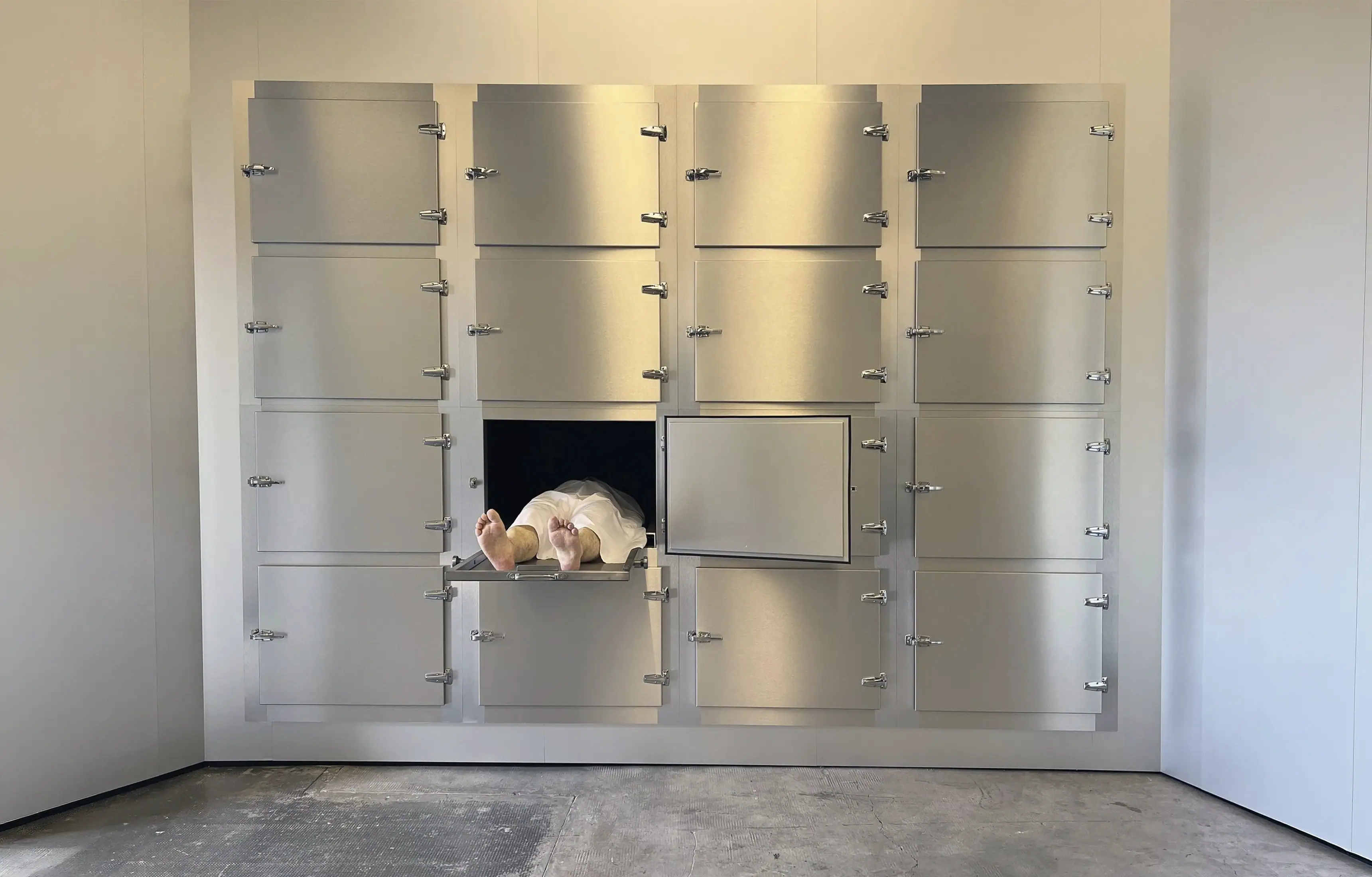
Visitors moved through the space like detectives working a scene rather than guests in a home. A Unitree A1 robot dog, the kind of quadruped robot increasingly used for industrial inspection, patrolled the rooms, walking and wagging on cue, the only moving body in an otherwise still interior. Around it sat a set of quietly disquieting works: Untitled (After the Lovers) (2015), two shrouded heads locked in a kiss; Looking Back (2022), a miniature easel fitted with a peephole that reveals a single watching eye; The Bed (2019), an egg-shaped silver vessel scaled for a smartphone rather than a body; and Untitled (2011), a bank of mortuary drawers with a silicone corpse’s bare feet visible at the edge of one. Elmgreen was direct about that last work’s logic: “This is the only real democratic thing in our whole way of living. It doesn’t really matter how rich or powerful you are, this is what you’ll look like in the end.” A home built for surveillance, a body reduced to feet in a drawer, and a dog that is the only thing in the room still capable of movement: the Nord Gallery stated the exhibition’s thesis more bluntly than any wall text needed to.

The ground floor was built to answer the building’s first show
The Podium’s ground floor was the one room in Useless Bodies? that did not invent a fictional interior. Instead it placed Elmgreen & Dragset’s contemporary sculptures of the male body directly alongside classical and neoclassical figures, a straightforward juxtaposition of ancient and current representations of the human form.

That pairing was not a stylistic choice made in isolation. Fondazione Prada’s own account of the exhibition states plainly that the room was inspired by Serial Classic, the exhibition that opened this exact Milan campus to the public on 9 May 2015, curated by the classical archaeologist Salvatore Settis with Anna Anguissola, and designed, in its physical layout, by Rem Koolhaas. Serial Classic examined how Roman sculptors serially copied and adapted Greek originals, using the Podium to stage its own confrontation between original and copy. Seven years later, in the same room, the same building, Elmgreen & Dragset restaged that confrontation with a different pairing: not Greek against Roman, but historical sculpture against a contemporary practice asking whether the body still needs representing at all. It is a connection Fondazione Prada draws explicitly in its own material and one that almost nobody writing about the show at the time carried through: Useless Bodies? was not simply installed in this building, it was built to talk back to the exhibition that opened it.

That the building’s architect on that first show was Koolhaas matters for the wider campus too. Fondazione Prada’s Milan site is a former distillery, the Società Italiana Spiriti complex, dating to the early 20th century, which OMA converted into the foundation’s permanent home, retaining the original industrial structures, the Podium and the Cisterna among them, while adding new elements including the gold-leafed Haunted House and the later Torre tower. Useless Bodies? is a show about bodies losing their productive function staged inside a campus built from a factory that once had a very specific productive function of its own. The exhibition does not point at that irony directly, but the Podium ground floor, answering the room’s own opening exhibition, is the moment the show is clearly aware of exactly where it is standing.

A courtyard of objects that no longer quite work
Outside, across the campus’s outdoor spaces, Elmgreen & Dragset placed a series of sculptures built from ordinary public objects, benches, fixtures, everyday street furniture, each altered in some small, specific way that renders it unusable. The alterations are deliberately subtle rather than dramatic: an object that still looks entirely functional at a glance, until a visitor tries to use it as intended. The intention, consistent with the artists’ long-running interest in public space, is to make visible the quiet mechanisms of control built into supposedly neutral street furniture, the bench designed to prevent lying down, the fixture designed to discourage lingering, translated here into a set of pieces that fail their function on purpose rather than by accident.

Two artists who have spent thirty years building rooms without their occupants
Useless Bodies? was the culmination of a method Elmgreen & Dragset have been refining since the mid 1990s. The pair are best known internationally for Prada Marfa (2005), a permanent, non-functioning replica Prada boutique built on an empty stretch of highway outside Marfa, Texas, stocked with real Prada stock from that season and left to weather in the desert, maintained today by the nonprofit Ballroom Marfa. It remains one of the most photographed pieces of public art in America, and it works on exactly the logic that runs through Useless Bodies?: a space built for a specific human transaction, retail, with no possibility of that transaction actually happening.

Their institutional history runs deep. In 2009 the duo represented both the Danish and Nordic Pavilions at the 53rd Venice Biennale with The Collectors, staging two fictional private art collections, one belonging to a recently deceased architect, and received a special mention from the jury. In 2012 they took the Fourth Plinth in London’s Trafalgar Square with a gilded bronze boy on a rocking horse, a monument-scaled work that quietly asked what public statuary is actually for. In 2013 the Victoria and Albert Museum in London staged Tomorrow, a full-scale fictional apartment belonging to an imagined bankrupt architect whose possessions were being sold off, the exhibition rooms built and dressed as a real flat rather than displayed as objects on plinths. That device, a complete fictional interior a visitor walks through as though it were real, is the direct ancestor of the Nord Gallery’s bunker-home nine years later. In 2017 the pair curated the 15th Istanbul Biennial, titled a good neighbour, extending their interest in domestic space and public life to an entire city-wide programme. In 2018 came This Is How We Bite Our Tongue at the Whitechapel Gallery, which built the fictional Whitechapel Pool inside the gallery, the direct precursor to the Cisterna’s drained spa. The duo now live and work in Berlin.

Final thoughts
It would be easy to describe Useless Bodies? as an exhibition about anxiety, a set of unsettling rooms about a body losing ground to automation and screens. That reading is not wrong, but it undersells what Elmgreen & Dragset actually built. Every space in the show, the office, the spa, the home, the street, is a real, specific piece of architecture that the body used to define and that now, deliberately, defines without it.

The strongest evidence of how carefully the show was constructed sits in the one room that looks, at first glance, the least conceptual: the Podium ground floor, with its classical statues standing next to contemporary sculpture. That pairing is not decoration. It is Elmgreen & Dragset answering, in the same room, the exhibition that opened this building seven years earlier, closing a loop between Fondazione Prada’s founding thesis about how bodies get represented and its own 2022 argument about whether they need representing at all.

Useless Bodies? worked because two artists who have spent three decades building fictional interiors, a Texas boutique nobody can shop in, a bankrupt architect’s flat at the V&A, a derelict pool at the Whitechapel, finally had the scale to build four of them at once, under one roof, in dialogue with the building’s own history as both a distillery and an art foundation. The body was absent from every room. The argument was in exactly how carefully each room had been built to miss it.

What was Useless Bodies? about?
Useless Bodies? was an exhibition by the artist duo Elmgreen & Dragset at Fondazione Prada, Milan, examining how the human body has lost its central economic and social role in the post-industrial, digital era, particularly after the COVID-19 pandemic.
Where and when did it take place?
It was staged across the Podium, the Nord Gallery, the Cisterna and the courtyard of Fondazione Prada’s permanent Milan campus, opening on 31 March 2022 and closing on 22 August 2022.
Who are Elmgreen & Dragset?
Michael Elmgreen, born in Copenhagen in 1961, and Ingar Dragset, born in Trondheim in 1969, are a Scandinavian artist duo who have worked together since 1995 and are based in Berlin. They are known for Prada Marfa in Texas, the 2012 Fourth Plinth commission in London and the 2013 exhibition Tomorrow at the Victoria and Albert Museum.
What was in the Nord Gallery, and what was the robot dog?
The Nord Gallery housed a fictional domestic interior resembling a bunker, spacecraft and laboratory, patrolled by a Unitree A1 robot dog. Works on show included Untitled (After the Lovers), Looking Back, The Bed and a mortuary-drawer installation titled Untitled.
What happened in the Cisterna?
The Cisterna, named for the site’s former distillery tanks, held three drained, spa-like environments including a pool and changing rooms, centred on the new commission What’s Left?, alongside The Touch and Too Heavy.
Does the exhibition connect to any earlier Fondazione Prada show?
Yes. The Podium ground floor, which paired classical sculpture with contemporary work, was explicitly conceived as a response to Serial Classic, the exhibition curated by Salvatore Settis with Anna Anguissola and designed by Rem Koolhaas that opened this same Milan campus to the public on 9 May 2015.
Can Useless Bodies? still be visited?
No. The exhibition closed on 22 August 2022. Fondazione Prada continues to programme its Milan campus with rotating exhibitions across the same spaces.





Leave a Reply