

Restaurant interiors
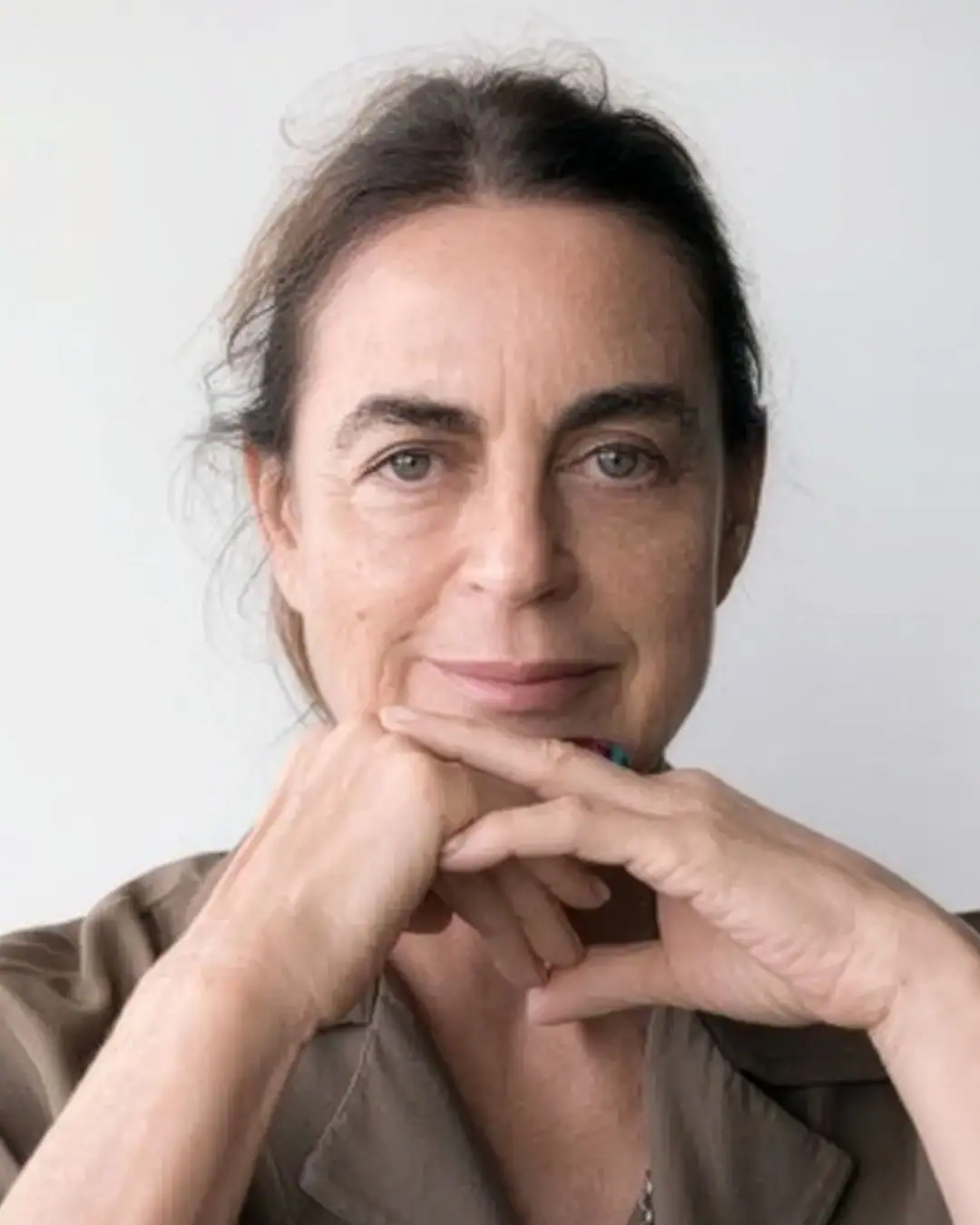
Reading time: 9 minEpoca has been called Art Deco, Belle Époque and a 1930s Paris bistro, sometimes in the same article. That disagreement is the most accurate thing anyone has said about the room, because Émilie Bonaventure is a trained art historian who composes from several periods rather than reproducing one.
Epoca opened at 17 rue Oudinot in the 7th arrondissement of Paris in October 2017. It is an Italian restaurant, the second Paris address of the Calabrian chef Denny Imbroisi after IDA in the 15th, and it is still trading in 2026. The interiors are by Émilie Bonaventure.
The room is small, organised around a central marble bar, and built from a very short list of decisions: a mustard ceiling, black and white stripes, honey velvet, black lacquer and opaline glass. It is the kind of interior that gets filed under Art Deco and left there.
That filing is worth arguing with, because the person who made it spent years in the twentieth-century design gallery trade and knows precisely which decade each of those elements belongs to. She is not quoting a period. She is assembling several, and the assembly is the design.

First, a correction: this is not a Frenchie project
It is easy to connect Epoca to Grégory Marchand, because Bonaventure has designed most of the Frenchie group. She did Frenchie on rue du Nil in 2015, Frenchie Covent Garden in 2016, the Frenchie Bar à Vin and Frenchie To Go in 2018, and L’Altro Frenchie on rue du Nil in 2023 to 2024.
Epoca is not one of them. It belongs to Denny Imbroisi, and the only link between the two restaurants is the designer herself, working for two different chefs independently.
There is a neat symmetry in that, though. Bonaventure designed an Italian restaurant in Paris for Imbroisi in 2017, and then, seven years later, an Italian restaurant in Paris for Marchand. L’Altro Frenchie is a forty-cover cucina povera room. Epoca is a bistro. Two Italian briefs, two entirely different answers, one designer.

The designer is an art historian
This is the fact that explains the work, and it is almost never mentioned.
Émilie Bonaventure was born near Lake Annecy into an Italian family, chose applied arts at fifteen against her teachers’ advice, studied at Antibes, and then read art history at the École du Louvre, specialising in twentieth-century decorative arts. She worked in an antiques shop through her studies, was a gallery assistant to Antoine Broccardo, whom she calls her godfather, and began her career at the Galerie Jacques Lacoste in Paris, the pre-eminent dealer in Jean Royère. She then worked at the agency of Chahan Minassian.
She founded her studio, be-attitude, in 2005, at twenty-seven. It runs, in her own description, at a family scale, working closely with artisans, and she is in business with her mother Isabelle, who handles the commercial side. She works from Pigalle and lives in the 9th.
The detail that matters most: her one documented award, at Paris Art + Design in 2008, was for a gallery stand, not for an interior. She won it for the scenography of the Galerie Jacques Lacoste’s presentation at PAD. She describes herself as a decorator-scenographer and art director, and she has said of Frenchie Covent Garden that she configured it so that it could be reconfigured like a theatre set, with the art and décor rotated.
So the training is curatorial and the method is theatrical. She hangs a room the way a specialist hangs a show, and she chooses each object knowing its provenance. On her own taste she is precise rather than vague: “I adore Jean Royère’s Liane light for its organic dimension.” On the discipline itself: “It is a job of orchestration.”

Art Deco or Belle Époque
The published descriptions of Epoca do not agree with each other. One French title calls it a Belle Époque interior in its headline and Art Deco in its text. Others call it an Art Deco bistro straight out of the Cinecittà studios, or simply a Paris bistro of the 1930s.
Those are not the same thing. Belle Époque runs roughly from 1871 to 1914 and gives you the brass, the opaline globes, the mirrors, the mosaic floor and the marble counter of a Paris café. Art Deco belongs to the 1920s and 1930s and gives you the geometry, the black lacquer, the bold stripe and the flat graphic confidence. The Cinecittà reference is different again, and later, pointing at Italian cinema of the 1950s and 1960s.
Epoca contains all three, deliberately. The bar, the mosaic, the opaline and the brass are Belle Époque grammar. The stripes, the lacquer and the geometric floor are Deco. The mustard ceiling and the graphic confidence of the whole thing lean cinematic. This is not confusion, and it is not pastiche either, because pastiche would pick one period and copy it faithfully.
It is what a scenographer does. Set designers do not reconstruct a year; they build a register that reads as a place. Epoca reads as an Italian room in Paris seen through a French bistro grammar, which is exactly what it is.

The room
The palette is very short: ochre, mustard and bronze, worked against black and white.
The ceiling is mustard, and it is the most important surface in the room. Colour overhead does two things in a small dining room. It draws the eye upward, which makes a modest floor plate feel taller than it is, and it throws warm reflected light down onto faces, which no amount of lamp specification will replicate.
The walls carry large-scale black and white striped wallpaper across the middle band, with black panelling below. That division is doing real work. The dark lower half absorbs the scuffs and shadows of a working restaurant, the stripe sits at eye level where it registers, and the ceiling colour finishes the wall above it. Three bands, three jobs.
The floor is mosaic and marble, laid in geometric black and white, so the ground and the walls share a language without repeating a pattern.
At the centre is a marble bar, used as an aperitivo counter, with striped tiling wrapping the base so the stripe travels from the wall down into the plan. It is served by black bar stools, and the bar top carries half-globe uplighters.
Seating is honey velvet banquettes with black piping, against black-lacquered tables. Chairs are described in one account as black metal and in others as wooden bistro chairs, which is not settled by the published record.
Lighting is the Belle Époque note held throughout: opaline glass globes with brass fittings in several forms, including five-globe chandeliers over the dining areas. Period mirrors do the rest of the reflective work.

The washroom
Bonaventure treats the lavatory as a room in its own right, and at Epoca she gives it the biggest tonal shift in the building.
The golden tones of the dining room are replaced by a rich mocha brown, which makes the brass fixtures read as gold rather than as yellow. Black tiles, a black work surface, a black basin and decorative curtains carry the main room’s black through into the smaller space.
The logic is sound. A washroom is the only room in a restaurant that a guest experiences alone, without a table, a companion or a menu to look at, so it is the one place where the interior gets someone’s complete attention for thirty seconds. Darkening it also resets the eye, so that the dining room reads brighter on the way back than it did on the way in.

The tableware and the menu
The scheme extends onto the table, which is where a scenographer’s habits show.
Cutlery is stainless steel. Plates are white faïence with black borders, which is the room’s black and white stripe reduced to its smallest possible statement and set down in front of every guest. The menu is designed as a special edition of the Corriere della Sera, so the graphic identity carries the Italian half of the brief while the room carries the French half.
That division is the sharpest idea in the project. The architecture is a Paris bistro. The tableware, the menu and the food are Italian. Neither side has to compromise, and the guest experiences the fusion rather than being shown it.
Bonaventure’s other rooms
Her portfolio is more coherent than a list of restaurants suggests, and one strand deserves far more attention than it gets: she is the designer of Paris’s museum cafés.
She has done Rose Bakery six times, at Le Bon Marché in 2013, twice in the 9th arrondissement in 2016, at the Musée de la Vie Romantique in 2018, the Maison de Balzac in 2019, the Jeu de Paume in 2021 and the Bibliothèque nationale de France in 2022. That is a body of work inside French cultural institutions that almost nobody has written about as a body of work.
Elsewhere: Paul on rue de Buci in 2020, along with the architectural identity for the brand’s boutiques internationally; Le 1903 for the chef Jean Sulpice at Talloires in 2022; deluxe suites at the Auberge du Père Bise, also for Sulpice, in 2019 and 2022; and Belle Maison in the 9th in 2016. Her own favourite among her projects is a private apartment, Talma in the 9th, from 2020. In April 2015 she opened Personnel & Friends on rue Milton, part shop, part gallery, part showroom, divided between her own selections and her collaborators’ work.
On how she picks a job, she is unambiguous: “What makes me choose a project is the people. It is extremely important to have shared values, a rapport. There has to be meaning, that is very important to me.”

Frequently asked questions
Who designed Epoca in Paris?
Émilie Bonaventure, the Paris decorator-scenographer who founded her studio be-attitude in 2005. The interiors were photographed by Rina Nurra.
Where is Epoca and whose restaurant is it?
17 rue Oudinot in the 7th arrondissement. It is the Italian restaurant of the chef Denny Imbroisi, his second Paris address after IDA in the 15th, and it opened in October 2017. It is not connected to Frenchie or to Grégory Marchand.
Is Epoca still open?
Yes, it is still trading in 2026. Published opening hours vary between sources, so it is worth calling the restaurant directly.
What style is the interior?
It draws on more than one period. The marble bar, mosaic floor, brass and opaline globes are Belle Époque café grammar; the stripes, black lacquer and geometric flooring are Art Deco; and the overall graphic confidence has been compared to Italian cinema. The room composes from several registers rather than reproducing one.
What is the interior made of?
A mustard ceiling, large-scale black and white striped wallpaper with black panelling below, mosaic and marble flooring in geometric black and white, a marble aperitivo bar with striped tiling around it, honey velvet banquettes with black piping, black-lacquered tables, opaline glass globe lights with brass fittings including five-globe chandeliers, and period mirrors.
What else has Émilie Bonaventure designed?
Most of the Frenchie group for Grégory Marchand, including Frenchie Covent Garden in London in 2016 and L’Altro Frenchie in Paris; six Rose Bakery sites including those at the Jeu de Paume, the Maison de Balzac, the Musée de la Vie Romantique and the Bibliothèque nationale de France; Le 1903 and suites at the Auberge du Père Bise for Jean Sulpice; and Paul on rue de Buci.
What is her background?
Art history at the École du Louvre, specialising in twentieth-century decorative arts, after applied arts at Antibes. She worked in the antiques and design gallery trade, including at the Galerie Jacques Lacoste, and won a prize at Paris Art + Design in 2008 for a gallery stand rather than for an interior.

Final thoughts
Epoca is a useful corrective to the way period interiors usually get discussed. The question is almost never whether a room is “authentically” of its period, because almost none of them are. The question is whether the person assembling the references knows what they are handling.
Bonaventure does, and it shows in the restraint. There are perhaps eight decisions in this room. A mustard ceiling, a stripe at eye level, black below, a marble bar, honey velvet, black lacquer, opaline and brass, and a black-bordered plate. Everything else follows from those. Knowing exactly where each reference comes from is what allows the list to stay that short.
The gap in the record is the making. Not one supplier, artisan, vintage dealer or fabricator is named anywhere for this project, which for a designer whose whole practice is built on working closely with artisans is a considerable omission, and one only she can fill.

Leave a Reply