
Interiors · California
Reading time: 7 minNearly a century after it first opened, the 1926 Fairmont Breakers Long Beach returns as one of Southern California’s most compelling hotel restorations — a heritage landmark reimagined by HBA San Francisco with coastal-inspired interiors, storied dining rooms and a new benchmark for luxury in the city.
Some buildings carry their history lightly; others wear it like a signature. The Fairmont Breakers Long Beach has always belonged firmly to the second category. Since 1926, its Renaissance Revival silhouette has anchored East Ocean Boulevard, a full-block presence that once placed Long Beach at the glamorous centre of Southern Californian life. Hollywood royalty passed through its doors — Elizabeth Taylor, Cary Grant and Clark Gable among them — alongside sporting legends like Babe Ruth and the celebrated aviators of the era, each adding a layer of stardust to an already glittering reputation.
Then, like so many grand hotels of its generation, it waited for the right next chapter. Which is precisely why its return matters. Following a transformative restoration led by HBA San Francisco, working alongside RVD Associates and Eden For Your World, the Breakers has re-emerged not as a museum piece but as a living, breathing hotel once again, a masterpiece of coastal modernity rooted in heritage. Long Beach has seen its share of architectural revivals, and this one feels like a turning point, for the city and for the wider story of heritage hospitality in California.


Honouring a Century of Stories
To understand the Breakers today, you have to begin with what came before. The original building, designed by Walker & Eisen, gave Long Beach one of its defining architectural moments: a hotel conceived as an event, from its grand arrival sequence to its rooftop evenings above the Pacific.
There is a wider context here, too. Long Beach has spent the past decade quietly rebuilding its cultural confidence, and the return of its most storied hotel gives that renewal a centrepiece. Grand hotels have always functioned as a city’s front parlour — the place where its self-image is performed — and for nearly a century the Breakers played that role for Long Beach. Its restoration is therefore as much a civic gesture as a commercial one.

HBA’s approach treats that legacy with genuine care rather than nostalgia. Exterior storefronts and period-specific windows have been faithfully reinstated, and transoms sealed during earlier seismic works have been reopened, drawing daylight deep into the interiors as it did a century ago. Inside, original plaster mouldings and restored ceiling heights recover the building’s true proportions, while smaller survivors — including the historic lobby mailbox — remain in place as quiet touchstones of 1926.
What impresses me most about this strand of the project is its discipline. Restoration of this kind rewards a light hand, protecting the very patina that gives a landmark its soul. Here, the heritage details are preserved not as relics behind glass, but as living components of a hotel that intends to be used, enjoyed and inhabited.

The Ocean as Muse
Rather than simply recreating the past, HBA takes a more evocative route: designing with the ocean itself as muse. Deep blues, warm golds and shimmering metallics thread through the interiors, capturing the play of sunlight on water and anchoring the guest experience in the building’s coastal DNA.
It is a palette that behaves less like decoration and more like narration. Subtle, reflective and undeniably Californian, it carries guests from the moment of arrival through to the rooftop, shifting in intensity from space to space while holding the whole experience together. In a building with this much history, that kind of connective thread is what makes the whole read as a single, coherent piece of design.
“The goal was to respect the legacy of the building while taking a modern approach to breathe new life into it.”
RODRIGO VARGAS, RVD ASSOCIATES
A Lobby That Reanimates the Roaring Twenties
Stepping into the restored lobby feels like walking into a conversation between decades. HBA describes the space in terms of poetic symmetry, and the phrase fits: polished marble floors, sculptural furnishings and soft-spoken hues temper the building’s 1920s opulence with a distinctly modern restraint.
At the centre of it all, a bronze-mirrored reception desk shimmers beneath a magnificent chandelier, an unapologetic nod to Jazz Age glamour that feels wholly celebratory. It is at once familiar and reimagined, and it sets the tone for everything that follows: refined, cinematic and unmistakably Fairmont.

Guest Rooms and Suites as Warm Sanctuaries
The hotel’s 185 guest rooms and 22 suites continue the coastal narrative at a more intimate register. Here, the deep blues meet tactile furnishings and sunlit metallic accents, creating rooms that feel like warm sanctuaries rather than showpieces. Many of the suites frame ocean vistas through generous windows, blurring the threshold between interior comfort and coastal landscape in a way that recalls the building’s original promise: the Pacific, always present, always part of the room.
The balance is finely judged. These are spaces confident enough to be quiet, letting texture, light and view do the work while the hotel’s more theatrical moments are saved for its public spaces.

The Sky Room, La Sala and Nettuno
And theatrical moments there are. The Breakers’ bars and restaurants have each been given a distinct personality, forming a constellation of venues that feel connected yet delightfully diverse.
The most storied of them is The Sky Room, revived from its 1938 origins as a glamorous dining experience above the city. Its return reasserts one of Southern California’s genuinely iconic settings — a room where the region’s golden-age mythology was partly written, now restored to the centre of Long Beach’s social life.
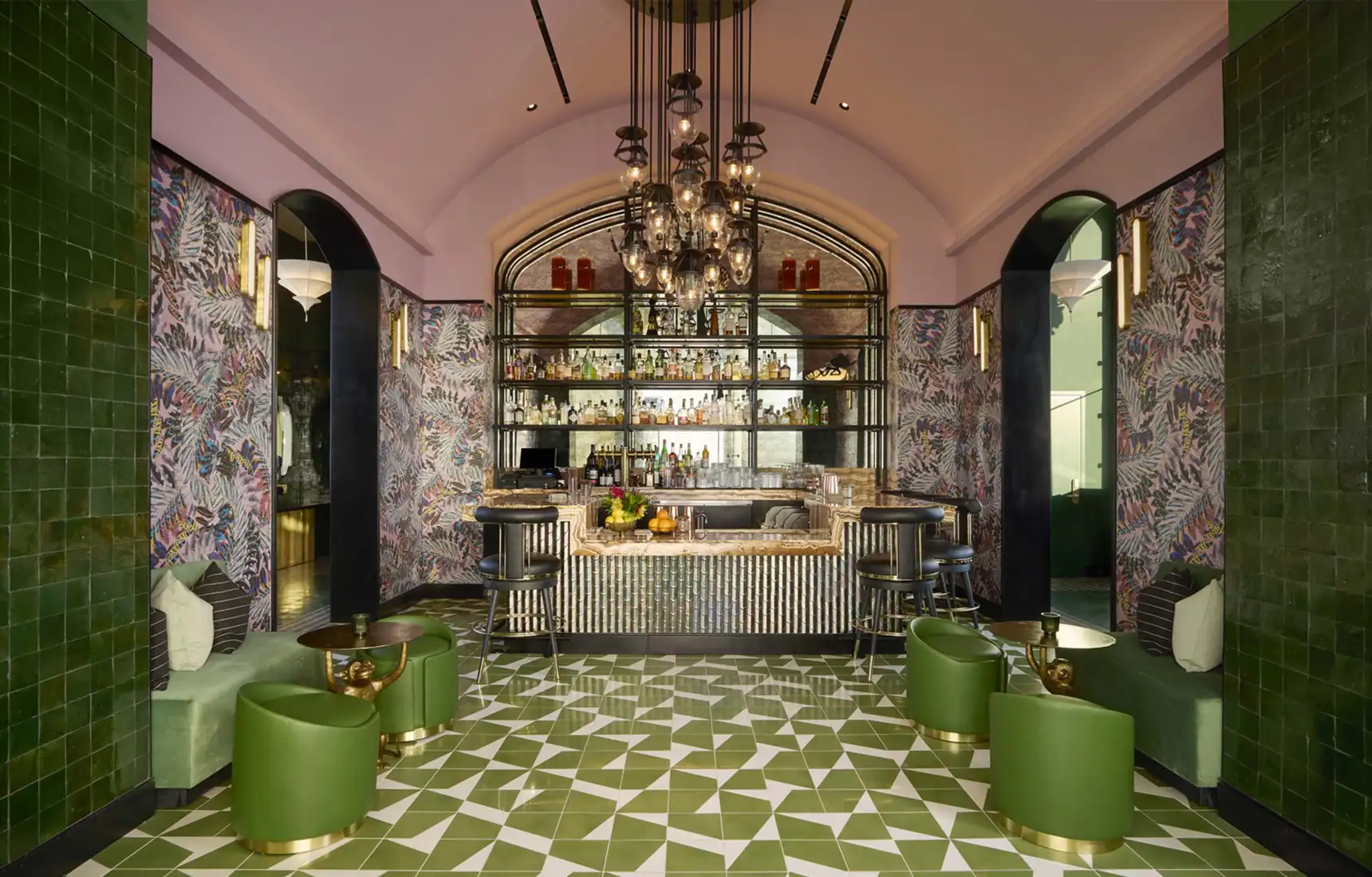
La Sala Bar takes a more playful register, embracing jewel tones, whimsical palm chandeliers and mosaic flooring reminiscent of water in motion. It is a space that entertains with genuine wit and polish. Nettuno, meanwhile, offers Italian elegance infused with casual Californian charm, its warm and welcoming palette making it the everyday heart of the hotel’s dining.
Taken together, the three venues demonstrate one of the project’s quiet strengths: a willingness to let each space shift in mood and meaning while remaining recognisably part of the same story.

A New Benchmark for Wellness and Leisure
The restoration also extends the Breakers’ offer well beyond its historic footprint of glamour. The hotel now houses Long Beach’s only luxury spa, alongside a two-storey fitness centre, a shimmering rooftop pool and a panoramic bar with views across the city and coastline.
What distinguishes these additions is how thoughtfully they are integrated into the building’s architectural legacy. Nothing feels bolted on. Instead, the wellness and leisure spaces read as the natural next chapter for a hotel that has always traded on the promise of escape — redefining what luxury hospitality can look like in the city without breaking faith with the building that hosts it.


Materiality: A Dialogue Between Past and Present
Perhaps HBA’s finest work here is in its handling of materiality. Restored plasterwork and columns preserve the essence of 1926; sculptural furnishings introduce a contemporary softness; stone and metal detailing adds depth and textural richness throughout. The result is an interplay of historic texture and modern refinement that establishes a rhythm across the hotel — raw yet polished, nostalgic yet new.
This, for me, is the lesson of the Breakers. Heritage projects are made by their materials. Handled with the care HBA has shown here, history becomes something you can actually touch. It is telling that the most memorable moments in the hotel are rarely the grandest: the cool weight of restored marble underfoot, the glint of bronze against original plaster, the way daylight now falls through reopened transoms exactly as it did a hundred years ago.


Respect and Reinvention
Rodrigo Vargas of RVD Associates captures the project’s ethos succinctly: the goal was to respect the legacy of the building while taking a modern approach to breathe new life into it. It is a simple statement that conceals an enormous amount of restraint, judgement and craft — and the industry has taken notice, with the project quickly earning multiple wins and finalist positions across global hospitality design awards.
That recognition feels deserved. The Breakers demonstrates a maturity in American heritage hospitality to match the finest European projects: the confidence to let a building’s history lead, and the skill to know exactly where the contemporary layer belongs.

A Landmark Reclaimed for the Next Century
The revival of the Fairmont Breakers Long Beach is more than a restoration; it is a reclaiming of identity. A building once alive with celebrity escapades, aviation milestones and glittering rooftop evenings hums with life once again — and this time, its glamour is built to last.
In its renewed form, the Breakers stands as a benchmark for what heritage hospitality can be: immersive, expressive, deeply rooted and yet unmistakably modern. It is a story of architecture, memory and the enduring power of place, told beautifully through HBA’s lens. The Breakers has always been a place of arrival. Today, that sentiment feels truer than ever.


Leave a Reply