
Design travel
Reading time: 12 minSixty acres of formal garden on the Thames at East Molesey carry the longest continuous design commission in Britain. Five hundred years of designers have worked the same ground, and the newest of them is the first to be handed a brief written by the weather rather than by a monarch.
Most great gardens are the work of one hand and one moment. Hampton Court is the opposite. It is a site that has been designed, redesigned, abandoned, argued over, excavated and designed again by a run of named practitioners stretching from a Kingston carver of heraldic beasts in the 1530s to a Hampshire garden designer working on a no dig planting scheme in 2025.
That continuity is the thing worth looking at. The 60 acres of formal gardens inside a 750 acre estate are not a single composition but a stratigraphy, and every layer was somebody’s design decision. Some layers were removed on purpose. Some survive because a king died before the demolition order could be carried out. The pleasure of the place, once you know the sequence, is being able to read which is which.
Historic Royal Palaces manages the whole of it as an independent charity. The palace is Grade I listed, the registered park and garden is Grade I on its own separate entry, and the gardens team runs to 42 gardeners and 60 volunteers raising more than 100,000 plants a year in the glasshouses. It is a working horticultural operation carrying a heritage brief, and in the last two years those two things have been asked to meet in public.

Henry VIII built a garden out of joinery, not planting
The Privy Garden of 1535 to 1538 would look wrong to a modern eye, because the design was carried in painted timber rather than in plants. Accounts record 180 wooden posts, 96 stanchions and 960 yards of rail, painted in the Tudor livery of white and green. On top of the posts sat carved and gilded heraldic beasts, made by Harry Corantt of Kingston, a maker whose name survives when far grander contributors to the palace do not.
The planting between all this structure was low and secondary. The garden was a three dimensional badge, read from the windows above as an assertion of ownership. To the west stood the Mount, a forty foot artificial hill crowned by the Great Round Arbour, a glazed timber banqueting structure that made a viewing platform out of a piece of landscape sculpture. Elizabeth I added a Stove House in 1570 to 1571, an early experiment in growing under heat.
Almost none of it survives above ground. The Tudor Long Gallery, 91 metres long and built between 1515 and 1525, was demolished in 1689. Of the enormous Tiltyard complex only the South East Tiltyard Tower still stands. The fullest visual record of the Tudor garden is Anthonis van den Wijngaerde’s panorama of 1558, which is why every subsequent recreation on this site has depended on drawings rather than remains.
The one modern piece of Tudor design here is deliberately declared as such. Todd Longstaffe-Gowan’s Chapel Court garden of 2009 sets eight “Kyngs beestes” on painted posts in a knot layout, a scholarly reconstruction presented as an interpretation rather than as a survival.
William and Mary bought a French garden and put it on a Thames terrace
The Baroque reworking from 1689 is the layer that still governs how you move through the site. Sir Christopher Wren was Surveyor of Works and William Talman was master of works on the buildings. On the ground, the executing gardeners were George London and Henry Wise, the most productive nursery partnership in England, and the parterre design is credited to the Huguenot designer Daniel Marot, who brought the vocabulary of the French court garden with him.
The Great Fountain Garden is the result: a vast semicircular parterre on the East Front, its beds cut as broderie and set with 13 fountains, from which three avenues radiate in a patte d’oie, the goose foot plan that pulls the eye out into Home Park. The central axis runs down the Long Water, a canal dug in 1661 to 1662 under Adrian May for Charles II, possibly to designs by André Mollet. John Evelyn recorded it in his diary in 1662, which fixes the completion window.
The best design decision on the site is the least visible. In 1701 the Privy Garden was lowered by roughly eight feet, an earth moving operation carried out purely so that the view from the King’s Apartments would clear the terrace wall and run to the Thames. It is a sightline bought with excavation, and it tells you exactly how these gardens were valued: £100,000 went into them in thirteen years.
Jean Tijou made the wrought iron screens that close the Privy Garden at the river end, twelve panels of ironwork that are among the finest of their date anywhere. Robert Balle supplied statuary from Livorno and John van Nost made the sundials. 2,000 tulips went in.
The whole scheme lasted barely a year in its finished form. Queen Anne swept the fountains out of the Great Fountain Garden in 1702 and had the box uprooted because she disliked the smell of it. Queen Caroline moved the Tijou screens in 1731. Nothing at Hampton Court stays as designed.

The Maze is the last fragment of a garden that no longer exists
Around 1700, London and Wise laid out a hedge maze for William III within the Wilderness, the formal bosquet of hornbeam and elm north of the palace. The Wilderness itself has since gone soft, replanted through the twentieth century with mass bulbs. The Maze is what remains of the original geometry.
It is a trapezoid of about a third of an acre, and it is multicursal, meaning it has choices and dead ends rather than a single winding path. That distinction matters. A unicursal maze is a contemplative device with no decisions in it. A multicursal one is a game, and building a game into a royal pleasure ground in 1700 was a genuine shift in what a garden was for. The average walk to the centre takes about twenty minutes.
It was planted in hornbeam and replanted in yew in 1963. It is the oldest surviving hedge maze in the United Kingdom, and it works for the same reason it worked three hundred years ago: the hedges are just tall enough to remove all information except the next junction.
Capability Brown stopped clipping, and the East Front got its strangest feature
Royalty stopped living at Hampton Court in 1760. Lancelot “Capability” Brown, Master Gardener from 1764, made a decision that reads as neglect and is better understood as taste. He stopped clipping the topiary. Formal geometry was out of fashion, and the saving on labour was his own.
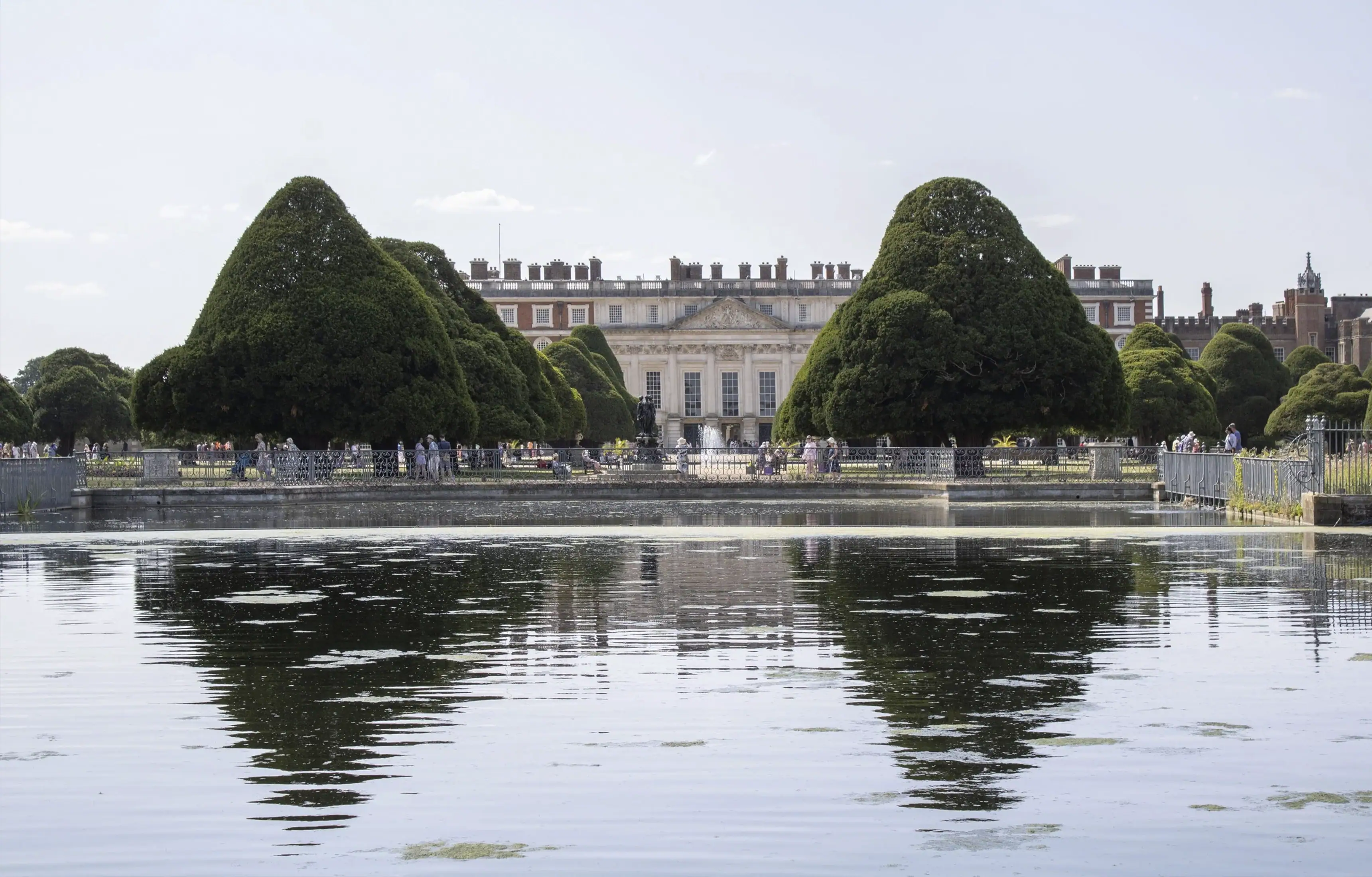
The stunted yews that Queen Anne had put in where Mary’s box had been simply grew. For roughly a century and a half nobody touched them. After the First World War the gardeners went back in and cut what they found into the giant toadstools that now line the East Front. Historic England describes Brown’s contribution as creating “tall irregular forms.”
Those trees are the most photographed thing in the garden and they belong to no style at all. They are Baroque in origin, Picturesque by omission, and Edwardian in silhouette. Some are around 300 years old.
Brown’s other legacy here is under glass. The Great Vine was planted in 1768 from a cutting taken at Valentines Mansion in Essex, with Historic Royal Palaces careful to say that Brown “directed the planting” rather than wielded the spade. It is a Vitis vinifera ‘Schiava Grossa’, better known as Black Hamburg. Its base circumference was 1.2 metres in 1887 and is four metres today, its longest rod runs to 36.5 metres, and it produces an average crop of about 272 kilograms of grapes, with a record of 383 kilograms in autumn 2001. It grows in an aluminium glasshouse of 1969 built over the original wooden one, and Hilary Theaker keeps it.

The 1995 Privy Garden restoration, and the argument it started
A fire on 31 March 1986 in the King’s Apartments set off the most consequential piece of garden design at Hampton Court in three centuries. Restoring the state rooms raised an obvious question: what were the King’s windows meant to look out at?
The answer was excavated. Between 1993 and 1995, under the direction of Dr Simon Thurley, with Dr Terry Gough as head of gardens, Greg Leeson as horticultural manager and scholarly work from David Jacques, Mavis Batey and Jan Woudstra, the Privy Garden was taken back to the scheme of 1701 as completed around 1702. The evidence base was unusually complete: full archaeological excavation of the beds and paths, Leonard Knyff’s bird’s eye view of about 1702 to 1703, Kip’s engraving of 1707, plans of about 1710 in the Soane Museum, and a modern topographic survey from 1981.
More than 20,000 box plants went in. The Prince of Wales opened it in 1995.
It remains one of the most rigorous garden restorations attempted in Britain, and it prompted a real design debate. The landscape historian Tom Turner made the case for the Great Fountain Garden as the better subject, on the grounds that it is the larger and more emphatically Baroque composition and the one most visitors actually see. The counter argument is that the Privy Garden had the evidence, and that a restoration is only as good as what can be proved. Both positions have held up. Thirty years on, the Privy Garden is the clearest surviving statement of Marot’s vocabulary in England, and the Great Fountain Garden is the one currently being redesigned.
There is a neat irony noted by Historic Royal Palaces’ own gardeners: the 1995 recreation has now been in the ground longer than the original garden ever was.
Ann-Marie Powell and the first Hampton Court garden designed for the weather
In 2024 Historic Royal Palaces appointed the garden designer Ann-Marie Powell to produce a new planting scheme for the Great Fountain Garden. Planting began in autumn 2025 and the scheme is on public view through 2026.
The numbers give the scale: 32 beds across 1.5 acres, close to 300 plant species, and a new National Collection of Echinacea purpurea running to 60 varieties. The method is no dig, which protects soil structure and carbon, and the balance has been shifted to roughly 80 per cent permanent planting and 20 per cent seasonal annuals, reversing the Victorian bedding logic that has governed this parterre since the 1850s.
The historical research behind it drew on archival plans, paintings and illustrations from the William and Mary, Queen Anne and Victorian phases, which is to say the design is a synthesis rather than a restoration. Alex Wigley, Head of Parks and Gardens, calls it “an exciting step forward for us in embracing sustainable horticulture.” Powell describes the work as “reimagining beauty through the lens of sustainability, resilience, and biodiversity.” The planting season coincided with the driest spring since 1893.
This is the design argument at Hampton Court right now, and it is a good one. For three hundred years the constraint on this garden was royal taste and royal money. The constraint now is water, labour, plant health and carbon, and for the first time the response to those constraints is being made in public, on the most visible parterre in the country, rather than tucked into a service area.

Two miles of box, five acres of lawn, and a citrus collection rebuilt from scratch
The rest of the estate is being worked on to the same logic. Amy Borthwick, senior gardener, has documented the position on box: the 20,000 plants in the Privy Garden face box blight and box tree caterpillar in a wetter, more humid climate, and the response is a controlled trial of 200 specimens each of Euonymus japonicus ‘Green Spire’, Buxus ‘Babylon Beauty’ and Buxus ‘Renaissance’, alongside reduced clipping, better drainage, adjusted mulching, tool sanitation and propagation of replacements from existing cuttings. There are two miles of box hedging on the site.
Graham Dillamore, head gardener at Hampton Court and Kensington, has set out the wider programme: less frequent grass cutting in selected areas, dead hedging for bird habitat, a move to battery powered equipment, the upper Pond Garden replanted in 2024 with hardy palms, foliage and topiary, and perennial trials on the East Front beds. The target is a reduction of roughly 10,000 summer annuals, 15,000 bulbs and 10,000 spring bedding plants a year. The five acres of fine lawn sit on free draining river gravel, which is exactly the wrong substrate for a drying climate.
The most charming piece of work is the slowest. Mary II’s exotics collection ran to 2,000 plants in the 1690s, overwintered in heated glass cases built by the Dutch carpenter Hendrick Floris. Since 1987, and now documented by Ian Tocher with Martin Einchcomb, the Queen Mary II Exoticks heritage collection has been rebuilt to around 215 taxa, including Seville orange, bergamot, Persian lime and Buddha’s hand. Larger trees stand on the Privy Garden terrace in summer, smaller ones in the Lower Orangery Garden beds, which Wren built for William III in 1701 to 1702 and which Terry Gough restored using c.1710 Soane plans and a 1732 layout, with propagation help from Kew.
Hampton Court now holds three National Plant Collections, Heliotropium designated in 2000, Lantana in 2008 and the Queen Mary II Exoticks, with the echinacea collection added from 2025.
What to look at, and in what order
Come in from the west and the sequence reads chronologically. Chapel Court, Longstaffe-Gowan’s 2009 Tudor knot, then the Pond Gardens, originally Henry VIII’s fish ponds, sunk and replanted by Mary II and given their present tiered, topiaried form in the early twentieth century. The Lower Orangery Garden and the Privy Garden follow, with Tijou’s screens at the far end.
Round the corner onto the East Front for the Great Fountain Garden, Brown’s yews and Powell’s new beds. North of that lies the Wilderness, best in early April when more than a million bulbs are out, and the Maze. The Rose Garden occupies William III’s old kitchen garden and has been evolving since the 1930s, currently carrying Rosa ‘Gertrude Jekyll’ and ‘A Shropshire Lad’ with Hydrangea paniculata ‘Limelight’. The Kitchen Garden of 1689, six walled acre plots built on Henry VIII’s tiltyard, was restored and reopened in June 2014 and now supplies the palace cafés. The 20th Century Garden carries the arboretum, including a collection of rare Ilex.
On the other side of the tiltyard site is the best contemporary design on the estate. The Magic Garden, by Robert Myers Associates for Historic Royal Palaces, opened in 2016: a one acre landscape of tournament ground, wild wood, mythical beasts’ lair, topiary garden and a spiral mount with moat and grotto, with a living willow dragon’s nest by the artist Tom Hare. It took a Landscape Institute award in 2017 and two Society of Garden Designers awards including the Grand Award, and it drew over 250,000 visitors in its first year. It is a play space designed with the same seriousness as the historic gardens around it, and it borrows their motifs without pastiching them.
Frequently asked questions
Who designed the gardens at Hampton Court Palace?
No single person. Henry VIII’s Privy Garden of 1535 to 1538 involved the Kingston carver Harry Corantt. The Baroque layout from 1689 is credited to Daniel Marot for the parterre design, with George London and Henry Wise executing, William Talman as master of works and Christopher Wren as Surveyor. Capability Brown was Master Gardener from 1764. Modern contributions come from Simon Thurley and Terry Gough on the 1995 Privy Garden restoration, Todd Longstaffe-Gowan on Chapel Court in 2009, Robert Myers Associates on the Magic Garden in 2016 and Ann-Marie Powell on the Great Fountain Garden from 2024.
How old is the Hampton Court maze?
It was laid out for William III around 1700 by George London and Henry Wise, within the Wilderness. Historic Royal Palaces dates it to the last years of William’s reign. It is the oldest surviving hedge maze in the United Kingdom, covers about a third of an acre, and was replanted from hornbeam into yew in 1963.
Is the Privy Garden original?
It is a documented recreation. The garden was restored between 1993 and 1995 to William III’s 1701 scheme, using full archaeological excavation together with Knyff’s view of about 1702 to 1703, Kip’s engraving of 1707 and plans of about 1710 in the Soane Museum. More than 20,000 box plants were used. It is one of the most rigorously evidenced garden restorations in Britain.
What is happening with the Great Fountain Garden?
Ann-Marie Powell was appointed in 2024 to design a sustainable planting scheme across its 32 beds and 1.5 acres. Planting began in autumn 2025 and the scheme is visible through 2026. It includes a new National Collection of Echinacea purpurea with 60 varieties and uses a no dig approach, with around 80 per cent permanent planting.
Is the RHS Hampton Court Palace Garden Festival still running?
No. The RHS has restructured its show calendar and the July slot is now filled by two new events, the RHS Badminton Flower Show, 8 to 12 July 2026 in Gloucestershire, and the RHS Sandringham Flower Show, 22 to 26 July 2026 in Norfolk. The final Hampton Court festival ran from 1 to 6 July 2025. The palace’s own garden programme continues, including the Tulip Festival from 11 April 2026.
How big is the Great Vine?
Planted in 1768 under Capability Brown, it has a base circumference of four metres and a longest rod of 36.5 metres, and it produces an average of about 272 kilograms of grapes a year, with a record of 383 kilograms in 2001. It is a Black Hamburg, and it is generally described as the largest grape vine in the world.
Final thoughts
The temptation with a site like this is to treat the gardens as scenery for the building. They are better read as a five hundred year sequence of design decisions, most of them documented, several of them reversible, and a few of them reversed within a year of completion by a monarch with an opinion about the smell of box.
What makes the current moment worth a visit is that the sequence is still running. The Great Fountain Garden is being replanted in front of the public, to a brief about water, soil and biodiversity rather than about display, on ground where Marot set thirteen fountains and Queen Anne pulled them out again. It is the same argument Hampton Court has always hosted, which is what a garden is for and who it is for, being had once more in the open.




Leave a Reply