
Design Travel · Saint-Barthélemy
Reading time: 7 minOn the quiet sands of Anse des Cayes, the Parisian architect François Champsaur has rebuilt a legendary St Barth hotel as the island’s first eco-luxury resort — a place where vivid Caribbean colour and serious sustainability sit in easy, sun-warmed balance.
Some hotels seem to have grown out of the landscape that holds them. Hotel Manapany, tucked into a green fold of hillside above the pale crescent of Anse des Cayes on Saint-Barthélemy, belongs firmly to that kind. Rebuilt and reimagined by the Parisian architect and designer François Champsaur, it is a resort that has learned the language of its island, the turquoise shallows, the tangle of tropical greenery, the shuttered timber of the old Creole houses, and speaks it fluently, in a voice that is at once relaxed, joyful and quietly principled. This is contemporary Caribbean luxury with a conscience, and it makes a persuasive case that the two belong together.


A legendary address, reborn
Manapany is not a new name on St Barth. The hotel occupies one of the island’s most storied stretches of shoreline, an address that carried a whiff of 1960s French glamour long before the current chapter began. That heritage is part of the appeal, and Champsaur has been careful to refresh it rather than erase it, keeping the easy, barefoot sophistication that made the place beloved while bringing its infrastructure and its environmental thinking firmly into the present.
The reinvention followed the property’s acquisition by the French hospitality group B Signature, which committed to a comprehensive rebuild rather than a cosmetic refresh. Public areas and guest rooms alike were taken back to first principles and reconstructed, with Champsaur entrusted with shaping the whole. The result is a hotel that feels thoroughly of today and thoroughly warm with it. Manapany reaches for timber, rope and colour, materials that hold the light and invite the hand, and the interiors are all the richer for it.


“Champsaur has created a hotel that is vivid without being loud, sophisticated without being stiff, and responsible without a trace of sanctimony.”


Colour, drawn from the island
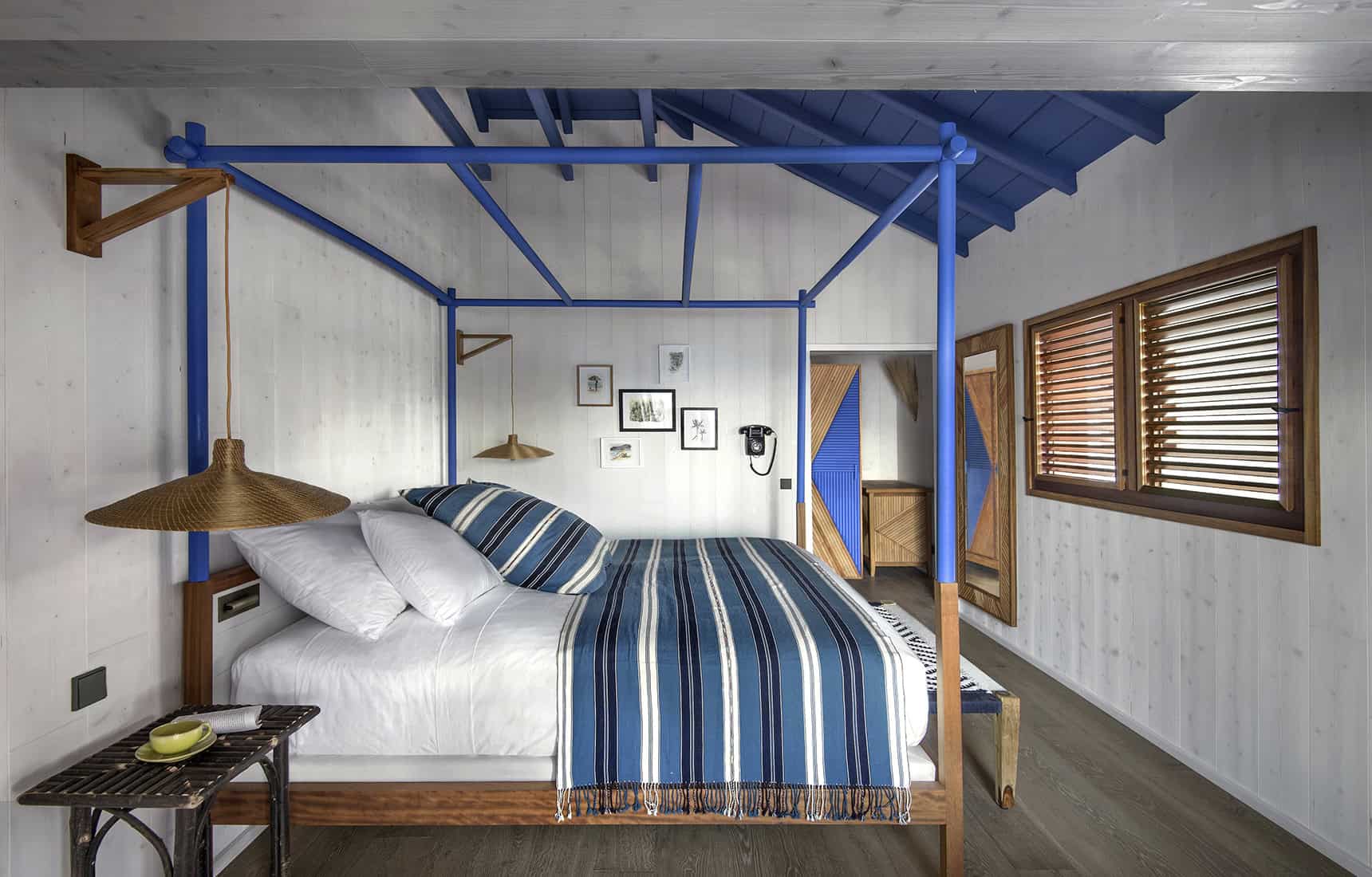
If there is a single quality that announces Champsaur’s hand at Manapany, it is his handling of colour. He has taken his cue directly from the island’s own palette, reading it closely and carrying it indoors. The blues of the sea and sky, the greens of the hillside, the soft browns of sand and bark, the crisp whites of the surf: all of it is drawn inside and layered through the interiors, then lifted with playful, unexpected pops of brighter colour.
The effect is refreshing in the truest sense. It gives the traditional island-villa aesthetic a jolt of energy, something alive and warmly human. Rich textures compound the effect, so that a room reads not as a colour scheme but as an atmosphere: cheerful, characterful, considered and thoroughly easy to live in. It is a fine balance to strike, and Champsaur strikes it with the confidence of a designer who trusts his own eye.
There is intelligence in the restraint of it, too. Colour at Manapany is never applied by the bucketful; it arrives in measured doses — a cushion, a painted door, a length of striped fabric — so that each accent registers against the calm backdrop of timber and white plaster. The trade winds and the shifting Caribbean light do the rest, animating the palette through the day until the same room feels subtly different at breakfast, at siesta and at dusk.


A vernacular of wood, stone and craft
For all its exuberance, Manapany is grounded in a deep respect for place. Champsaur’s design draws openly on the vernacular architecture of Saint-Barthélemy — the wooden decks, the shading pergolas, the louvred shutters that filter the Caribbean light and coax the trade winds through a room. These are not decorative quotations but functional inheritances, the accumulated wisdom of how to build well in a hot, bright, salt-laced climate.
The material palette follows the same logic. Wood, stone and cement do the heavy lifting, chosen for their honesty and their tactility rather than for show. They lend the resort an organic, hand-touched quality, a sense that every surface has weight and grain and will age gracefully in the sea air.
It is in the detailing, though, that the project’s soul truly shows. Throughout the interiors, handmade pieces add a layer of artisanal charm that no amount of money can fake: braided-rope mirrors, benches upholstered in wool, straw lamps sourced from Brazil, and hand-woven rugs made by Mexican artisans. Each object carries the fingerprints of the person who made it, and together they root the hotel in a global network of craft. This is decoration as storytelling, a quiet insistence that the way a thing is made matters as much as the way it looks.


Forty-three cottages, each its own
Accommodation at Manapany is arranged as a scattering of forty-three rooms, suites and cottages, threaded through the gardens and down towards the beach, and including a characterful Creole villa and a dedicated beach house for those who want the water quite literally on their doorstep. No two spaces are quite alike. Some open onto the greenery of the hillside, others frame the ocean directly, but all share the same sun-soaked sophistication and the same anchoring in natural texture — local woods, breezy linens, hand-woven rugs underfoot.
The genius of the layout is its sense of privacy within a resort. Champsaur has kept the scale low and the footprint dispersed, threading the cottages through the planting, so that each one feels like a small private retreat with its own patch of shade and sky. It is an approach that flatters the landscape and the guest in equal measure, and it is entirely in keeping with St Barth’s preference for discretion over spectacle.

Dining and wellness, rooted in the island
A resort of this calibre lives or dies by its table, and Manapany’s is a serious one. The Restaurant Manapany trades on freshness, flavour and a certain French culinary flair, under the direction of executive chef Anthony Martel, whose years working along the French Riviera inform a confident, seafood-forward style. Much of what appears on the plate has travelled only a very short distance to get there — fish landed by local fishermen, herbs cut from the hotel’s own garden — so that the menu becomes another expression of the resort’s connection to its surroundings.
Wellness is treated with the same care. The spa is built around all-natural treatments devised by Dr Hauschka, the German skincare house celebrated for its plant-based, holistic approach — a natural fit for a hotel that has made respect for the living world its founding creed. Between the water, the garden and the treatment room, Manapany offers the kind of restoration that feels earned rather than merely purchased.
It helps, too, that the setting does so much of the work. Anse des Cayes is one of St Barth’s gentler bays, a sheltered arc of sand and shallow water on the island’s northern coast, set a little apart from the lively social scene of Gustavia and Saint-Jean. That gentle sense of seclusion suits the mood Champsaur has built: unhurried, low-key, given over to a long lunch and a longer swim.


Sustainability as a founding principle
What distinguishes Manapany among the island’s many beautiful hotels is that its environmental thinking is a founding principle, written into the fabric of the place and into the way it runs from day to day. It is, by common account, St Barth’s first genuinely eco-luxury resort, and it wears the distinction lightly.
The hotel is powered in large part by solar energy. It operates recycled-water systems to husband one of the island’s most precious resources, and it runs a fleet of electric vehicles that move quietly through the grounds. Most charming of all are the orchards: flourishing groves of lemon, orange, banana, avocado, mango and soursop that supply the kitchens, scent the air and bind the resort to the soil it stands on. Sustainability here is something you can taste, smell and see, a working landscape as well as a beautiful one.


A new grammar for Caribbean luxury
Saint-Barthélemy has long been a byword for a certain kind of exclusivity, a magnet for travellers in search of privacy, polish and impeccable service. Manapany honours that tradition, and it adds to it. It offers craft in abundance; it offers a design language drawn from the island itself; and it offers a genuine, structural commitment to the environment, built into the way the resort is made and run.
For the design-minded traveller, that combination is rare and quietly thrilling. Champsaur has created a hotel that is vivid without being loud, sophisticated without being stiff, and responsible without a trace of sanctimony — a place that proves, convincingly, that a tropical escape can be both a celebration of contemporary craftsmanship and an act of care towards the landscape that makes it possible. At Hotel Manapany, the future of Caribbean luxury looks a great deal like its best traditions, only greener.


Leave a Reply