
Art & Culture · New York
Reading time: 9 minEvery May, New York becomes a design capital. From Gallery FUMI’s Tribeca debut to Tom Dixon in a car park and the Haas Brothers’ uncanny survey, here are the exhibitions, installations and tours to seek out across the 2026 festival.
Every May, New York City turns itself over to design, and 2026 promises one of the festival’s most expansive editions yet. Running from 14 to 20 May, NYCxDesign once again draws together interiors, architecture, product design, lighting, art, technology and culture in a citywide programme of exhibitions, installations, talks, launches and immersive experiences. It is less a single event than a mood that settles over the whole city for a week.

What makes NYCxDesign so distinctive is its refusal to stay put. It unfolds across all five boroughs, turning galleries, showrooms, hotels, studios, museums and public spaces into destinations for discovery. This year’s programme spans more than 250 events across ten design disciplines, anchored by the heavyweight fairs: chief among them ICFF, which returns to the Javits Center from 17 to 19 May under the theme “Common Ground” with more than 400 brands, alongside the ever-reliable WANTED. There is equal pleasure in the sprawl, too: the collectable-design presentations in Tribeca and NoMad, the large-scale installations, the open studios, and the conversations about AI, sustainability and the future of urban living that give the week its intellectual charge. What follows is a personal edit of the moments worth building a route around.
Materials of Joy: Gallery FUMI in New York

If there is one show to anchor a downtown day, it is this. Materials of Joy: FUMI in New York brings London’s Gallery FUMI to Galerie56 in Tribeca, marking the start of a three-month collaboration and the gallery’s most serious statement of intent in the United States to date. It gathers fifty-one handcrafted works by fifteen of the most collectable names on FUMI’s roster, forgoing any single theme in favour of something more revealing: a portrait of the gallery’s whole sensibility, where conceptual ambition is always grounded in traditional, hand-led making.
The cast is formidable — Max Lamb, Rowan Mersh, Sam Orlando Miller and Jesse Schlesinger among them — and the individual pieces are the sort you travel for: a gold-leaf-finished chair by Max Lamb, a quartzite-inlaid cabinet by Francesco Perini, a sculptural bronze coffee table cast by Voukenas Petrides using ancient lost-wax techniques. Arriving in New York after presentations in Los Angeles and Chicago, it confirms FUMI’s growing American presence and the city’s pull as a global platform for collectable design.
The DUMBO Projection Project: V7

For something on a civic scale, cross the river. Now in its seventh edition, The DUMBO Projection Project: V7 turns the raw infrastructure of the neighbourhood into a monumental digital canvas, projecting immersive video artworks across the Manhattan Bridge and the BQE wall of Dr Susan Smith McKinney Steward Park. Set against the ceaseless movement of taxis, trains and traffic, it is one of New York’s most distinctive open-air art experiences, and a reminder that the city’s best galleries are sometimes not galleries at all.
This year’s edition reflects on DUMBO’s own identity — its history, present and imagined future — and introduces a more participatory format, inviting visitors to engage with the projections through web-based experiences, games and smartphone interactions. It is a smart, generous piece of programming, and a persuasive example of how technology can reshape the way a city experiences art.
Haas Brothers: Uncanny Valley

Few contemporary practices resist definition quite like that of Nikolai and Simon Haas. Uncanny Valley, a mid-career survey organised by Cranbrook Art Museum and now touring nationally, immerses viewers in a world where sculpture, furniture, ceramics, installation and digital experimentation collapse into a single, fluid language. Some eighty-five works chart the evolution of a practice defined by imagination, humour and technical hybridity — hybrid creatures, speculative environments and algorithmically generated forms that position design as at once deeply tactile and technologically expansive.
At its heart is the brothers’ ongoing pursuit of what they call “problem-solving fantasies,” merging hand-built craft with computational systems and narrative world-building. Collaboration matters here, too, with works developed alongside beadwork artisans in Cape Town and craft communities in California. The result is a vivid, often surreal proposition: that objects can be emotional, unruly and alive with story, sitting exactly at the intersection of art, craft and emerging technology.
Art Deco Icons of NYC Tour

Not every highlight sits behind a gallery door. Read through a design lens, Manhattan reveals a city where history is built into the skyline itself, and the Art Deco Icons of NYC Tour is the ideal way to see it. This curated walk traces New York’s defining 1920s and 1930s design language, moving between street level and subterranean passages to reframe Midtown as a layered composition of ornament, symbolism and ambition.
From the unmistakable crown of the Chrysler Building to the civic grandeur of Rockefeller Center, the route explores how Art Deco shaped the visual identity of the modern city — while uncovering the lesser-known details that make it sing, from the storied Track 61 beneath the Waldorf Astoria to the sculptural flourishes of the Graybar and General Electric buildings. Along the way it takes in cultural touchpoints too, bringing architecture, cinema and myth together to reveal a city continually shaping, and shaped by, its own design legacy.
TOWNHOUSE x Costantini & SERHANT.

For a rare look behind a closed door, TOWNHOUSE x Costantini & SERHANT. transforms a seven-storey private residence into an immersive installation where collectable design, contemporary craft and residential architecture meet. A mid-eight-figure listed property opens to the public for the first time, curated by Costantini founder William C. Stuart, with each floor conceived as a distinct environment so that objects are experienced in context rather than isolation.
Works by artists and collaborators from Costantini’s wider network are woven throughout — all available for acquisition — reinforcing the dialogue between collecting, living and display. A programme of intimate dinners, conversations and gatherings animates the house alongside the installation, offering rare access to both the work and the people behind it. It is a genuinely unusual proposition: contemporary design seen not on a plinth, but at home.
The Art of Feathers by Julien Vermeulen

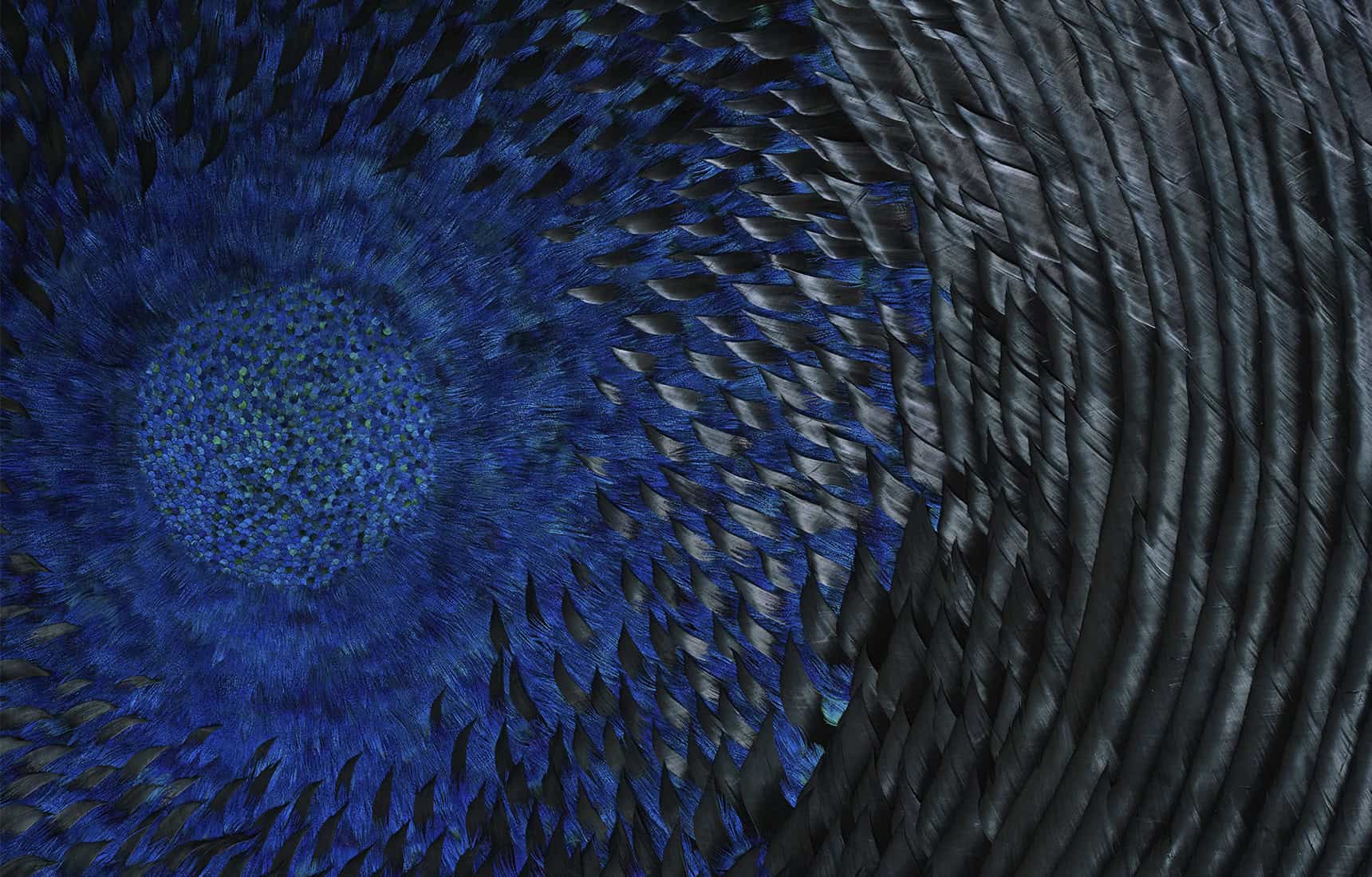
One of the festival’s quieter revelations, The Art of Feathers is presented by Maison Parisienne and marks the first United States exhibition by the French feather artist Julien Vermeulen. It reimagines a centuries-old craft through a resolutely contemporary lens, unveiling sculptural decorative panels composed from goose, peacock, turkey and pheasant feathers. Through layered textures, deep black surfaces and iridescent reflections, the works explore the relationship between material, light and abstraction, turning feathers into something closer to architecture.
Drawing on the example of artists such as Kazimir Malevich and Pierre Soulages, Vermeulen treats the feather not as ornament but as a medium capable of depth, movement and real emotional intensity. Burned, curled, woven and hand-dyed, each composition pushes the limits of traditional savoir-faire while preserving the meticulous handcraft at its heart — a striking case study in how heritage technique can be reinterpreted for a new generation of collectors.
Tom Dixon: The Carpark

Trust Tom Dixon to find the least likely room in the city and make it his own. For NYCxDesign 2026 the British designer brings his industrial aesthetic to New York with The Carpark, an immersive presentation that channels the experimental, material-led philosophy behind his globally recognised studio. Known for pieces such as the Melt pendant and the Mirror Ball lighting collections, Dixon works at the meeting point of sculpture, engineering and interiors, pairing honest materials with bold, instantly legible forms.
Set within an unconventional urban space, The Carpark blurs the line between showroom, architectural intervention and experiential environment. Two decades in, Dixon’s studio has become one of the most influential contemporary design brands of its era, with work held by the Museum of Modern Art, the Victoria and Albert Museum and the Centre Pompidou. Here, that language is turned loose in a setting designed to be walked through rather than simply looked at.
New Artists & Works — Twenty First

Presented by Twenty First, New Artists & Works pairs recent additions to the gallery’s programme with significant new pieces by established collaborators, in a material-driven survey of contemporary collectable design. Spanning sculptural furniture, lighting and wall-based works, it foregrounds process as both concept and craft: wood is hand-chiselled and charred, bronze textured and polished, woven fibres turned into painterly, almost pictorial compositions.
The show introduces new voices, Clotilde Ancarani, Géraldine Cornette de Saint Cyr, Kaspar Hamacher and J McDonald among them, alongside work by Jean-Marie Fiori, Alice Gavlet, Alexandra Mocanu, Emmée Parizot, Marcin Rusak and Rowin’Atelier. Together they set organic silhouettes against architectural structures, from monolithic seating and cabinetry to luminous wall pieces that quietly expand what a typology can be. It is a considered, coherent presentation that captures the evolving language of design at its most crafted and progressive.
House of Finn Juhl x Sea New York: Japan Series

Danish modernism meets contemporary New York fashion in one of the week’s most charming collaborations, as House of Finn Juhl and the label Sea New York reimagine Finn Juhl’s iconic Japan Series. The celebrated mid-century collection is transformed through richly embroidered textiles developed with Denmark’s historic Kjellerup Væveri, introducing a new tactile dimension to Juhl’s sculptural forms and letting the furniture read simultaneously as collectable design and textile expression.
Staged as an immersive pop-up, the presentation reinterprets Juhl’s original design language through layered colour, pattern and texture, with Sea New York’s handcrafted aesthetic bringing softness and intricacy to the whole. It is a small show with a big idea, capturing the growing intersection of interiors and fashion, and offering an intimate way to encounter a piece of Danish design history through an entirely contemporary lens.
Look Book Offsite: Form and Feeling

Finally, for a sense of where independent American design is heading, seek out Form and Feeling, presented by ICFF and AvroKO. Extending the spirit of the fair beyond the Javits Center, it transforms AvroKO’s Host on Howard into an intimate platform for independent North American studios working across furniture, lighting and sculptural objects, examining how traditional materials can be reshaped by contemporary thinking.
Co-curated by Julia Haney Montanez and AvroKO, the showcase gathers emerging and established voices alike — Cuff Studio, Coil + Drift, Simon Johns and Thomas Yang among them — united by a shared focus on material exploration and process-led making. Set within a hospitality-driven space designed for conversation and discovery, it positions collectable design in a warmer, more experiential context, and makes a fitting final stop on any NYCxDesign itinerary.
From collectable design and immersive installations to architectural tours and cross-disciplinary collaborations, NYCxDesign 2026 once again demonstrates why New York remains one of the most influential creative capitals in the world. Across galleries, showrooms, public spaces and cultural institutions, this year’s programme captures a widening dialogue between art, technology, interiors, fashion and material innovation — a compelling snapshot of where contemporary design is heading, and of the ideas, materials and makers shaping its future.

Leave a Reply