
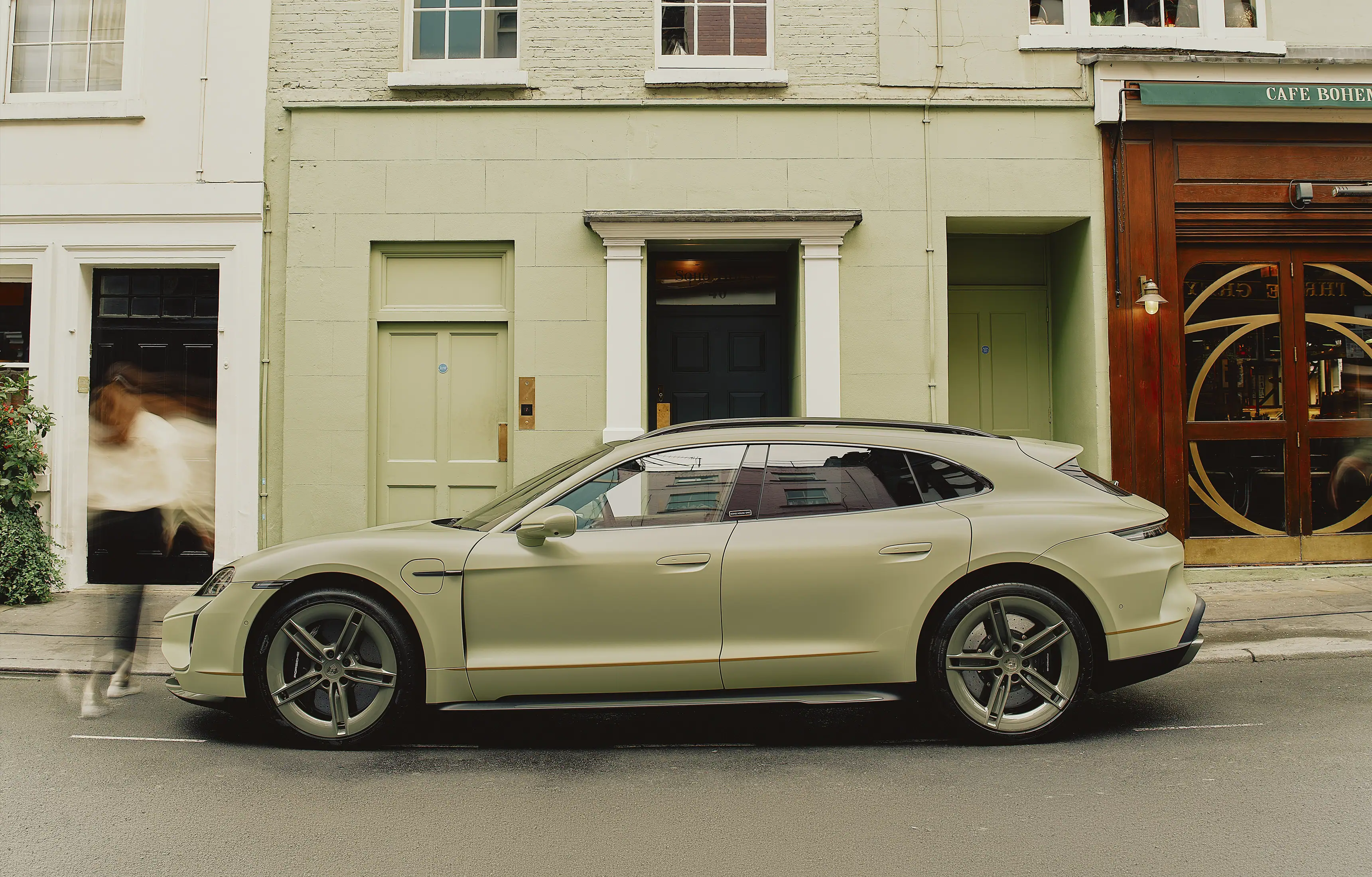
A Porsche Sonderwunsch commission usually starts with a customer’s imagination. This one started with a building. Porsche and Soho House have spent sixteen months translating the colour, the window grid and the material language of 40 Greek Street, the club’s first address, into a 952 PS electric estate car. The result argues that a one-off car can be read the same way as a one-off room.
A Sonderwunsch commission built from an address
Porsche’s Sonderwunsch programme exists to turn one customer’s idea into one factory-built car. For its newest commission, the customer was not a private collector but Soho House, the private members’ club group, and the idea was not a colour or an engine spec but an entire building. The result is the Taycan Turbo S Sport Turismo Soho House One: a 700 kW, 952 PS electric estate finished in a satin green mixed to match a Georgian townhouse on Greek Street in London’s Soho, with an interior built around a jacquard fabric, a burl wood trim and a panoramic roof pattern drawn from the same address.

Porsche unveiled the car at Icons of Porsche, Sunstede Silverstone Edition, from 20 to 21 June 2026, before giving Soho House members a closer look at Soho Farmhouse on 25 June. It is Soho House’s first automotive collaboration, built by Porsche’s Sonderwunsch team under its director, Claas Hoops, working with the design group behind Soho Home, the club’s interiors brand.
Most bespoke car stories stop at the options list: this colour, that leather, this badge. What makes Soho House One worth a longer look is where each of those options actually came from. Nothing on this car is decorative in the ordinary sense. The paint, the fabric, the wood and the roof all trace back to one physical building, and the car reads less like a livery exercise and more like a piece of architecture that has been asked to also do 260 km/h.

What Soho House One actually is
Strip away the story and the car underneath is a standard Taycan Turbo S Sport Turismo: 700 kW and 952 PS on overboost with Launch Control, a 0 to 100 km/h time of 2.4 seconds, a top speed of 260 km/h and a WLTP range of up to 607 km on the 800-volt architecture that lets it charge from 10 to 80 per cent in around 18 minutes. Sonderwunsch has not touched any of that. Everything it changed sits on the surface and inside the cabin, which is the point: this is a demonstration of what the programme’s design and craft side can do to a car Porsche already builds, rather than a new piece of engineering.
The exterior is finished in a Porsche Paint to Sample Plus colour developed specifically for this commission and named Greekstreetgreen, applied in a satin finish that Porsche’s paint specialists spent more than a hundred hours preparing and matching. The 21-inch Mission E Design wheels, part of the car’s SportDesign package, are painted in a contrasting Monteverde Green metallic. A hand-painted coachline and the Turbo S badging run in a bespoke brass tone Porsche calls Soho House One Brass, and the same brass appears in a rear badge that redraws the building the car is named after: three abutted Georgian frontages condensed into a grid of nine squares, echoing the sash windows of the townhouses at 40 Greek Street.

Inside, the leather is Truffle Brown, used for the edging and the deep-pile carpets, against a newly developed Soho Home fabric called Murphy Jacquard in a chocolate tone, woven with precision-dyed flock yarn into a geometric pattern drawn from 180 House, Soho House’s Strand address. Burl wood, rather than the carbon weave usually offered on the Turbo S, runs across the dashboard and door linings. The panoramic glass roof uses Porsche’s Variable Light Control, its electrochromic dimming etched with a triangular pattern that throws a stained-glass shadow into the cabin as the glass darkens. Smaller details carry the same logic through: LED door courtesy lights project the Soho House crest, the carbon sill guards carry an illuminated nameplate, and the car comes with a personalised boot mat, a bespoke documentation folder and a key finished in Greekstreetgreen with its own fabric pouch. Other British marques have reached for the same move, tracing a single fabric back to a specific, named source rather than a mood board, a discipline Murphy Jacquard is now part of.

The building the colour actually comes from
Greek Street was laid out around 1680 as part of Soho’s original street grid, named for a Greek church that has since become St Mary’s on Charing Cross Road. Number 40 is an eighteenth-century survivor of that development: three separate Georgian townhouses, later knocked together, that reached Grade II-listed status long before anyone thought to put their colour on a car. The address has its own history worth knowing regardless of Porsche. Its most notable resident was Emma Hamilton, the eighteenth-century courtesan later famous as Lord Nelson’s mistress, and by 1906 a Metropolitan Police officer was describing the street as the worst in the West End, a reputation that says more about Soho’s decline at the time than about the building itself.

Nick Jones opened the first Soho House there in January 1995, in the two floors above Café Boheme, his restaurant on the same street. He has described the move as accidental: his landlord, Paul Raymond, simply phoned and asked if Jones wanted the floors above the restaurant. The clientele Café Boheme had already gathered, mostly people working in film and media who wanted somewhere quieter to keep talking after service, became the club’s first membership committee, and the House launched with 500 members. The building’s own structure, three interconnected townhouses under one address, became the source of Soho House’s three-floor logo, and thirty years later it is the same structure that gives Soho House One its rear badge and its roof pattern. The car’s design team did not invent a Soho House aesthetic and apply it to a Porsche. They took the actual floor plan of the club’s first building and worked outward from it.

How a members’ club became a material language
Turning a building into a car took Porsche’s Sonderwunsch craftspeople and Soho Home’s design team roughly sixteen months, most of it spent on two problems: getting a paint colour to match a real facade rather than a mood board, and getting a fabric pattern to survive being cut, stretched and stitched over a car seat rather than laid flat as upholstery. Interior technicians disassembled a standard production Taycan and spent around 40 hours perfecting how the Murphy Jacquard, the burl trim and the Truffle Brown leather sat against each other before signing off the combination.

Claas Hoops, who runs Sonderwunsch at Porsche, has summed up the brief in a single line: “The goal was to bring the Soho atmosphere into a Porsche in a way that felt authentic to both worlds.” That is a harder brief than it sounds, because a members’ club and a sports car solve for almost opposite things. A Soho House room is built to soften a space and slow people down. A Turbo S Sport Turismo is built to do the opposite as fast as physically possible. The car resolves that tension by keeping its performance completely untouched and putting all of the softening into materials: heavy jacquard rather than carbon weave, burl rather than gloss trim, a warm brass rather than a sharper chrome. It is restraint used deliberately, in a segment where Sonderwunsch commissions more often lean toward carbon and neon ambient lighting.
Deniz Keskin, Porsche’s director of brand management and partnerships, has framed the project as a continuation rather than a one-off stunt, describing it as the newest chapter in a partnership between the two companies that already runs through joint cultural programming. That framing matters for what happens next: Soho House One is a single car, built for Soho House rather than for sale, but it establishes a working method, matching a Sonderwunsch build to a specific address and its interiors brand, that neither company has closed the door on repeating.

What Sonderwunsch actually does
Sonderwunsch, German for special request, is Porsche’s programme for building cars that do not exist anywhere else, and it is considerably older than most of the customers who now use it. Its origins trace to 1955, when the industrialist Alfried Krupp asked Porsche to fit a rear windscreen wiper to his 356 A Coupé, a request the factory obliged rather than dismissed. Demand for that kind of individual attention grew through the 1960s and 1970s, including a rally-prepared 911 in 1968 and a road-legal 917 built in 1975, and in 1978 Porsche formalised the work into a dedicated department under Rolf Sprenger.

Today the programme is based at Porsche’s Zuffenhausen headquarters, and every Sonderwunsch customer is assigned a dedicated consultant who coordinates regular sessions with designers and, where the request needs it, engineers from the Technical Development Centre in Weissach. The scope runs from single bespoke options and Paint to Sample Plus colours on an otherwise standard new car, through complete factory restorations of classic Porsches, to entirely new one-off concepts built around a customer’s own idea. Recent commissions have included a yellow 911 Speedster built for the architect Luca Trazzi and a 911 S/T built for the collector Jorge Carnicero, both developed the same way Soho House One was: as a genuine collaboration between the customer’s own reference points and Porsche’s engineers, rather than a menu of factory options. Porsche is not alone in running a programme like this. Rolls-Royce’s own Bespoke atelier has produced work just as specific, from a Phantom whose dashboard became a private gallery to a Spectre trimmed in materials sourced to match a single bamboo grove. What is unusual about Soho House One is not that a marque built a one-off. It is that the reference point was a building nobody involved had any hand in designing.

What this means for the Taycan estate
Soho House One arrives at a specific moment for the body style underneath it. Porsche has confirmed that both Taycan estate variants, the Sport Turismo and the higher-riding Cross Turismo, will be dropped from the United States lineup after the 2026 model year, leaving American buyers with the saloon alone. The decision is a US one rather than a global one: both estate variants continue in Europe, where the Sport Turismo is built and where it sells in far greater numbers, so Soho House One’s own body style is in no danger in the market that actually produced it. It does mean that a Sonderwunsch commission built around the fullest expression of the Sport Turismo’s shape, its long, low roofline is what makes the Variable Light Control glass worth having in the first place, has landed at the point where that shape’s audience is narrowing rather than growing. Sonderwunsch cars are usually judged against the customer who commissioned them. This one is worth watching against the body style it sits on.

Final thoughts
It would be easy to describe Soho House One as a car with a members’ club’s branding on it, the automotive equivalent of a hotel amenity kit. Look at where each material decision actually came from and that description falls apart. The green is not a brand colour chosen from a swatch book. It is the measured, matched colour of a real Georgian facade on Greek Street, taken to a paint shop and reproduced to the point where a hundred hours went into getting the satin finish right. The badge is not a logo. It is the floor plan of three eighteenth-century townhouses, redrawn as a nine-square grid. The fabric on the seats was designed for a room on the Strand before it was ever cut for a seat bolster.
What Soho House One actually demonstrates is that Sonderwunsch’s real skill is not fitting a request, the way it once fitted Alfried Krupp’s rear wiper. It is translation: taking a piece of architecture that has nothing to do with cars and finding the specific, correct place on a Taycan for each part of it to live. A rear windscreen wiper is a request. A building rebuilt in paint, jacquard and burl wood, and folded into a shape that does 260 km/h, is something closer to an argument. Porsche has been building special requests since 1955. This is the first one built from a building.

Frequently asked questions
What is the Porsche Taycan Soho House One?
A one-off Porsche Taycan Turbo S Sport Turismo, developed through Porsche’s Sonderwunsch personalisation programme in collaboration with Soho House. It uses the standard Turbo S Sport Turismo’s 700 kW, 952 PS drivetrain, with all of the commission’s work applied to the paint, materials and trim.
When and where was it unveiled?
Porsche revealed the car at Icons of Porsche, Sunstede Silverstone Edition, from 20 to 21 June 2026, followed by an exclusive showcase for Soho House members at Soho Farmhouse on 25 June 2026.
What inspired the design?
40 Greek Street in London’s Soho, the Georgian townhouse where Nick Jones opened the first Soho House in January 1995. The exterior colour, the rear badge, the interior fabric and the panoramic roof pattern are all drawn from that building.
What colour is it, and how was it made?
A bespoke Porsche Paint to Sample Plus shade called Greekstreetgreen, applied in a satin finish and matched to the actual facade of 40 Greek Street over more than a hundred hours of preparation.
Is this car for sale?
No. It is a single Sonderwunsch commission built for Soho House rather than a production model or a customer-ordered car available to buy.
What is Porsche Sonderwunsch?
Porsche’s bespoke personalisation programme, based at its Zuffenhausen headquarters, which pairs customers with dedicated consultants, designers and engineers to build one-off cars, custom colours and full classic restorations. Its roots go back to a special request made by the industrialist Alfried Krupp in 1955.
Is the Taycan Sport Turismo being discontinued?
In the United States, yes: Porsche has confirmed both Taycan estate variants, the Sport Turismo and Cross Turismo, will be dropped from the US range after the 2026 model year. Both continue in Europe, where the Sport Turismo is built and sells in higher volumes.
Who designed the interior fabric?
Soho Home, Soho House’s interiors brand, developed a new jacquard weave called Murphy Jacquard specifically for this car, based on geometric motifs from 180 House, the club’s Strand location in London.

Leave a Reply