
ART & CULTURE · LONDON
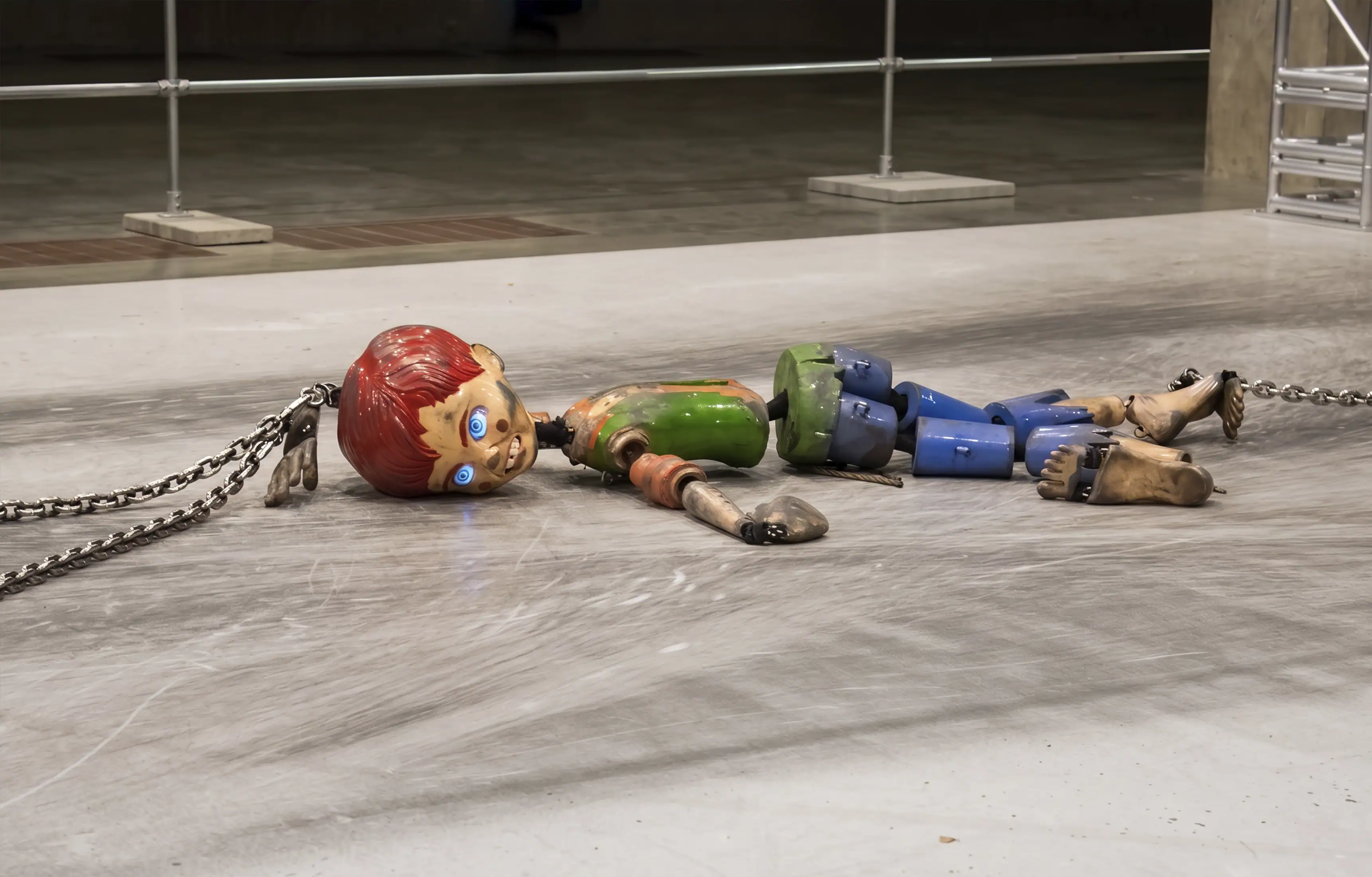
Reading time: 8 minJordan Wolfson’s Colored Sculpture is a seven-foot animatronic puppet, chained by its head and limbs to a gantry, that gets dragged, lifted and dropped on its own head while its screen eyes lock onto whoever is watching. It showed at Tate Modern’s Tanks in 2018, and a version has lived in Tate’s permanent collection since, a gift from collectors Joe and Marie Donnelly. Documenting it properly took three separate sessions, and the piece has stayed with this writer longer than almost anything else covered on this site.
Introduction
Jordan Wolfson is, by his own account and most other people’s, difficult to categorise and harder to look away from, and Colored Sculpture, the animatronic puppet he built between 2014 and 2016, is the work that made that reputation impossible to ignore. It debuted at David Zwirner in New York in May 2016, toured to the LUMA Foundation in Arles and the Stedelijk Museum in Amsterdam, and arrived at Tate Modern’s Tanks in London in May 2018, where it ran until that August. Tate has held a version in its permanent collection since, gifted by the collectors Joe and Marie Donnelly, which means the piece that follows is not really about a show that closed years ago. It is about a work that is still, technically, home.
That distinction matters because Wolfson himself is having a genuinely current moment as this goes to press: his first solo show of new work in New York since 2017 opens at Gagosian on 18 September 2026, his inaugural exhibition with that gallery after joining its roster alongside his existing representation at David Zwirner and Sadie Coles HQ in 2022. Colored Sculpture is the work that explains why that show matters, and why, at forty-five, Wolfson is routinely described as one of the defining artists of his generation.
What actually happens when it performs
The puppet itself stands over seven feet tall, built from polyurethane elastomer over a metal armature, styled as a grinning American boy, freckled, gap-toothed, dressed like an illustration from an old Mad Magazine cover or a description of Huckleberry Finn, with a design lineage Tate has traced back through Howdy Doody, the marionette star of 1950s American children’s television. Chains run from a gantry overhead to its head, one arm and one leg, mechanised to lift, drag, swing and drop the figure against the gallery floor in a repeating sequence that never quite settles into a predictable rhythm.
Its eyes are screens. Sensors built into the installation detect where visitors are standing, and the puppet’s gaze tracks them as it is thrown around the room, so the piece appears to notice you specifically at the exact moments it is least in control of its own body. A recorded monologue in Wolfson’s own voice plays throughout, a numbered, disjointed list of statements: “Five: To touch you… Thirteen: I killed you. Fourteen: You’re blind… Sixteen: To lift you… Eighteen: To weigh you…” The numbering gives the list a bureaucratic, almost liturgical quality, as though the puppet is working through a checklist rather than confessing to anything, which makes the specific violence of individual lines land harder rather than softer.

Why this one took three sessions to document
Wolfson is, in this writer’s view, one of the more genuinely underrated artists working today, not for lack of critical attention but because the work resists the kind of quick, confident take a gallery visit usually produces. Documenting Colored Sculpture properly took three separate sessions rather than one. The first pass was spent simply absorbing the mechanics, learning the rhythm of the chains, working out when the eyes would find you next. The second was spent trying to hold two contradictory readings in mind at once, sympathy for a figure being battered against a concrete floor, and unease at a figure that appeared to be watching and addressing its own violence back at the room. By the third session, both readings had stopped resolving into anything settled, and that unresolved feeling is, as far as this writer can tell, the entire point of the piece rather than a failure to understand it. Few works covered on this site have produced that particular kind of exhaustion, the sense of having been genuinely worked on by an object rather than having simply looked at one.

An aggressor who is also a victim
Tate’s own framing of the piece gets at exactly this difficulty: “the figure can also be seen as an aggressor as well as a victim.” That sentence does more curatorial work than it might first appear to. A viewer’s instinct on seeing a childlike figure thrown repeatedly against the floor is sympathy, and Wolfson knows it, which is why the monologue’s more threatening lines, I killed you, land as a kind of ambush partway through. The puppet has not done anything to deserve the abuse it is receiving, and it has also, apparently, killed someone, and the piece never resolves which fact should govern how a viewer feels about what they are watching.
The specific cultural references matter here rather than reading as decoration. Huckleberry Finn is a story about a boy navigating an adult world of violence and moral compromise largely alone. Howdy Doody is a marionette, an object literally built to be controlled by other hands, performing cheerful innocence for a television audience that could not see the strings. Building a puppet out of both references and then making that puppet the author of its own recorded threats collapses the distance between the innocent child archetype and the violence it supposedly stands outside of, which is a more precise and considered use of American pop culture iconography than a work about disturbing puppetry strictly needs.

From a debut at David Zwirner to a permanent home at Tate
Colored Sculpture was made in Los Angeles between 2014 and 2016 and had its first public showing at David Zwirner’s New York gallery in May 2016. It travelled that same year to the LUMA Foundation in Arles and to Amsterdam’s Stedelijk Museum, where it was presented across two sequential parts titled MANIC/LOVE and TRUTH/LOVE, before reaching Tate Modern’s Tanks in May 2018 for a run that closed that August. The version now in Tate’s collection, accessioned as T15218, arrived as a gift from the collectors Joe and Marie Donnelly rather than a purchase, and its listed medium, metal, polyurethane elastomer, motors, video, sound and software, reads more like an engineering manifest than a typical sculpture credit line, which is itself a small indication of how much of the piece’s effect depends on mechanism rather than surface.

The artist behind it
Jordan Wolfson was born in New York in 1980 to a secular Ashkenazi Jewish family and grew up with three older sisters before earning a BFA in sculpture from the Rhode Island School of Design in 2003. He has been based in Los Angeles since 2013, and his practice has consistently pushed toward whatever technology can produce the most direct physical or emotional reaction in a viewer: Female Figure (2014), an animatronic figure in a witch mask that used facial recognition to track viewers years before Colored Sculpture refined the same trick, has since been named among the artworks that defined its decade by both ARTnews and Artnet News. Real Violence (2017), a virtual reality piece depicting Wolfson beating a figure with a bat, appeared in that year’s Whitney Biennial and became one of the most argued-over inclusions in the exhibition’s recent history. Wolfson has described his own approach to the discomfort his work produces plainly: “I’m not here to heal the world. I’m an artist. My job is to see the world.”
That trajectory continued in 2023 with Body Sculpture, an even larger and more technically ambitious animatronic work acquired by the National Gallery of Australia in 2020 for roughly £3.5 million and finally unveiled, after pandemic-related delays, in December 2023. The gallery’s director, Nick Mitzevich, called it “a historic acquisition for the National Gallery, marking a milestone in contemporary art.” Wolfson himself has described the piece’s intent in terms consistent with everything Colored Sculpture already does to a viewer: “The intention is that the movement of Body Sculpture elicits the viewer to become activated in their bodies and therefore present.”

What is next
Wolfson’s upcoming Gagosian exhibition, opening 18 September 2026 at the gallery’s 555 West 24th Street space in New York, is his first solo presentation of new work in the city since 2017, the same year Real Violence appeared at the Whitney. He has described it as “a very traditional sculpture show,” built over roughly eighteen months, featuring medium to large-scale sculptures incorporating found colour and black-and-white photography drawn from the internet, personal archives and academic sources. A new animatronic work is reportedly in development, though Wolfson has declined to say when or where it will debut. Asked about the attention a major New York return generates, he offered a line that could double as a statement of intent for everything documented in this piece: “I’m not here to retain power and transform that power into mediocrity. I’m here to do art. This is serious.”
Frequently asked questions
What is Colored Sculpture?
An animatronic puppet by Jordan Wolfson, made 2014 to 2016, styled as an American boy and suspended by chains that lift, drag and drop it while its screen eyes track viewers and a recorded monologue plays.
Where can Colored Sculpture be seen?
It debuted at David Zwirner, New York, in 2016, and showed at the LUMA Foundation, the Stedelijk Museum and Tate Modern’s Tanks, London, in 2018. A version is now part of Tate’s permanent collection, a gift from Joe and Marie Donnelly, though it is not necessarily always on display.
Who is Jordan Wolfson?
An American artist, born 1980, based in Los Angeles, known for technologically sophisticated sculpture and installation including Female Figure (2014), Colored Sculpture (2016), Real Violence (2017) and Body Sculpture (2023).
Does Jordan Wolfson have a new show?
Yes. His first solo show of new work in New York since 2017 opens at Gagosian on 18 September 2026, his debut exhibition with that gallery.
Why is Colored Sculpture considered disturbing?
It deliberately makes a viewer feel sympathy for a figure suffering violence while that same figure delivers a monologue including the line “I killed you,” refusing to resolve whether it is the victim or the aggressor in the scene.
Final thoughts
Colored Sculpture is not a piece that resolves, and it is not supposed to. A viewer arrives ready to feel sorry for a chained, battered figure and leaves without a clean answer as to whether that sympathy was ever warranted, which is a harder thing for an artwork to sustain across a whole exhibition run than a single startling image. Wolfson has built a career on exactly that refusal, from a witch-masked figure that tracked faces in 2014 through a Whitney Biennial VR piece that argued about who gets to depict violence and why, to a puppet now sitting in Tate’s own collection asking the same unresolved question it asked in 2016. Whatever the new sculptures at Gagosian turn out to be this September, the puppet chained to a gantry in the Tanks remains the clearest demonstration of what makes Wolfson worth the discomfort of paying close attention.


Leave a Reply