
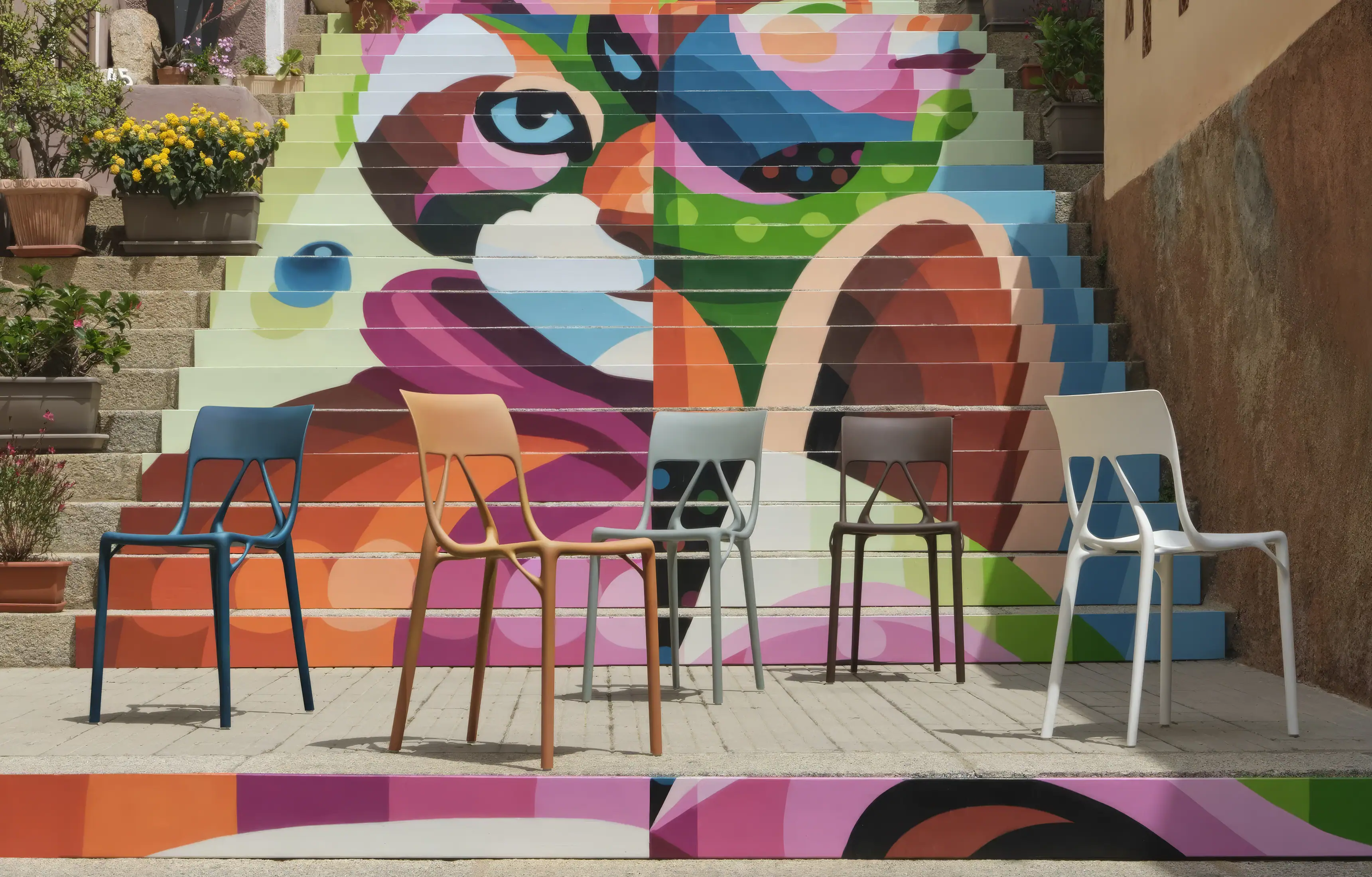
A cylindrical storage unit invented in 1969 made plastic furniture serious. Fifty-six years later, the family that built that idea used a chair partly designed by an algorithm to say what comes next. Kartell’s Brompton Road flagship spent London Design Festival 2025 making the case that heritage and invention are the same project, not opposites.
For eight days in September 2025, Kartell’s flagship store at 223 Brompton Road became the Italian brand’s stage for London Design Festival. The Shape of What’s Next ran from 13 to 20 September, inside the festival’s wider run of 13 to 21 September, and brought the UK debut of Kartell’s 2025 collection, Future Perspectives, to the Brompton Design District.
The presentation was built around new work from five designers: Philippe Starck, Patricia Urquiola, Ludovica Serafini and Roberto Palomba, and Piero Lissoni, alongside a reissue of a 1963 Joe Colombo lamp. On Thursday 18 September, the store hosted a programme of live conversations on design, authorship and collaboration. Lorenza Luti, Kartell’s marketing and retail director, led the creative direction of the presentation. It ran the same week as Lee Broom’s void-lit Christmas installation at Mandarin Oriental Mayfair and Max Lamb’s ceramic chairs at Gallery FUMI, two more results of the same festival week.
That last name matters more than a credit line suggests. Lorenza Luti is the daughter of Claudio Luti, Kartell’s chairman, who bought the company from his wife’s parents in 1988. Those parents were Giulio Castelli and Anna Castelli Ferrieri, the couple who founded Kartell in 1949 and, through Ferrieri’s work as an architect and later art director, turned injection-moulded plastic into a serious material for furniture rather than a novelty. The family has not left the building since. What follows is the case for reading Brompton Road not as a showroom refresh but as the latest chapter of a single, seventy-six-year argument about what plastic, and now software, can be asked to do.

What was actually on Brompton Road
The presentation occupied Kartell’s full flagship store rather than a separate pavilion, which meant the London Design Festival crowd encountered Future Perspectives the way any customer would: laid out across a working shop floor, open daily from 10am to 6pm. That is a deliberate choice for a brand whose UK retail presence is itself part of the story it wants to tell, and it put the collection inside the everyday rhythm of a shop a Londoner can return to the following week. The presentation sat within the Brompton Design District, a stretch of Chelsea and Knightsbridge that this year’s edition, curated by Alex Tieghi-Walker under the theme “A Softer World,” used as one of its main hubs.
Six product lines carried the presentation. Starck’s A.I. Lite chair and his Camomille lamp, a portable rechargeable light running for 50 to 100 hours on a charge. Urquiola’s Aaland seating system, a modular sofa and armchair range with removable bouclé and satin covers designed to be reconfigured rather than fixed. Serafini and Palomba’s Albert table, pairing an aluminium base with a porcelain top across four colourways. Lissoni’s Wisewise shelving, a modular wooden bookcase built to be customised room by room, alongside a reworked Trays collection in new tone-on-tone finishes. Each piece had already appeared at Salone del Mobile in Milan in April 2025, where Future Perspectives first launched; London was its first stop outside Italy, and Downtown Design in Dubai followed in November.

The family that made plastic respectable
Kartell’s founding story is usually told as a materials story, and it is worth telling properly, because it explains why a brand built on injection moulding now talks about artificial intelligence without sounding like it has changed subject.
Giulio Castelli founded Kartell in 1949 to make car accessories. His wife, Anna Castelli Ferrieri, trained as an architect at the Politecnico di Milano, graduating in 1943 under the influence of the Rationalist architect Franco Albini, and ran her own practice before she began designing for the company her husband had started. Her first Kartell piece appeared in 1964; by 1966 she was designing for the brand regularly, and from 1976 to 1987 she served as its art director. Her defining work, the Componibili storage unit, launched in a rectangular form in 1967 and was redesigned into the cylindrical shape it is still known by in 1969: a stack of drawers moulded entirely in ABS plastic, sold in colours no wooden cabinet came in, and light enough to move with one hand. It made the case, against a design establishment that treated plastic as disposable, that a moulded polymer could be a permanent piece of furniture. That argument is the one Kartell has been extending ever since.
Castelli and Ferrieri sold the company in 1988 to their son-in-law, Claudio Luti, who remains its chairman, chief executive and president. His daughter, Lorenza Luti, now runs Kartell’s marketing and retail operation, and it was her creative direction that shaped the Brompton Road presentation. Three generations of one family have now defined what Kartell means at three different moments: a founder who bet on a new material, an architect who proved it belonged in a home, and a marketing director now asking what a chair looks like when part of its shape was decided by software. The Shape of What’s Next is a title that only really makes sense once you know whose family has been answering that question, in different forms, since 1949.

What “A.I.” actually means on this chair
The A.I. Lite chair shown in London is the direct descendant of a specific piece of design history, and it is worth being precise about it, because “AI” gets attached to a great deal of product marketing that has nothing to do with what happened here.
In 2019, Starck, Kartell and the software company Autodesk built the original A.I. chair using generative design: rather than sketching a form and then engineering it, the team gave Autodesk’s software a structural brief, in Starck’s words, “do you know how we can rest our bodies using the least amount of material?,” along with the manufacturing constraints of injection moulding, and let it propose forms that met both. Autodesk described the process as working “a lot like a child learning,” with each round of feedback sharpening the software’s understanding of what Starck wanted. Starck himself called it “a conversation,” and argued that software with no “culture, memories or influences” could arrive at structural solutions “outside of the human brain, outside of our habits and how we are used to thinking.” The chair went into production in 2019 as what Autodesk called the first industrial chair designed using artificial intelligence, and its central claim was not novelty but efficiency: a seat that held a body’s weight using less material than a conventionally engineered equivalent, which is a sustainability argument as much as a technical one.
A.I. Lite is that logic taken a step further. It uses a recycled plastic frame, comes in six colourways, and reduces the chair’s mass again without giving up the load-bearing geometry the original generative process worked out. Seen next to the Componibili’s plastic argument from 1969, it reads less like a gimmick and more like the same project with a new tool: use the least material a structure can get away with, and let that constraint produce the form.

The rest of the room
The other four designers on Brompton Road extended different parts of Kartell’s catalogue rather than its manufacturing philosophy, and together they showed how wide the brand’s current register runs.
Patricia Urquiola’s Aaland system, first shown at Salone del Mobile in 2024 and carried into the 2025 collection with new finishes, treats seating as genuinely modular: individual elements interlock into sofas, armchairs and daybeds, and the bouclé and satin covers are designed to be removed and replaced rather than reupholstered. Ludovica Serafini and Roberto Palomba’s Albert table pairs an aluminium base with a porcelain top, a materials combination that reads as more architectural than domestic, in four colour options. Piero Lissoni’s Wisewise shelving is wood rather than plastic, built as a modular system that can be configured to a specific room rather than sold as a fixed unit, which puts it in dialogue with the same customisation logic Urquiola applies to seating. Alongside it, Lissoni’s Trays collection returned in new tone-on-tone finishes, a small but telling detail: it shows Kartell treating colour and surface, not just structural form, as a place to keep innovating each season.
The collection also folded in a reissue of Joe Colombo’s KD28 lamp, originally designed for Kartell in 1963, in new finishes. Placing a sixty-two-year-old design alongside a chair developed with generative software was presumably deliberate: it makes the point that Kartell’s history and its current experiments are the same continuous line, not a heritage wing next to an innovation lab.

Milan to London to Dubai, and what Brompton Road gave it
Future Perspectives launched in Milan during Salone del Mobile, the collection’s largest and most trade-facing stage. Brompton Road was a different kind of appearance: a UK debut inside a working retail store, embedded in a festival district built around pedestrian browsing rather than trade-fair appointments, and timed to a single evening of public conversation on 18 September rather than a press view. Downtown Design in Dubai in November put the same collection back into a fair context. Three cities, three formats, one set of products: it is a useful reminder that how a collection is staged changes what it argues, even when the objects themselves do not. It is the same Milan-first pattern behind Lee Broom’s Beacon, launched in the Italian glassmaking country that made it, another piece that only fully makes sense once you know where its materials or its family history actually started.
For a visitor to Brompton Road specifically, the useful thing the format gave them was proximity. The pieces were not roped off inside a pavilion; they were arranged through a shop a customer could return to the following week to actually buy from, which is a different kind of encounter with new design than a fair booth allows. Positioned inside the Brompton Design District, itself curated in 2025 around ideas of care and connection, Kartell’s presentation sat alongside a season of London design retail that was, more broadly, treating showrooms as places to spend time rather than simply transact.

Frequently asked questions
What was Kartell’s presentation at London Design Festival 2025 called?
The Shape of What’s Next, staged at Kartell’s flagship store at 223 Brompton Road, London, from 13 to 20 September 2025.
What collection was on display?
The UK debut of Future Perspectives, Kartell’s 2025 collection, which had launched at Salone del Mobile in Milan in April 2025 and later travelled to Downtown Design in Dubai in November 2025.
Which designers were involved?
Philippe Starck, Patricia Urquiola, Ludovica Serafini and Roberto Palomba, and Piero Lissoni contributed new or updated pieces, alongside a reissue of a 1963 lamp by Joe Colombo.
What is the A.I. Lite chair?
A lighter, more sustainably produced evolution of Starck’s 2019 A.I. chair, the first industrial chair developed using Autodesk’s generative design software. It uses a recycled plastic frame and comes in six colourways.
Who led the creative direction of the London presentation?
Lorenza Luti, Kartell’s marketing and retail director, and the daughter of chairman Claudio Luti.
When did London Design Festival 2025 run overall, and where was Kartell within it?
The festival ran from 13 to 21 September 2025. Kartell’s presentation, open daily from 10am to 6pm, sat within the Brompton Design District, one of the festival’s Chelsea and Knightsbridge hubs, curated in 2025 by Alex Tieghi-Walker.
Was there a public programme alongside the products?
Yes. On Thursday 18 September, Kartell hosted live conversations at the Brompton Road store exploring the future of design, authorship and collaboration.
Who founded Kartell, and how does that history connect to this presentation?
Giulio Castelli founded Kartell in 1949; his wife, the architect Anna Castelli Ferrieri, became its art director and designed the Componibili storage system, launched in 1969, which helped establish moulded plastic as a legitimate material for furniture. The couple sold the company to their son-in-law, Claudio Luti, in 1988. His daughter, Lorenza Luti, directed the Brompton Road presentation, making it a three-generation continuation of the same family’s design argument.
Final thoughts
It would be easy to read a flagship-store product launch as exactly that and nothing more: new colourways, a UK debut, a party on a Thursday. The detail that changes the reading is the family standing behind it. Kartell has spent seventy-six years making a single argument, that a manufactured material can be trusted with permanence, and every generation of the Castelli and Luti family has restated it with the tools available to them. Anna Castelli Ferrieri had injection moulding and a stack of drawers. Philippe Starck, working with Kartell in 2019, had generative software and a question about how little material a body actually needs to rest on. Lorenza Luti, in September 2025, had a shop on Brompton Road and eight days to put both arguments in the same room.
That is what The Shape of What’s Next actually named. Not a slogan about the future of design in general, but a specific, traceable line running from a 1969 cylinder to a chair an algorithm helped shape, held together by one family who never stopped asking the same question about the least material a design can get away with.

Leave a Reply