
Art & Culture · Mayfair
Reading Time: 7 minutes
Max Lamb has spent two decades asking whether unglamorous materials, pewter, volcanic rock, felled trees, can be trusted to hold a body’s weight. His new collection with 1882 Ltd puts the same question to fine bone china, the one material furniture design has always assumed could not survive being sat on.
Introduction
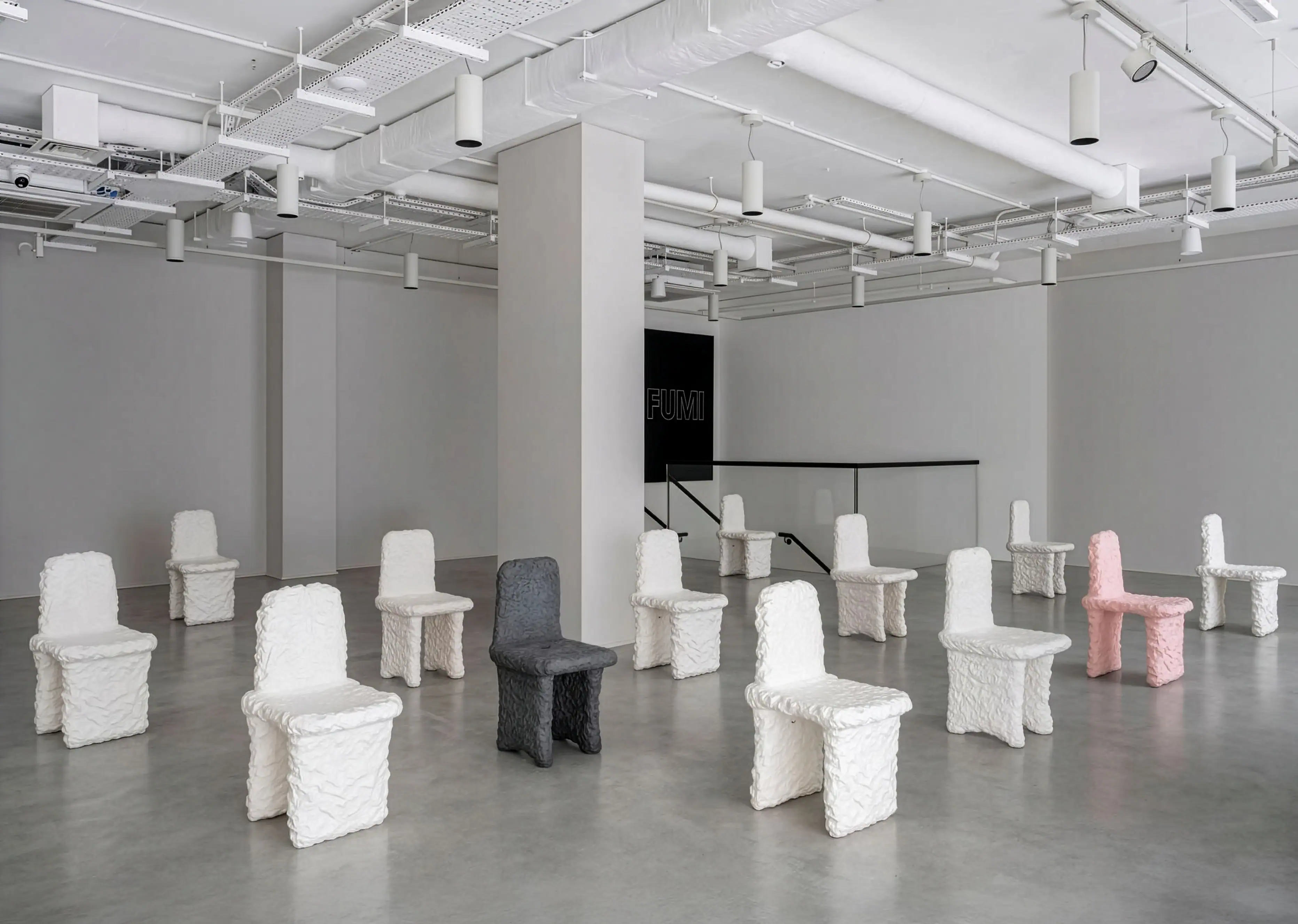
Crockery, the joint collection by designer Max Lamb and ceramics manufacturer 1882 Ltd, was shown at Gallery FUMI in Mayfair from 11 to 30 September 2025, during the London Design Festival. It comprises chairs and stools cast entirely in fine bone china: no timber frame, no metal armature, nothing beneath the ceramic surface but more ceramic. The pieces are left unglazed, finished only in the white, black and blush pink that the clay itself produces in the kiln.
The premise sounds like a stunt until you look at who made it. Lamb has built an entire career on testing whether materials furniture design considers unsuitable, too soft, too brittle, too raw, can in fact be trusted to bear weight. Ceramic is the one material that had, until now, stayed outside that project entirely, for the obvious reason that everybody already knows what happens when you sit on a plate. Crockery is Lamb and 1882 Ltd’s answer to why that assumption might be wrong.


The material Max Lamb hadn’t broken yet
Lamb trained at Northumbria University and then at the Royal College of Art, where he studied under Tom Dixon, who hired him as a special projects designer after graduation. Since launching his own studio in 2007, his signature has been a refusal to let a material’s reputation decide what it is allowed to become. He has cast stools from molten pewter poured directly into carved sand moulds. He has hand-carved seating from quarried marble and volcanic rock. He felled a 187-year-old ash tree from his own family’s land and turned its 131 logs into a single body of work, My Grandfather’s Tree. He invented Marmoreal, a terrazzo-like composite of his own devising, and worked in traditional Japanese Urushi lacquer using centuries-old application methods. The common thread across all of it is a phrase Lamb himself has used to describe his own practice: he is “at home with honest materials.”


Ceramic sits outside that lineage for a specific reason. Every other material on that list is at least structurally plausible as furniture before Lamb gets near it: stone holds weight, pewter can be cast thick, wood is furniture’s default material. Fine bone china is different. It is, by design and reputation, the material you are told not to lean on. Crockery takes Lamb’s usual question, can this bear a body’s weight, and applies it to the one substance where the honest answer has always seemed to be no. That is the actual experiment here, and it is a considerably higher-stakes one than his earlier work in stone or pewter, both of which were at least intuitively strong enough to sit on before anyone tested them.
That earlier body of work has already earned Lamb serious institutional recognition. He was named Design Miami/Basel’s Designer of the Future in 2008, won the Courvoisier Award the following year and received an HSBC Design Collection Commission in 2010. His pieces sit in the permanent collections of the Cooper Hewitt in New York, the Vitra Design Museum in Germany, the Israel Museum in Jerusalem, the Wolfsonian-FIU in Miami, the Centre National des Arts Plastiques in Paris and Design Museum Gent in Belgium. His 2015 project Exercises in Seating, forty uniquely constructed chairs arranged in a circle, remains the clearest single demonstration of the working method Crockery now extends into ceramics: take a familiar object type, strip away every assumption about how it should be built, and see what still counts as a chair when you are done.


A family firm built to do exactly this
Lamb could not have run this experiment without 1882 Ltd, the Stoke-on-Trent ceramics company that manufactured the collection, and the choice of partner is not incidental. 1882 Ltd was founded in 2011 by Emily Johnson and her father Christopher, the fourth and fifth generations of the Johnson family in British pottery. The company’s name marks 1882, the year their ancestors Alfred and Frederick Johnson bought the bankrupt J. W. Pankhurst Company and founded Johnson Brothers, which grew by the 1950s into an operation producing a million pieces of pottery a week and went on to hold Royal Warrants. Since 2021, 1882 Ltd has worked from part of the historic Wedgwood factory in Barlaston, Staffordshire, expanding from four potters and four kilns to twenty-three potters and eleven kilns.

That lineage matters for what Crockery actually required technically. Slip-casting, the process of pouring liquid clay into a mould and controlling its drying before firing, is a technique the ceramics industry has refined for structural precision for well over a century. Lamb’s contribution was a set of hand-carved plaster models, made by his own hand, that served as the master references for each piece. 1882 Ltd’s contribution was the industrial-scale craft knowledge to translate those models into slip-cast fine bone china capable of holding together, and holding weight, at furniture scale. Johnson and her team have collaborated with a roster that includes Faye Toogood, John Pawson, Bruce McLean, Giles Deacon, Shona Heath and Robbie Williams, and describe the company’s core drive as marrying progressive design with industrial craftsmanship, working across fine bone china, earthenware and stoneware for everyday objects as well as special editions. Lamb’s brief, structural rather than decorative, asked something different of that technical range than a dinner service or a sculptural vessel would. It is one thing to collaborate with a designer on the shape of a plate. It is another to be trusted with whether a chair made of the same material will hold a person’s weight without a single hidden support.


How a plate becomes a chair
Each piece in the collection began as a full-scale plaster model, hand-carved by Lamb, which then became the master mould for slip-casting in liquid clay. The pieces went through controlled drying before firing, with no glaze and no surface embellishment applied at any stage. The resulting palette, white, black and a soft blush pink, is not a chosen finish but the material’s own result of how each clay body reacts to heat, which means the collection’s colour story is really a record of the firing process itself rather than a design decision layered on afterward.
Leaving the surfaces unglazed is the detail that makes the collection’s argument legible at a glance. A glazed ceramic chair could read as a decorative object dressed up to resemble furniture. Left raw, Crockery‘s pieces read instead as exactly what they are: solid fired clay, asked to do a job clay is not supposed to be able to do, with nothing hidden and nothing dressed up to disguise the risk.


Gallery FUMI’s second act this season
Gallery FUMI has hosted Crockery at its Hay Hill townhouse in Mayfair, the same address behind the gallery’s earlier 2025 summer exhibition, Casa al Mare, in which Lamb’s work also appeared as one voice among several. Founded in 2008 by Sam Pratt and Valerio Capo, the gallery launched its first show, titled Materialism, from a space in Shoreditch during that year’s London Design Festival, on the same week a newspaper headline declared the financial crisis officially arrived. Seventeen years and a move to Mayfair later, the gallery is back where it started each September: opening a London Design Festival show built around exactly the kind of material risk-taking that gave its debut its name.

Where Casa al Mare placed Lamb’s work inside a wider group exploring an Aeolian, sun-bleached palette across several designers, Crockery is the reverse: one designer, one manufacturer, one material, examined in enough depth to fill an entire show. Read together, the two exhibitions this year make the case for FUMI’s current programming rather better than either would alone. One demonstrates the gallery’s range across a season; the other demonstrates how far it is willing to let a single idea run when the idea is strong enough.
The gallery’s own account of its first fifteen years describes the distance travelled since that Shoreditch debut as a move “from a DIY concept to being part of the world’s most important fairs,” and its current exhibitor presence at PAD and Design Miami bears that out. A programme confident enough to give one designer and one manufacturer an entire show, rather than folding every new material story into a group exhibition, is exactly what that growth in standing is supposed to buy a gallery. Crockery is that confidence being spent well.


Frequently asked questions
What is Crockery?
A collection of chairs and stools by designer Max Lamb and ceramics manufacturer 1882 Ltd, cast entirely in fine bone china and shown at Gallery FUMI, London, from 11 to 30 September 2025.
Who is Max Lamb?
A British designer, born in Cornwall in 1980, known for testing whether raw and unconventional materials, including pewter, marble, volcanic rock and felled timber, can function structurally as furniture.
Who is 1882 Ltd?
A Stoke-on-Trent ceramics manufacturer founded in 2011 by Emily Johnson and her father Christopher, descended from the Johnson Brothers pottery family, now operating from part of the historic Wedgwood factory in Barlaston.
Are the pieces glazed?
No. Every piece is left unglazed, finished only in the white, black and blush pink that result naturally from the firing process, with no added colour or surface treatment.
How were the pieces made?
Lamb hand-carved full-scale plaster models, which became master moulds for slip-casting in liquid clay, followed by controlled drying and firing at 1882 Ltd’s Stoke-on-Trent workshop.
Has Max Lamb shown at Gallery FUMI before?
Yes. His work also featured in the gallery’s summer 2025 group exhibition, Casa al Mare, alongside several other designers working in an Aeolian-inspired palette.

Final thoughts
Furniture designers borrow the vocabulary of strength testing often enough that it has become a cliché: pushing a material past what it is supposed to do. Crockery earns the phrase rather than performing it, because fine bone china is not a material anyone seriously expected to survive the test. What makes the collection convincing is not just Lamb’s nerve in proposing it, but 1882 Ltd’s century and a half of family expertise in knowing exactly how far clay can be pushed before it stops being crockery and starts, genuinely, being furniture.
Max Lamb’s work also appears in Gallery FUMI’s summer 2025 group show, Casa al Mare: Gallery FUMI Brings the Aeolian Islands to Mayfair, at the same Hay Hill address.
The same festival week, Kartell staged its own London Design Festival presentation, The Shape of What’s Next, at its Brompton Road flagship.

Leave a Reply