
ART & CULTURE · MILAN
Reading time: 9 minA pink and silver mirrored cabinet on galvanised copper legs, and a set of ceramic vases named after childhood sweets, shared a second-floor apartment in Milan’s Brera Design District for six days in April 2018. Manfredi Moretti’s Aesthetic Visions was staged inside a room built for living rather than exhibiting, and that domestic setting is what let two very different objects, one glinting and industrial, one soft and handmade, make the same point about colour.
Milan Design Week 2018 ran from 17 to 22 April, with the Salone del Mobile at Rho Fiera anchoring a city-wide Fuorisalone programme that spilled into courtyards, showrooms and private apartments across every design district. In the Brera Design District, on the second floor of a building at Via Palermo 5, the gallery Manfredi Style opened Aesthetic Visions, a group presentation of twenty-one designers working across furniture, lighting, art and installation, with exhibition design by Studio MILO’s Arianna Crosetta and Federica Gosio.
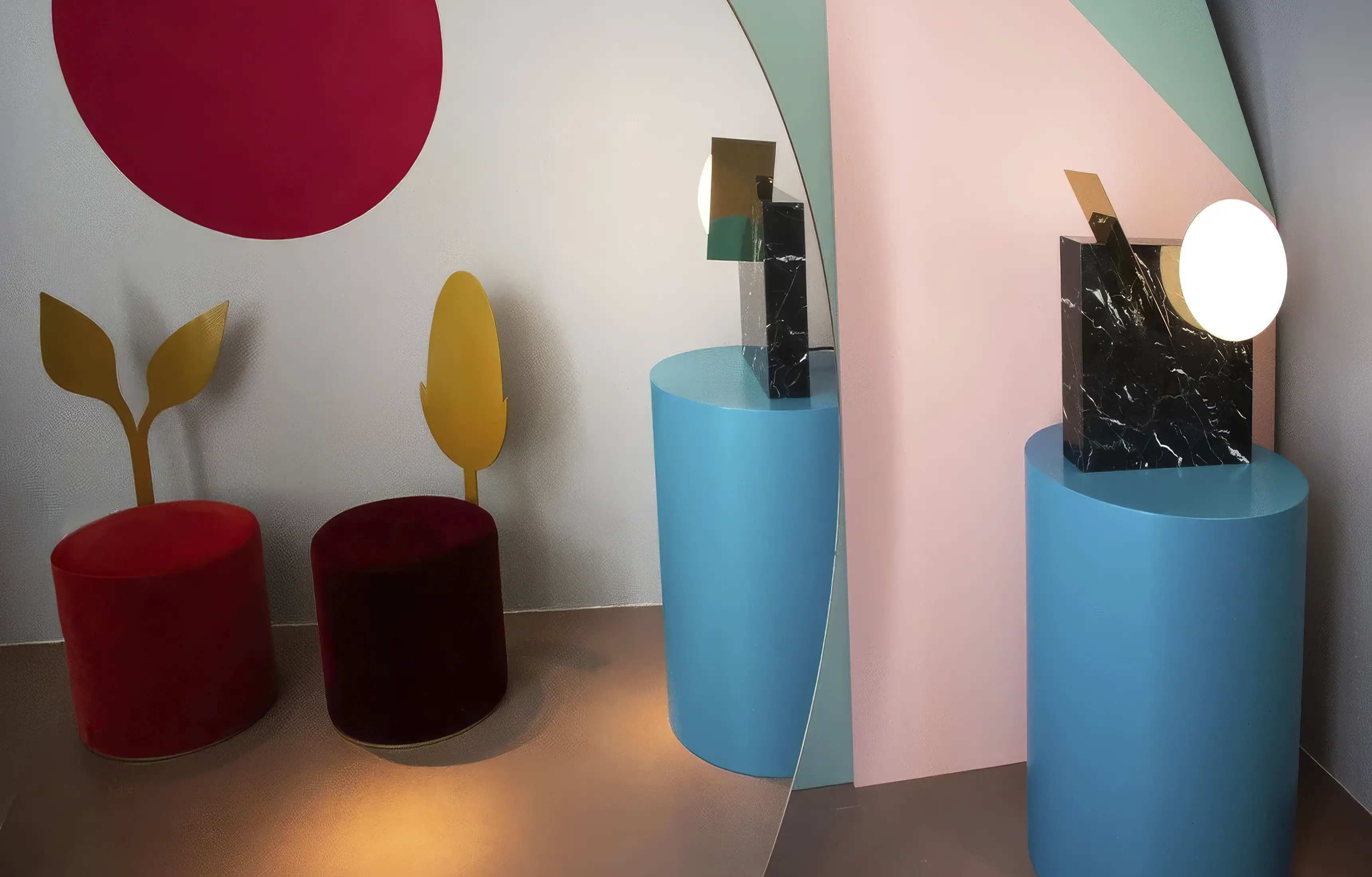
Two objects from that room carried the exhibition’s argument most clearly. The Bolle Cabinet, made by the Italian glass specialist Effetto Vetro, paired a pink and silver mirrored facade with legs finished in galvanised copper. A few metres away, the South Korean ceramicist Ahryun Lee showed Imaginary Drinks, a set of vividly glazed vases from the body of work she calls her Tasty collection. Both pieces were built to work in a room somebody might actually live in, and that is exactly the room Manfredi Style gave them.

What Aesthetic Visions actually was
Manfredi Style’s exhibition ran for the full six days of Milan Design Week, from 17 to 22 April 2018, with a press preview on the afternoon of 16 April. The venue was not a fair hall but a second-floor apartment on Via Palermo, in the cluster of streets around the Pinacoteca di Brera that has become one of Fuorisalone’s most consistent addresses for smaller, curated presentations. Studio MILO’s Arianna Crosetta and Federica Gosio designed the installation, setting contemporary furniture, ceramics and lighting inside rooms that kept their domestic proportions rather than being stripped back to gallery white.

The roster ran to twenty-one names across several continents, spanning furniture, art, lighting, installation and what the gallery grouped as special materials. Alongside the Bolle Cabinet and Ahryun Lee’s ceramics, the presentation included Rodrigo Bravo’s Monolith Series, Jorge Varela’s Cabinet II, Vito Nesta’s Corteo for Les Ottomans, work by Merve Kahraman and Paolo Giordano, and Hagit Pincovici’s Flamingo. The Indian studio Raw Material showed its Offcut 03 Coffee Table, built from the offcuts of stone slabs left over from larger commissions. It was a wide net for a single apartment, and the choice to stage that range in a lived-in space rather than a stand said as much about the gallery’s intent as any individual object did.

The Bolle Cabinet: colour, mirror and the mechanics of gloss
The Bolle Cabinet’s facade is built from mirrored glass in pink and silver, arranged so the two tones meet and reflect into each other across the surface rather than sitting as separate panels. A mirrored surface does not hold a single colour so much as collect whatever colour is around it, which means the cabinet’s appearance shifts with the room, the light and the objects placed near it. That is the specific effect of high-gloss, reflective glasswork: the surface returns light rather than holding it still, so the piece is never quite the same twice. Set inside a domestic room with shifting daylight, as it was at Via Palermo 5, the cabinet reads as a surface in active conversation with its surroundings.

The legs are finished in galvanised copper, a metal chosen for what it does with age as much as for its colour. Copper darkens and develops patina with handling and exposure, and a galvanised finish, built up by depositing a fine, even layer of metal electrolytically rather than applying it as paint, keeps that responsiveness intact instead of sealing it away under a lacquer coat. Paired with the glass above, the effect is a piece that combines two different relationships to time and light: glass that changes instantly with whatever is reflected in it, and metal that will change slowly over years of use. The cabinet is made by Effetto Vetro, an Italian workshop that specialises in coloured cut glass and crystal, producing furniture, lighting and mirrors largely for the interior design trade rather than for retail, which is a large part of why a piece this specific in its glasswork rarely surfaces outside a presentation like this one.

Manfredi Moretti’s curatorial model
Manfredi Style is the gallery founded and directed by Manfredi Moretti, who runs the business from Florence while the company itself is based in Singapore, with exhibitions staged in both cities as well as in Moscow and, for Milan Design Week, in rented apartment space in Brera. Moretti curates the gallery’s roster of more than ninety designers and artists around a stated interest in origin, history and uniqueness, drawing explicitly on Florence’s Renaissance tradition of artisan production as a reference point for how the gallery selects work. Beyond Effetto Vetro and Ahryun Lee, that roster has included the New York studio Bower, the ceramicist Hélène Morbu, and the Eindhoven collective VANTOT, made up of Esther Jongsma and Sam van Gurp.
That range, spanning cut glass, ceramics, industrial-style furniture and collective design practice, is the point of the gallery’s format rather than an accident of scheduling. A single apartment showing twenty-one designers only holds together if the person curating it is choosing pieces for how they will sit next to each other in a room, not simply filling a stand. The pairing of the Bolle Cabinet’s glass and metal with Ahryun Lee’s ceramics, in that light, was a curatorial decision as much as a scheduling one: two makers working in entirely different materials, put in the same domestic space because both were making an argument about colour and surface.

Ahryun Lee and the taste memory behind the Tasty collection
Ahryun Lee was born in Seoul in 1989 and studied ceramics at Seoul National University before completing a postgraduate degree at the Royal College of Art in London in 2016. She now works from a studio in Bavaria, Germany, taking her early Korean training in restrained, functional form and, by her own account, opening it up under the influence of the Royal College’s more expressive design culture into the playful, saturated colour and tactile surface that now defines her work.

The vases she showed at Manfredi Style, under the title Imaginary Drinks, belong to a larger body of work she calls the Tasty collection, which she has developed since 2017 around the idea of translating taste and childhood memory into ceramic form. Individual pieces carry names that read like a sweet shop: Melting Blue, taking its lumpy, faceted surface from the memory of a jawbreaker; Juicy Blue Pop and Crunch Blue, built around the memory of a blue jelly sweet; So Sour!, whose wiggling, puckered form is meant to read as the physical sensation of biting into a lemon. Lee has described the process as a kind of associative game, starting from a specific memory, finding the emotional register that memory carries, and only then translating it into colour and surface.
The technique behind that surface is worth describing precisely, because it explains why the vases read as handmade rather than manufactured even at a glance. Lee applies her glazes using a disposable syringe rather than dipping or spraying, building up colour and texture in controlled lines and dots across the clay. Crucially, she has said she never uses that method to seal a piece’s surface entirely, which keeps the glaze tactile and, in her own account, revisable, rather than locking the form under an even, factory-flat coat. Each vase in the Tasty collection is built and glazed individually as a result, which is why no two pieces in the series are identical even when they share a name.

Two design weeks, one collection, one year
The Imaginary Drinks series had already been shown once before Milan, at Materialia in Italy in 2017, and Lee has continued developing the wider Tasty collection in the years since, showing further work at Koibird in London in 2019 and at a solo exhibition in France in 2022. What connects Milan Design Week 2018 to the rest of that trajectory is a detail worth making explicit: eight months after Aesthetic Visions closed in Brera, Ahryun Lee appeared again on the international design calendar, this time at Design Miami/ 2018 in December, where J. Lohmann Gallery gave over its entire stand to a presentation of three Korean ceramicists working in three unrelated techniques.

That is not a coincidence of scheduling so much as a fact about how a working ceramicist’s career actually moves in a given year, one that a single fair listing or gallery release rarely makes visible on its own. Lee spent April in a curated apartment show in Milan and December on a commercial gallery stand at one of the world’s most closely watched collectible design fairs, on two different continents, carrying the same underlying practice, colour language and hand-applied glazing technique into both rooms. Read together, Milan and Miami are less two separate appearances than two different contexts for testing the same body of work: one inside a domestic apartment alongside twenty other designers, the other inside a commercial gallery’s dedicated stand alongside two other Korean ceramicists working in entirely different methods.

What the domestic setting gave the work
An apartment on the second floor of a building in Brera keeps a stair to climb, rooms with their doors intact, real proportions and, in this case, real daylight. That setting let a piece like the Bolle Cabinet do the thing it is actually built for, which is to sit in a room and change with it over the course of a day. Ahryun Lee’s vases gained from the same scale. A syringe-applied glaze built up in fine, tactile lines rewards being seen close, at eye level, on a shelf or a table, exactly the vantage point a domestic room provides as a matter of course.
That is what staging Aesthetic Visions above Milan’s streets gave the twenty-one designers Manfredi Style brought together that April: objects built for domestic life, seen in a domestic setting. The Bolle Cabinet’s mirrored facade and Ahryun Lee’s hand-glazed ceramics made very different arguments about colour, one through reflected light and industrial finish, the other through memory and touch, and a rented apartment in Brera was the room built to let both arguments be heard clearly.

Final thoughts
It would be easy to describe Aesthetic Visions as one more Fuorisalone stop among the hundreds that fill Milan every April, notable mainly for being hard to find. What the apartment on Via Palermo actually offered was more specific than that. Manfredi Moretti curated twenty-one designers into a handful of domestic rooms and let two of the strongest pieces in that room, a mirrored cabinet built to change with its surroundings and a set of ceramics built from a syringe-applied glaze that keeps its own surface tactile, be judged at the scale they were designed for.
The connection between Ahryun Lee’s April in Milan and her December in Miami, the same body of work carried from a curated apartment show to a commercial gallery stand on the other side of the world within a single year, is not a detail either fair’s own listing was built to surface. It is, though, the clearest evidence of what a working ceramicist’s practice actually looks like across twelve months: one collection, developed steadily since 2017, finding two very different rooms to be seen in. That is the argument Manfredi Style’s gallery above Milan’s streets was making all along, quietly and at close range, for six days in April 2018.
What was Manfredi Style’s exhibition at Milan Design Week 2018 called?
Aesthetic Visions, staged from 17 to 22 April 2018 on the second floor of a building at Via Palermo 5 in Milan’s Brera Design District.
Who founded Manfredi Style?
Manfredi Moretti, who directs the gallery from Florence while the company is based in Singapore, curating a roster of more than ninety designers and artists.
What is the Bolle Cabinet made from?
A facade of pink and silver mirrored glass, made by the Italian glass specialist Effetto Vetro, set on legs finished in galvanised copper.
Who made the Bolle Cabinet?
Effetto Vetro, an Italian workshop specialising in coloured cut glass and crystal furniture, lighting and mirrors.
Who is Ahryun Lee?
A South Korean ceramicist, born in Seoul in 1989, trained at Seoul National University and the Royal College of Art in London, now working from a studio in Bavaria, Germany.
What is Ahryun Lee’s Tasty collection?
A body of ceramic work she has developed since 2017, translating taste memories and childhood sensations into glazed ceramic form, with individual pieces named for the flavours or sweets that inspired them.
Did Ahryun Lee show anywhere else in 2018?
Yes. Eight months after Milan, she appeared at Design Miami/ 2018 in December as part of J. Lohmann Gallery’s stand Breaking the Mold: Contemporary Korean Ceramics.
How was the exhibition space at Via Palermo 5 different from a typical design week venue?
It was a second-floor apartment rather than a fair pavilion or showroom, keeping its domestic proportions and daylight so the twenty-one designers’ work could be seen in a room built for living rather than exhibiting.

Leave a Reply