
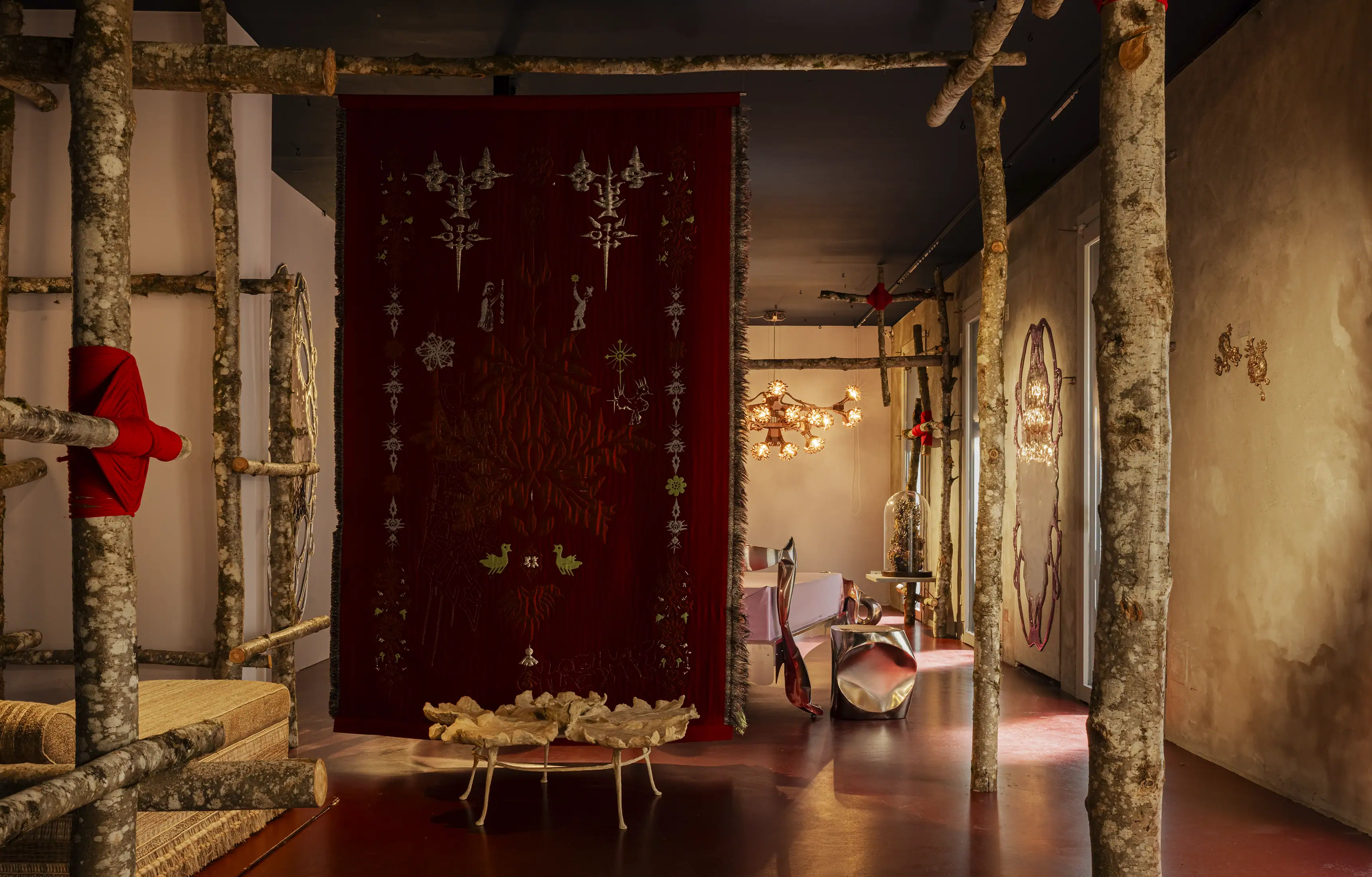
For Milan Design Week 2026, Nina Yashar’s gallery split into two exhibitions running under one roof. She curated one herself. The other she handed entirely to Valentina Ciuffi and Joseph Grima, the pair behind Alcova, who filled it with tapestries, wax and talismanic objects and called it La Casa Magica, a home read as ritual rather than shelter.
Introduction
La Casa Magica, curated by Valentina Ciuffi of Studio Vedèt with exhibition design by Joseph Grima’s studio Space Caviar, occupied part of Nilufar Gallery’s Via della Spiga showroom in Milan from 20 to 26 April 2026, during Milan Design Week. Fifteen designers and studios contributed objects exploring the home not as a functional space but as a container for belief, ritual and protection, working in tapestry, wax, metal and reflective surfaces.

That alone would make it a considered piece of Milan Design Week programming. What sharpens it is where it sat. Nina Yashar’s own curated show, Le Pied-à-terre Cosmopolite, occupied the same Via della Spiga building at the same time, built around an entirely different premise, a cosmopolitan collector’s brief city stay furnished with vintage and contemporary design. Rather than curate the whole gallery herself for the week, Yashar gave part of her own building to a different curatorial voice altogether, one working in a different register on a different argument.
That decision, not the tapestries or the wax objects individually, is the position worth taking seriously here. A gallerist forty-seven years into her career let two entirely separate ideas about what a home is run concurrently under her own roof, rather than smoothing them into one house style for the week.

What La Casa Magica actually looked like
Where Le Pied-à-terre Cosmopolite organised its rooms around function, an entrance, a living area, a dining area, La Casa Magica organised its objects around belief. The exhibition’s stated premise treated the home as a space that has always absorbed more than furniture, fears, desires, rituals and attempts at protection, and asked its fifteen contributors to make objects that behaved less like furnishings and more like devices for evoking those things directly.

Sonia Górecka contributed textile tapestries built to document a kind of historical memory rather than simply decorate a wall. Anita Morvillo showed sculpture-lamps, objects that refused the usual split between a light source and a standalone form. A group of contributors, Kym Ellery, Filippo Carandini and the practice AB+AC Architects among them, worked toward what the exhibition described as a ritualistic sacrality, objects with a deliberately ceremonial rather than domestic register. Materially, the show ran on tapestries, metals, wax and reflective metallic surfaces, a palette built to catch and distort light rather than simply furnish a room, reinforcing the sense of objects behaving like devices rather than décor.
Christian Pellizzari was a natural fit for that brief. Recognised by Giorgio Armani in 2014 before moving from fashion into installation work, Pellizzari has spent the years since exploring nature, mythology and altered states of perception, debuting the art side of his practice with Genetic Variations at NOMAD Capri in 2022 and returning to Nilufar in 2025 with a Murano glass piece built around the rye plant and its historical association with the hallucinogenic fungus Claviceps purpurea, a genuinely folkloric, talismanic subject for a designer to take on in glass. A designer already working at the exact intersection of material craft and inherited superstition was always going to end up in a show about the home’s ritual undercurrent rather than its furniture.

Two exhibitions, one gallery, one week
It is worth being precise about what actually happened at Via della Spiga during Milan Design Week 2026, because it is easy to read the two shows as a single event with two names. They were not. Le Pied-à-terre Cosmopolite, curated by Yashar herself, staged a specific fantasy: a cosmopolitan collector’s compact city apartment, mixing seventy years of vintage design icons with new work, organised entirely around how a room is actually used. La Casa Magica, curated by Ciuffi with Grima’s studio designing the space, staged something closer to an argument: that a home has always meant more than its function, and that a design object can carry ritual and symbolic weight most gallery presentations leave out entirely.

Both exhibitions ran the same six days, in the same building, under the same gallery’s name. Nilufar’s third 2026 presentation, Nilufar Grand Hotel, ran concurrently at the separate Nilufar Depot, curated by Yashar again and built around hospitality rather than either the domestic or the ritual register. Across the week, Yashar’s own gallery hosted three distinct arguments about what design owes to the idea of home, staged in two buildings, only one of which she curated personally.

The apartment format itself was everywhere across Milan that week, not just at Nilufar. Eight separate domestic interiors opened their doors across the city during Milan Design Week 2026, ranging from industrial spaces near Porta Genova to historic residences in Brera, each staging some version of design inside a lived-in room rather than a conventional stand. Against that backdrop, the more ordinary choice would have been for La Casa Magica to simply be Nilufar’s own entry in the same trend, another well-appointed apartment show among eight. Handing the brief to Ciuffi and Grima instead, and letting them push the premise toward ritual and symbolism rather than another liveable interior, is what kept it from reading as one more entry on that list.

Valentina Ciuffi: from semiotics under Umberto Eco to co-founding Alcova
Ciuffi’s route into curating design did not start in a gallery. She studied the semiotics of architecture in Bologna, on a programme directed by the semiotician and novelist Umberto Eco, and spent roughly a decade afterward working as a journalist, including a stint at the design magazine Abitare, before founding her own practice, Studio Vedèt, in 2016. That training shows directly in how La Casa Magica is framed: rather than asking what a chair or a lamp does, the exhibition asks what a chair or a lamp means, treating objects the way semiotics treats language, as signs that carry meaning beyond their stated function.

In 2018, Ciuffi co-founded Alcova with Joseph Grima, a design platform that has since become one of the more closely watched fixtures of Milan and Miami’s design calendars, known for staging work inside disused or overlooked buildings rather than conventional exhibition halls. Alcova’s Miami editions alone have run inside a motel in 2023, the city’s oldest hotel, the Miami River Inn, dating to 1908, in 2024, and returned to that same historic hotel again in 2025, with a move to three separate historic buildings across Mexico City announced for Art Week 2027. Each edition shares a working method with La Casa Magica even though the two projects are formally separate: take a genuine building with its own history, and let the design shown inside respond to what that building already means rather than treating it as a neutral backdrop. The difference this time is that the building in question was not one Ciuffi and Grima found and adapted themselves. It was already Nina Yashar’s.

Space Caviar: a decade spent asking what a home actually is
Joseph Grima’s studio, Space Caviar, founded in Milan in 2013 with Tamar Shafrir, brings its own decade of research on domestic space to the exhibition design here. The studio’s SQM: The Home Does Not Exist project and its accompanying publication SQM: The Quantified Home, which won a gold medal at the European Design Awards in 2015, examined how the home has shifted from a private, self-contained space into an environment increasingly shaped and measured by data and technology. Grima has spent years asking the same underlying question La Casa Magica asks, what a home actually is once its comfortable, functional surface is set aside, only previously through the lens of surveillance and connectivity rather than ritual and belief.

That is the connection worth naming plainly: La Casa Magica is not a one-off theme dreamed up for a single Milan Design Week slot. It is the same inquiry Space Caviar has been running for over a decade, redirected this year from the technological register toward the symbolic one, applied for the first time inside somebody else’s gallery rather than a building Grima and Ciuffi found and adapted themselves through Alcova. Grima’s practice has also handled historical material directly before, curating a 2018 Fuorisalone retrospective on the architect Lina Bo Bardi’s collaborative studio work from 1948 to 1951, which suggests his interest in La Casa Magica’s premise, that a domestic object can carry meaning inherited from somewhere else entirely, is a genuine research thread rather than a theme picked to suit the brief.

Frequently asked questions
What was La Casa Magica?
An exhibition at Nilufar Gallery in Milan, curated by Valentina Ciuffi of Studio Vedèt with exhibition design by Joseph Grima’s studio Space Caviar, exploring the home as a symbolic and ritual space rather than a purely functional one.
Where and when did it take place?
At Nilufar Gallery, Via della Spiga 32, Milan, from 20 to 26 April 2026, during Milan Design Week.
Who curated La Casa Magica?
Valentina Ciuffi, founder of Studio Vedèt and co-founder of the design platform Alcova, with exhibition design by Joseph Grima’s studio Space Caviar.
How is this different from Le Pied-à-terre Cosmopolite, also staged at Nilufar?
Le Pied-à-terre Cosmopolite was curated by Nilufar’s founder Nina Yashar herself and staged a collector’s compact city apartment. La Casa Magica ran concurrently in the same building but was curated by Valentina Ciuffi around an entirely different premise, the home as a symbolic and ritual space rather than a lived-in one.
Which designers featured in La Casa Magica?
Fifteen designers and studios, including Sonia Górecka, Anita Morvillo, Kym Ellery, Filippo Carandini, AB+AC Architects, Anna Zoe Hamm, Clara Schweers, Made By Astronauts, David Aliperti, Flora Manon, Davide Monaldi, Pauline Esparon, Emily Thurman, Etienne Marc and Christian Pellizzari.
What is Alcova, and how does it relate to this exhibition?
Alcova is a design platform co-founded by Valentina Ciuffi and Joseph Grima in 2018, known for staging design fairs inside disused historic buildings in Milan and Miami. La Casa Magica is a separate project from Alcova, but is curated and designed by the same pair.
Can La Casa Magica still be visited?
No. The exhibition ran for six days, from 20 to 26 April 2026, and has since closed.

Final thoughts
The easy way to cover Milan Design Week is to treat every gallery as a single voice for the week, one theme, one press release, one story. What actually happened inside Nilufar’s Via della Spiga building in April 2026 was more interesting than that. Nina Yashar, forty-seven years into running the gallery, spent one week hosting two unrelated arguments about what a home is for, hers built around a collector’s lived-in apartment, Valentina Ciuffi and Joseph Grima’s built around ritual, belief and the parts of domestic life that furniture alone does not explain.
That the second argument came from Alcova’s own founders, working inside somebody else’s building rather than one they had found and adapted themselves, is the detail worth remembering after the tapestries and the wax objects are packed away. Grima has spent a decade asking what a home actually is once its comfortable surface is set aside. La Casa Magica is that same question, asked one more time, this time inside Nina Yashar’s own gallery instead of Alcova’s.

Leave a Reply