
ART & CULTURE · LONDON
Reading time: 11 minMoss, meltwater, fog and four hundred and fifty small geometric models made from copper wire, cardboard and Lego. Tate Modern’s 2019 retrospective In Real Life traced four decades of Olafur Eliasson’s work, from a 1990 light projection made at art school to a bronze cast of a vanished glacier. The show’s quietest room held its strongest argument: the research that eventually became the shimmering facade of Reykjavik’s concert hall.
Olafur Eliasson: In Real Life opened at Tate Modern on 11 July 2019 and ran until 5 January 2020, curated by Mark Godfrey, then Senior Curator of International Art, with Emma Lewis, Assistant Curator. It was the largest exhibition of the Danish-Icelandic artist’s work ever staged in the United Kingdom, bringing together around 40 works made between 1990 and 2019, the great majority of them never previously shown in this country.

Olafur Eliasson Beauty 1993 / Photography: Anders Sune Berg Courtesy of the artist; neugerriemschneider, Berlin; Tanya Bonakdar Gallery.
The show moved chronologically and thematically at once, from a set of light-based experiments Eliasson made as a student to the glass, ice and bronze works he was producing at the time of the exhibition, by way of the kaleidoscopes, waterfalls and coloured-fog rooms that made his name in the 2000s. It ended, deliberately, not with a single sculpture but with a room of research: the Model room, some 450 prototypes and geometric studies built with the Icelandic architect and mathematician Einar Thorsteinn between 1996 and Thorsteinn’s death in 2015.
That closing room is where this piece starts, because it is the part of the exhibition that explains the rest of it. Eliasson’s finished installations, the fog, the coloured light, the suspended spheres, are usually read as effects. The Model room shows them as the visible surface of a much longer geometric investigation, one that also produced a building most visitors to the show will have seen photographs of without knowing the connection: the crystalline south facade of Reykjavik’s Harpa concert hall.

Olafur Eliasson Wavemachines, 1995 Photography: Anders Sune Berg Kunstmuseum Basel © 1995 Olafur Eliasson
From a rain window to a spinning kaleidoscope: what visitors actually walked into
The exhibition opened outside, on Tate Modern’s riverside terrace, with Waterfall (2019), a scaffolding tower some ten metres high pumping river-fed water over its edge in a continuous sheet, stripped of any decorative casing so the mechanism, the pump, the pipework, the steel frame, was as visible as the water itself.

Olafur Eliasson Moss wall, 1994 / Photography: Anders Sune Berg Courtesy the artist; neugerriemschneider, Berlin; Tanya Bonakdar Gallery, New York / Los Angeles © 1994 Olafur Eliasson
Inside, an early works room gathered the pieces Eliasson made while still a student at the Royal Danish Academy of Fine Arts: Window projection (1990), a beam of light thrown through a window onto the gallery wall so that passers-by outside became part of the image; Wannabe (1991); I grew up in solitude and silence (1991); and Wavemachines (1995), motorised troughs of water rippled by hidden mechanisms into repeating patterns. Moss wall (1994), a wall entirely covered in Scandinavian reindeer lichen, filled the room with a faint, damp, forest smell that visitors reported noticing before they saw the piece itself. Beauty (1993) used a fine mist and a single spotlight to produce a rainbow that existed only from certain angles, disappearing the moment a visitor moved to try to hold it in the eye.
A kaleidoscope room followed, built around Your spiral view (2002), a walk-through steel tunnel lined with mirrored triangles that fractured the visitor’s own reflection into a repeating geometric pattern, and Your planetary window (2019), unveiled at Tate for the first time. Suspended overhead was In real life (2019), the sphere that gave the exhibition its title: a geodesic structure of interlocking mirrored and coloured-glass triangles, hung so that it caught and multiplied whatever light and colour was moving through the room beneath it, different for every visitor who stood under it.

Olafur Eliasson Waterfall, 2019 / Photography: Anders Sune Berg Courtesy the artist; neugerriemschneider, Berlin; Tanya Bonakdar Gallery, New York / Los Angeles © 2019 Olafur Eliasson
The physicist who never finished physics: Eliasson’s route to Berlin
Olafur Eliasson was born in Copenhagen on 5 February 1967 to Icelandic parents who had moved to Denmark the previous year. His parents separated when he was eight, and while he grew up mainly in Copenhagen, he spent long stretches of his childhood and adolescence in Iceland, where his father, an artist, had returned to live and paint. That split upbringing, city winters and Icelandic summers spent among glaciers, lava fields and hot springs, is the biographical fact most often reached for to explain his work, and it holds up better than most explanations of that kind: the landscape he describes returning to as a teenager is, materially, the landscape several of his best-known works are built from.

He studied at the Royal Danish Academy of Fine Arts in Copenhagen from 1989 to 1995, and in 1995, the year he graduated, founded Studio Olafur Eliasson in Berlin. What began as a personal workspace has grown into an operation the studio itself describes as a laboratory for spatial research: architects, technicians, art historians, archivists, filmmakers, cooks and administrators, working alongside Eliasson on installations, public commissions and the studio’s own research projects, several of which sit well outside a conventional art practice, including sustainable energy initiatives and work with policymakers on climate-related design.

Olafur Eliasson in collaboration with Einar Thorsteinn – Model room – 2003 / Photo: Anders Sune Berg / Moderna Museet, Stockholm. Purchase 2015 funded by The Anna-Stina Malmborg and Gunnar / Höglund Foundation / © 2003 Olafur Eliasson
Four hundred and fifty models, and the mathematician most visitors walked past
The Model room, first assembled in 2003 and expanded continuously since, is a long steel-legged table carrying roughly 450 small constructions: geodesic fragments, polyhedra, tessellated surfaces and folded paper studies, made from copper wire, cardboard, photocopied paper, Lego bricks, wood, foam and rubber balls, arranged on a specially built nonorthogonal display system so that no two objects sit at quite the same angle to the room. It documents nineteen years of collaboration between Eliasson’s studio and Einar Thorsteinn (1942 to 2015), and it is, structurally, the opposite of everything else in the exhibition: nothing in it is finished, nothing in it is meant to be looked at from a fixed point, and most of it was never intended to leave the studio.
Thorsteinn’s own background explains why the room looks the way it does. Trained as an architect at the Technical University of Hannover, he spent his career specialising in polyhedral and spherical geometry, working directly in the tradition of Buckminster Fuller, and between 1969 and 1972 he worked with the German architect Frei Otto on the tensile roof structures of the Munich Olympiapark, built for the 1972 Summer Olympics, before returning to Iceland to establish his own geometric research practice. He later applied the same structural thinking to a very different brief, designing mobile lunar research laboratories with the engineer Guillermo Trotti for NASA. He met Eliasson in the mid-1990s, and what began as occasional conversation became a formal, continuous studio collaboration from 1996 onward, run alongside Eliasson’s own production rather than folded into it.
Shortly after Thorsteinn’s death in 2015, Moderna Museet in Stockholm acquired the Model room as a permanent part of its collection, describing it as a key work in Eliasson’s practice. It has since travelled to a handful of institutions willing to take on a piece that keeps growing, Tate Modern among them in 2019, and it normally lives in Stockholm between loans.

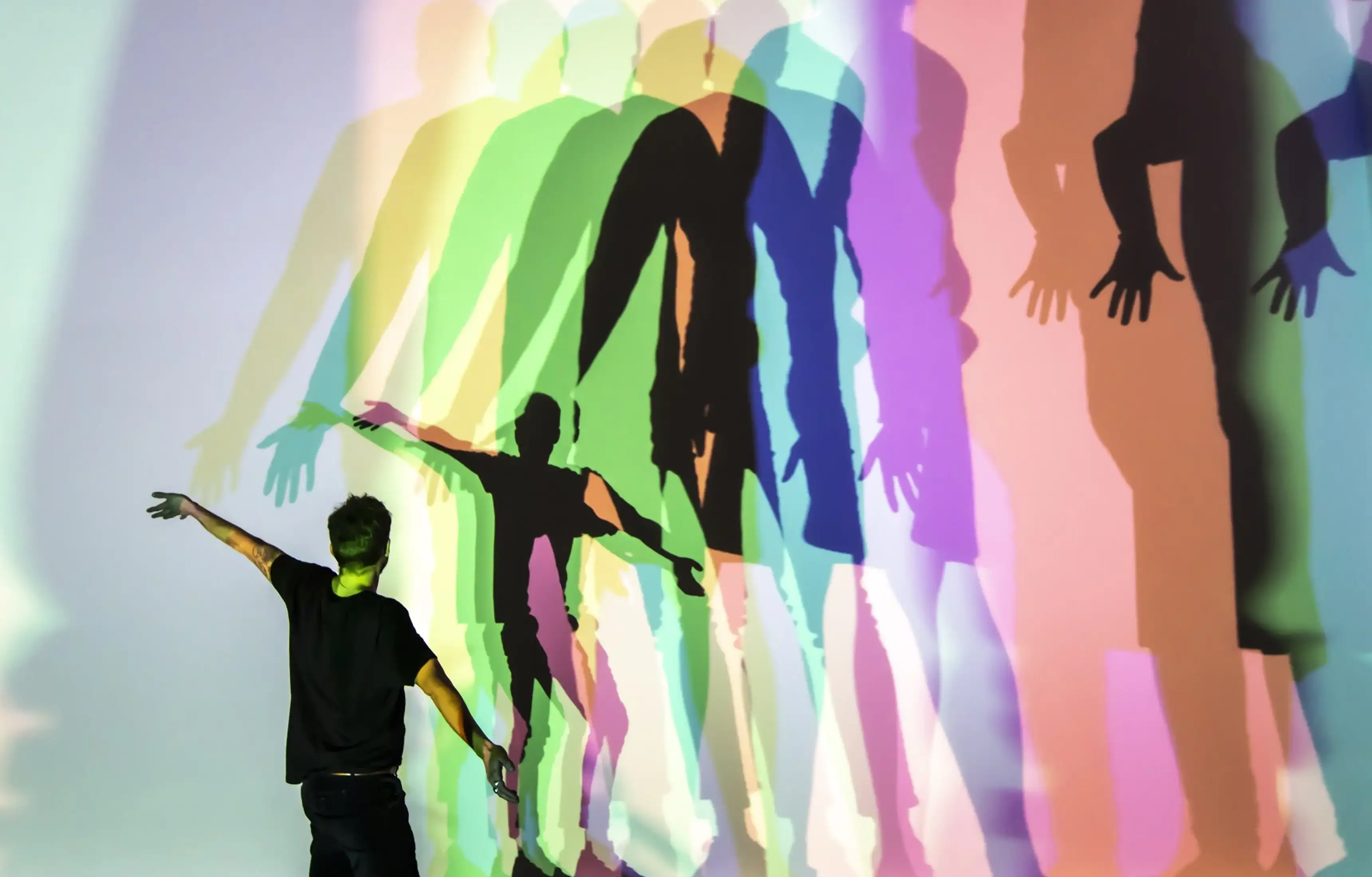
Olafur Eliasson Your uncertain shadow (colour), 2010 / Photography: María del Pilar García Ayensa / Studio Olafur Eliasson Thyssen-Bornemisza Art Contemporary Collection, Vienna © 2010 Olafur Eliasson
How a tabletop shape from the 1980s became a concert hall’s skin
Among the models in that room, one geometric unit does more work than any other: the quasi brick, a twelve-sided module of rhomboid and hexagonal faces that Thorsteinn had developed on his own in the 1980s, well before he and Eliasson began working together, as a shape that could stack and interlock without gaps in three dimensions. In 2002, the same year Eliasson made Your spiral view, the two of them began investigating what the quasi brick could do outside a model box: whether a form developed for tabletop geometric research could be built at architectural scale.

(1) Olafur Eliasson Your spiral view, 2002 / Photography: Anders Sune Berg Boros Collection, Berlin © 2002 Olafur Eliasson
The answer stands in Reykjavik. Between 2005 and 2011, Eliasson’s studio worked with Henning Larsen Architects on the facades of the Harpa Concert Hall and Conference Centre, and the building’s south wall is built from three-dimensional quasi bricks in steel and colour-effect filter glass, panels that shift colour according to the angle of the light and the position of the viewer, deliberately echoing the crystalline basalt columns found across the Icelandic coastline. The other facades use two-dimensional patterns derived from the same geometry. It is one of the clearest cases in contemporary architecture of a research model made in an artist’s studio becoming, without significant translation, the outer skin of a public building used by hundreds of thousands of people a year.

Olafur Eliasson Your planetary window, 2019 Photography: Anders Sune Berg Courtesy the artist; neugerriemschneider, Berlin; Tanya Bonakdar Gallery, New York / Los Angeles © 2019 Olafur Eliasson
That is the argument the Model room was quietly making inside Tate Modern’s final gallery, and it is easy to miss if the room is read only as an archive. It is not a record of ideas Eliasson had already used elsewhere. It is the visible working-out of a shape that already exists, at full scale, in a concert hall six hundred miles away, and several of the models on that table are earlier drafts of a wall that visitors to Reykjavik walk past every day without necessarily knowing its origin was a table of Lego and copper wire in a Berlin studio.

Olafur Eliasson In real life, 2019 / Photography: Anders Sune Berg Courtesy of the artist; neugerriemschneider, Berlin; Tanya Bonakdar Gallery, New York / Los Angeles © 2019 Olafur Eliasson
Ice, twice moved to make a point, and the works that followed it
The exhibition’s final rooms turned from geometry to glaciers, framed by the scale of the loss involved: the Greenland ice sheet has been losing an estimated 200 to 300 billion tonnes of ice a year. Glacial currents (2018) arranged fragments of glacial ice directly onto sheets of pigment wash, letting the ice’s own melt pattern draw the image as it disappeared. The presence of absence pavilion (2019) was a bronze cast, not of a glacier, but of the empty space a melting block of glacial ice had left behind, a sculpture of an absence rather than an object. Glacial spherical flare (2019) used glass made from rock particles eroded by glacial movement, fashioned into a lens-like form that scattered light across the surrounding wall.

Olafur Eliasson and Minik Rosing Ice Watch, 2014 Supported by Bloomberg Photography: Charlie Forgham Bailey © 2018 Olafur Eliasson and Minik Rosing
Artexhibition booking
Behind all three sat Ice watch, Eliasson’s most widely seen glacial work, made with the Greenland geologist Minik Rosing and staged three times before it reached London. The first placed twelve blocks of glacial ice in Copenhagen’s City Hall Square in October 2014, timed to the publication of the UN Intergovernmental Panel on Climate Change’s Fifth Assessment Report. The second moved twelve blocks to the Place du Panthéon in Paris in December 2015, to coincide with the COP21 negotiations that produced the Paris Agreement. The third and largest arrived in London on 11 December 2018: 24 blocks in a circle outside Tate Modern and six more outside Bloomberg’s European headquarters, thirty in total, cut from ice that had calved from the Greenland ice sheet into the Nuup Kangerlua fjord near Nuuk, individual pieces weighing between 1.5 and 6 tonnes. Eliasson and Rosing shipped the ice in nine refrigerated containers to Immingham before it travelled on to London, timing the installation to COP24 in Katowice and to the same IPCC warning, issued weeks earlier, that the world had roughly twelve years left to limit the most severe effects of climate change. Visitors to the Tate Modern piazza that December could rest a hand on ice that had, weeks before, still been part of Greenland.

Olafur Eliasson The presence of absence pavilion, 2019 / Photography: Anders Sune Berg Courtesy the artist; neugerriemschneider, Berlin; Tanya Bonakdar Gallery, New York / Los Angeles © 2019 Olafur Eliasson
The lamp that turned an art practice into a company
The exhibition’s final gallery, titled the Expanded Studio, stepped outside the artwork entirely to show what the studio does when it is not making objects for a museum wall. Its clearest example is Little Sun, a solar-powered LED lamp Eliasson designed with the Danish engineer Frederik Ottesen, launched at Tate Modern in July 2012. The lamp itself is a small sculptural object, a flower-shaped disc of yellow, orange or clear plastic mounted on a solar panel, but its purpose sits entirely outside the gallery: roughly 1.1 billion people worldwide still live without reliable access to electricity, most of them relying on kerosene lighting that is expensive, unhealthy to breathe and a fire risk. Little Sun sells the lamp through a social business model, at a lower price in off-grid regions of sub-Saharan Africa than in Europe, and reinvests in local distribution networks run largely by women. By the time of the Tate retrospective, the initiative had reached several million people and expanded into solar phone chargers alongside the original lamp. It is, among the works on the exhibition’s title wall, the one that never appears in a museum at all once it leaves the shop.

Glacial spherical flare, 2019 Photography: Anders Sune Berg Courtesy the artist; neugerriemschneider, Berlin; Tanya Bonakdar Gallery, New York / Los Angeles © 2019 Olafur Eliasson
Artexhibition booking
Final thoughts
It is easy to describe In Real Life as a show about atmosphere, fog, coloured light, reflected spheres, and stop there. Every one of those rooms earns that description. But the exhibition’s own structure argued for something more specific: that Eliasson’s perceptual effects and his geometric research are the same project, worked at two different scales, and that the Model room was placed last because it is the key to everything that came before it.
The strongest evidence for that argument is not in the exhibition catalogue. It is standing in Reykjavik, in a concert hall wall built from a shape a mathematician worked out on a table in the 1980s and an artist helped build at architectural scale two decades later. Ice watch makes a similarly direct case in a different register: art moved physically, three times, in step with the exact diplomatic and scientific moments it was responding to, so that the object and the argument arrived in the same place at the same time.
In Real Life closed in January 2020, but its two clearest arguments are still standing. One is a wall in Iceland that hundreds of thousands of people walk past each year. The other is a lamp, reaching millions of people who will likely never see a museum at all.
When did Olafur Eliasson: In Real Life run at Tate Modern?
It ran from 11 July 2019 to 5 January 2020, curated by Mark Godfrey with Emma Lewis.
How many works were in the exhibition?
Around 40 works, spanning from 1990 to 2019, the majority of which had never previously been shown in the United Kingdom.
What is the Model room, and who is Einar Thorsteinn?
It is a table of roughly 450 geometric prototypes and studies, made from materials including copper wire, cardboard, Lego and wood, documenting a collaboration between Olafur Eliasson’s studio and the Icelandic architect Einar Thorsteinn between 1996 and Thorsteinn’s death in 2015. It has been part of the Moderna Museet collection in Stockholm since shortly after Thorsteinn’s death.
How is the Model room connected to Harpa concert hall in Reykjavik?
Einar Thorsteinn developed the twelve-sided quasi brick module in the 1980s. He and Eliasson began exploring its architectural use in 2002, and between 2005 and 2011 Eliasson’s studio used the quasi brick, built at full scale in steel and colour-effect glass, for the facades of Harpa, designed with Henning Larsen Architects.
What was Ice watch, and where was it shown?
A work made with geologist Minik Rosing, using large blocks of glacial ice cut from Greenland’s coast. It was staged in Copenhagen in 2014, Paris in 2015, and London in December 2018, when 24 blocks were arranged outside Tate Modern and 6 outside Bloomberg’s European headquarters.
What is Little Sun?
A solar-powered LED lamp designed by Olafur Eliasson with engineer Frederik Ottesen, launched at Tate Modern in 2012 as a social business bringing affordable off-grid lighting to communities without reliable electricity access.
Is Olafur Eliasson: In Real Life still open?
No. The exhibition closed at Tate Modern on 5 January 2020.

Leave a Reply