
Automotive Design · Goodwood
Reading Time: 9 minutes
In 2017, Rolls-Royce‘s design team took the one part of a car dashboard that usually hides its technology and turned it into a glass-fronted exhibition space instead. Since then, the marque has commissioned a haute couturier, an heir to a Hermès illustrator’s archive, and painters working through Shanghai’s Private Office to fill it. The result is a genuinely new kind of gallery: private, mobile, and driven rather than visited.
Introduction
Most dashboards spend their design budget hiding things: wiring, ducting, the architecture that makes the rest of the car work. In July 2017, Rolls-Royce’s design team, led by then Director of Design Giles Taylor, did the opposite. Phantom VIII arrived with a single, uninterrupted sheet of glass running the width of the fascia, with a cavity behind it built specifically to hold commissioned art. Rolls-Royce named the space The Gallery, and its then chief executive, Torsten Müller-Ötvös, described the idea plainly: “bringing art, within art.”
That is the frame worth applying to everything Rolls-Royce has commissioned into that space since, because eight years on, the Phantom Gallery has become something closer to a standing exhibition programme than a single design feature. Haute couture, historic illustration, and Chinese mural painting have all been translated into it, each commission asking the same underlying design question: what does an artist’s technique become when the canvas is fixed to a car, unrepeatable, and owned by one person rather than hung in a public room.

The couturier who lent the car her own collection’s name
The most technically ambitious answer so far arrived in 2023, when Rolls-Royce unveiled Phantom Syntopia, developed over four years between the Bespoke Collective at Goodwood and the Amsterdam atelier of the Dutch haute couturière Iris van Herpen. Van Herpen has spent nearly two decades building a couture house around biomimicry, translating the mechanics of natural forms, water, wind, cellular structure, into garments using techniques closer to industrial design than traditional dressmaking: electromagnetic weaving, three-dimensional leather sculpting, and couture-grade 3D printing. Her clients have included Cate Blanchett, Björk and Beyoncé, and her collections show twice yearly at Paris Haute Couture Week.
The car does not take its name from the Phantom nameplate alone. Syntopia was the name of van Herpen’s own 2018 haute couture collection, built on the same biomimicry principles later adapted for the car. Rolls-Royce borrowed her collection’s title rather than inventing a new one for the commission, a detail that tends not to survive most coverage of the car and that says something about how the collaboration actually worked: this was van Herpen’s design language applied to a Rolls-Royce, not a Rolls-Royce restyled to look like her work.

The translation shows most clearly in the Starlight Headliner, by some distance the most complex ceiling Rolls-Royce has ever built into a production interior. It combines 162 hand-applied glass organza flower petals with 995 individual fibre-optic lights, a single process that reportedly took more than 300 hours to complete. The exterior finish, Liquid Noir, layers purple, blue, magenta and gold pigments to produce a paint that shifts colour with the light, achieved with techniques adapted from van Herpen’s own iridescent textile work. Rolls-Royce’s Bespoke leadership at the time, Gavin Hartley as Head of Bespoke Design and Jonathan Simms as General Manager of Bespoke, worked directly with van Herpen’s Amsterdam team to move her techniques from fabric to fixed automotive materials, including a bespoke cedarwood fragrance released through a mechanism built into the headrests, itself an unusual brief for a couture house to be asked to solve.
Van Herpen’s own description of the commission, “I wanted this to become a state-of-the-art experience being overwhelmed by the forces of nature,” reads as couture language until it is set against what actually had to be solved. A dress can move with a body and respond to how fabric drapes on a moving form. A car interior is fixed, load-bearing and has to survive years of use, heat and vibration, none of which apply to a runway garment. The three-dimensional textile sculptures in Phantom Syntopia’s cabin, built using the same tufting and rug-making techniques as van Herpen’s couture ateliers, had to be engineered to hold their form permanently rather than for the length of a single show.

A landscape painted for a client who never saw it
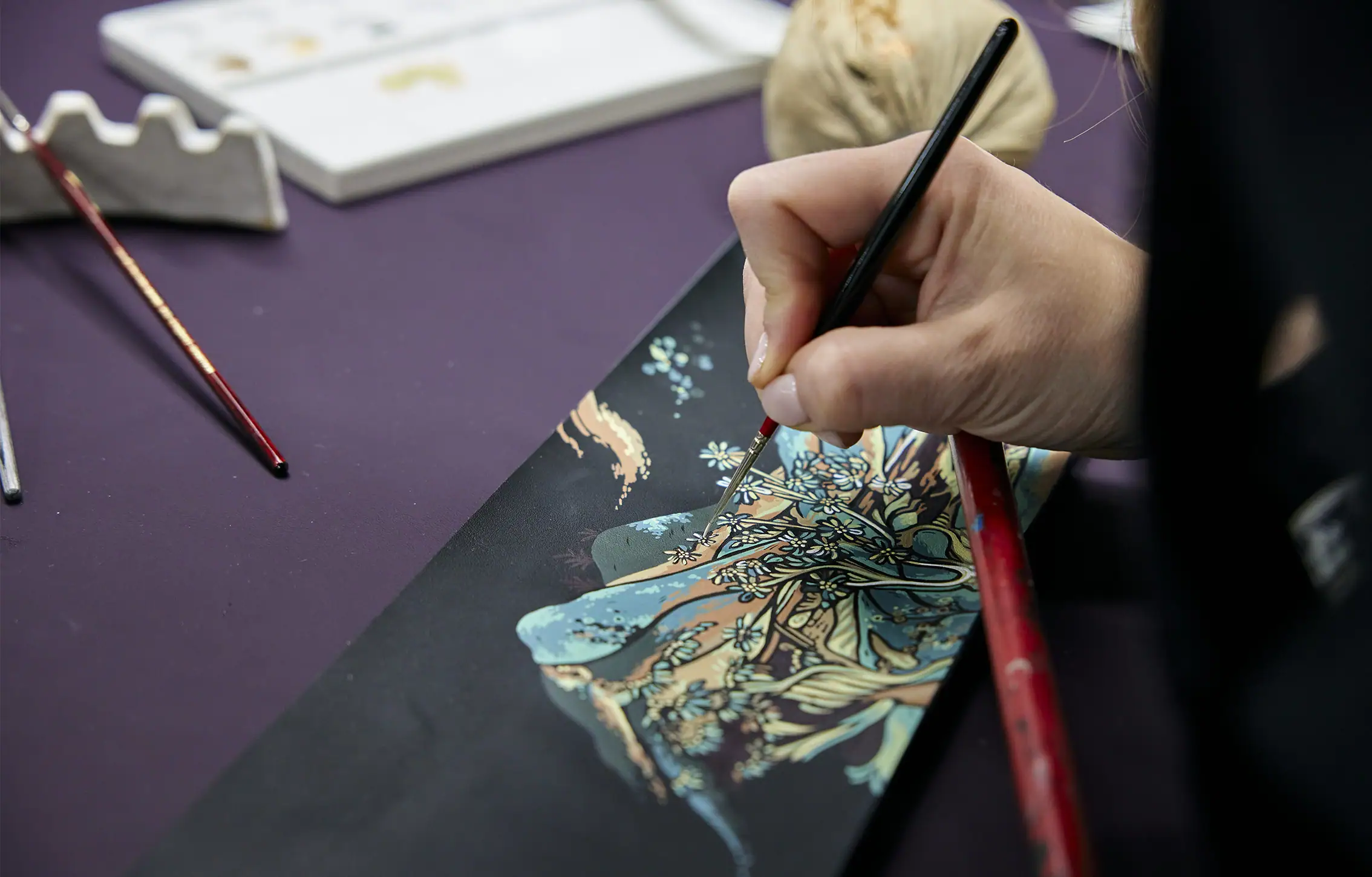
Two years after Phantom Syntopia, Rolls-Royce presented a very different kind of Gallery commission: three Bespoke Phantoms inspired by the murals of Dunhuang, a Chinese Buddhist cave complex whose paintings date back more than a thousand years. Commissioned through Private Office Shanghai, the centrepiece of each car’s interior is a hand-painted Gallery artwork depicting a landscape on black leather, finished with a Silken Spirit motif embroidered in white and black thread to evoke apsaras, the flying celestial figures common to the Dunhuang murals and to Buddhist art more broadly.

Where Phantom Syntopia translated a living designer’s contemporary technique into the car, the Dunhuang Phantoms did the reverse: translating a millennium-old painting tradition into a medium, embroidered leather inside a glass-fronted automotive fascia, that has no real precedent in Chinese art history at all. It is a genuinely difficult brief. A painting made for a temple wall assumes stillness, scale and public devotion; a painting made for a car dashboard has to work at a fraction of the size, survive vibration and light exposure, and be legible to an audience of one.
Private Office Shanghai exists precisely for commissions like this, a dedicated arm of Rolls-Royce’s Bespoke operation built to work with clients whose reference points sit entirely outside the marque’s usual European and North American design vocabulary. The Dunhuang Phantoms are the clearest evidence yet of what that office actually produces when given a serious brief: not a generically “Asian-inspired” motif applied to a Western car, but a specific, art-historically literate translation of one particular archive of paintings into a medium that archive was never made to survive in.

Three commissions, one gallery wall
The range of what the Phantom Gallery can hold is easiest to see by placing three recent commissions next to each other. The Anthology Gallery, built for the Phantom Centenary Private Collection marking a hundred years of the Phantom nameplate in 2025, is the most literal: fifty 3D-printed, vertically brushed aluminium fins, interlaced like the pages of a book, each one sculpted with letters that spell out quotations drawn from a century of press coverage of the car. It is a gallery about the car’s own critical reception, built to frame the driver’s view through the windscreen.
Phantom Oribe took a different route entirely, developed in collaboration with Hermès. Its Gallery artwork is based on a design by the French illustrator Pierre Péron, who died in 1988 and whose work over several decades produced many of Hermès’s most recognisable scarf patterns, including the house’s signature horse motif. The artwork is hand-painted onto open-pore Royal Walnut and staged behind glass exactly as Péron’s original illustrations would be framed in a gallery, a rare instance of a fashion house’s own archive being licensed into a car rather than a new commission being made for one.
The Koa Phantom takes the simplest brief of the three and executes it with the most restraint: a single panel of rare, open-pore Hawaiian koa wood, selected and bookmatched so its grain forms a continuous, landscape-like composition across the Gallery space. There is no applied artwork here at all. The wood itself, chosen for a client with what Rolls-Royce describes as a personal connection to Hawaii, is treated as the finished piece.

Four new techniques, and who is leading them now
Rolls-Royce has also used the Gallery format outside single-client commissions, most recently at London Craft Week 2026, where the marque unveiled four new craft techniques built at Phantom Gallery scale: three-dimensional leather hand-sculpting, three-dimensional metal hand-sculpting, three-dimensional veneer work, and hand-applied beadwork. London Craft Week itself, founded in 2015, now runs over 1,000 makers from more than 30 countries each year, and Rolls-Royce’s presence there functions less as a product launch than as a demonstration piece for the Bespoke workshop’s own capability, shown to an audience of craftspeople rather than car buyers.

That programme now sits under Martina Starke, who became Rolls-Royce’s Head of Bespoke Design in 2024 after a career at BMW Group that began in 2001 and included years running Designworks, BMW’s innovation studio. Starke trained first as a textile apprentice before moving into formal design study, a background that maps unusually well onto a role built around fabric, embroidery and applied surface craft. Her own description of the job is blunt: “everything we do is client-driven, we turn clients’ dreams into reality,” built on research into a client’s own passions rather than a house aesthetic imposed from outside. Under her design leadership and Domagoj Dukec’s direction of the wider design language, the Gallery has moved from a single spectacular commission every few years toward something closer to a standing craft programme, of which the four London Craft Week techniques are the most recent public instalment.

What the Gallery actually is
Rolls-Royce has described the format, in its own materials, as a new typology: a private, mobile exhibition space, experienced not in a public gallery but in moments of quiet reflection. That framing is worth taking seriously rather than treating as marketing language, because it identifies a real and fairly unusual design problem. A public gallery commission has an audience, a run of shows, and a wall that will hold other artists’ work in future. A Phantom Gallery commission has an audience of one owner and their guests, a single fixed location for the rest of the car’s life, and a physical context, vibration, light through a windscreen, proximity to a driver’s hands on the wheel, that no conventional exhibition space has to solve for. Van Herpen’s iridescent paint, the Dunhuang embroiderers’ leather landscape, and Péron’s licensed Hermès illustration are each, in their own way, an answer to that same unusual brief.

Frequently asked questions
What is the Rolls-Royce Phantom Gallery?
A glass-fronted space built into the Phantom’s dashboard, introduced in 2017, designed specifically to hold commissioned artwork. Rolls-Royce describes it as a private, mobile exhibition space rather than a conventional design feature.
Who designed Phantom Syntopia?
Phantom Syntopia was developed between Rolls-Royce’s Bespoke Collective and the Dutch haute couturière Iris van Herpen, unveiled in 2023 after four years of development. Its name comes from van Herpen’s own 2018 haute couture collection, Syntopia.
What are the Dunhuang Phantoms?
Three Bespoke Phantom commissions, arranged through Private Office Shanghai, whose Gallery artwork is hand-painted on black leather and inspired by the murals of the Dunhuang caves in China, a Buddhist site with paintings dating back more than a thousand years.
Who leads Bespoke design at Rolls-Royce now?
Martina Starke, who became Head of Bespoke Design in 2024 after a career at BMW Group, including running its Designworks innovation studio. She trained originally as a textile apprentice.
Has Rolls-Royce shown Bespoke craft techniques outside individual car commissions?
Yes. At London Craft Week 2026, Rolls-Royce unveiled four new craft techniques, three-dimensional leather and metal hand-sculpting, veneer work and beadwork, built at the scale of a Phantom Gallery for public exhibition.
Final thoughts
The Phantom Gallery is easy to describe as a novelty, a piece of dashboard theatre for cars that already have very little left to prove. What the last eight years of commissions actually show is closer to a genuine curatorial programme: a couturier lending the car her own collection’s name and techniques, a client-led commission that required inventing a way to embroider a thousand-year-old mural tradition onto leather, and a fashion house’s own archived illustrator licensed in rather than imitated. Rolls-Royce’s own name for the format, a private, mobile exhibition space, undersells how specific and difficult the brief actually is for each artist who takes it on.

Rolls-Royce’s Spirit of Ecstasy, the figure at the centre of the marque’s oldest iconography, has its own origin story, including a hidden inscription and a later joint commission with Fabergé. That is covered separately: The Rolls-Royce Fabergé Egg That Carries a Century-Old Secret.
Leave a Reply