Art · Venice
Reading Time: 11 minutesThe Brazilian Pavilion at Venice Biennale 2026 has a bridge running through its middle, and Adriana Varejão has painted the sky on it. Rosana Paulino answers from the floor with cocoons, thread and terracotta. Between them, in the first show since the building’s restoration finished, the pavilion stops being a room and becomes a surface.
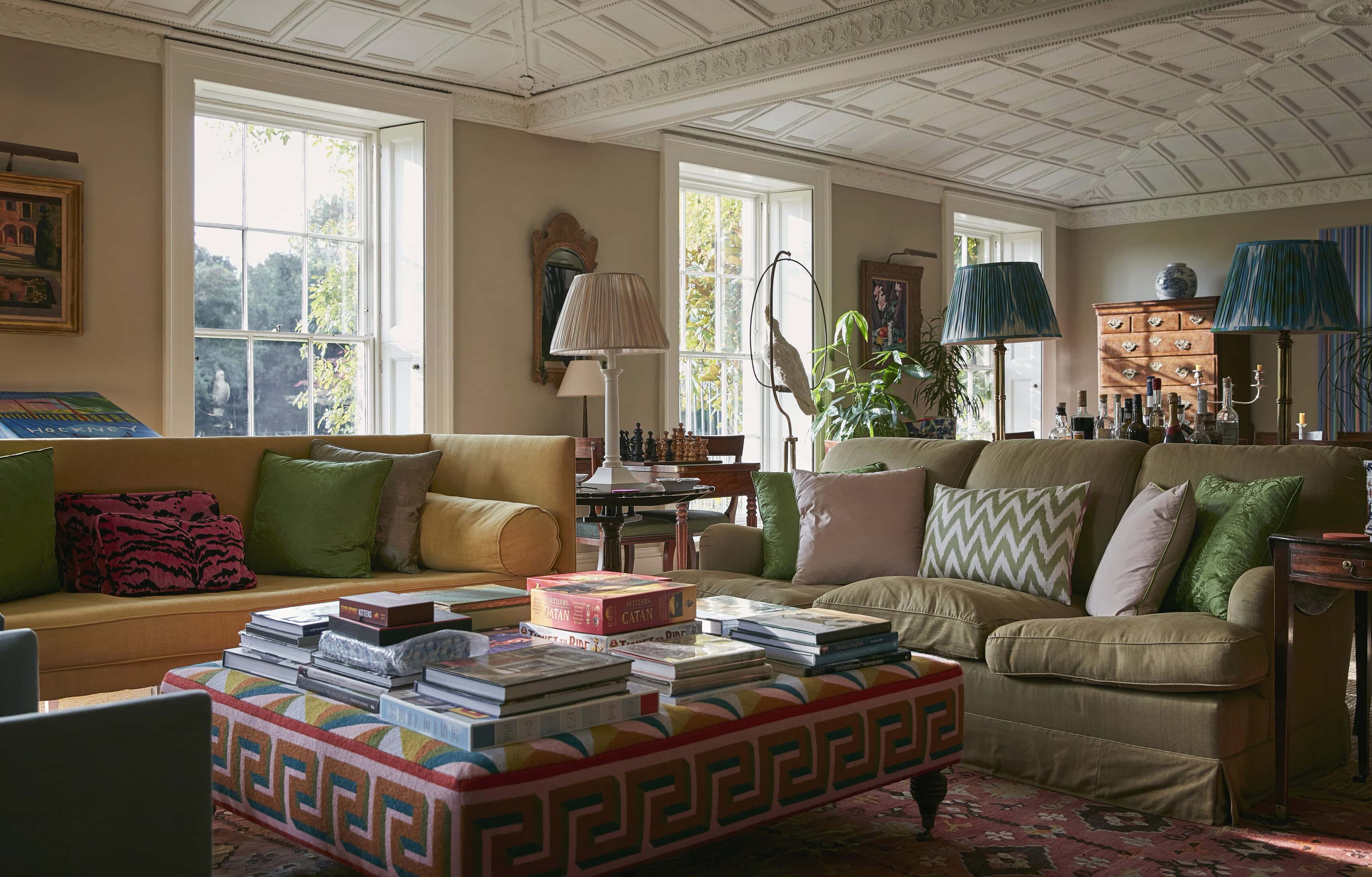
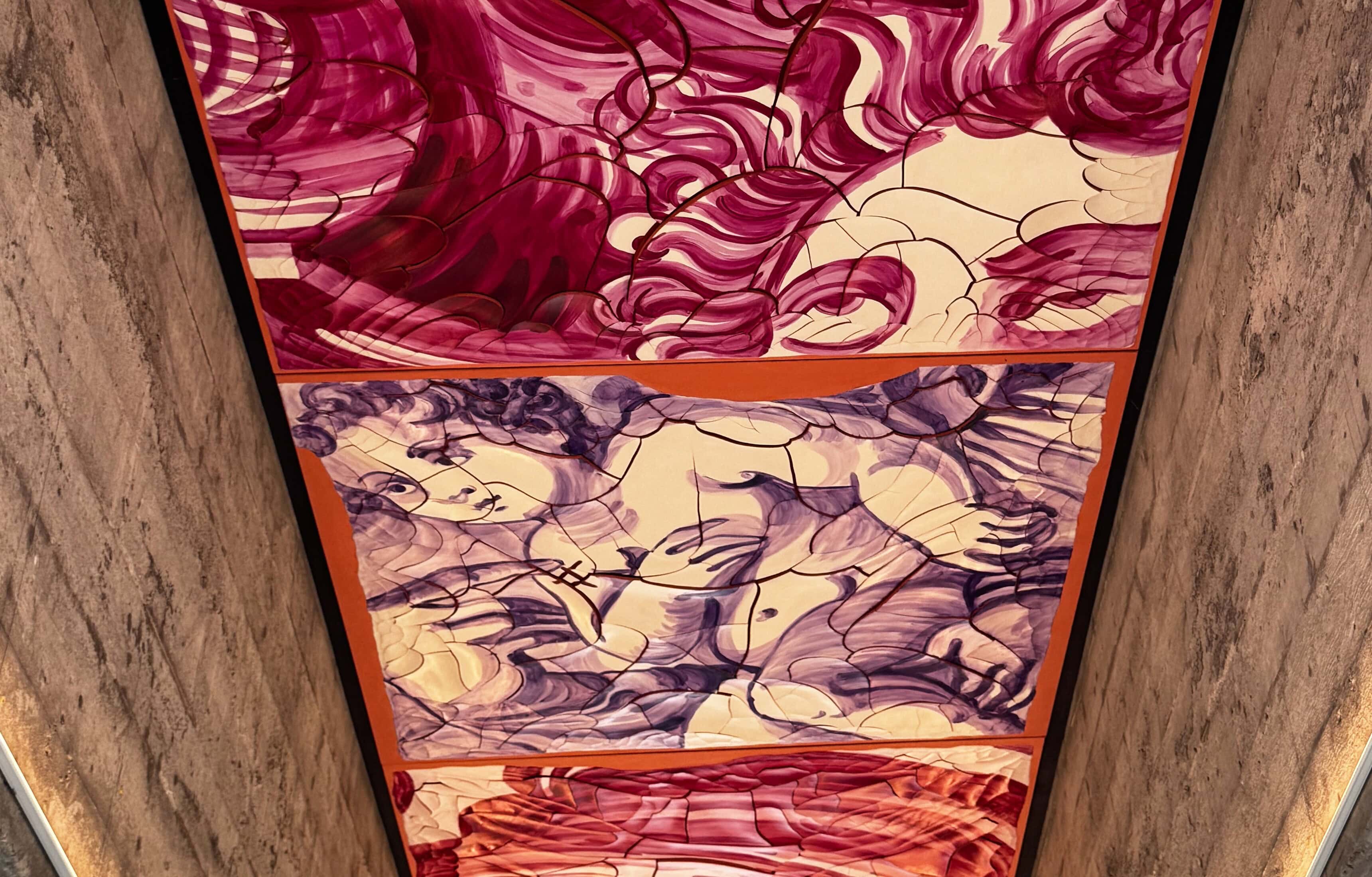
The Brazilian Pavilion at Venice Biennale 2026 is the clearest argument in the Giardini for treating a building as a material rather than a container. Walk in from the Castello end and the first thing overhead is a deep beam of board marked concrete running the whole length of the hall, splitting the ceiling in two. Between its flanks, Adriana Varejão has installed a painted panel that reads as a sky: wine red Baroque scrollwork at one end, cooling through violet and ochre to grey water at the other, the entire surface fractured with the fine crackle of old glaze. The building’s one piece of structural drama now carries a ceiling painting. Everything else in Comigo ninguém pode follows from that decision. It is the same instinct that runs through the rebuilt Central Pavilion at the other end of the gardens, where the architecture was rebuilt and the exhibition then organised itself around the new plan.

The pavilion was drawn as a bridge before it was drawn as a room
The building is from the mid 1960s and it came out of one of the most interesting partnerships in Brazilian modernism. Henrique Mindlin, born in São Paulo in 1911, wrote Modern Architecture in Brazil in 1956, the book that carried Lúcio Costa, Oscar Niemeyer and Affonso Eduardo Reidy to an international readership. Giancarlo Palanti, born in Milan in 1906, was one of the figures of Milanese rationalism before he left for Brazil in 1946 and set up Studio d’Arte Palma with Lina Bo Bardi, making furniture out of Brazilian timber. The two opened an office together in Rio in 1955. The Venice pavilion came from that office, with Walmyr Lima Amaral.
There is a detail in the Italian state’s own architecture census that changes how the building reads. The scheme the three of them drew in 1959 passed the building commission and was never constructed. It proposed taking out the footbridge over the canal and folding a bridge into the pavilion itself, which would have opened the view towards San Pietro di Castello, and it was designed so that the whole thing could be taken apart and moved. The pavilion that stands instead was proposed in 1964 by the Venetian architect Amerigo Marchesin, who is listed in that census as architect of record, and built the following year.

What survived the swap is the bridge. The pavilion is two parallel volumes joined across the middle by a cantilevered covered gallery, and the structure that does the joining is a single exposed concrete beam folded into an inverted C. It is the only element in the building that behaves like infrastructure rather than architecture. Sixty years later it is the element Varejão chose to paint. the Nordic Pavilion works the same way, where Sverre Fehn’s concrete grid is the thing the whole installation is hung from.
What the restoration gave back
The Fundação Bienal de São Paulo ran the repair of the building with the Ministry of Culture and the Ministry of Foreign Affairs, in three phases. The first dealt with structure. The second recovered original elements, the lateral glass walls above all, along with the façade. The third finished in early 2026, a few months before the opening.
Those glass walls are the reason the interior looks the way it does now. They sit as ribbon windows high in the flanks, wooden slats and glass, washing the white walls from above while the flat roof brings more light down through skylights behind a diffusing velarium. The light arrives sideways and from overhead at once, and it falls on raw concrete, white plaster and a polished pale floor. It is a very even light, and it is the condition both artists have worked to.

Varejão painted the sky under the concrete
The ceiling panel is the single most confident move in the pavilion. Varejão has spent three decades making paintings that pretend to be other materials: plaster, tile, meat, carved Baroque woodwork, wet ceramic. The method is physical. She builds a thick plaster ground on canvas, works oil into it, and then lets or makes the surface craze, so that the finished painting carries the crackle of a glaze that has aged for two centuries.

Run along the underside of the beam, that craquelure does something specific. A Baroque church ceiling is painted to dissolve the structure above you and open the building to a sky. Here the structure stays absolutely present, sixty centimetres of board marked concrete on either side, and the sky is a cracked tile surface that keeps announcing it is a made thing. The colour runs the length of the hall like weather, from the deep wine scrollwork over the entrance through violet cloud and a band of ochre earth to a grey green swell at the far end, where the doors open onto the Giardini. You read it by walking under it, which is the oldest way of reading a ceiling and the newest thing in the building.

Her smaller works in the hall take the same idea down to the scale of a canvas. An orange monochrome hangs with a dark fissure opening down its centre, the edges curling back like dried skin. An oval in a heavy dark frame holds a black and white engraved forest, and in the middle of it the surface has burst open into red, green and pink matter, thick and wet looking, framed by a ragged lip. A grid of small white tiles carries five long red incisions, cut rather than painted. Anjo encarnado, from 2025, is oil and plaster on canvas. Varejão made new work for the building and described the paintings as distributed through the space in unpredictable ways, so that the pavilion becomes an active part of the piece.

Rosana Paulino weaves the other half
Rosana Paulino, born in São Paulo in 1967, holds the floor and the lower walls, and her material thinking rhymes with Varejão’s exactly. Where Varejão splits a skin to show what is under it, Paulino spins a new one.
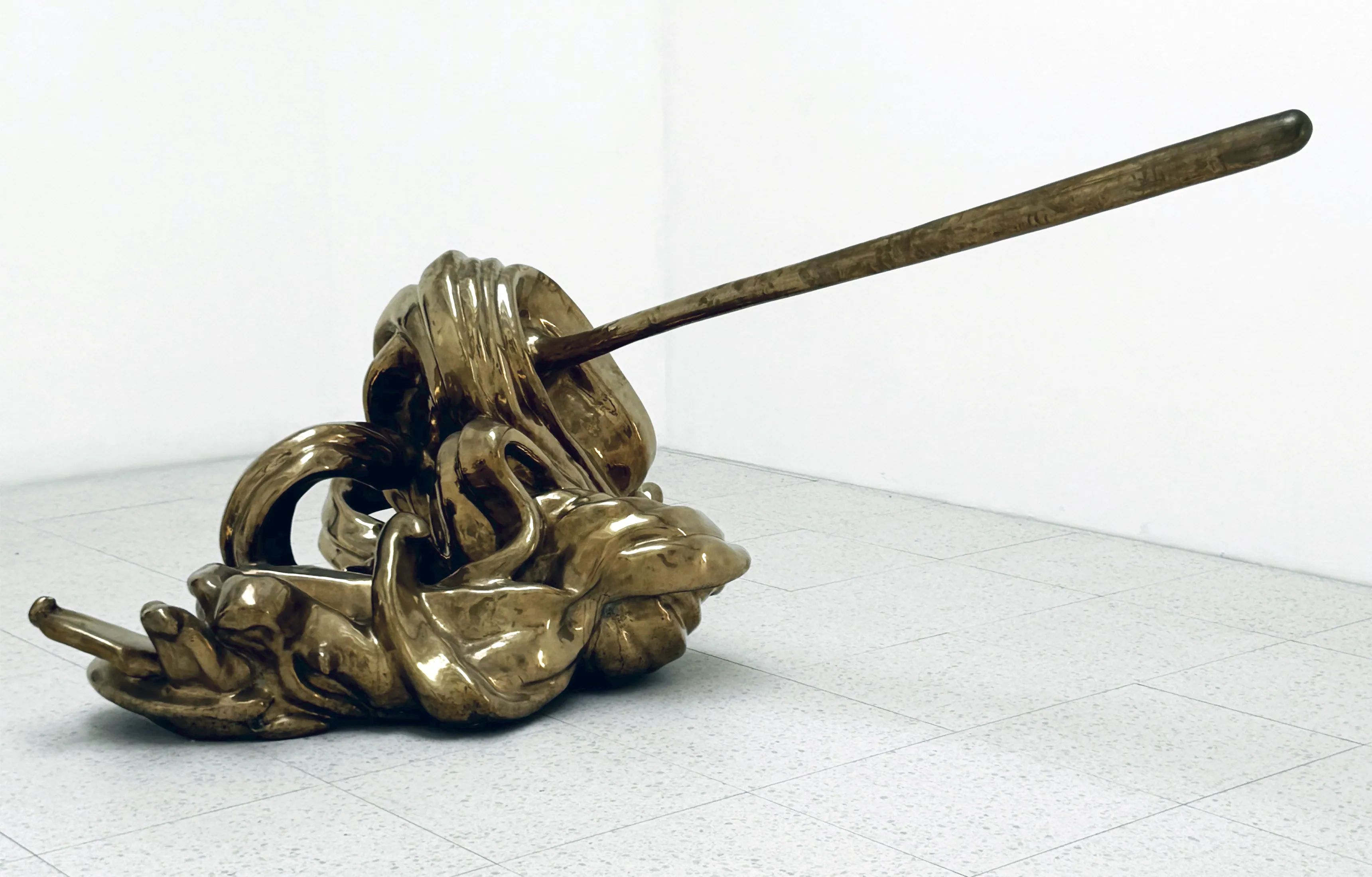
Tecelãs, from 2003, is the clearest statement of it. Small terracotta figures, each one a torso or a limb, are bound into white cocoons of cotton and synthetic thread and scattered up a white wall like a swarm caught mid flight. Underneath them, a massed row of terracotta tubes lies along the floor line, open at one end, the shed casings of whatever has already left. The title means weavers. The work is faience, terracotta, cotton and synthetic thread, and it was made more than twenty years before this pavilion.

Along the lip of the lowered central area she has set a rail of thin rusted steel rods, bent over at the top like shepherds’ crooks and strung with fine thread into webs. Paper cocoons hang in them, some blank and crumpled, others printed with photographs of Black women. This is Aracnes and Ninfa tecendo o casulo, the nymph weaving the cocoon, and the rods carry the whole argument of the exhibition in one detail: reinforcement bar, the thing that normally stays buried inside concrete, standing up out of a concrete edge and holding silk. the Belgian Pavilion reaches a similar place from the opposite direction, casting a performance vocabulary into plaster so that it holds still.
Her largest wall piece is a quilt of printed cloth panels. An azulejo scene of a figure in a boat, a sailing ship drawn in blue and white, an anatomical heart, the stowage plan of a slave ship, x-rays of a pelvis, a woman in white seated among leaves, two men walking into the sea. Across a photograph of open water two words are printed: CALUNGA GRANDE, the great water in Kongo cosmology, the ocean that divides the living from the dead. Red thread runs down out of a stitched tile cross and hangs loose below the panels. Paulino has worked this material as Atlântico Vermelho since the middle of the last decade.

And then the plant the exhibition is named for. Comigo-Ninguém-Pode, made in 2026 for the series Senhora das plantas, is acrylic and grease pencil on canvas: a figure seated in orange, rooted at the base, with dieffenbachia leaves growing out through the body. In Brazil the plant goes by the door of a house as protection. It is also toxic, which is where the name comes from, and it translates roughly as nobody can handle me.

Diane Lima asked for one voice, not two
Diane Lima is the curator, with Giovanna Querido as curatorial assistant, and the commissioner is Andrea Pinheiro, president of the Fundação Bienal de São Paulo. Lima has said her challenge was to present Varejão and Paulino as a composition rather than a pairing, a single voice with harmonies and dissonances in it, and that the gesture should work like jazz, performative and sensory rather than didactic.

The exhibition design is by Daniela Thomas, who came to it from thirty years of production design and film direction, including Terra Estrangeira and Linha de Passe with Walter Salles, and who was one of the creative directors of Rio’s section of the 2016 Olympic opening ceremony. That background shows in how the pavilion is paced. There is no chronology and there are no room captions steering you. Works from more than three decades sit next to pieces finished this year, chosen for colour, material and iconography rather than date, and the circulation is deliberately interrupted so that you keep turning back.
How to see the Brazilian Pavilion at Venice Biennale 2026
Comigo ninguém pode runs from 9 May to 22 November 2026 at the Brazilian Pavilion in the Giardini di Castello. The pavilion sits towards the eastern end of the gardens, past the Central Pavilion, and it is a twenty minute walk from the Arsenale entrance. If you are walking in from the Riva, the sculpture in the Giardini della Marinaressa is on the way and takes another half hour.

Give it half an hour and walk it twice. The first pass, keep your eyes down: the terracotta, the cocoons, the rusted rods, the cut tiles. The second pass, walk the length of the hall with your head back and let the ceiling run. Then stand at the far doors, look back along the beam with the garden light behind you, and the two halves of the show close on each other.
Frequently asked questions
What is the Brazilian Pavilion showing at Venice Biennale 2026?
The Brazilian Pavilion is showing Comigo ninguém pode, a two artist exhibition of Adriana Varejão and Rosana Paulino curated by Diane Lima, with exhibition design by Daniela Thomas. It runs from 9 May to 22 November 2026 at the pavilion in the Giardini di Castello, and it is presented by the Fundação Bienal de São Paulo with the Ministry of Culture and the Ministry of Foreign Affairs.
What does Comigo ninguém pode mean?
It is the Brazilian name for dieffenbachia, the plant that is kept by the door of a house as protection. The plant is toxic, which is where the phrase comes from, and it translates roughly as nobody can handle me or nobody can defeat me. The title also points to a drawing in Rosana Paulino’s series Senhora das plantas.
Who designed the Brazilian Pavilion in the Giardini?
The design is credited to Henrique Mindlin, Giancarlo Palanti and Walmyr Lima Amaral, who had an office together in Rio de Janeiro. The Italian state’s architecture census lists the Venetian architect Amerigo Marchesin as architect of record for the building that was constructed in 1964 and 1965, and records an earlier 1959 scheme by the three that was approved and never built.
What has Adriana Varejão made for the Brazilian Pavilion?
New work conceived for the building, including a long painted panel set into the soffit of the concrete beam that runs the length of the hall, so that the structure carries a cracked tile sky. Her smaller paintings in the pavilion include an oval work whose engraved forest bursts open into red matter, an orange monochrome split by a fissure, and a grid of white tiles cut with red incisions.
What is Rosana Paulino showing?
Work that spans more than twenty years, including Tecelãs from 2003, made in faience, terracotta, cotton and synthetic thread, and new pieces for the pavilion. Cocoons of thread and paper hang from bent steel rods along the edge of the lowered central floor, and a quilt of printed panels carries the words Calunga Grande across a photograph of open sea.
When was the Brazilian Pavilion restored?
The Fundação Bienal de São Paulo carried out the work in three phases with the Ministry of Culture and the Ministry of Foreign Affairs. The first phase covered structural repairs, the second recovered original elements including the lateral glass walls and the façade, and the third was completed in early 2026, shortly before the Biennale opened.
Final thoughts
Two artists who had never shown together are easy to present as a conversation. What Diane Lima has done instead is harder and better: she has put their materials in the same room and let them finish each other’s sentences.
Varejão’s whole practice is a skin that splits. Plaster crazes, tile cracks, a monochrome opens down the middle and something soft is behind it. Paulino’s is a skin being made. Terracotta bound into cotton, silk spun around a body, thread stitched back through a tile. One opens, the other closes, and both of them are working on the same wound.

The building turns out to be the third artist. A pavilion drawn by the man who wrote the book on Brazilian modernism, with a Milanese rationalist who had already left Italy for São Paulo, and finished in Venice by a local architect. A bridge that was designed, abandoned and then kept anyway as a beam. Sixty years of a structure waiting for somebody to notice what it was, and a ceiling painting that finally answers it.
Go for the pairing if the artists are what brought you. Go for the beam if you came for the architecture. Either way, walk it twice.
Project Credits
Go further from here
Add to calendar
Google CalendarApple or OutlookRead next
Alma Allen has the whole of the US Pavilion for Venice Biennale 2026, with walnut burl, Colorado Yule marble and bronze, in a 1930 building that a co-operative of American…