
Automotive Design · Goodwood
Reading Time: 9 minutes
Rolls-Royce‘s first Coachbuild Collection car is named after a house on the French Riviera, and that house is named after a road in Derby. Project Nightingale traces its whole design argument back through that chain, to a specific 1928 car that still exists and still turns heads at concours events a century later.
Introduction
Sir Henry Royce built the factory on Nightingale Road, Derby, himself, in 1908. It ran until 1939 and it is where Rolls-Royce’s early motor cars were made. Some years later, when Royce built a winter retreat in the hills above Le Canadel on the Côte d’Azur, he had three buildings put up rather than one: a private villa, a design studio he called Le Bureau, and a house for his engineers and designers, which he named Le Rossignol, French for the nightingale, in tribute to the road where it had all started.
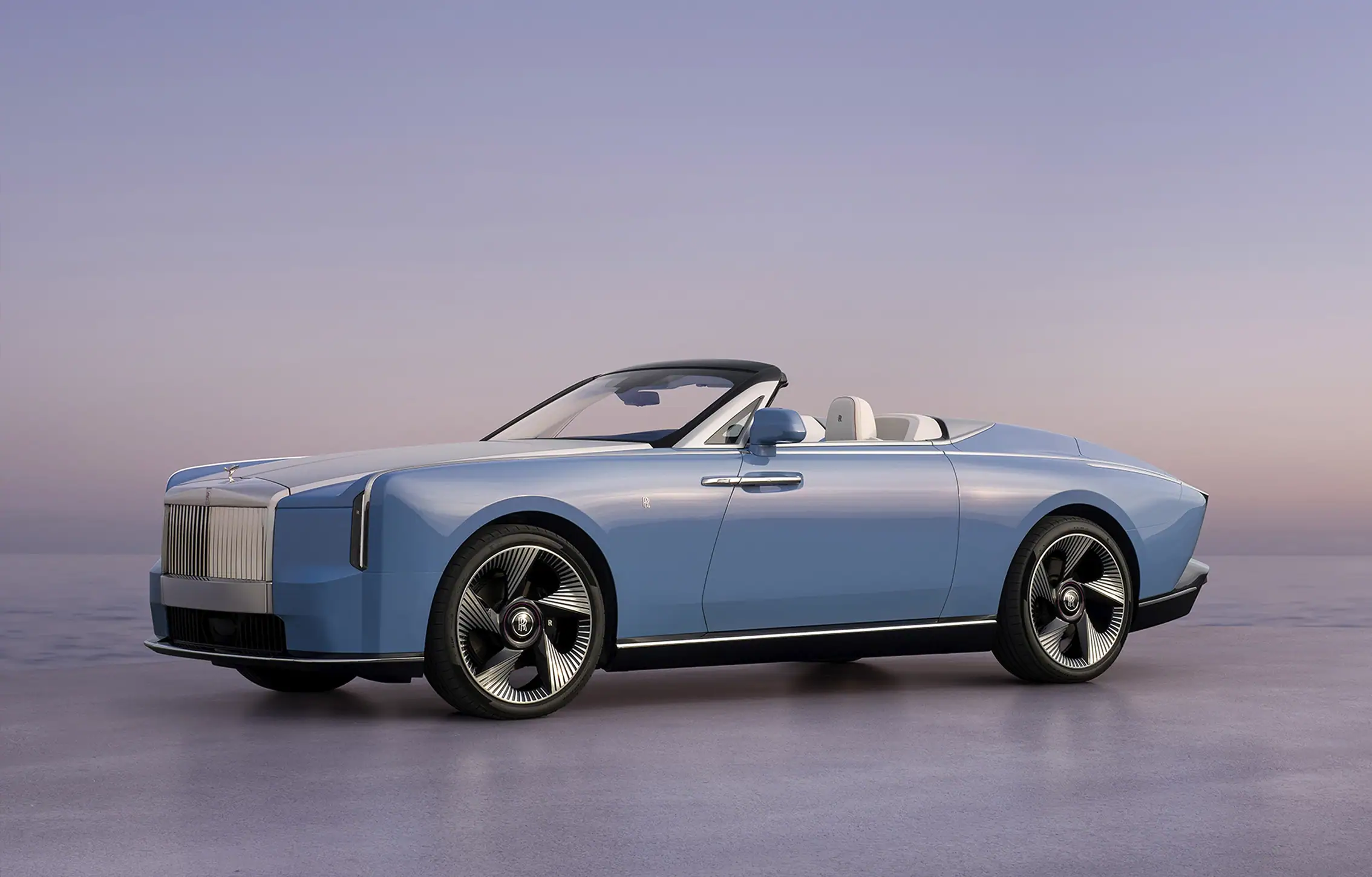
Project Nightingale, the first car in Rolls-Royce’s new Coachbuild Collection and unveiled at Goodwood in April 2026, takes its English name from that French house, which took its name from an English road. It is a small piece of naming trivia, and it is also the whole design argument in miniature. This is a car that does not claim a new idea. It reaches back through a specific, traceable lineage and asks what a Rolls-Royce looked like when Royce’s own team was freest to experiment, then builds that.
An open-top, two-seat electric drophead limited to 100 cars, Project Nightingale is built on the same Architecture of Luxury platform that underpins Spectre, at Rolls-Royce’s Goodwood plant, with deliveries beginning in 2028. It is invitation-only. Its colours and materials, Rolls-Royce says, will not be repeated on any other model.

The car that lent Nightingale its colour and its shape
Rolls-Royce has described Project Nightingale’s torpedo-shaped body as a homage to the 16EX and 17EX, a pair of experimental cars Royce commissioned in 1928 to answer critics who thought Rolls-Royce lacked sporting credibility next to Bentley. What tends to go unsaid is that one of those two cars still exists, still runs, and has a documented history stranger than the tribute it inspired.
The 17EX was designed by Rolls-Royce’s chief engineer Ivan Evernden, working from Royce’s own patented method of lightweight construction, laminating sheet steel and plywood into the body sills. Its raked windscreen and lightened wings were built for speed: Royce wanted a chassis capable of 95 to 100mph. The coachwork went to Jarvis of Wimbledon in 1928, finished in a bright, distinctive blue, the same coachbuilder that had recently built Malcolm Campbell’s land speed record car, Blue Bird, in a shade that matched closely enough that the resemblance was almost certainly deliberate.

Project Nightingale’s exterior colour, Côte d’Azur Blue, is a direct reference to that 1928 finish. It is worth knowing what happened to the car that finish first appeared on. Sold a few months after completion, the 17EX was bought in November 1928 by Maharajah Hari Singh, ruler of the princely state of Jammu and Kashmir, who according to the historian Gautam Sen used it more for one-upmanship than driving and sold it on within three years. Its next Indian owner, Provat Kumar Mitter, drove it hard, racing it on family journeys across the country through the 1930s and 1940s. It later crossed to Europe, was fully restored in the 1990s by the Italian coachbuilder Gianni Pena, and has since won Best in Show at both the Valletta Concours and the ICONS Concours in Mallorca. Today it belongs to the Indian industrialist and collector Yohan Poonawalla, who has brought it back into Indian ownership very close to a century after the Maharajah first bought it.
Project Nightingale, in other words, is not paying tribute to an idea. It is paying tribute to a specific object with a specific, unbroken and still-continuing history, which is a more exacting standard for a coachbuilt car to be measured against than most homages set for themselves.

Three rules and a torpedo
Rolls-Royce’s design team worked to three stated principles for Project Nightingale: upright to flowing, meaning the car’s proportions move from a formal, vertical front end into a single continuous line toward the rear; a central fuselage, the aluminium spaceframe body treated as one uninterrupted volume rather than a collection of separate panels; and flying wings, the front wings extending rearward in an unbroken sweep. The wheels, at 24 inches in diameter, are the largest ever fitted to a production Rolls-Royce, chosen to hold the proportions of that long, low body in check.
None of this is abstract design language. It is a direct, legible translation of what made the 16EX and 17EX look fast while parked: a single volume, minimal visual interruption, and a stance that reads as motion even at a standstill. Domagoj Dukec, Rolls-Royce’s Director of Design, has described the result as built on “grand proportions, absolute surface discipline, and a clarity of line that rewards the closest attention.” It is the same vocabulary Rolls-Royce has used about its production cars for a decade, applied here with nothing to compromise it: no rear doors, no boot to disguise, no B-pillar to resolve.

The aluminium spaceframe itself is a departure from how Rolls-Royce has built its recent Bespoke flagships, most of which have worked from an existing production platform reshaped and re-trimmed. Project Nightingale shares its underlying Architecture of Luxury platform with Spectre, but the body itself is a genuinely new structure, engineered specifically for a two-seat, open-top format with no fixed roof to brace against and no rear doors to accommodate. That is a harder engineering problem than it looks: an open car has to find its torsional stiffness somewhere else in the structure, typically the sills and the floor, which is precisely where Royce’s own 1928 lightweight construction method, laminating steel sheet over plywood, was solving the same problem for the 17EX nearly a century earlier. The engineering logic, not just the styling, repeats across the century.

An interior built from an actual birdsong
The Nightingale name is not confined to badging. The car’s ambient lighting system, called Starlight Breeze, was developed by analysing the actual soundwave pattern of a nightingale’s song and translating its rhythm into the sequencing of the cabin’s lights: 10,500 individual points, in three sizes, set into a horseshoe-shaped form that wraps the cabin. It is a more literal piece of craft than the name usually gets credit for. Most brands that reach for birdsong as a design reference stop at the metaphor. Rolls-Royce’s Bespoke workshops built an acoustic pattern into a physical lighting sequence.

The rest of the interior follows the same logic of taking a reference seriously rather than gesturing at it. The rear deck, described internally as the Aero Afterdeck, and the boot, the Piano Boot, both extend the exterior’s single-volume language into the car’s rear third. Saddle-leather motifs recall the tack room rather than the salon, a deliberate move away from Rolls-Royce’s usual drawing-room register toward something closer to grand touring. The Spirit of Ecstasy figure itself has been reworked as a rotary controller that rises from the dashboard when the door opens, a piece of the marque’s oldest iconography turned into the newest piece of its interior architecture. The colourway shown at launch, Charles Blue, Grace White, Deep Navy, Peony Pink and Openpore Blackwood against the Côte d’Azur Blue exterior, was chosen specifically because Rolls-Royce says none of it will reappear on any other model.
The Bespoke Collective, the arm of Rolls-Royce that builds these one-off and ultra-limited commissions, works from Goodwood rather than from a separate coachbuilding facility, which is itself a point of continuity with how Jarvis of Wimbledon and the other independent coachbuilders of the 1920s and 1930s worked: skilled hands, a small production run, and a design brief specific to one commission rather than a model line. The difference a century on is that the client relationship, the design language and the manufacturing all sit inside the same company, rather than being split between a chassis maker and an outside coachbuilder as they were for the 17EX.

The designer’s argument
Dukec joined Rolls-Royce as Director of Design in October 2024, arriving after a decade at BMW, where he rose to Head of Design after starting in front-wheel-drive models, and before that a decade at Citroën in Paris, following design studies at the Pforzheim School of Design and an internship in Barcelona. He describes his own method as that of an “emotional rationalist,” pairing German precision with a more expressive Latin instinct, and he has said plainly that he does not want to design “something that already existed,” which sits oddly against a car built explicitly on a 1928 reference until you notice what he actually means by it: Rolls-Royce, in his view, sits “at the intersection of” industrial design, architecture and fine art, and its cars function as “functional sculpture,” objects clients treat as canvases for their own expression rather than finished statements from the factory.

Project Nightingale is Dukec’s clearest demonstration of that argument so far. It does not repeat the 17EX. It takes the 17EX’s design logic, the audacity of Royce’s original experimental programme, and asks what that same audacity produces with a modern spaceframe, a silent electric powertrain and a century of Bespoke craft behind it. Chris Brownridge, Rolls-Royce’s Chief Executive, has framed the car as answering clients who “asked us for our most ambitious work,” combining coachbuilding’s design freedom with the marque’s electric powertrain for what he called “a uniquely potent yet serene expression of open-top motoring.”

What the Coachbuild Collection signals
Project Nightingale is the first car in a new, ongoing Coachbuild Collection, a formal return to the kind of one-off and limited commissions that built Rolls-Royce’s reputation before the war and that the marque has approached more cautiously since, through occasional Bespoke flagships rather than a standing programme. At 100 cars, invitation-only and hand-built at Goodwood, it sits above the existing Bespoke commission structure as a distinct tier, aimed at clients who have already exhausted what a fully personalised production car can offer.
Validation testing begins in the summer of 2026, with road-going deliveries from 2028. Rolls-Royce has not disclosed a price and has said only that further engineering detail will follow as the car progresses through its testing programme.

Frequently asked questions
What is Rolls-Royce’s Coachbuild Collection?
It is a new, ongoing programme of ultra-limited, one-off style coachbuilt cars sitting above Rolls-Royce’s standard Bespoke commissioning structure. Project Nightingale, unveiled in April 2026, is the first car in the collection.
How many Project Nightingale cars will be built?
100, by invitation only, hand-built at Rolls-Royce’s Goodwood plant, with deliveries beginning in 2028.
Why is it called Project Nightingale?
The name comes from Le Rossignol, French for nightingale, the house Sir Henry Royce built for his design and engineering team on the Côte d’Azur. He named that house after Nightingale Road in Derby, where he had personally designed the factory that built Rolls-Royce’s early cars from 1908.
What inspired Project Nightingale’s design?
Rolls-Royce’s own 16EX and 17EX experimental cars from 1928, built to demonstrate the marque’s sporting capability. The 17EX in particular, finished in a bright blue by the coachbuilder Jarvis of Wimbledon, lent Project Nightingale both its torpedo-shaped body and its Côte d’Azur Blue exterior colour.
Is Project Nightingale electric?
Yes. It is built on Rolls-Royce’s Architecture of Luxury platform, the same electric platform that underpins Spectre, though Rolls-Royce has not yet disclosed full powertrain specifications.

Final thoughts
Homage cars usually gesture at a decade or a design language. Project Nightingale reaches for something narrower and harder to fake: a specific car, a specific colour applied by a specific coachbuilder, and a naming chain that runs back through an actual house on an actual hillside to an actual road in Derby. That the 17EX still exists, in Indian ownership again after a century, gives the tribute a weight that most retrospective design language does not earn. Rolls-Royce has not simply revived a look. It has revived a lineage that never actually stopped being traceable, and built the newest chapter of it by hand at Goodwood.

Spectre Series II, unveiled the same year, draws its own new Bespoke fabric from a bamboo grove beside Villa Mimosa, Henry Royce’s main house on the same stretch of Cote d’Azur coastline. That story is covered separately: The Bamboo Grove That Ended Up Inside a Spectre.

Leave a Reply