
ART & CULTURE · LONDON
Reading time: 9 minBruno Pogačnik Tremow and Ivana Vukšić do not divide the work between them. They pass the same drawing back and forth, or work on it at once, until neither can say who started it. At White Cube Mason’s Yard, that working method met its ideal subject: a garden, the oldest site there is for the argument between what grows wild and what gets tended. TARWUK’s own practice turned out to be making the same argument from the inside.
Every garden is an argument, even before anything is planted in it. It says that this patch of ground will be shaped by a hand rather than left to whatever seeds the wind brings, and it never quite settles the question of who wins. Between 1 February and 18 March 2023, White Cube’s Mason’s Yard gallery in London became one, for a debut exhibition by the Croatian artist duo TARWUK, titled Posadila sam kost u zimskom vrtu, which translates loosely as “I planted a bone in the winter garden.”

TARWUK is Bruno Pogačnik Tremow and Ivana Vukšić, a married couple who have worked as a single artistic entity since 2014. The Mason’s Yard show, their first solo exhibition in the UK, filled the gallery with sculpture, large-scale painting and works on paper, all built from the same central image: a garden as the place where nature’s unpredictability and a person’s need to order it are permanently, productively at war.
What makes the show worth returning to three years on is not only the theme, which White Cube’s own programming has since developed twice more. It is that TARWUK’s method of making the work is itself an answer to the question the work is asking. Two people who have given up working separately, in order to build a single disputed territory between them, made a show about exactly that kind of territory. Nobody writing about the exhibition at the time drew that line all the way through, and it is the more interesting story than the garden metaphor on its own.

What was actually in the room
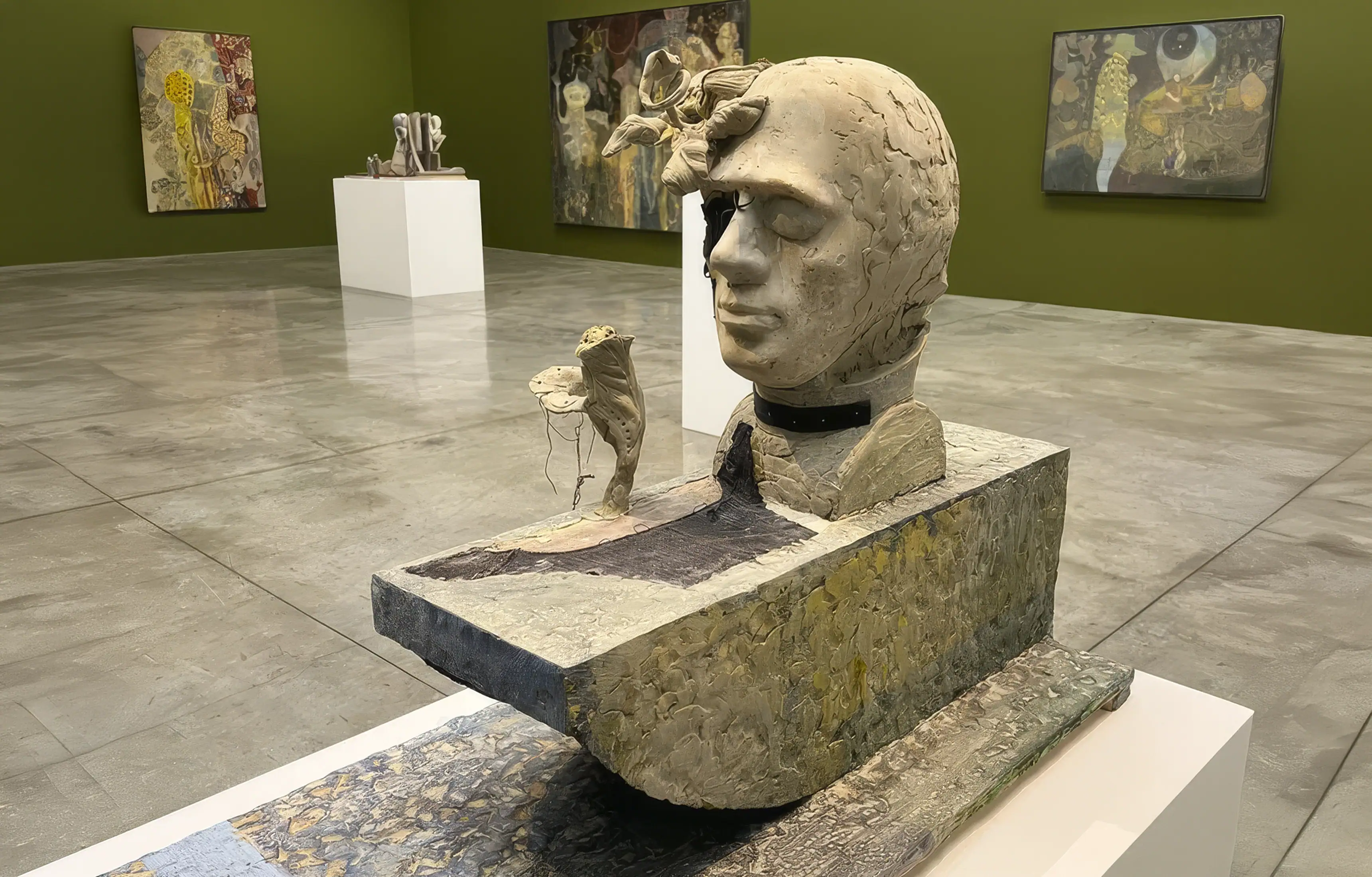
The installation combined sculpture, painting and works on paper across the gallery’s two floors, arranged as what TARWUK describe as “architectural models of organic growth.” One sculpture from the show, KLOSKLAS_1969_evitisoP_elbuoD (2022), gives a sense of how these objects are actually built: acrylic, epoxy clay, steel, wood, aluminium, polyurethane foam and plastic, worked up into a compact, carnival-like form measuring 100 by 126 by 57.5 centimetres. Across their wider practice, TARWUK build with an unusually wide material vocabulary for two people working as one hand, resin clay and polyurethane foam alongside leather, wax, coffee, horse and deer bone, human teeth, mirrors, chains and salvaged, found objects, whatever the piece being built is asking for.

The paintings and works on paper, meanwhile, are dense with reference: late nineteenth-century Symbolism, the expressive distortion of Edvard Munch and Les Nabis, Byzantine iconography and Art Nouveau florals, layered until a single figure can read as several centuries of European image-making at once. TARWUK have described this layering as reaching for “the rich earth of the subconscious,” and the phrase fits the work better than most curatorial language does: nothing in these paintings sits on a single, stable surface. Everything is built from strata.
The title itself carries the same instinct for reversal that runs through TARWUK’s titling generally. Works are frequently named backwards, so that KLOSKLAS_1969_evitisoP_elbuoD reads, flipped, closer to something like “double positive,” a small piece of the same argument the exhibition is making at full scale: read the surface forward and it is one thing, read it against the grain and it is another.

Two names, one hand
Bruno Pogačnik Tremow was born in Zagreb in 1981; Ivana Vukšić was born in Dubrovnik the same year. Both grew up through the Yugoslav wars and the dissolution of the state that had shaped their childhoods, an experience that runs under nearly everything TARWUK has made since, without either of them ever having to say so directly. Vukšić holds a postgraduate degree from the Faculty of Political Science in Zagreb; Pogačnik Tremow holds dual master’s degrees from Columbia University and the Academy of Fine Arts in Zagreb. They married, and in 2014 they took a shared studio in Chinatown, New York, and stopped signing work individually.
That decision is the part of the story a listings piece tends to skip past on the way to the exhibition dates, and it is worth pausing on, because it is the actual subject of the work as much as the garden is. TARWUK is not a brand name two artists share. It is, in their own description, “a condition,” and they have said they think of it “not as a duo, but as a third entity that is neither one nor the other, but both at the same time.” That is an unusual thing for two trained, individually credentialled artists to give up in order to make.

A studio with no division of labour
Ask most two-person studios how the work gets made and the answer involves a split: one person drafts, the other builds; one handles form, the other handles colour. TARWUK have said, directly, that this is not how they work. “We work together with no division of labour, in a complete merge where the boundary between one and the other blurs and becomes porous.” On drawings specifically, their account is even more precise: “We either work on the same drawing simultaneously, or we pass these back and forth between us.”
That is a genuinely unusual working method, closer to a shared nervous system than a collaboration in the ordinary sense, and it is the detail that turns Posadila sam kost u zimskom vrtu from a show about a theme into a show that demonstrates it. A garden is cultivated ground fighting a permanent low-level battle against wildness. TARWUK’s studio is two separate people fighting the same battle against the instinct to work apart, and losing it on purpose, every day, in favour of a single merged hand. The exhibition did not need to say this for it to be true of how it was made. It is the fact a reader would not get from the wall text or the listing, because it only becomes visible once the studio practice and the show’s stated theme are put next to each other.

The garden as the show’s real argument
White Cube’s framing of the exhibition treated the garden as, in essence, a stage: a bounded space where nature is invited in and then made to behave, ornament, enclosure and battleground all at once. TARWUK’s sculptures, arranged through the gallery like a cast of characters mid-performance, extend that idea into three dimensions. They are not garden ornaments in any literal sense. They are what a garden ornament might become if the discipline holding its shape ever slipped, part figure, part growth, part architecture, caught at the moment of turning into something else.
This is where the show earns its place as a design argument rather than only an art one. A garden is one of the plainest pieces of design there is: a space where light, structure, boundary and growth are all specified, in the same way a building’s are, except that half the materials are alive and will not stay specified for long. TARWUK’s installation treated the gallery the same way, staging fixed sculptural forms against paintings that seem to be actively decomposing and reassembling on the wall. The tension between what is built to last and what is left to keep changing is the same tension a landscape architect manages on every commission. TARWUK just refused to resolve it.

A red courtyard borrowed from Split
One reference point in the paintings connects the show’s abstract theme to a very specific piece of design history. In January 1968, a group of Croatian artists painted the peristyle courtyard of Diocletian’s Palace in Split entirely red overnight, an unsanctioned intervention in one of the most tightly controlled pieces of designed civic space in the region, a Roman imperial courtyard that had survived seventeen centuries largely unaltered. It was treated as vandalism at the time and became, over the following decades, one of the founding gestures of the Yugoslav artistic avant-garde that TARWUK’s own work keeps returning to.
The reference matters for exactly the reason the garden does. Diocletian’s courtyard is designed space in its purest form, engineered, proportioned, meant to be read a particular way for two thousand years. Painting it red was a wild act performed directly onto a cultivated one, the same collision Posadila sam kost u zimskom vrtu stages between the tended garden and whatever “the bone” represents once it is buried in it. TARWUK did not invent this tension. They grew up in the cultural aftermath of a country that had already tried to resolve it in a public square, and the exhibition carries that history forward without ever needing to explain it outright.

Where the collaboration has gone since
White Cube announced its representation of TARWUK in January 2023, immediately ahead of the Mason’s Yard show, and the relationship has continued to deepen since. The gallery gave the duo a Paris exhibition later the same year, and a third Mason’s Yard solo show ran from 9 July to 15 August 2026, its ground floor built around an installation the gallery described as a “harmonic percolator,” paired with video work and a suite of sculptural chairs functioning, in effect, as silent performers in their own right. TARWUK’s paintings from that most recent show introduced a vivid orange into a palette that had previously stayed muted, depicting, for the first time in their public exhibition history, imagery drawn from their own ancestral village.
Beyond White Cube, TARWUK’s solo exhibitions include Collezione Maramotti in Reggio Emilia, the Museum of Fine Art in Osijek, and Halle für Kunst Steiermark in Graz, alongside representation by Matthew Brown in Los Angeles and Apalazzo Gallery in Brescia. Their work has also been shown at Lafayette Anticipations in Paris, the Frye Art Museum in Seattle, Kunsthalle Wichita and the Drava Art Biennale in Osijek. It has entered public collections including the Metropolitan Museum of Art in New York and Moderna Museet in Stockholm, a rapid institutional rise for two artists who spent the first years of the collaboration working, entirely on their own terms, out of a shared studio in Chinatown.

Final thoughts
It would be easy to read Posadila sam kost u zimskom vrtu as a show about a metaphor: the garden as a stand-in for memory, or history, or the subconscious, dressed in Symbolist paint and carnival sculpture. That reading is not wrong, but it stops one level too early.
What actually happened at Mason’s Yard was two artists who had already given up the idea of working separately, staging an exhibition about the impossibility of anything, a garden included, staying wild and tended at the same time. The show did not illustrate that tension from the outside. It was made by two people living inside it, in a studio where the boundary between one hand and the other had already been allowed to blur.
That is the more durable version of the story, and it travels better than the theme alone. TARWUK’s studio is the garden the exhibition is describing, cultivated on purpose, out of two lives that arrived there separately.
What does the exhibition title *Posadila sam kost u zimskom vrtu* mean?
It translates loosely from Croatian as “I planted a bone in the winter garden,” a phrase that sets up the exhibition’s central image of a garden as a site of both growth and burial.
Who are TARWUK?
TARWUK is the shared artistic identity of Bruno Pogačnik Tremow (born 1981, Zagreb) and Ivana Vukšić (born 1981, Dubrovnik), a married Croatian couple who have worked as a single collaborative entity since 2014.
Where and when was the exhibition held?
At White Cube Mason’s Yard, 25 to 26 Mason’s Yard, London SW1Y 6BU, from 1 February to 18 March 2023. It was TARWUK’s first solo exhibition in the UK.
What kind of work was in the show?
Sculpture, large-scale painting and works on paper, built from materials including acrylic, epoxy clay, resin clay, steel, wood, aluminium and polyurethane foam, alongside the bone, wax, leather and found-object materials that recur across TARWUK’s wider practice.
How do the two artists actually work together?
They describe their process as having no division of labour: they either work on the same piece simultaneously or pass it back and forth between them, treating TARWUK as a single shared identity rather than two individual practices working side by side.
Where else has TARWUK’s work been shown?
Solo exhibitions include Collezione Maramotti, the Museum of Fine Art in Osijek, Halle für Kunst Steiermark and further White Cube exhibitions in Paris and London, alongside gallery representation from Matthew Brown in Los Angeles and Apalazzo Gallery in Brescia.
Is TARWUK still working with White Cube?
Yes. The gallery has given the duo three solo exhibitions at Mason’s Yard, most recently from 9 July to 15 August 2026, as well as a 2023 exhibition in Paris.
Where is TARWUK’s work held in public collections?
Their work has entered public collections including the Metropolitan Museum of Art in New York and Moderna Museet in Stockholm.
Leave a Reply