
[Section] · [Location]
Reading time: 6 minA 1960s warehouse in Wynwood, ten thousand square feet, with strange vegetation painted across the outside by one of the great French designers of the twentieth century. Ralph Pucci opened his new Miami gallery during Art Week — and the story of how a family mannequin-repair business ended up here is a great deal better than the building.
Wynwood is a neighbourhood that speaks in murals. Once a warehouse district, it was remade as a street-art destination, and the visual language of the place is paint on a wall — big, loud, and made to be photographed.
So when Ralph Pucci opened his new Miami gallery at 550 NW 28th Street during Miami Art Week 2023, and marked the occasion by having murals painted across the exterior, he was speaking the local dialect.
But he did not commission a graffiti writer. He commissioned Elizabeth Garouste.
That single decision tells you a great deal about the operation — and about a man whose entire career has consisted of taking something ordinary and treating it, with complete seriousness, as art.


Who Ralph Pucci actually is
This is the part the design press routinely skips, and it is the best story in the room.
In 1954, Nick and Lee Pucci began repairing mannequins in the basement of their house in Mount Vernon, New York. Not designing them. Repairing them — fixing the chipped fingers and cracked shoulders of the figures that stood in shop windows.
Their son Ralph joined the business in 1976, aged twenty-two, and started making his own.
What happened next changed an entire category. Barneys New York commissioned Pucci to work with the French designer Andrée Putman on mannequins for its new downtown store, and together they produced the Olympian Goddess — muscular, metallic, androgynous, and unlike anything a retail floor had seen before. It did not flatter. It did not simper. It stood there like a sculpture that had agreed, reluctantly, to wear clothes.
From there Pucci turned the mannequin into a genuine medium, commissioning figures from artists and designers who had never made one and had no business making one — and finding that this was precisely why they worked.
In 2015, the Museum of Arts and Design in New York gave him a full exhibition: Ralph Pucci: The Art of the Mannequin. It showed more than thirty of his mannequins and rebuilt his sculpture studio inside the museum.
A family firm that repaired shop dummies in a basement ended up with its founder’s studio reconstructed in a New York museum. Hold that in your head while you walk around the Miami gallery, and the whole place makes sense.


The building
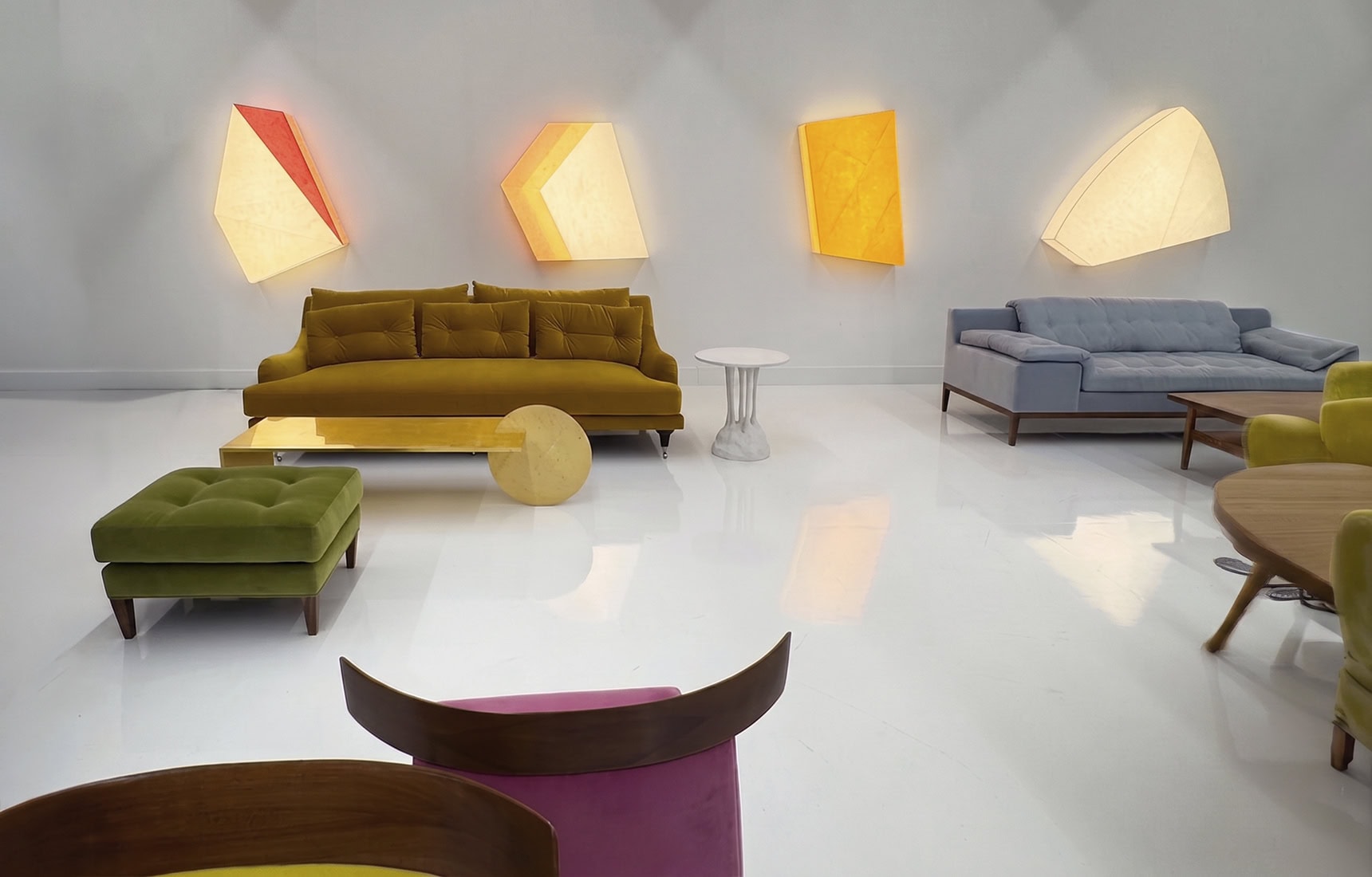
The new space is a 10,000 square foot gallery in a 1960s former warehouse, and the choice of building is entirely consistent: Pucci’s New York headquarters and his Los Angeles gallery are both industrial too.
There is a logic to it beyond the aesthetic. Pucci’s business has always been a making business — sculpting, casting, finishing — and his galleries have never quite pretended otherwise. They have the volume and the light of a workshop rather than the hush of a showroom. In New York he has staged live sculpting demonstrations, turning the act of making a figure into something you can watch.
An old warehouse is the right container for that. It has room for the work and no pretensions about it.
“Miami is an exciting, vibrant city where many cultures and creatives come together,” Pucci said at the opening. “The local community and visitors appreciate quality design, and we have enjoyed a decade of success there already in our previous gallery. We are excited to have more space to show the diverse works of our stable of artists and designers.”
Ten years in Miami already, in other words. This was not an arrival. It was a promotion.


Elizabeth Garouste — Strange Vegetation
The murals across the building’s exterior are the work of Elizabeth Garouste, and it is worth being clear about who that is, because “iconic French designer” does not begin to cover it.
Garouste — with her long-time collaborator Mattia Bonetti — was responsible for one of the most consequential ruptures in late twentieth-century design. Their work of the 1980s, sometimes gathered under the label Barbares, was deliberately primitive, mythic and hand-wrought: forms that looked as though they had been dug up rather than drawn, at a moment when design orthodoxy was still smooth, rational and modern. They gave a generation permission to be strange.
Strange Vegetation — painted across the outside of a warehouse in Wynwood — is a very fine joke, and a completely sincere one. In a neighbourhood whose walls are covered in street art, Pucci has put up a mural by a designer who has spent forty years making the decorative arts feel ancient and slightly dangerous.
It is the same instinct that produced the mannequins: take the expected form, hand it to the least expected person, and see what comes back.


Van der Straeten and Naggar
The opening exhibition gathered work by more than twenty artists and designers, with new pieces from two of Pucci’s most significant collaborators.
Hervé Van der Straeten began as a jewellery designer, working for the great Paris fashion houses, before turning to furniture — and it shows in everything he makes. His bronze and lacquer pieces have the precision and the audacity of jewellery scaled up until it can hold a lamp: sculptural, mirrored, gilded, and entirely unbothered by restraint.
Patrick Naggar, the French architect, artist and designer, is one of Pucci’s longest-standing partners, and has designed mannequins for him as well as furniture. His work has an intellectual coolness that anchors a room otherwise inclined to shout.
Neither of them is a Miami name, and that is the point. Pucci has spent a career importing European strangeness into American rooms.


Why a permanent gallery, in Art Week
There is something quietly contrarian about opening a 10,000 square foot permanent gallery during the week when the entire design world is living in temporary booths.
Miami Art Week is, by construction, ephemeral: the fairs go up, the fairs come down, and the city returns to itself by the middle of December. To choose that week to plant something permanent — a warehouse, painted, with a decade of Miami business already behind it — is a statement about staying.
And it runs against the current. Elsewhere in American collectible design, galleries have been moving the other way: out of storefronts and into houses, shown by appointment, quiet and private. Pucci has done the opposite. He has taken a big industrial box, put a mural on the front of it, and opened the door.
I know which I find more generous.


Frequently asked questions
Where is Ralph Pucci’s Miami gallery? 550 NW 28th Street, in Wynwood — a 10,000 sq ft gallery and showroom in a former 1960s warehouse, which opened during Miami Art Week 2023.
Who is Ralph Pucci? The head of Ralph Pucci International. The family business began in 1954 when Nick and Lee Pucci started repairing mannequins in their basement in Mount Vernon, New York. Ralph joined in 1976 and began making his own, transforming the mannequin into a medium for artists and designers. The Museum of Arts and Design staged Ralph Pucci: The Art of the Mannequin in 2015.
What is the Olympian Goddess? The mannequin Pucci created with the French designer Andrée Putman for Barneys New York — muscular, metallic and androgynous, and a decisive break with the retail mannequin as it had existed until then.
Who painted the murals? Elizabeth Garouste, whose work — much of it made with Mattia Bonetti — helped redefine European decorative arts in the 1980s. Her murals for the Miami opening are titled Strange Vegetation.
Who else showed at the opening? More than twenty artists and designers, including new work by Hervé Van der Straeten and Patrick Naggar.
Where else does Ralph Pucci have galleries? New York (the headquarters) and Los Angeles — both, like Miami, in industrial buildings.


Final thoughts
Two people in a basement in Mount Vernon, mending the broken hands of shop-window dummies.
Seventy years later: ten thousand square feet in Wynwood, a French design legend painting vegetation across the front of it, and a stable of artists inside making furniture that behaves like sculpture.
Ralph Pucci’s whole career has been an argument that there is no such thing as a lesser object — only a lesser attention paid to it. The mannequin proved it first. The gallery is simply where the argument is now being held.

Leave a Reply