
ART & CULTURE · LONDON
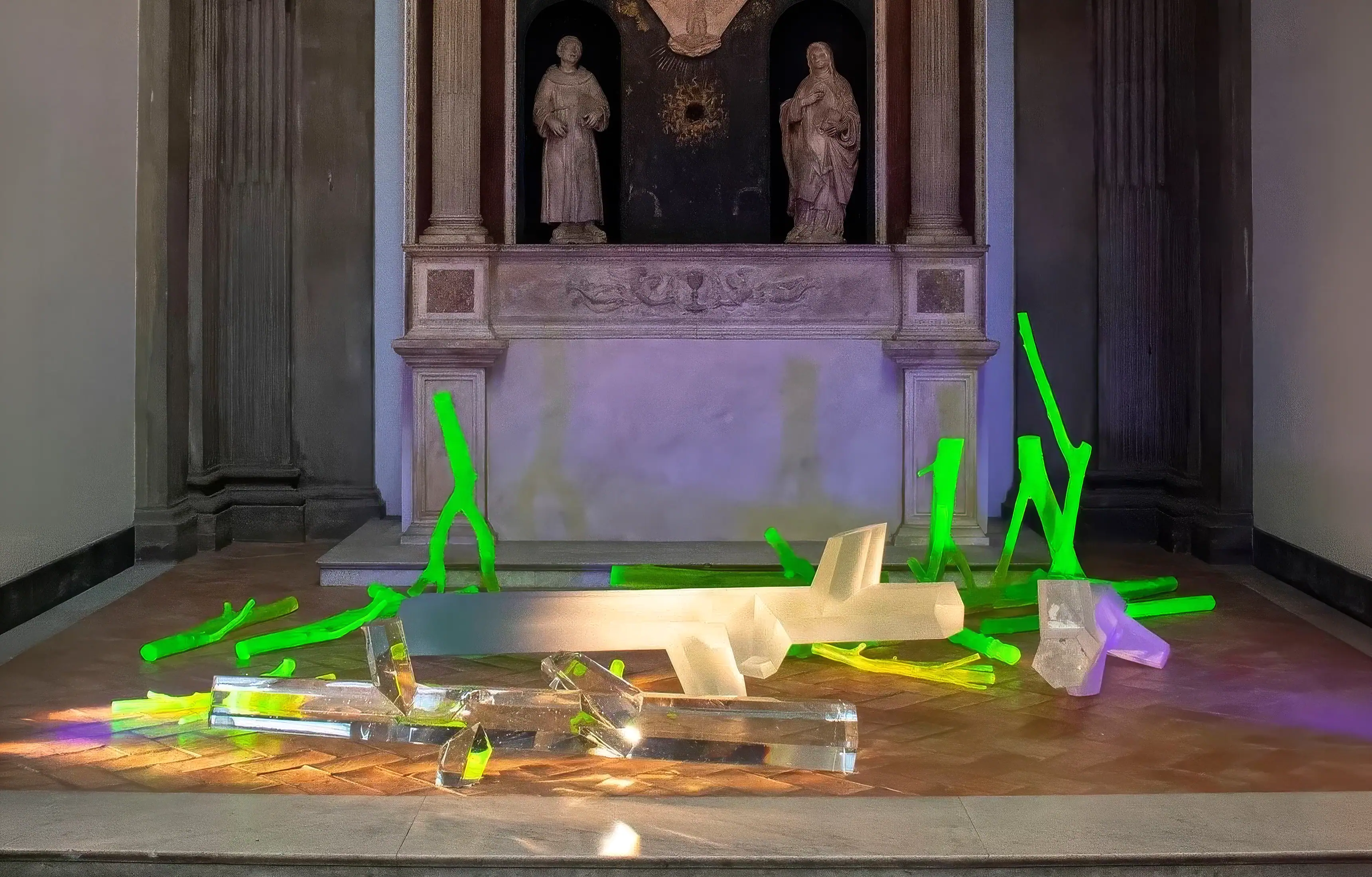
Reading time: 10 minUranium glass branches glowing green among the V&A’s medieval altarpieces. A New Orleans Big Chief’s beaded suits set beside tapestries woven in 1425. A doughnut of bamboo and carbon fibre lifting itself out of a fountain. For London Design Festival 2019, the Victoria and Albert Museum did not give its commissions a room of their own. It put them inside the collection, and let four very different makers argue their case in front of the objects that made their work possible.
London Design Festival 2019 ran across the capital from 14 to 22 September, and the Victoria and Albert Museum spent that week as one of its busiest venues, hosting more than a dozen separate commissions and displays across its galleries, courtyard and public programme. That scale is easy to report and hard to make interesting on its own. What made the V&A’s 2019 edition worth returning to is where, specifically, four of those commissions ended up.
Rony Plesl’s glass installation Sacred Geometry went into the Medieval and Renaissance Galleries, among the museum’s own Czech glass holdings. Big Chief Demond Melancon’s hand-beaded Mardi Gras Indian suits, shown with the London collective Assemble, went into the Tapestries Gallery, beside a set of tapestries woven in 1425. Kengo Kuma’s Bamboo Ring: Weaving into Lightness took over the John Madejski Garden, the museum’s own courtyard. Matthew McCormick’s Avalanche occupied the landing outside the British Galleries.
None of those placements were incidental, and none of the four makers were treated as visitors passing through. Each was set down beside the part of the V&A’s permanent collection that shared its lineage: glassmaking beside glassmaking, textile craft beside textile craft, a garden structure beside the museum’s own courtyard architecture. The result is a festival week that argued something specific about where contemporary design belongs, and did it four times over.

Sacred Geometry: glass built to answer the room around it
Rony Plesl’s installation took the form of three large hexagonal glass trunks, standing among the medieval and Renaissance objects the V&A already had in the room. Each trunk carried a pair of identical twin branches made from uranium glass, the historic glassmaking material that fluoresces a vivid green under ultraviolet light. Positioned among devotional and architectural pieces from the museum’s own collection, the branches read, under UV, as something closer to a votive flame than a houseplant.

The forms drew on two ideas at once: fire and wood, the two raw components glassmaking has depended on since it began, and sacred geometry, the proportional systems that run through both religious architecture and the Renaissance objects surrounding the piece in the gallery. The trunks themselves were made using a large-scale casting technique, developed with the Czech glass company Bolety, that let Plesl work at a scale conventional glassblowing does not easily allow.
Uranium glass is worth pausing on, because it is a genuinely old technique rather than a novelty prop. Glassmakers have coloured glass with uranium oxide since the 1830s, and pieces from the following century are still traded today under names including canary glass and vaseline glass, both describing the same pale yellow-green colour the material takes in daylight, before it fluoresces under UV. Production paused during the Second World War and resumed in the late 1950s using depleted rather than natural uranium, and decorative uranium glass is still manufactured today, its uranium content regulated well below any level that poses a risk in ordinary handling or display. Plesl’s branches used that history deliberately: a Victorian-era decorative technique, employed at a scale nobody attempted with it in the nineteenth century, glowing beside architectural fragments several centuries older still.

Rony Plesl: the professor who scaled up Czech glass
Plesl has run the Studio of Glass at Prague’s Academy of Arts, Architecture and Design since 2008, and was made a full professor of design and architecture there in 2017. He trained outside the Czech tradition before returning to it, spending four years in Venice studying under Italian glass masters, an apprenticeship he has described as formative to how he now works. In 2017 he was also appointed art director of the Czech glass brand Rückl, developing a design programme for the company alongside his own studio practice.
His pieces sit in major collections including the Corning Museum of Glass in New York and, separately from this installation, the V&A’s own holdings, and he has won the Red Dot Award twice, in 2007 and again in 2019, the year of this installation. The casting method behind Sacred Geometry, developed with Sin Studio Gallery, is one he was among the first artists to use at monumental scale, which is why three trunk forms of this size, each carrying a pair of glowing branches, had not been attempted in quite this way before.
Black Masking Culture: a New Orleans tradition inside the tapestry hall
The Tapestries Gallery held two beaded suits by Big Chief Demond Melancon, displayed alongside V&A tapestries woven in 1425 that depict hunting scenes: boars, bears, swans, otters, deer and falconry. Curator Meneesha Kellay set the two bodies of work deliberately close together, contemporary beadwork and five-and-a-half-century-old weaving occupying the same room.
Melancon leads the Young Seminole Hunters, one of New Orleans’s Black masking tribes based in the city’s Ninth Ward, a role he has held as Big Chief since 2012 after more than twenty-five years spent making suits and masking at Mardi Gras. Black masking, often known outside New Orleans as the Mardi Gras Indian tradition, dates back more than two centuries in the city, growing out of the historic ties between African American and Native American communities there. Suits made in the tradition are entirely hand-sewn and hand-beaded, worked afresh every year and worn once, at Mardi Gras, before the process begins again.

The two suits shown at the V&A were Ethiopia (2018), a yellow suit built around a portrait of Haile Selassie alongside imagery of the rock-hewn churches of Lalibela and lion-headdressed kings, and Bras-Coupé (2016), a beige and gold feathered suit depicting the legendary formerly enslaved leader of a Louisiana uprising. Melancon works in beads as small as two millimetres, and each suit takes in the region of a million individual beads, hand-sewn across an apron that runs from waist to ankle, a dickie and a decorated waistcoat. Beneath the visible layers, Melancon builds in further imagery depicting enslaved people’s experience and celebratory dance, kept partly hidden by design, as a private element of the work rather than a display for the viewer. Where nineteenth-century masking suits often carried Native American imagery, Melancon’s suits reframe the tradition around African and African American history directly, using Black masking’s inherited technique to tell a different set of stories within it.

Why Assemble was the collective the V&A called
Assemble is the London-based collective that won the Turner Prize in 2015 for Granby Four Streets, a project that restored a set of derelict terraced houses in Liverpool into affordable homes and shared enterprise space, working directly with the residents who lived there. That project set the pattern the group has kept since: architecture practised as long-term, hands-on community work, rather than as a finished object handed over at completion.
That same pattern is what connected Assemble to Melancon before the V&A was ever involved. The collective co-designed the Material Institute, a free arts and fashion school built inside a former industrial building in New Orleans’s Ninth Ward, offering local residents access to tools, space and professional teaching they would not otherwise have had. Melancon has taught there as a founding tutor since the school opened in 2018, one year before London Design Festival 2019. The V&A display grew directly out of that relationship: Assemble, already working alongside Melancon in New Orleans, proposed bringing his suits to London, and then built the display furniture themselves, a set of solid oak stands modelled on the way samurai armour is traditionally presented, made to the exact measurements of each suit. It was Melancon’s first showing of his work outside the United States, staged by a collective he had already been teaching alongside for a year, in a New Orleans school built to give other people in his own neighbourhood the same kind of making practice.
Bamboo Ring: a doughnut that lifts itself into the air
Kengo Kuma’s Bamboo Ring: Weaving into Lightness filled the John Madejski Garden with a ring roughly the shape of a giant doughnut, built from two-metre-diameter component rings woven diagonally over the courtyard’s fountain. Each ring combined bamboo, specifically Phyllostachys edulis, bent into shape at a factory in Komatsu, Japan, then laminated with carbon fibre for rigidity before being shipped to London for assembly.
The structure was built to move. Pull both ends of the ring at once and it deforms, lifting roughly half of itself into the air, a live demonstration of what Kuma called pliancy, precision, lightness and strength working together. Bamboo alone bends easily but resists structural load; carbon fibre alone is rigid but heavy for its strength. Laminated together, Kuma argued, the combination points to what he described as the material of the future, developed with Ejiri Structural Engineers and his own Kengo Kuma Laboratory at the University of Tokyo.
The installation also arrived almost exactly a year after Kuma’s first UK building opened its doors. V&A Dundee, his design for the museum’s outpost on the Tay, opened to the public on 15 September 2018, a single day short of a year before Bamboo Ring went up in London. The garden installation was not Kuma’s introduction to the V&A name. It was his second design for it within twelve months, this time built from the lightest materials he works in rather than the 2,500 concrete panels that make up Dundee’s cliff-like exterior.

Avalanche: a corridor built from a mountain
Matthew McCormick’s Avalanche took the form of a low-lit, highly reflective corridor on the landing outside the British Galleries, built almost entirely from Barrisol, a stretchable membrane material, with an internal wall backlit by Osram LED strips against mirrored glass barriers arranged in a progressively narrowing sequence. Visitors moved through in small groups, the reflective surfaces compressing the sense of the space around them as they went.
McCormick, a Canadian lighting and interior designer and a backcountry snowboarder, built the piece as a response to a friend’s death in an avalanche and to the way shifting weather patterns have changed snowpack conditions in the mountains he grew up riding. The corridor was designed to function, in his own description, as an interactive reflection chamber, using light, reflection and confined space to put a visitor briefly inside a controlled, physical sense of scale and disorientation, rather than illustrating the idea through image or text.

The argument behind the placement
Set the four commissions side by side and the choice of gallery stops looking like scheduling and starts looking like the point. Plesl’s glass sits with the V&A’s own Czech glass. Melancon’s beadwork sits with the V&A’s own 1425 tapestries. Kuma’s bamboo ring sits in the museum’s own courtyard, a year after his own building for the V&A opened in Dundee. Each commission was placed with the part of the collection that shares its material history, rather than gathered together in a single festival pavilion set apart from the rest of the museum.
That decision does real work. A visitor walking the Medieval and Renaissance Galleries encounters Plesl’s uranium glass beside centuries of glassmaking the V&A already holds, and the new piece reads as the latest entry in a continuous history rather than a one-week intervention. The same is true in the Tapestries Gallery, where Melancon’s suits sit beside weaving from six centuries earlier and both bodies of work are read, correctly, as textile craft carried out at an extraordinary level of hand skill, whatever century it comes from. Placing new work inside the permanent collection, rather than beside it, makes the argument for contemporary design’s place in a historic museum without needing a wall label to say so.
Final thoughts
It would be simple to describe London Design Festival 2019 at the V&A as four installations placed in four galleries. That misses what the placements were actually doing. Each maker was set down beside the part of the museum’s own collection that shares a material history with their work, glass beside glass, textile beside textile, a garden structure beside the museum’s courtyard, and the V&A’s own building beside the architect’s other building for it in Dundee.
The result was a week in which contemporary design did not visit the V&A’s collection. It joined it, in the room, standing beside the objects that made the comparison possible. Uranium glass glowing next to a medieval altarpiece, a beaded suit hung near a six-hundred-year-old tapestry, a bamboo ring lifting itself out of a fountain in a nineteenth-century courtyard: each pairing argued that the techniques on show, casting, beading, weaving and, in Kuma’s case, binding bamboo to carbon fibre, belong to one continuous history rather than two separate ones.
That is what a museum can do with a festival week that a temporary pavilion cannot. It can put the new work in the room with the old work and let the visitor draw the line themselves.
When did London Design Festival 2019 take place?
London Design Festival 2019 ran from 14 to 22 September 2019 across London, with the Victoria and Albert Museum as one of its principal venues.
What was Rony Plesl’s Sacred Geometry?
Sacred Geometry was a glass installation by the Czech artist Rony Plesl, made from three large hexagonal glass trunks with paired branches of uranium glass, shown in the V&A’s Medieval and Renaissance Galleries among its own Czech glass collection.
Why does uranium glass glow green?
Uranium glass contains trace uranium oxide, which absorbs ultraviolet light and re-emits it as visible green light. It is a decorative glassmaking technique dating to the 1830s and remains legal and safe to handle and display today, with uranium content tightly regulated.
Who is Demond Melancon?
Demond Melancon is the Big Chief of the Young Seminole Hunters, a Black masking tribe based in New Orleans’s Ninth Ward, and has led the tribe since 2012. His hand-beaded suits were shown at the V&A alongside the London collective Assemble in the Tapestries Gallery.
What is the connection between Assemble and Demond Melancon?
Assemble co-designed the Material Institute, a free arts and fashion school in New Orleans’s Ninth Ward, where Melancon has taught as a founding tutor since 2018. That existing collaboration led directly to the V&A display the following year.
What was Kengo Kuma’s Bamboo Ring made from?
Bamboo Ring: Weaving into Lightness was built from bamboo, specifically Phyllostachys edulis, laminated with carbon fibre and woven into a ring roughly two metres in component diameter, installed over the fountain in the V&A’s John Madejski Garden.
What was Matthew McCormick’s Avalanche installation?
Avalanche was a low-lit corridor built from Barrisol and mirrored glass, backlit with LED strips, on the landing outside the V&A’s British Galleries, designed as an immersive response to McCormick’s experience of avalanche danger in the mountains of eastern Canada.


Leave a Reply