
ARCHITECTURE · NEW YORK
Reading time: 9 minOne hundred and fifty four interlocking staircases, wrapped in copper-toned steel, rising sixteen storeys above Manhattan’s West Side. Thomas Heatherwick’s Vessel took the form of an Indian stepwell and turned it upside down, building an amphitheatre for climbing rather than a well for water. Eight years on, it remains one of the few pieces of public sculpture in New York designed to be walked through rather than looked at, and the considered work that went into reopening it is as much a part of its design story as the structure itself.
At the centre of Hudson Yards, the vast development that has reshaped Manhattan’s Far West Side over the past decade, sits a structure that resists easy description. It is not a building, though it has sixteen storeys. It is not quite a sculpture, though it stands entirely still. It is not a staircase, though it is made of nothing else. Vessel, designed by Thomas Heatherwick and his London studio, opened on 15 March 2019 as the physical and symbolic heart of Related Companies’ 28-acre development, a five-storey-high lattice of copper-clad steps that visitors could climb from the plaza floor to a viewing platform above the surrounding towers.
Vessel’s story since then has not been a straight line. It closed to the public more than once between 2019 and 2021, following a series of deaths by suicide, and it did not reopen until October 2024, after a lengthy and carefully considered redesign of its safety features. That history is part of any honest account of the structure, and this piece sets it out plainly, alongside the fuller story: a genuinely unusual piece of public design, built on a historical idea nobody else had thought to bring to New York, made by a studio with a distinctive and consistent design language, and now reopened as a considered, safer version of itself.

A honeycomb of stairs at the heart of Hudson Yards
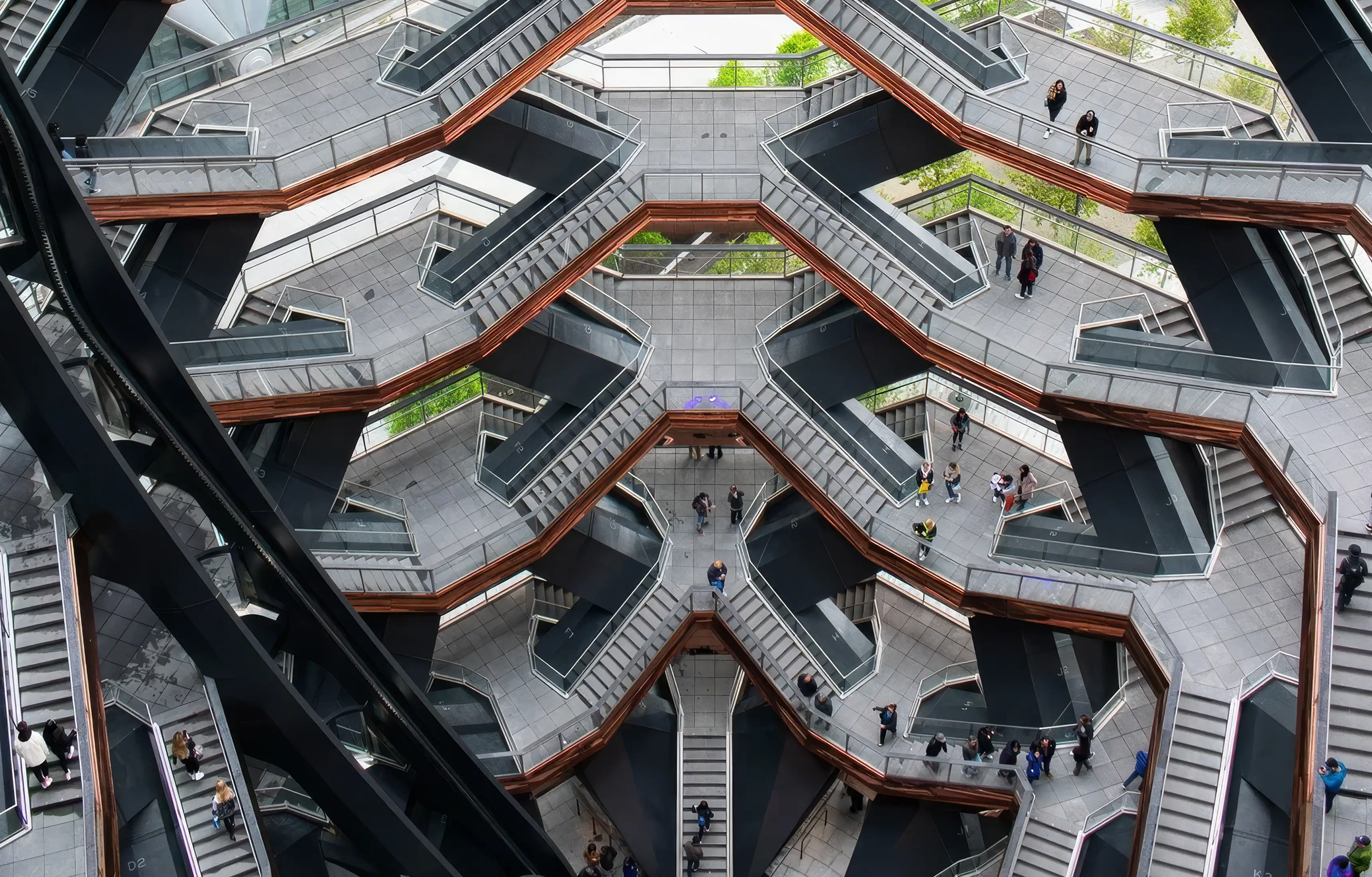
Vessel stands in the public plaza at the base of Hudson Yards, the largest private real estate development in United States history, framed by the glass towers that Related Companies and its architectural partners built around it. Physically, it is a lattice of 154 interlocking flights of stairs and 80 landings, adding up to 2,500 individual steps and more than a mile of climbable route packed into a structure that is only 50 feet wide at its base. It widens as it rises, reaching roughly 150 feet in diameter at its open top, so that the whole form flares outward like a vase or a woven basket turned on its point.
Every stair tread, riser, handrail and landing underside is clad in a warm, coppery bronze steel, chosen so that the structure reads as a single continuous material rather than as an assembly of parts. From a distance, the effect is closer to a honeycomb or a piece of woven basketwork than to conventional architecture; up close, the geometry becomes genuinely disorientating, staircases crossing beneath and above one another in patterns that owe an obvious debt to Escher. There is no single route to the top. Visitors choose their own path through the lattice, and two people climbing together will rarely take the same one twice.

Thomas Heatherwick and the idea of an inverted stepwell
The starting point for the design was not New York at all. Heatherwick has described being struck by photographs of stepwells in Rajasthan, the extraordinary subterranean structures built across parts of India over centuries to give communities reliable access to water through the dry season. A traditional stepwell descends: tiers of stone steps zigzag downward, often past several storeys, to a pool at the base. Heatherwick’s idea was to take that logic and turn it inside out, building a structure that used the same choreography of interlocking staircases, but sent people up into the open air rather than down toward water, on a site where there was no natural amphitheatre or hillside to build into.
That inversion is the design argument that makes Vessel more than a photogenic staircase. A stepwell is public infrastructure disguised as architecture, built to bring a community together around a resource everyone needed. Heatherwick’s version keeps the social logic and discards the utilitarian one: there is no water at the bottom of Vessel, only people, and the climb itself is the destination. It is worth remembering that Related Companies’ chief executive, Stephen Ross, wanted a landmark that would draw people to Hudson Yards’ plaza in every season, not a decorative centrepiece for a single ribbon-cutting. A stepwell-derived structure, built to be occupied rather than admired from a bench, answers that brief directly.

How it was made
Vessel’s construction was as unusual as its concept. The steel structure was fabricated in Italy by Cimolai, the engineering firm also responsible for major stadium and bridge projects across Europe, in 75 large interlocking sections that were shipped to New York and assembled on site over more than two years. Getting a structure this geometrically complex to arrive plumb and level, section by section, from across the Atlantic, was as much a feat of logistics as of engineering.
The copper-toned cladding was a deliberate material choice rather than a decorative one. Raw steel or aluminium would have read as cold and industrial against the glass curtain walls surrounding the plaza; a warmer, coppery finish gives Vessel a sense of age and craft that its very contemporary geometry does not immediately suggest, and it catches New York’s low winter light in a way that a matt or painted surface would not. The same finish runs across every handrail, tread and landing soffit, which is part of why the structure reads as sculptural rather than merely functional: there is no visible seam between what holds you up and what you are looking at.

Vessel within the Hudson Yards masterplan
Vessel does not stand alone. It is the anchor of Related Companies’ public plaza, the open civic space at the centre of a development that also includes The Shed, the neighbouring cultural centre designed by Diller Scofidio and Renfro with Rockwell Group, and the retail and office towers that line the plaza’s edges. Where those buildings are enclosed, ticketed or leased, Vessel was conceived from the outset as the one element of the plaza that anybody could walk into and climb, without a reservation, a meeting or a reason to be there. That distinction, a genuinely public object at the centre of an overwhelmingly private development, is part of what made it a landmark rather than simply a large piece of street furniture.
Hudson Yards itself was built on a platform over an active Long Island Rail Road storage yard, an engineering undertaking on a scale that has few precedents in Manhattan. Vessel sits directly above that platform, at the point where the development’s plaza, retail and residential elements all converge, which is why Related Companies chose it, rather than any of the surrounding towers, as the site’s defining image.
A considered response: the 2024 safety redesign
Vessel closed to the public on more than one occasion between 2019 and 2021, following a series of deaths by suicide among visitors. It remained closed for close to three years while Related Companies and Heatherwick Studio worked with mental health and suicide-prevention specialists on how the structure could reopen responsibly. That process resulted in a substantial physical change: floor-to-ceiling steel mesh, fitted to every balcony and landing from the second level upward, engineered to sit close enough to the original handrail geometry that it reads as part of the structure rather than a retrofit. Vessel reopened to the public on 21 October 2024. Its uppermost level remains closed while further work continues on a mesh solution that can be fitted there without altering the silhouette of the piece.
It is worth stating plainly what that redesign represents. Retrofitting safety mesh across a structure built from 154 individually geometrically distinct staircases, without disguising the original design or interrupting the views the structure was built to offer, is a genuinely difficult design problem, and the solution that resulted has been developed with the same level of care as the original structure. As of 2026, Vessel operates on a timed-ticket system, with general admission from ten dollars, free entry for New York City residents on Thursdays, and a limited release of free same-day tickets each week, a deliberately more considered model of public access than the free-for-all opening of 2019.

Two Heatherwick buildings, one material language
Vessel is not the only project Heatherwick Studio has built for Related Companies on Manhattan’s West Side. A short walk south, beside the High Line in Chelsea, the studio’s Lantern House uses a strikingly similar material instinct: where Vessel is wrapped in copper-toned steel, Lantern House’s faceted bay windows meet its custom brickwork in dark, bronze-toned metal mullions, chosen for the same reason, to bring warmth and weight into a stretch of Manhattan otherwise dominated by glass curtain walls. Seen together, the two buildings read as a single, deliberate material argument the studio has made twice on the same stretch of the city: that a warm, metallic, hand-finished surface can do work that flat glass cannot, whether the object in question is climbed or lived in.
That throughline is easy to miss because the two projects are usually written about separately, one as sculpture and one as residential architecture. Read side by side, they show a studio applying the same material conviction at two very different scales, within a few blocks of each other, for the same developer. It is a more useful way to understand Heatherwick Studio’s New York work than treating Vessel as an isolated one-off.
Visiting Vessel today
Vessel is open daily from 11am to 7pm, with timed entry booked in advance through its own ticketing site. The lower levels are accessible to all visitors, and an elevator runs to the fifth, seventh and eighth floors for anyone who needs it. Only sections that have been fitted with the new safety mesh are currently open to climbers, which means the experience today is a genuine, if slightly reduced, version of the original 2019 climb rather than a full return to it. The plaza around Vessel, including views of The Shed and the surrounding towers, remains freely accessible without a ticket, and the structure is worth seeing even for visitors who choose to admire its geometry from below rather than climb it.

Final thoughts
It would be easy to tell Vessel’s story as a cautionary tale about ambition outrunning judgement, and easier still to tell it as a simple success story about a viewing platform with good sightlines. Neither version holds up to what the structure actually is. Vessel is a serious piece of public design, built on a historical idea, the Indian stepwell, that nobody had previously thought to bring to a New York plaza, fabricated with real engineering difficulty in Italy, and finished in a material that gives it warmth few structures of its scale ever achieve. It is also a structure that its owners and designers have been willing to close, study and rebuild in response to what happened to the people who used it, at real cost and over several years, rather than reopen it unchanged.
Both of those things are true at once, and the second does not diminish the first. The mesh now fitted across Vessel’s upper levels is not a compromise bolted onto someone else’s design; it was made by the same studio, to the same standard of material care, as the structure it protects. Alongside Lantern House a short walk north, it shows a practice returning to the same corner of Manhattan with the same conviction about warmth, weight and material honesty, applied twice, at two very different scales, for the same city block.
Vessel is worth visiting for what it is: a climbable piece of public sculpture, built from an idea five centuries old, that gives Hudson Yards a genuinely occupiable centre in a development otherwise defined by towers you can only look up at.
Vessel, Hudson Yards
What is Vessel at Hudson Yards?
Vessel is a 16-storey public sculpture designed by Heatherwick Studio, made from 154 interlocking flights of stairs, 80 landings and 2,500 steps clad in copper-toned steel, standing at the centre of the Hudson Yards development on Manhattan’s West Side.
Who designed Vessel?
Vessel was designed by Thomas Heatherwick and Heatherwick Studio, working for developer Related Companies, with the steel structure fabricated in Italy by Cimolai.
When did Vessel open?
Vessel opened to the public on 15 March 2019. It closed on more than one occasion between 2019 and 2021, and reopened with revised safety features on 21 October 2024.
What is Vessel made of?
Vessel is a steel structure, assembled from 75 large interlocking sections fabricated by Cimolai in Italy, clad throughout in a copper-toned steel finish across every stair, handrail and landing.
Is “Vessel” the structure’s official name?
Yes. Vessel began as a construction nickname while Hudson Yards ran a public competition to choose a permanent name; the studio and developer ultimately kept Vessel, the working name, as the finished structure’s official title.
Why did Vessel close, and is it open now?
Vessel closed to the public on more than one occasion between 2019 and 2021, following a series of deaths by suicide. Related Companies and Heatherwick Studio worked with mental health specialists on a redesign, fitting floor-to-ceiling safety mesh throughout the structure, and Vessel reopened on 21 October 2024.
What inspired Vessel’s design?
Thomas Heatherwick has said the design began with the stepwells of Rajasthan, historic Indian structures built to descend to underground water. Vessel takes the same interlocking staircase logic and inverts it, sending visitors upward into the open air rather than down to a water source.
How do you visit Vessel today?
Vessel is open daily from 11am to 7pm on a timed-ticket system, with general admission from ten dollars and free entry for New York City residents on Thursdays. Booking is through Vessel’s own ticketing site in advance.


Leave a Reply