
ART & CULTURE · MILAN
Reading time: 11 minIn April 2018, Wonderglass filled the Istituto dei Ciechi in Milan with a self-described universe called Kosmos, four separate presentations in cast, blown and fused glass by the Bouroullec brothers, Atelier Fornasetti, J&PEG and Studiopluz. Two of those four names, on closer inspection, turn out to share a maker. Kosmos was also the year Wonderglass said in public that it wanted to be known for more than the chandelier, and then let its most established Venetian technique, casting, do most of the arguing.
Wonderglass presented Kosmos at the Istituto dei Ciechi in Milan from 17 to 22 April 2018, timed to Milan Design Week and the Salone del Mobile. The Venetian glass house filled the Via Vivaio building’s rooms with four distinct bodies of work, cast glass objects by Ronan and Erwan Bouroullec, a cloud-form lighting collection by Atelier Fornasetti, a stop-motion film by the artistic duo J&PEG, and an illuminated sound sculpture by Studiopluz, unified under one immersive environment of ambient soundscape and a kaleidoscopic floor built to reference refracted light through glass.
Kosmos takes its name seriously. The Greek word describes an ordered universe rather than a chaotic one, and Wonderglass used it to argue that four very different collaborators, working in three different core techniques, were still describing one coherent material world. Maurizio and Christian Mussati, who run Wonderglass together, used the exhibition to make a second, more pointed argument about their own studio: that they wanted to move past the object typology that had built their name since 2013, the chandelier, and show what else Venetian cast, blown and fused glass could do.
That second argument is worth remembering, because Wonderglass would return to the same rooms the following year with nendo’s gravity-led Shape of Gravity chandelier collection, a project built entirely around a chandelier as its centrepiece. Kosmos came first, though, and its four rooms are where the studio actually tested how far its craft could travel away from the form it was known for.

What Kosmos actually put on show
The building at Via Vivaio 7 is not a conventional exhibition venue. It is the working home of the Istituto dei Ciechi di Milano, an institute for the education of blind people founded in 1840 by Michele Barozzi, occupying a neoclassical complex built from 1892 to a design by the architect Giuseppe Pirovano. Wonderglass had launched itself as a studio in the same building in April 2013, and returned to it for Kosmos five years later, filling its formal, light-filled rooms with an environment built specifically for the show: an ambient soundscape running through the spaces, and a floor treated to read as a kaleidoscope, its pattern standing in for the way light splits and repeats inside worked glass.
Against that backdrop, the four presentations were staged as genuinely separate bodies of work rather than variations on a single theme. The Bouroullec brothers’ cast glass objects and Fornasetti’s cloud-form lighting collection anchored two rooms with the studio’s most established technique, casting and blowing worked by hand. J&PEG’s film and Studiopluz’s sculpture, shown as part of Wonderglass’s more experimental Wonderlab strand alongside a glass bench by the designer Dan Yeffet, pushed in the opposite direction, toward moving image and sound rather than fixed form. The range was the point. A studio arguing that it was more than a chandelier maker needed to show more than one way of using its material, and Kosmos gave it four.

Ronan and Erwan Bouroullec’s Alcova, cast without the industrial precision
The French design duo Ronan and Erwan Bouroullec made Alcova, a collection of cast glass vessels and screen-like niche forms in bold orange, soft green, grey and clear tones, named for the Italian word for a private recess or alcove, a place, as the brothers have put it, where lovers meet. The niches come in two shapes, right-angled or semicircular, and are designed to hold or frame the collection’s cylindrical vessels, either singly or grouped into small still-life arrangements. Ronan Bouroullec has cited the Italian painter Giorgio Morandi’s studies of grouped bottles and jars as a reference for how the pieces are meant to be composed together, letting the same handful of forms read differently depending on how they are arranged.
The technique is where the Bouroullecs pushed hardest against Wonderglass’s usual precision. Molten glass is poured onto a flat surface and rolled, much as a baker would roll dough, before being draped over wooden moulds by a team of eight craftsmen who trim the edges, work out imperfections and smooth the surfaces by hand within about a minute, before the piece is moved into an annealing oven for slow, controlled cooling that prevents it from cracking. Rather than iron out every trace of that process, Ronan Bouroullec asked the workshop to let it show. “We wanted to play with the material’s own movement,” he has said of the collection, describing his interest as lying in what he calls the parameter of imperfection, the visible evidence of a piece having passed through a person’s hands rather than a mould calibrated for uniformity. Maurizio Mussati has said he wants to keep working with the brothers specifically to push the technical and size limits of what cast glass can be asked to do, treating Alcova as a starting point rather than a finished brief.

Fornasetti’s Through the Clouds, glass and metal reading as daydream
Atelier Fornasetti, under artistic director Barnaba Fornasetti, contributed Through the Clouds, a lighting collection built from delicate blown glass clouds, finished frosted white, with slender metal obelisks rising up through them. The obelisks are printed and lacquered in the atelier’s own finishes, most notably a rich malachite green and a marbled Marbalia pattern, and the pendants were shown in two sizes, a smaller version measuring 500 millimetres in diameter by 750 millimetres tall and a larger one at 500 by 900 millimetres.
The reference behind the obelisk is a specific one. Fornasetti has connected the form to ancient Egyptian symbolism, in which the obelisk represented a petrified ray of sunlight and stood as an emblem of Ra, the sun god, an image the atelier folds into a lighting collection built around the more contemporary, gentler idea of daydreaming, clouds as the mind wandering, obelisks as a fixed point of light breaking through. It is a piece of Fornasetti’s visual language rather than a novelty pattern applied to glass, printed metal and blown glass worked together rather than one material simply decorating the other. For a sense of how that same visual language has since expanded into permanent retail architecture, Inside Fornasetti’s New Milan Flagship is worth a further look, though a flagship store and a single lighting collection are different scales of the same design vocabulary rather than directly comparable projects.

J&PEG’s Invisible Cities (Origins), a glass city built for a camera
J&PEG is the Milan-based artistic duo of Antonio Managò, born in 1978 in Busto Arsizio, and Simone Zecubi, born in 1979 in Gallarate, working together since the mid-2000s across photography, performance, installation and video. Their practice outside Wonderglass has been shown at Castello Sforzesco in Milan, the MART museum in Rovereto and the Boghossian Foundation in Brussels, generally built around staged photography and performance rather than product design.
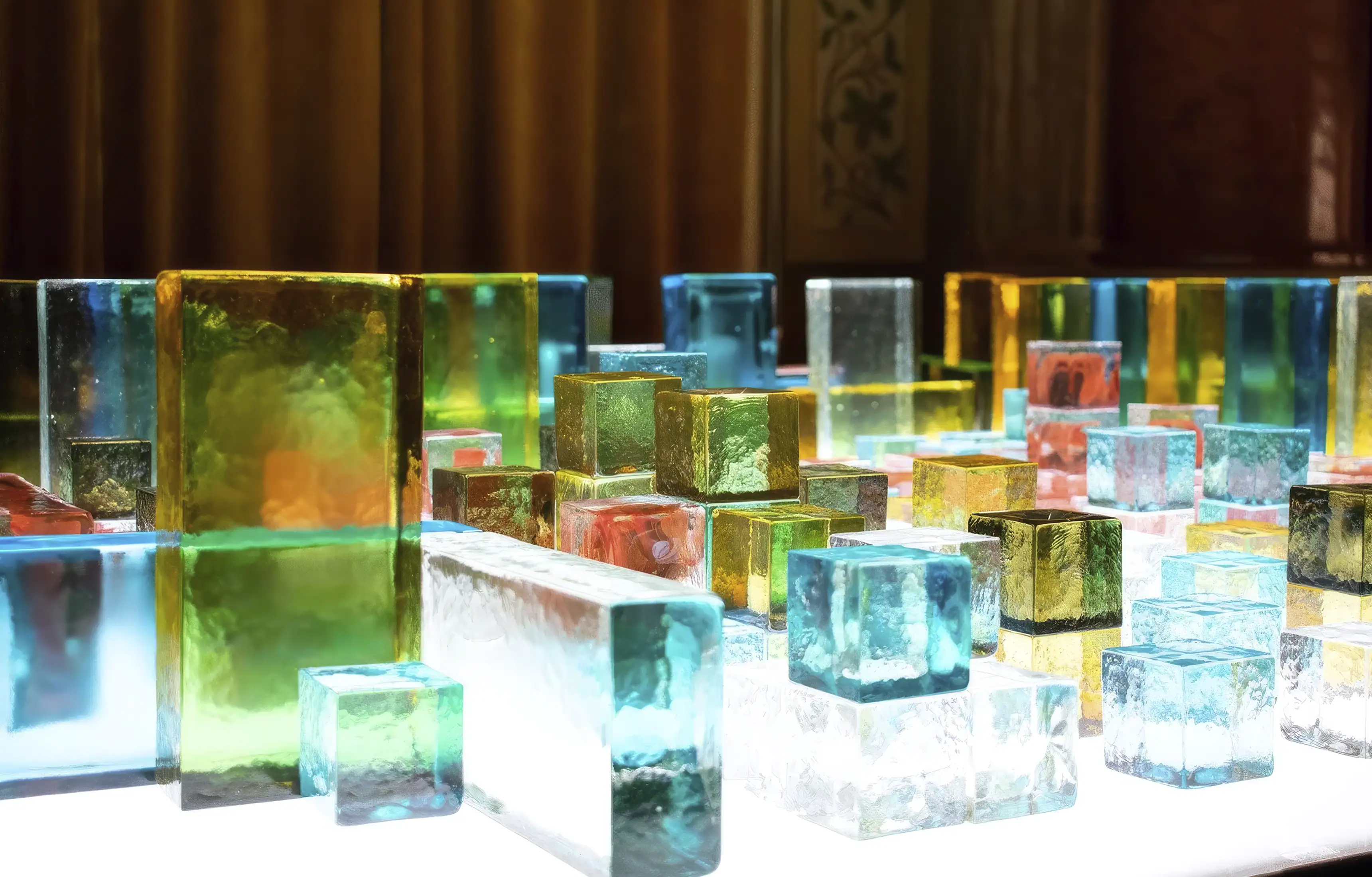
For Kosmos, the pair made Invisible Cities (Origins), a stop-motion film staged around a miniature glass cityscape, coloured blocks and towers arranged into an urban skyline, that follows a single glass ball on a journey through it. The title nods to Italo Calvino’s novel of the same name, and the film’s own description frames it as a surreal tale that celebrates the utopian vision of the city and the role glass plays in urban architecture, reading Wonderglass’s raw material as a proxy for the buildings and skylines it can eventually become. Where the Bouroullecs and Fornasetti showed finished objects, J&PEG’s contribution was a piece of storytelling built from the same glass vocabulary, cast blocks standing in for a city rather than a vessel.

Studiopluz’s Echo, translating a black hole’s sound into glass
Studiopluz, the London-based multidisciplinary practice founded by Simone Zecubi in 2018, made Echo, an illuminated sculpture built from a series of hand-blown glass discs arranged concentrically around a central light source, one disc finished with a silver mirror surface, its core built from glass and plexiglass, and a black polished speaker housing set into the structure with a silver chrome spacer. The finished piece measures 500 millimetres in diameter and 1,800 millimetres across, and was produced as a limited edition of eight, alongside two prototypes and two artist’s proofs.
The idea behind it draws directly on astrophysics. Research into the sound black holes emit, the way even the most distant, apparently silent reaches of the universe still resonate with energy, gave the piece its concept, and Studiopluz built a mechanism to match: the glass discs diffuse light outward in overlapping rings that behave like visible sound waves, while the integrated speaker actually plays an audible soundscape built to evoke that resonance. A visitor moving around Echo changes both the light pattern they see and the point in the room where the sound reads most clearly, so the piece keeps behaving differently depending on where in the room someone stands, translating an invisible cosmic phenomenon into something that can be walked around and listened to.

The connection nobody drew between two of Kosmos’s four rooms
Here is the detail that separates the two experimental Wonderlab pieces from the rest of Kosmos‘s billing. J&PEG, the duo behind Invisible Cities (Origins), is Antonio Managò and Simone Zecubi. Studiopluz, the practice behind Echo, was founded that same year, 2018, by Simone Zecubi alone. One person contributed, under two different names, to two of the four presentations inside the same exhibition, without any of the surrounding coverage at the time drawing the line between them.
It is not an accident of naming. Studiopluz’s own website today files J&PEG inside its own navigation as one of the practice’s projects, formally folding Zecubi’s earlier duo work under the studio he went on to build in his own right. Managò remains J&PEG’s other, equally credited half, and the film itself is a J&PEG piece rather than a Studiopluz one. But Kosmos was, structurally, an exhibition in which one designer was working on both sides of its most experimental wing at once, testing a fixed collaborative practice and a newly founded solo one in the same rooms, in the same week. Wonderglass built the show around the idea of one universe holding several distinct bodies of work. It turned out to be more literally true than the billing let on.

Wonderglass and the Venetian workshops behind the show
Wonderglass was founded in 2013 by Maurizio Mussati and his son Christian, working between Venice, where the glass itself is made, and London, and organised around three core techniques, cast, blown and fused glass. The studio’s reputation rests on pairing that Venetian craft with designers who do not come from a glass background, on the theory that an outside eye asks the workshop questions it would not think to ask itself; Zaha Hadid, Jaime Hayon, Nao Tamura and Oki Sato of nendo were all part of its 2013 launch programme at the Istituto dei Ciechi, the same building Kosmos returned to five years later.
Beyond its named collections, more than half of Wonderglass’s work is bespoke commission for architects and brands, frequently produced without a public credit, including a storefront for Chanel in Amsterdam and lighting collections for the architect Richard Meier. Maurizio Mussati has described the studio’s craftsmen, a stable team with more than fifteen years of collaborative experience, as among the best in Europe specifically at cast glass production, a claim Kosmos was built to demonstrate rather than simply assert. Having told visitors in 2018 that they wanted to be known for more than the chandelier, the Mussatis spent the rest of that decade proving the point by breadth, casting, blowing, sound, film, before returning to the chandelier itself in 2019 with nendo, this time built from a technique, gravity-formed casting, that Kosmos‘s own Bouroullec and Wonderlab rooms had already been rehearsing.

Final thoughts
It would be easy to read Kosmos as a survey show, four names sharing a building because Milan Design Week rewards volume. That reading undersells what Wonderglass actually did with it. The Mussatis used the exhibition to say, in public, that they wanted to be known for more than the object that had built their name, and then proved it by technique rather than by statement, casting with the Bouroullecs, blowing with Fornasetti, and handing the studio’s most experimental strand over to film and sound. Four different answers to the same question, all made from glass shaped in the same Venetian workshops.
The detail that gives the show its sharpest edge is the one nobody selling it mentioned. Two of its four presentations, on the exhibition’s more experimental side, were connected by a single designer working under two names in the same rooms in the same week, a fixed duo and a studio he had only just founded, tested side by side rather than presented as related. Wonderglass called the show a universe holding several distinct bodies of work. On its Wonderlab side, that turned out to be closer to literal fact than billing.
Kosmos also reads differently with the benefit of what came after it. Wonderglass would return to the Istituto dei Ciechi a year later with a project built entirely around the chandelier it had just said it wanted to move past, this time using a version of the gravity-led casting the Bouroullecs and the Wonderlab rooms had already been testing in 2018. The 2018 show was not a detour from the chandelier. It was where the studio worked out what else it could do with the same hands, before deciding what to do with them next.
What was Wonderglass’s Kosmos exhibition?
Kosmos was a Milan Design Week exhibition staged by the Venetian glass studio Wonderglass in April 2018, bringing together four separate presentations in cast, blown and fused glass by Ronan and Erwan Bouroullec, Atelier Fornasetti, J&PEG and Studiopluz inside one immersive environment.
Where and when was it held?
At the Istituto dei Ciechi, Via Vivaio 7, Milan, from 17 to 22 April 2018, during Milan Design Week and the Salone del Mobile.
What did Ronan and Erwan Bouroullec show at Kosmos?
Alcova, a collection of cast glass vessels and niche-shaped screens in orange, green, grey and clear tones, hand-cast by Wonderglass’s craftsmen and designed to be grouped in still-life arrangements.
What was Fornasetti’s Through the Clouds?
A lighting collection by Atelier Fornasetti combining hand-blown frosted glass clouds with printed and lacquered metal obelisks, referencing ancient Egyptian solar symbolism, shown in two sizes.
Who are J&PEG and what did they contribute?
J&PEG is the Milan artistic duo of Antonio Managò and Simone Zecubi. For Kosmos they made Invisible Cities (Origins), a stop-motion film following a glass ball through a miniature glass cityscape, referencing Italo Calvino’s novel of the same name.
What was Studiopluz’s Echo and how did it work?
Echo was an illuminated sculpture by Studiopluz, the practice founded by Simone Zecubi, built from concentric hand-blown glass discs around a central light source with an integrated speaker, translating research into the sound emitted by black holes into a moving pattern of light and an audible soundscape.
Is there a connection between J&PEG and Studiopluz?
Yes. Simone Zecubi, one half of the duo J&PEG alongside Antonio Managò, founded Studiopluz in 2018, the same year as Kosmos, meaning one designer contributed to two of the exhibition’s four presentations under two different names.
Who founded Wonderglass?
Maurizio Mussati and his son Christian founded Wonderglass in 2013, based between Venice, where the glass is made, and London, working across cast, blown and fused Venetian glass with designers from outside the glass world.

Leave a Reply