
ART & CULTURE · MILAN
Reading time: 9 minAt Milan Design Week 2019, Oki Sato of nendo and the glassmakers at Wonderglass agreed not to fight gravity but to let it finish the design. Sheets of molten glass, still soft from the furnace, were left to sag and fold under their own weight until they set. The result, shown at the Istituto dei Ciechi as Shape of Gravity, was a 2.5 metre chandelier and a collection of furniture that nobody actually shaped by hand.
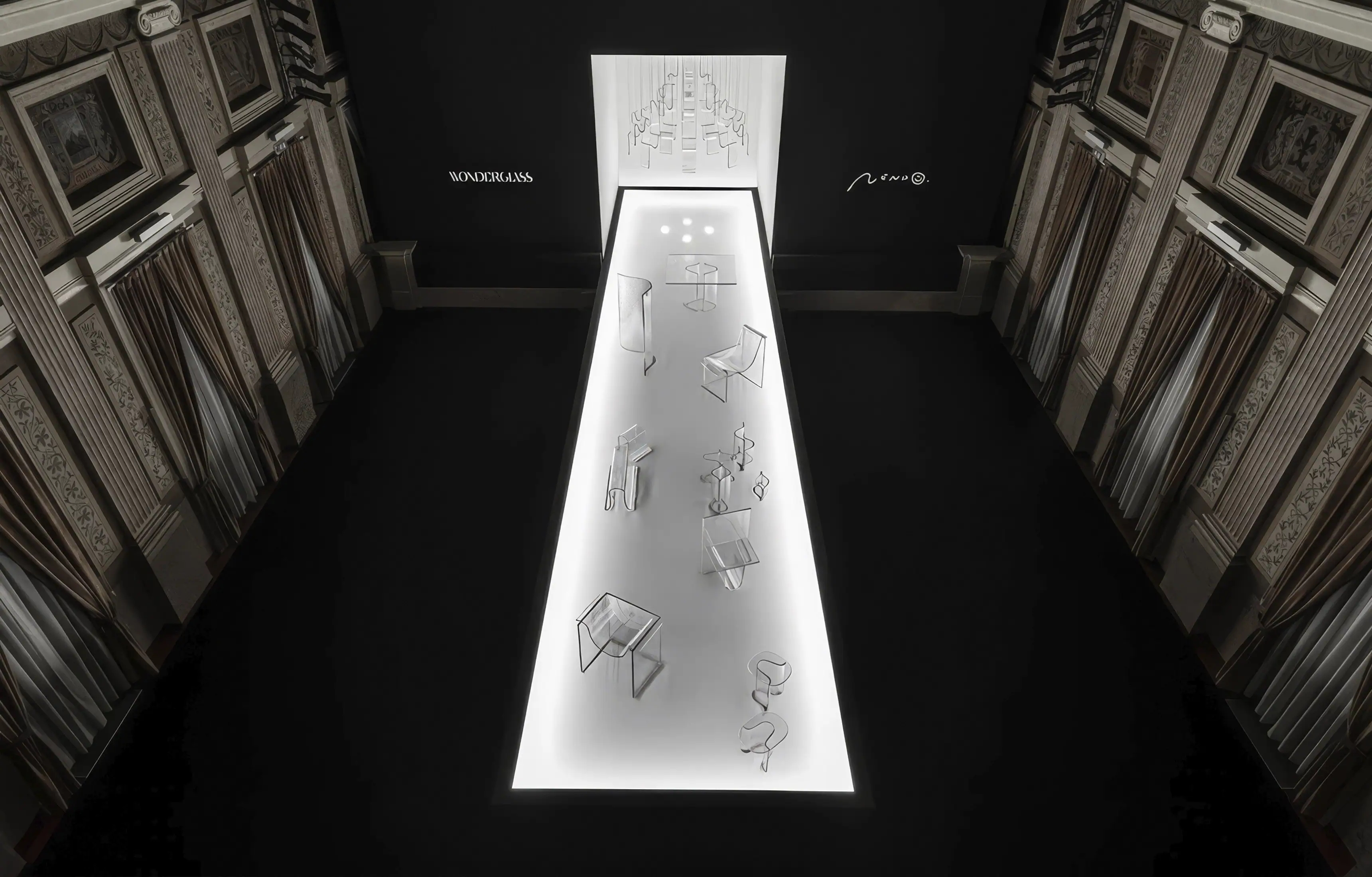
Wonderglass presented Shape of Gravity at the Istituto dei Ciechi in Milan from 9 to 14 April 2019, timed to Milan Design Week and the Salone del Mobile. The exhibition brought together the Venetian glass house’s craftsmen and Oki Sato, the Tokyo and Milan-based founder of the design studio nendo, around a single collection called Melt: cast glass chairs, a chaise longue, tables, tabletop vessels, and a chandelier that became the show’s centrepiece.
That chandelier, also called Melt, spans 2.5 metres in diameter. Its glass elements hang in overlapping arcs and folds, each one shaped not by a mould in the conventional sense but by the material’s own weight as it cooled. Under light, the rippled surfaces of the glass catch and scatter reflections across the room, so the fixture reads differently depending on where a visitor stands beneath it.
The design argument behind Shape of Gravity is a simple one to state and a difficult one to execute: remove the hand from the final shaping of the glass, and let physics do that part of the job instead. Sato has described the collection as an exercise in restraint rather than intervention, and the craftsmen at Wonderglass had to relearn their own material to make it work.

What Shape of Gravity actually put on show
The Melt collection reads, at first glance, like a set of furniture carved from ice. Every piece is cast or worked glass, left clear enough to show the small bubbles and density shifts that Venetian glassmaking has never fully eliminated and has long treated as proof of the hand behind the work. Chairs and a chaise longue carry the soft, slumped arches that gave the collection its name. A dining table and a side table repeat the same logic at a flatter scale, their edges settling into shallow curves rather than staying rigidly flat. Tabletop vessels complete the range.
The Melt chandelier sits above all of it as the collection’s most ambitious single piece. Its cascading glass forms were built up from individual cast elements, layered so that the fixture keeps a sense of weightlessness despite being made from one of the heaviest materials a designer can specify. Wonderglass and nendo positioned the chandelier as newly launched for the Istituto dei Ciechi presentation, rather than as an extension of an existing product line, which is part of why it carried the show.

How gravity became the design tool
The technique is where Shape of Gravity earns its title. Molten glass was worked in Wonderglass’s furnace, poured and smoothed into sheets by the studio’s craftsmen while it was still soft, and then transferred, still hot, onto steel supports built specifically to hold it in place without dictating its final form. From there, gravity and the glass’s own viscosity took over. As the sheets cooled, they sagged, folded and settled into arches on their own, and the craftsmen’s job shifted from shaping the material to managing the conditions, principally temperature and timing, that decided how far it would move before it set.
Christian Mussati, who runs Wonderglass with his father Maurizio, has described the process as one where the artisan’s hand mattered less than the artisan’s control of temperature. That is a significant admission from a glasshouse whose entire reputation rests on the skill of its craftsmen, and it is also the most interesting fact in the whole project. Wonderglass did not simplify its craft to make Shape of Gravity. It asked its glassmakers to master an entirely different, less visible skill: reading a material closely enough to know exactly when to stop guiding it and let it move by itself.
Sato has been direct about where the idea came from. Watching Wonderglass’s artisans coordinate around the melted material in the workshop, he noticed that the moments he found most beautiful were the ones where nobody was actively shaping the glass at all, just holding the conditions steady while it found its own arch. “The main idea was to let the glass flow by itself using gravity and using the weight of the glass itself,” he has said of the collection. “In a way, doing less and achieving more is the most complicated thing to do.” He has also put it more simply: he discovered the beauty of the material in the instant a flat sheet of glass first formed a curve under nothing but its own weight.

Oki Sato and nendo’s habit of noticing the overlooked
Sato founded nendo in Tokyo in 2002, straight out of a master’s degree in architecture at Waseda University, and opened a second studio in Milan in 2005. The name is the Japanese word for a child’s modelling clay, chosen because it describes the studio’s own working method as much as any material: pliable, provisional, and willing to take a new shape from whatever idea is pressing on it. Nendo has grown into one of the largest design studios of its generation, employing more than fifty designers and producing upward of a hundred projects a year across furniture, architecture, packaging and exhibition design.
Sato’s stated ambition for that output is what he calls giving people a small “!” moment, an instant of unexpected delight triggered by noticing something ordinary in a new way. He has said that what interests him is paying attention to the small details other people do not find interesting, and that he is drawn to projects with enough uncertainty in them to make him faintly anxious about the outcome. Shape of Gravity fits that description closely. A studio built on precise, controlled decision-making chose, for this project, to hand a large part of the final decision to gravity, and to treat the resulting uncertainty as the point rather than a risk to be designed out.
Glass was not new territory for Sato going into the Wonderglass collaboration; he had designed the Press pendant light for the Czech glassmaker Lasvit in 2013, exploring how a mould could record the moment glass and metal met. What Melt changed was the relationship to the mould itself. Where Press used a fixed form to capture glass at a single instant, Shape of Gravity removed the fixed form almost entirely and let the glass keep moving until it chose its own instant to stop.
Wonderglass and the Venetian workshops behind the collection
Wonderglass was founded in 2013 by Maurizio Mussati and his son Christian, with a stated aim of keeping the skills of Venetian master glassmakers in active use rather than treating them as heritage on display. The studio works between Venice, where its glass is made, and London, and organises its output around three core techniques: cast, blown and fused glass. In 2018 the operation grew into a wider collective, Made In WonderGlass, bringing glassmakers, research institutes and partner companies together under one umbrella around the family’s original workshops. That year Wonderglass also staged Kosmos at the same Istituto dei Ciechi venue, an earlier presentation pairing the Bouroullec brothers, Fornasetti and others with the studio’s cast, blown and fused glass.
The Mussatis have built Wonderglass’s reputation on pairing that Venetian craft with designers who do not come from a glass background, on the theory that an outside eye asks the workshop questions it would not ask itself. Zaha Hadid, Jaime Hayon, John Pawson, India Mahdavi, Marcel Wanders and Ronan and Erwan Bouroullec have all produced work through the studio, and Christian Mussati has spoken of Shape of Gravity specifically as a project that pushed the boundaries of what cast glass could be asked to do, precisely because Sato was not trained to think about the material’s limits in the way a glassmaker would be.

A return to the room where Wonderglass began
The detail that gets lost in most accounts of Shape of Gravity is that it was not nendo’s introduction to Wonderglass. It was a return. Wonderglass launched itself as a studio at the Istituto dei Ciechi in April 2013, in the same rooms it came back to six years later, and Sato was already part of that first show. His piece then was Komori, a chandelier made with the mosaic house Bisazza, its blown glass shades hung in the same loose, gathered formation as a colony of roosting bats, each shade steering its LED light downward into the room below.
That earlier piece and Melt make an instructive pair. Komori used a fixed, deliberately drawn silhouette, glass shaped to resemble something specific and then multiplied. Shape of Gravity went the opposite way six years later, removing the drawn silhouette altogether and letting the material’s own behaviour stand in for a shape Sato might otherwise have sketched. Read together, the two projects trace a single designer’s relationship with one glasshouse moving from control toward release, staged in the same rooms both times. Nobody selling the 2019 show mentioned the 2013 one, which is a shame, because it is the strongest evidence in the whole project that Shape of Gravity was a considered next step rather than a one-off experiment with a novel technique.
The Istituto dei Ciechi as a setting, not just a venue
The Istituto dei Ciechi di Milano was founded in 1840 by Michele Barozzi as an institute for the education of blind children in the city, and it has occupied its present building on Via Vivaio since construction began there in 1892, to a neoclassical design by the architect Giuseppe Pirovano. The building carries the ordered, deliberate detailing typical of the period, tiers of pilasters across its facade moving from Doric to Ionic to Corinthian, and a concert hall, the Sala Barozzi, frescoed with medallion portraits of composers around a historic organ. Milan Design Week has used the building repeatedly since Wonderglass’s own 2013 debut there, and its combination of formal, light-filled rooms and quiet civic history gives glasswork like Melt a setting considerably more sympathetic than a standard fair stand.
There is a coherence to holding a project about material sensitivity, sensing exactly when glass wants to move and when to let it, inside a building whose founding purpose was about other, equally exacting forms of sensitivity. Nobody involved with Shape of Gravity has made that connection explicit, and the exhibition never needed to, but it is difficult to walk the Sala Barozzi and not notice it.

Final thoughts
It would be easy to describe Shape of Gravity as a technical stunt, glass that looks like it is melting because it briefly was. That reading misses what the collection is actually arguing. Sato and Wonderglass built Melt around a deliberate transfer of authorship, from the hand that shapes to the material that behaves, and treated the uncertainty of that handover as worth showing rather than worth hiding. The chandelier’s 2.5 metres of overlapping glass are not an approximation of a sketch. They are a record of exactly how far a specific sheet of hot glass wanted to move on one particular day in Murano.
That is also why the return to the Istituto dei Ciechi matters more than a coincidence of venue. Sato first worked with Wonderglass in the rooms where the studio introduced itself in 2013, with a chandelier built from a fixed and deliberately drawn form. Coming back six years later with a collection that removed the drawn form altogether is the clearest evidence that Shape of Gravity was the next chapter in a specific, ongoing conversation between one designer and one glasshouse, not a standalone showpiece for a single design week. The glass did the moving. The relationship is what held its shape.
What was Wonderglass x nendo’s Shape of Gravity?
An exhibition of cast glass furniture and lighting by the Venetian glass studio Wonderglass and the Japanese design studio nendo, shown at Milan Design Week 2019. Its collection, called Melt, included chairs, tables, tabletop pieces and a 2.5 metre chandelier, all shaped using gravity rather than moulds alone.
Where and when was it held?
At the Istituto dei Ciechi, Via Vivaio 7, Milan, from 9 to 14 April 2019, during Milan Design Week and the Salone del Mobile.
What is the Melt chandelier?
The centrepiece of the exhibition, a 2.5 metre diameter chandelier built from cast glass elements that were left to fold and settle under their own weight while still hot, rather than being pressed into a fixed mould.
How was the glass shaped without a mould?
Wonderglass’s craftsmen worked the molten glass into sheets and transferred it, still hot, onto steel supports designed to hold it without forcing its shape. Gravity and the glass’s own viscosity pulled it into arches and folds as it cooled, with the craftsmen controlling only the temperature and timing of the process.
Who is Oki Sato?
The founder and principal of nendo, a design studio he established in Tokyo in 2002 after studying architecture at Waseda University. Nendo has a second studio in Milan and works across furniture, architecture and exhibition design.
Who founded Wonderglass?
Maurizio Mussati and his son Christian founded Wonderglass in 2013, based between Venice, where the glass is made, and London, with a focus on cast, blown and fused Venetian glasswork made alongside international designers.
Had nendo worked with Wonderglass before this collection?
Yes. Sato designed Komori, a bat-form chandelier made with the mosaic house Bisazza, for Wonderglass’s own launch exhibition at the same Istituto dei Ciechi venue in April 2013, six years before Shape of Gravity.


Leave a Reply