
ART & CULTURE · MIAMI
Reading time: 9 minZhang Huan installed two Buddha sculptures on Miami’s South Beach for the 2019 Faena Festival, positioned to face one another. One was cast in aluminium and built to last. The other was built from incense ash collected from temples across China over three years, and built to fall apart. The gap between the two is the entire work.
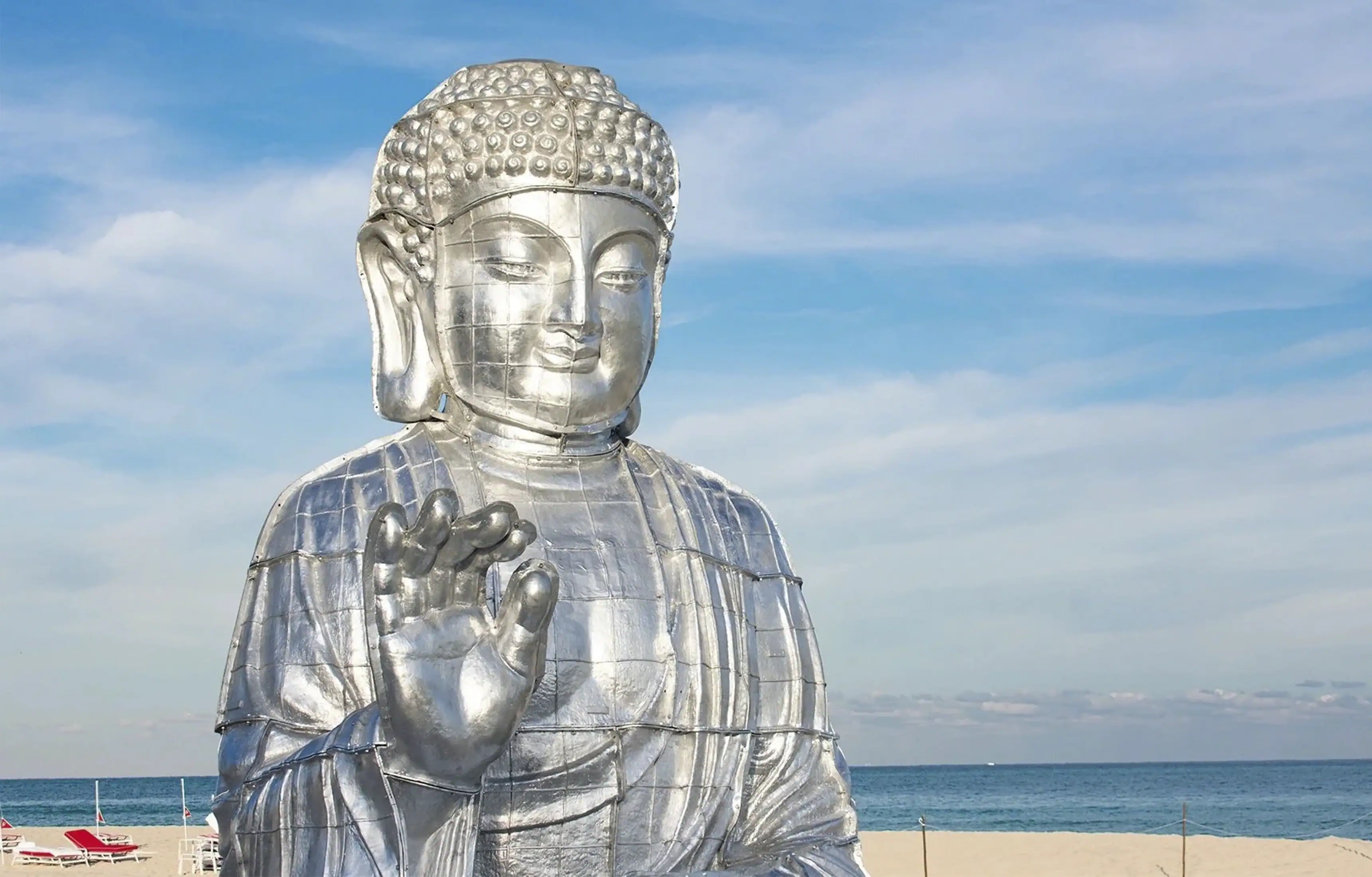
For the second Faena Festival, staged across Miami Beach during Art Basel week in December 2019, the Chinese artist Zhang Huan installed a pair of Buddha sculptures on the sand at Faena Beach. They stood facing each other. One was cast in aluminium, its surface built to catch and throw back the light of the sun by day and the moon by night. The other was built entirely from incense ash, gathered from Buddhist temples across China over three years, and left in the open air to be worked on by wind, rain and salt for the length of the festival.
Titled Miami Buddha, the piece was unveiled at 7pm on 2 December 2019, in an unmasking ceremony that opened the week-long festival, themed “The Last Supper” and curated by Zoe Lukov. It was the third time Zhang Huan had built this exact pairing, aluminium against ash, one Buddha built to endure and one built to be spent. The first two were made for Shanghai and Sydney. Miami got the third, and the ocean did to it what a Sydney winter and a Shanghai gallery had done before.
The piece rewards more than a glance at two big Buddhas on a beach. The material argument behind it runs back through three decades of Zhang Huan’s work, to a moment in a Shanghai temple in 2005 and, before that, to a market stall in Tibet in the early 1990s. Both moments turn on the same instinct: taking hold of something that was about to be thrown away, and making it the entire subject of the work.

Two Buddhas, face to face, on the sand
The physical arrangement is exact and it is the point. Two Buddha sculptures, each seated, positioned so that they look directly at one another across a stretch of open sand rather than standing side by side or facing the same way as a matched pair usually would. That confrontation, rather than any pedestal or plinth, is what tells a visitor to read them against each other.
The aluminium figure is cast, polished and durable, the kind of object built to survive an outdoor installation without changing. Aluminium takes and holds a bright, reflective finish, and Zhang Huan used that quality deliberately: by day it catches direct Florida sun, by night it picks up moonlight and the ambient glow of a beachfront during Art Basel week, so the figure never goes fully dark.
The second figure is built from compacted incense ash, collected over three years from temples across China and bound into sculptural form. Ash has no structural memory once it is exposed to Miami’s climate. Salt air, humidity, wind and rain worked on it for the length of the festival, and it was designed to lose definition as the days went on, exactly as intended: not damaged, but running its course. The two objects, aluminium and ash, permanent and perishable, sit across from each other and make the same argument that a single sculpture could not.
From Beijing’s East Village to a Shanghai temple floor
Zhang Huan was born in 1965 in Anyang, in China’s Henan province, and made his name in the early 1990s as one of the artists working in Beijing’s East Village, a loose community of performance artists working with almost nothing but their own bodies. His best known early work, 12 Square Meters (1994), had him sit motionless for an hour in a public latrine, his body coated in honey and fish oil to draw flies, a piece that turned the physical conditions of a specific place in Beijing into the entire content of the work. He moved to New York in 1998 and continued performance-based work there for several years.
He returned to China in the mid 2000s and set up a large studio in Shanghai, and the return coincided with a shift in his practice from performance to object making, much of it worked through Buddhist material and imagery. The decisive moment came in 2005, at Shanghai’s Longhua Temple, where Zhang Huan watched incense ash from thousands of individual offerings being swept up to be discarded. Rather than let it go, he began collecting it. That single decision, to keep material that was on its way to being thrown out, became the foundation of an entire body of work: ash paintings first, then ash sculpture, sourced from temples in Shanghai and the neighbouring provinces of Jiangsu and Zhejiang, and eventually collected specifically for individual commissions such as Miami Buddha.
Zhang Huan has described the ash itself as carrying something beyond its physical properties: the residue of what he has called the collective memory and collective blessing of the people who lit each stick of incense. The material is not a substitute for bronze or stone. It is the specific, accumulated residue of a very large number of individual prayers, compacted into a form, and the work only holds together because that residue does.

The other half of his Buddha practice began in a Tibetan market
The aluminium figure standing opposite the ash has its own origin story, and it predates the ash works by more than a decade. In the early 1990s, travelling in Tibet, Zhang Huan came across fragments of Buddhist statuary in local markets: feet, legs, arms and fingers of small bronze Buddha figures, broken up during the Cultural Revolution when Buddhist imagery across China was systematically destroyed. He began collecting these fragments, and the scale of what he found, hands and feet sized for figures many times larger than the human body, became the starting point for a series of monumental copper and steel sculptures built at a scale the original fragments only hinted at.
Three Legged Buddha (2007) and Three Heads Six Arms, both built from hammered copper over steel armatures and weighing more than ten tonnes each, grew directly out of those market fragments. Three Heads Six Arms has travelled from Zhang Huan’s Shanghai studio to San Francisco’s Civic Center Plaza, to Hong Kong, to Florence’s Forte di Belvedere, and now sits in the permanent collection at Parkview Green in Beijing. Long Ear Ash Head (2007) sat between the two strands of the practice, a monumental head in ash and steel, its elongated earlobes referencing a Buddhist symbol of enlightenment, made in the same years he was beginning to work in incense ash at scale.
Read together, the two material strands in Zhang Huan’s Buddha works are closer than they first appear. The copper sculptures are built from the surviving fragments of statues that were deliberately destroyed. The ash sculptures are built from the residue of incense that was about to be swept away. Both are made from what was left over after an act of loss, one violent and historical, one small and everyday, and both turn that leftover material into the entire form of a Buddha rather than hiding it inside one.
Sydney first, then Miami: the same pairing in a new climate
The exact format used in Miami, an aluminium Buddha facing an ash Buddha, was not new in 2019. Zhang Huan first built this pairing for Sydney Buddha, shown at Carriageworks in Redfern from January to March 2015 in association with the Sydney Festival. That version used twenty tonnes of incense ash, built over five days by Zhang Huan and a team of twelve assistants into a seated figure 5.3 metres tall, facing a matching aluminium form. At the work’s public unveiling, sections of the ash figure’s hand and face were allowed to collapse into its own lap as part of the reveal, a deliberate demonstration rather than an accident of handling.
Miami Buddha repeats that architecture rather than inventing a new one, and the repetition is itself part of the argument. Each staging uses ash gathered specifically for that city, from temples local to the source, so the material is never generic: the Sydney work drew on temples around Shanghai, Jiangsu and Zhejiang, and the Miami ash was gathered from temples across China over a three-year period specifically for the Faena commission. The aluminium half stays constant in concept if not in casting, a fixed point against which each city’s ash is given its own timeline to fall apart. Miami’s contribution to that timeline was salt air and direct beach exposure, a faster and more visibly physical process than a gallery interior would have allowed.

Why Alan Faena commissions work at this scale
Miami Buddha was not an isolated booking. It was the second edition of the Faena Festival, an annual week of commissioned work staged across the Faena District during Art Basel Miami Beach, and it sat inside a wider pattern set by the district’s developer, the Argentinian hotelier Alan Faena. Faena had already built a comparable arts-led waterfront district in Buenos Aires before turning to a stretch of Miami Beach’s Collins Avenue, where he assembled a team that included OMA, led on the project by partner Shohei Shigematsu, to design the Faena Forum, a cultural venue completed in 2016 alongside a hotel converted from the historic Saxony by Baz Luhrmann and Catherine Martin and a residential tower by Foster and Partners.
Shigematsu has described culture as the driving force behind OMA’s collaboration with Faena in Miami Beach, and the Forum was built with public programming in mind from the outset, including a domed 12 metre auditorium with a central glazed oculus and an Assembly Hall built to host exactly the kind of large-scale commission a festival needs. That building programme explains why a developer, rather than a museum, was in a position to give Zhang Huan a stretch of open beach and the freedom to let a sculpture fall apart in public over a week. The 2019 festival, curated by Zoe Lukov, who had previously worked at MOCA Los Angeles under Jeffrey Deitch, placed Zhang Huan’s Buddhas alongside new commissions from Myrlande Constant and Gabriel Chaile and video work by Camille Henrot and the Propeller Group, all of it free and open to the public across the district Faena had built specifically to hold it.

Final thoughts
It is easy to describe Miami Buddha as a beach sculpture about impermanence and leave it there. That is accurate as far as it goes, but it treats the piece as a single idea illustrated twice, when the more interesting fact is that neither material in it was ever meant to become sculpture. The aluminium Buddha’s form traces back to fragments of destroyed bronze statues Zhang Huan found in a Tibetan market in the early 1990s. The ash Buddha’s material traces back to a pile being swept off a temple floor in Shanghai in 2005. In both cases the sculpture exists because Zhang Huan kept something other people had already finished with.
That is also why Miami Buddha is not a one-off response to a Miami Beach commission. It is the third staging of a pairing that started in Shanghai, was refined in Sydney over five days and twenty tonnes of ash, and arrived in Florida with three years of collected material behind it. Each city supplies its own weather and its own timeline for the ash to run down, and each aluminium twin stays bright while it happens.
The result is a sculpture that does its most important work after the opening. A finished bronze Buddha asks to be looked at once and remembered. Miami Buddha asked to be watched over a week, with the understanding that half of what a visitor saw on Monday would not be there, in the same form, by Sunday. That is not a compromise built into the material. It is the entire reason Zhang Huan chose it.

Leave a Reply