
Products & Objects · Hong Kong
Reading Time: 7 minutes
Six wool rugs, unveiled at Tai Ping’s London showroom, trace back to a single piece Ed Ng and Terence Ngan designed for their own mountain home in Japan. The Ami collection is AB Concept’s second body of work for the Hong Kong carpet house, and it swaps the aerial abstraction of their first for something made from memory instead.
Introduction
Ami, the six-piece rug collection by Hong Kong studio AB Concept for the carpet house Tai Ping, was unveiled at Tai Ping’s Fulham Road showroom in London from 15 to 19 September 2025, during the London Design Festival. Each rug is hand-tufted in undyed and dyed wool, its surface worked with needlepoint, crochet, carving and bevelling to mimic the ridges and pulls of a knitted textile. The palette is autumn on a Japanese mountainside: burnt orange, mustard yellow, sage green, cream.

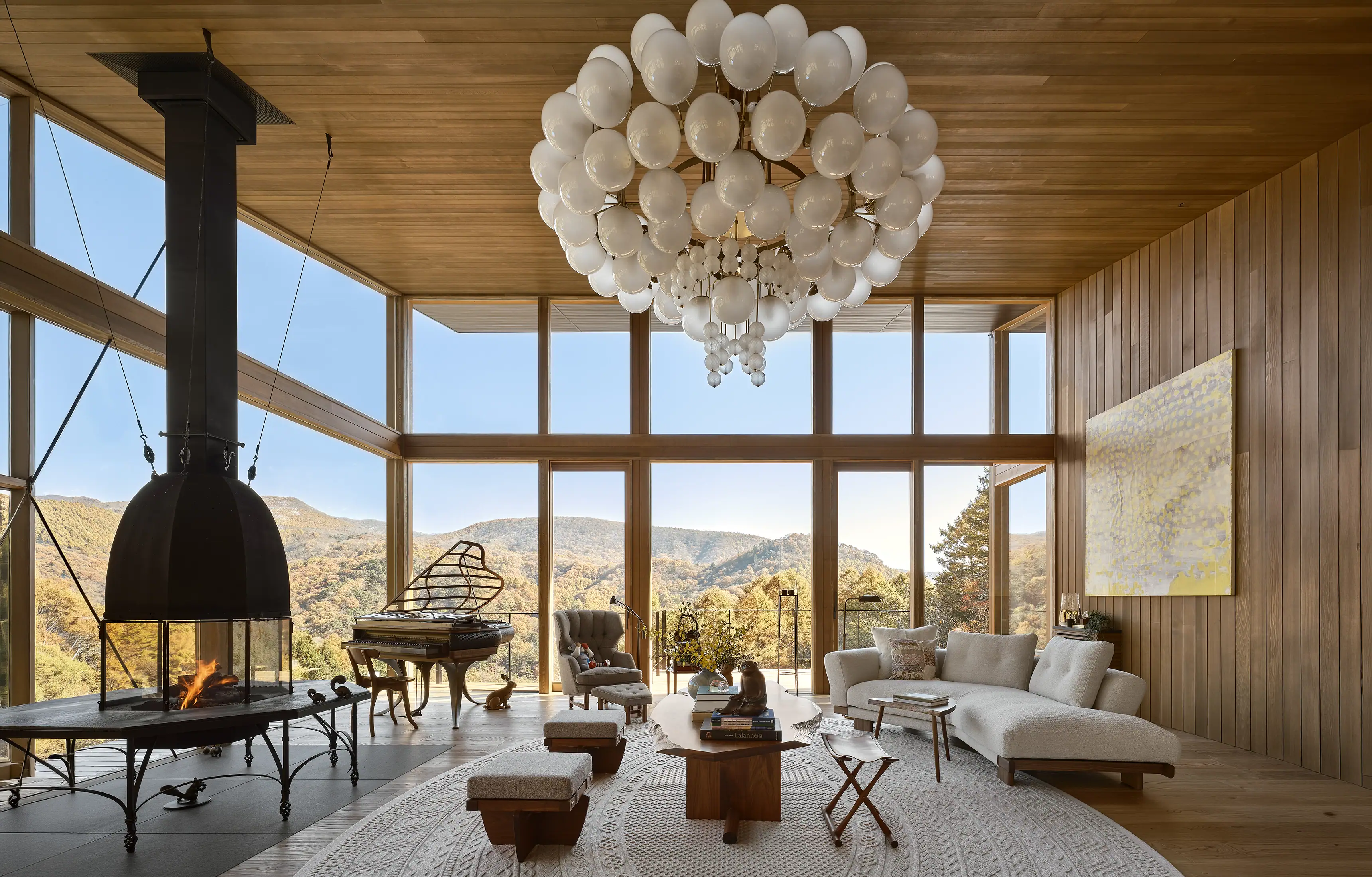
The collection did not begin as a collection. It began as a single bespoke rug, four by five and a half metres, designed by AB Concept co-founder Ed Ng for the private mountain home he shares with his design and business partner Terence Ngan in Karuizawa, Japan. Ng has described the starting point plainly: watching his grandmother knit sweaters as a child. “I have always been fascinated with craft, and knitting in particular,” he has said. A domestic rug, made for a house nobody outside the practice was meant to see, is now available to buy in six designs and four sizes. That journey from private floor to public collection is the story worth telling here, more than the collection’s good looks alone.


An 安
From clouds to cable-knit
Ami is not AB Concept’s first work for Tai Ping. Their earlier collaboration, Nephele, named for the Greek nymph of clouds, was a four-piece couture set built around aerial perspective: Polis read as city lights seen from above, Oread as Hong Kong’s harbour, Boreas as Antarctic ice fields, Syrinx as windswept grass. Tai Ping’s embroiderers worked those pieces in gold Glosilk thread and embroidered silk ribbon, a technically virtuosic, materially precious set built around a view from a great height.

Ami is Nephele’s opposite in almost every register that matters. Where the first collection looked down from the sky, the second looks down at a domestic floor. Where Nephele reached for gold thread and silk, Ami commits to a single material, undyed wool, worked with techniques, cable twists, honeycombs, diamond lattices, that belong to hand-knitting rather than fine embroidery. The shift is not a step down in ambition. It is a deliberate move from the abstract to the personal, and it says something about where a practice goes after two decades of hospitality work in the world’s grandest lobbies: eventually, the material story that matters most is the one closest to home. Reading the two collections side by side, in order, is the clearest account available of how AB Concept’s relationship with craft has matured.


Ikoi 憩
The house that started it
The rug that became Ami was made for Itsu Sho Sha, the mountain residence Ng and Ngan built in Karuizawa, a hot-spring resort roughly an hour from Tokyo by Shinkansen, sometimes described as Japan’s answer to an Alpine retreat. Completed in 2022, the project has since been recognised at the 2025 Createurs awards and the 2024 A&D awards. It follows an earlier home the pair built nearby, a two-storey timber and stone house profiled in 2019, which they described at the time as an antidote to the pace of professional life in Hong Kong and Taipei. Karuizawa, for two designers whose working life is built around other people’s hotels and residences, is where the addresses belong entirely to them.

That distinction matters for how Ami reads. A collection designed for a client brief answers somebody else’s questions about scale, budget and brand fit. A rug designed for your own floor answers only one question: what do you actually want to walk on, barefoot, in autumn, in the mountains. Ng’s answer drew on the most specific material memory he had, his grandmother working wool into a sweater, stitch by stitch, and scaled it from a garment to a floor. The six finished designs are what happened when that single domestic answer was developed into a full collection for sale.


Iyashi 療
Six rugs, one material
Every piece in the Ami collection is worked entirely in wool, hand-tufted as its base and then finished with needlepoint, crochet, carving and bevelling to build the varying pile heights that give a tufted rug the tactile complexity of something knitted by hand. The designs come in oval, round and rectangular formats, and the collection is offered in sizes from two by two metres up to three by four metres.

Each rug carries a short name intended to describe a mood rather than a motif: a piece in burnt orange associated with calm, a sculptural rounded design associated with repose, a beige rug worked in a cut-and-loop technique that visibly recalls the ribbing of a knitted sweater, a grey runner built from interwoven bands, a design emphasising quiet stillness, and a sage green piece finished with hand-embroidered wool and associated with healing. Ed Ng has described the design logic behind the set as intentionally understated: “The patterns are very simple and elegant yet quite complex, and the juxtaposition of geometric shapes creates a fresh, contemporary feel.” That combination, plain at a glance and considerably more worked the longer you look at the surface, is the collection’s actual argument. It is also, not incidentally, a fair description of hand-knitting itself.


Kara 空
A carpet house built on the palace habit
Tai Ping is not a young company adopting a designer for novelty. It was founded in Hong Kong in 1956 by Sir Lawrence Kadoorie, Sir Horace Kadoorie and a group of international associates, its name chosen to mean “great peace.” The same Kadoorie family later built The Peninsula hotel group and Hong Kong’s CLP power utility, which places the origin of Tai Ping’s carpets inside one of the city’s defining business dynasties rather than in the textile trade alone. Early in the company’s history, a director developed a motorised hand-tufting gun that sped production dramatically and was subsequently adopted across the wider carpet industry, an innovation with an outsized effect on how tufted rugs are made worldwide to this day.

The company’s reputation for exceptional commissions was established fast and has never really lapsed. In 1961, Tai Ping was commissioned to produce a carpet measuring 6.7 by 12.2 metres for the White Drawing Room at Windsor Castle. Further commissions followed for Buckingham Palace, the Élysée Palace, the royal households of Thailand and Brunei, a mosque at Riyadh International Airport, and, through its American Edward Fields brand acquired in 2005, the White House and Air Force One. In 2010 the company acquired La Manufacture Cogolin, a French hand-woven Jacquard carpet house founded in 1924, adding a European weaving tradition to its Asian manufacturing base.
The detail that explains why a collaboration like Ami now sits at the centre of Tai Ping’s business, rather than at its edges, is more recent: in 2017, the company divested its commercial carpet division entirely to concentrate on custom, artisan-made work. A named-designer collection built around personal memory and hand technique is not a marketing exercise bolted onto a volume manufacturer. It is the exact kind of project the company restructured itself to make.


Sei 静
Who is AB Concept
AB Concept was founded in Hong Kong in 1999 by architect Terence Ngan and interior designer Ed Ng. Over more than two decades the studio has built a global practice spanning architecture, interiors and creative direction, working primarily across luxury hospitality and high-end residential projects, and extending in recent years into furniture, lighting and textile design. The practice describes its own approach as balancing rigour with warmth, treating a project’s function and its emotional effect on the people inside it as equally serious design problems. Ami, and Nephele before it, are the clearest examples yet of that approach applied to a single material rather than to an entire building.


Wa 和
Frequently asked questions
What is the Ami collection?
A six-piece collection of hand-tufted wool rugs designed by Hong Kong studio AB Concept for the carpet house Tai Ping, unveiled at Tai Ping’s London showroom during the London Design Festival in September 2025.
Who designed the Ami collection?
Ed Ng and Terence Ngan, co-founders of AB Concept, the Hong Kong architecture and interior design studio they established in 1999.
What inspired the collection?
A bespoke rug Ed Ng designed for the mountain home he and Terence Ngan built in Karuizawa, Japan, drawing on childhood memories of watching his grandmother knit.
What materials and techniques are used?
Each rug is hand-tufted in wool, then finished with needlepoint, crochet, carving and bevelling to create varying pile heights that mimic knitted texture.
Is this AB Concept’s first collaboration with Tai Ping?
No. Ami follows Nephele, an earlier four-piece couture collection inspired by aerial views and worked in gold silk thread and embroidered silk ribbon.
Is the Ami collection available to buy?
Yes. The rugs are sold through Tai Ping in sizes from two by two metres up to three by four metres, in oval, round and rectangular formats.

Final thoughts
Most designer rug collections arrive as a brief: a brand wants a name attached, a name wants a new material to work in, and the result sits somewhere between the two. Ami arrived the other way round. It started as a floor in a house nobody but its owners was meant to see, built from a memory specific enough that no brief could have produced it, and only afterwards became something Tai Ping could put in a showroom on Fulham Road. Reading it against Nephele, the collaboration’s first, more abstracted body of work, the direction of travel is clear. AB Concept’s material story, two decades and one carpet house into the relationship, has moved from what the world looks like from above to what it feels like underfoot, at home, in autumn.
Leave a Reply