ART & CULTURE · DUBAI
Reading time: 8 minHisham Sharif’s first solo exhibition at Ayyam Gallery, and his first in the United Arab Emirates, is built on patterned interiors, recurring mirrors and a declared debt to nineteenth-century French painting. That debt did not start with him. His father, AbdulRahim Sharif, trained in Paris in the 1970s and was later made a Chevalier in France’s own order for the arts. The son’s solo debut was staged at the institution his father helped establish. Allusive Veil is less a discovery than a continuation.
Allusive Veil opens at Ayyam Gallery in Dubai on 23 September 2026 and runs until 30 October, with a vernissage on the opening evening from 6pm to 9pm in the presence of the artist. It is Hisham Sharif’s first solo exhibition with the gallery and his first solo show anywhere in the UAE, arriving at Ayyam’s space on Alserkal Avenue, the Al Quoz warehouse district that has spent nearly two decades turning industrial sheds into the Gulf’s densest concentration of galleries.
The five paintings supplied ahead of the show, Behind the Mirror, Red Room, She Calls Me Pinocchio, The Mistake and Wake Up, share a register: domestic interiors rendered in acrylic, built from layered colour rather than drawn outline, in which a mirror, a window or a reflective surface repeatedly interrupts the room. Sharif has described his own influences as running back to nineteenth-century French painting, a claim that is easy to make and rarely investigated. In his case, it holds, and it holds because of where it comes from.

A room built to hold the picture, not just show it
Ayyam Gallery was founded in Damascus in 2006 by Khaled and Jouhayna Samawi, with Hisham Samawi joining as a partner instrumental in the gallery’s later expansion. It represents a roster of Arab and Iranian artists, and its move to Dubai, prompted by the war in Syria, turned it into one of the programmes most associated with preserving and continuing Syrian and wider Levantine art practice through a period when doing so in the region of origin became impossible. The gallery’s Alserkal Avenue space, B11 on Street 8 in Al Quoz 1, sits inside a district that has become the reference point for the Gulf’s gallery scene, built out of former marble and car repair warehouses from 2007 onward.
Sharif is not the gallery’s only painter interested in what a room does to the person inside it. Ayyam has also shown Safwan Dahoul, whose four-decade Dream series follows a single recurring figure through interiors that have grown steadily tighter around her. Sharif’s rooms are different in almost every particular, dense with pattern and colour where Dahoul’s are stripped to near abstraction, but the two painters are working the same problem from opposite ends: what an interior does to a person who cannot leave it, and how much of that can be shown through the architecture of the room rather than the person’s face.

The room Sharif paints, and the room his father learned to paint it in
The nineteenth-century French reference in Sharif’s work is not an abstraction borrowed secondhand from art history. His father, AbdulRahim Sharif, born in Manama in 1954, studied under the sculptor Marcel Gili at the École nationale supérieure des Beaux-Arts in Paris during the 1970s, where he won the Pierre David-Weill prize and the Grande Masse des Beaux-Arts prize. He went on to complete a Master of Fine Arts at Parsons School of Design in New York in 1978, before returning to Bahrain in 1982. There, he became a founding member of the Bahrain Arts Society, the country’s oldest visual arts institution.
In February 2022, AbdulRahim Sharif was made a Chevalier in France’s Ordre des Arts et des Lettres, one of the country’s most senior honours for contribution to the arts, presented at a ceremony at the French Embassy in Bahrain. That same month, father and son staged a joint exhibition, Sharif & Sharif, at the Bahrain Art Centre in Muharraq, pairing AbdulRahim’s landscapes with Hisham’s own work on themes of humanity, corruption and conflict.
It was not the pair’s first point of contact through an institution. Hisham Sharif’s own solo debut, Frightening the Dark, was staged in 2017 at the Bahrain Arts Society, the body his father had helped found thirty-five years earlier. A nineteenth-century French painting tradition, carried home by one generation and passed to the next through the same building, is a considerably stronger claim than a stated influence.

Interiors built on tension, not narrative
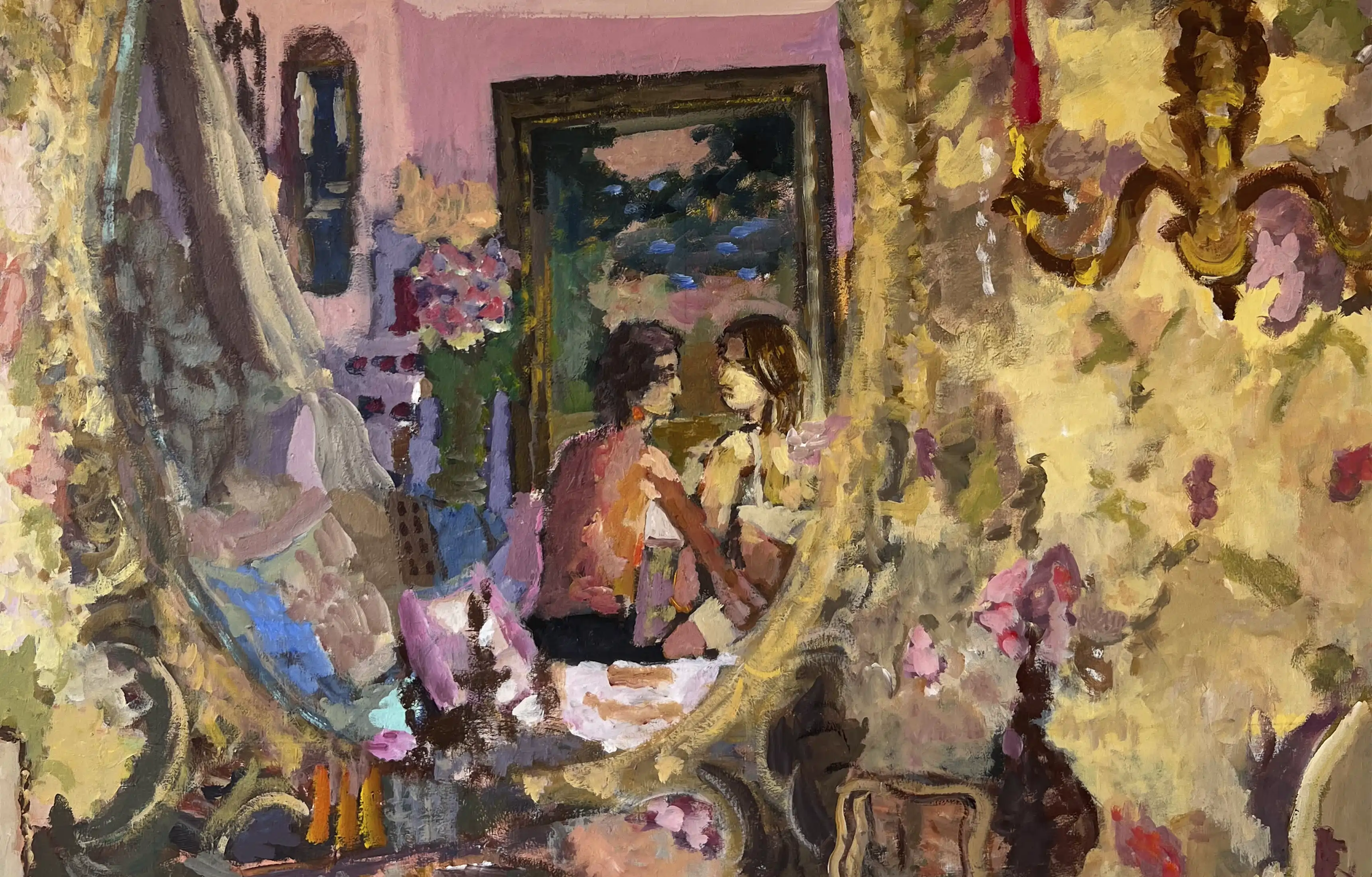
Sharif’s own description of his method is that his paintings are not interested in telling a story. They are built instead from layered washes, scraped textures and shifts in tone, working toward mood rather than plot. That shows across the five works. Wake Up, at 130 by 100 centimetres, holds a sunset-lit window and an abandoned easel canvas above a bed left in disorder, its palette running from deep orange through to cooler greys where the light does not reach. Red Room, at 80 by 70 centimetres, commits entirely to a single saturated colour, a reclining figure on a four-poster bed viewed through the bed’s own wooden posts as though the frame itself were a kind of veil. Behind the Mirror, the largest of the five at 140 centimetres square, uses an oval mirror to show two figures in a room the viewer cannot otherwise see, set against a densely patterned gold interior.
The mirror recurs across the work as more than a device. It lets Sharif show a second room inside the first, a technique with a long history in the French painting he cites but one he uses specifically to blur what is actually present in the scene from what is only reflected in it. She Calls Me Pinocchio turns the same instinct on the artist’s own studio, a shelf of paint tubes, brushes and jars rendered in warm, cluttered detail beneath a shadowed, near-featureless figure whose presence is implied rather than depicted. The human subject, where it appears at all across the five works, is never the loudest element in the frame. The colour and the pattern carry the argument, and the figure is allowed to recede into it.

The cheetah, the gazelle, and a tradition older than the painting
The Mistake introduces the clearest example of Sharif’s use of animal symbolism: a cheetah reclining on a striped daybed beside a woman in a richly patterned robe, set against a densely decorated wall hanging. The pairing of cheetah and gazelle across Sharif’s wider body of work draws on a specific and well-documented tradition rather than a generalised idea of myth. Persian and Mughal royal courts kept trained cheetahs, known in Persian as yuz, to run down blackbuck and gazelle on the hunt, a practice recorded in miniature painting from the sixteenth century onward and continued at scale under rulers including Akbar. The predator and the prey were not abstract opposites in that tradition. They were animals that shared the same hunting ground, one bred and collared for the pursuit of the other. Sharif’s own reworking of the pairing, folding it into a domestic interior rather than a hunt, keeps the tension of that relationship while relocating it entirely indoors.
A finance degree, and the structure underneath the colour
Sharif’s route into painting did not run through art school first. He holds a Bachelor’s degree in Banking and Finance from Bangor University in Wales, a detail that sits oddly against paintings built from scraped texture and layered colour until it is read as a working method rather than a biographical footnote. Sharif has described his approach as applying structural clarity to the chaotic, and the paintings bear that out: however dense the pattern or saturated the colour, each composition is built around a single architectural anchor, a mirror frame, a window, a bedpost, that holds the rest of the surface in place. It is the same discipline a financial model demands, applied to a canvas instead of a spreadsheet.

A decade of prizes building toward a debut
Sharif’s exhibition history has been built steadily rather than suddenly. He placed second in the Yusuf bin Ahmed Kanoo Art Prize in 2018, received the Recognition Award for Outstanding Work at the 45th Bahrain Annual Fine Arts Exhibition in 2019, and won the Al Dana Award, the exhibition’s grand prize, at its 50th edition in 2024. Between those points he completed a residency in New York with Residency Unlimited, backed by the Bahrain-based advisory firm Art Select, running from February to April. His work now sits in the permanent collection of the Bahrain National Museum. Allusive Veil is the first time that decade of institutional recognition inside Bahrain has been tested against an international gallery audience, in a market that has not yet had the chance to see his work in person.
When does Hisham Sharif’s Allusive Veil open, and how long does it run?
The exhibition opens with a vernissage on 23 September 2026, from 6pm to 9pm, and continues until 30 October 2026.
Where is the exhibition being held?
At Ayyam Gallery, B11, Alserkal Avenue, Street 8, Al Quoz 1, Dubai. The gallery is open Monday to Friday from 11am to 7pm and Saturday from 12pm to 6pm.
Is this Hisham Sharif’s first exhibition in the UAE?
Yes. Allusive Veil is his first solo exhibition with Ayyam Gallery and his first solo exhibition anywhere in the United Arab Emirates.
What materials does Hisham Sharif work in?
Acrylic on canvas and acrylic on panel. The five works supplied ahead of the exhibition range from 80 by 70 centimetres to 140 by 140 centimetres.
Is Hisham Sharif related to the artist AbdulRahim Sharif?
Yes. AbdulRahim Sharif is his father, a Bahraini painter honoured as a Chevalier in France’s Ordre des Arts et des Lettres in 2022 and a founding member of the Bahrain Arts Society.
What does the exhibition title Allusive Veil refer to?
Sharif’s own description of the work is that it stays veiled yet allusive, addressing coming of age, love and relationships within a conservative society through colour and composition rather than explicit narrative.

Final thoughts
Sharif’s paintings are often described as haunted by fragments of personal and collective history. That is true in a more literal sense than the phrase usually carries. The room he paints today, dense with pattern, interrupted by a mirror, built on colour rather than outline, is a room his father learned to paint in Paris half a century earlier, then helped bring home by founding an institution built to hold it. Sharif’s own solo debut happened inside that same building. Allusive Veil, in a gallery two countries and one generation further on, is where that education finally gets a room built for it on its own terms.
Exhibition Details
Go further from here
Add to calendar
Google CalendarApple or OutlookRead next
The first Frieze Abu Dhabi is built around a thirteenth century shrine assembled from reused Roman stone, rebuilt in the atrium out of timber and cloth by Dala Nasser.
Abu Dhabi