
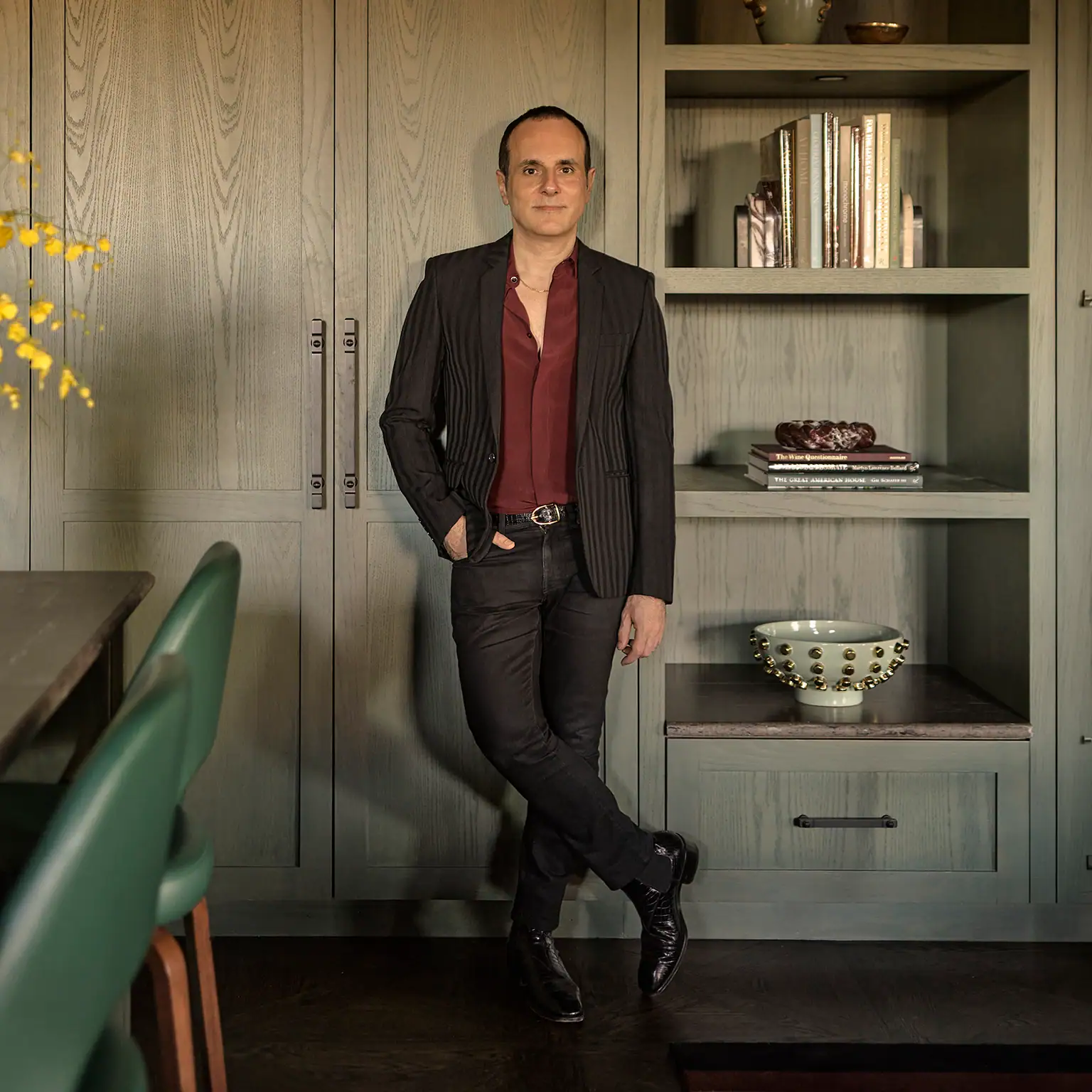
Sydney, Australia AUGUST 2026
Greg Natale opened his eponymous Sydney studio in 2001, after five years at architectural firms including Garth Barnett Designers, HBO+EMTB and SJB, and a design education that ran from TAFE NSW’s Enmore Design Centre to visual arts at Sydney College of the Arts and architecture at the University of Technology, Sydney. His 2002 renovation of a Sydney apartment, coordinating pattern across walls, blinds, linen and artwork, established the maximalist language now recognised worldwide as Milanese Maximalism, a style expanded upon in his books The Tailored Interior (2014) and The Patterned Interior (2018). His latest project, Gordon House, reworks a 1918 Federation home on Sydney’s North Shore for a family of six, pairing parquetry flooring and custom mouldings with checkerboard zellige tiles, veined marbles and a citrus banded, vaulted living space he describes as “Eclectic Mediterranean meets Postmodern charm”.
In this interview, Greg talks about the modernist discipline behind his maximalism, why every layered pattern begins with restraint, and how cinema, from Dynasty to The Shining, still shapes the emotional journey he designs into every room.
 Greg Natale’s Gordon House, entrance hallway with parquetry flooring and a sunburst mirror.
I always like to begin with a minimalist foundation, referencing the work of great modernist architects to inform the interior architecture. From there, I build the space through layers of form, materiality, pattern and colour.
Understanding a space’s visual composition is key to achieving the right sense of proportion and to determining where there is too much or too little visual weight. For me, it’s about orchestrating each element as part of a cohesive whole, finding equilibrium between pattern and colour mixed with the restraint of neutrals. This interplay creates the right level of tension, while juxtaposition introduces rhythm, contrast and visual interest.
 Greg Natale’s Gordon House, powder room with checkerboard zellige tiles and a citrus-banded ceiling.
My design approach usually begins by examining the architectural lines, details, and the floor plan to understand the interior landscape I am working with. This helps inform how I shape the space and develop the visual language that needs to be conveyed, working from the outer layers towards the finer elements that contribute towards the decorative narrative. This works in parallel with the design brief set by the clients, which supports conceiving the overall theme for the interiors.
 Greg Natale’s Gordon House, a children’s bedroom with playful pattern and a window seat.
Every element within a space needs to be intentional. This goes back to the design brief and concept developed with the client. I see maximalism as an art form centred on storytelling: expressing the client’s narrative, as the interiors become an extension of their identity in the space they inhabit. I see this practice as designing a set for a film, where the interiors take you on a journey through the owner’s space. While I perceive visual excess as arising from a place where no thoughtful purpose is being served in a space.
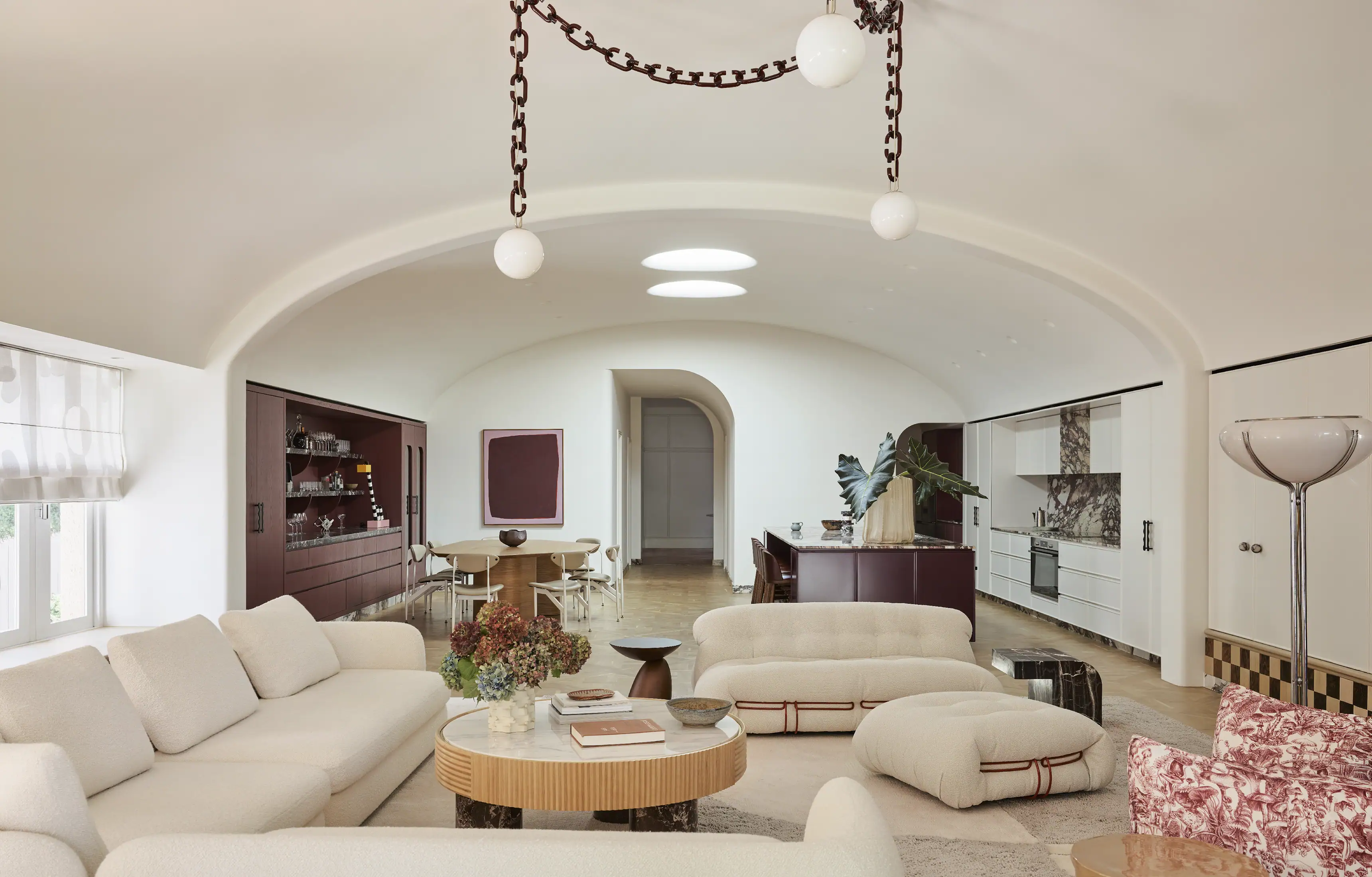
 Greg Natale’s Gordon House, the vaulted open-plan living and kitchen space.
When I work on an interiors project, the colour palette is informed by all three of these factors. Understanding the residence’s landscape setting helps establish and connect the interiors to the site, making the design response genuine and considered. This process is also closely tied to conceiving the colour palette with the client, while my own creative instinct guides the overall selections to ensure that all the colours work in unison.
 Greg Natale’s Gordon House, a sitting room with postmodern silhouettes and a patterned rug.
During the early stages of my career, when I first established my own studio, many of my references came from the Art Deco period, which naturally evolved into the Hollywood Regency style. However, over the years, my style has evolved, and I have always admired the works of Italian Rationalist and modernist architects such as Mies van der Rohe and Paul Rudolph. At the same time, when I first started, I looked towards and still reference the works of the late David Nightingale Hicks, particularly his Maximalist approach to interiors. So, because of this mix of references, of modernist architects which lend to contemporary lines, combined with layering, my designs carry this melange of historical languages, which is now expressed as Milanese Maximalism.
At the moment, I’ve been working more with coloured Brazilian stones because they are more dramatic and expressive, mixing and pairing them with a range of timbers, including oak, walnut and burl. This creates a dialogue between materials, balancing the visual weight of one against the warmth and tactility of the other. While both are natural materials, they possess distinct qualities: timber introduces warmth and texture, while stone brings a sense of architectural permanence through its weight and solidity.
When focusing on texture, microcement and stucco are finishes I particularly enjoy working with to establish a specific mood. Although subtle, their tonal variations and softly textured surfaces interact beautifully with light, creating depth and movement across the walls.
Lastly, I like to introduce brushed stainless steel and chrome to capture and reflect light within a space, while drawing attention to architectural and decorative details. Their reflective qualities provide another layer of contrast, bringing a sense of precision and refinement to the more organic materials.
 Greg Natale’s Gordon House, a powder room with microcement walls and an angular postmodern mirror.
Yes, absolutely. What drew me to interiors from a young age was observing the set designs of films and TV shows. I was particularly drawn to the interiors of Dynasty in the 80s and to films like Stanley Kubrick’s The Shining, and to how they conveyed the lifestyle and personas of the characters. So, apart from layering the interiors with storytelling for my clients, I love to take them on an emotional journey. For me as a designer, this means composing a mood that guides the interiors on a voyage.
 Greg Natale’s Gordon House, a bedroom with a cobalt velvet headboard and a Murano glass chandelier.
For me, most of my clients are aware of my work and approach me to design their homes with the same maximalist touch. However, I think across the industry, and from what I saw at Milan Design Week this year, there is a movement in the market towards embracing more colour, including bold shades from chartreuse to merlot. They are definitely becoming more confident, and I think we are moving away from the negative perception that maximalism has carried for so long towards viewing it through a new lens that conveys storytelling.
 Greg Natale’s Gordon House, the covered outdoor dining patio overlooking the garden.
When I first launched my own product range in 2017, it began with designing custom pieces for my clients’ homes. Even through my various collaborations with many of the premium product suppliers, ranging from flooring, bathware, furniture, wallpaper, and rugs, I design furnishings and fixtures, envisioning how they can work within their own residences. These pieces converse with the interiors of my projects, becoming part of the cinematic orchestra of the space.
 Greg Natale’s Gordon House, a bedroom with arch-patterned wardrobe doors in dusty rose.
Currently, interiors are very curvy and earthy in tone, and I think we will be moving into an era when interiors will be more masculine and hard-edged. I see this as drawing on 70s and 90s references, with influences from Calvin Klein, John D’Urso’s high-tech style, and the work of David Chipperfield and John Pawson. We’ve already begun to see this shift at Milan Design Week, with designs featuring black leathers, chrome and cooler greys, and structured forms.
 Greg Natale’s Gordon House, the 1918 Federation exterior on Sydney’s North Shore.
I would like to thank Greg Natale for such a considered conversation about the discipline behind his maximalism, from the modernist foundations that inform every layered interior to the cinematic storytelling that guides each client brief. Gordon House, his reworking of a 1918 Federation home for a family of six, is a vivid demonstration of that thinking, pairing traditional craftsmanship with the bold pattern and colour that have become his signature.



Leave a Reply