
Art & Culture · Mexico City
Reading time: 7 minA 1920 mansion remodelled by one of Mexico’s first modernists. A school on an eighteenth-century boulevard. A glass villa by Francisco Artigas, empty for a decade and brought back to life. Alcova is going to Mexico City for Art Week 2027 — and, as ever, the buildings are half the exhibition.
Alcova has spent eight years proving that the building a fair chooses can be as alive as the work inside it.
Since it was founded in 2018 by Valentina Ciuffi of Studio Vedèt and Joseph Grima of Space Caviar, Alcova has moved through Milan like something restless — a former panettone factory, a military hospital, a slaughterhouse, an abandoned modernist villa, a monastery. Each year a new site; each site treated not as a neutral container but as an active participant in the work shown inside it. It now draws more than 90,000 visitors a year, and its eleventh edition runs 20–26 April 2026 across the Baggio Military Hospital and Franco Albini’s Villa Pestarini.
Now it is leaving the continent again. After three editions in Miami since 2023, Alcova has announced its first Latin American edition: Mexico City, for Art Week, in February 2027.
And the venues it has chosen are, characteristically, the story.

Why Mexico City, and why now
The move is less a leap than an acknowledgement.
Mexico has for years been one of the most richly represented creative scenes inside Alcova Milan, emerging designers and established galleries alike. Mexico City has, in that time, become one of the most watched creative capitals in the world, with a contemporary scene maturing at extraordinary speed and an Art Week, anchored by Zona Maco, that has consolidated into a genuine moment in the international design calendar.
Alcova, in other words, is not discovering Mexico City. It is following its own exhibitors home.
The edition is being developed in partnership with Proyectos Públicos, the Mexico City platform founded by Pepe Islas, which works across architecture, hospitality and culture to reactivate buildings of historical value. It is an unusually well-matched partnership: a nomadic fair that specialises in occupying forgotten buildings, working with a local organisation whose entire practice is the reactivation of exactly such places.

Three buildings, three Mexicos
Here is what makes this edition worth paying attention to, beyond the announcement itself. The three chosen venues do not simply happen to be beautiful. Taken together, they trace a century of Mexican architecture — and the visitor who walks all three will have received, whether they intended it or not, an education.
Casa Palomar — the aristocratic city, and the moment it turned modern
The first site sits on General Prim, in the Juárez neighbourhood — one of Art Week’s key hubs, and a district with a very particular origin.
Juárez was laid out at the turn of the twentieth century, during the Porfiriato, as an aristocratic enclave modelled on European taste. Bankers, industrialists and professionals built their mansions along streets deliberately named after European cities. It was, quite consciously, an attempt to make a Mexican quarter that looked like somewhere else.
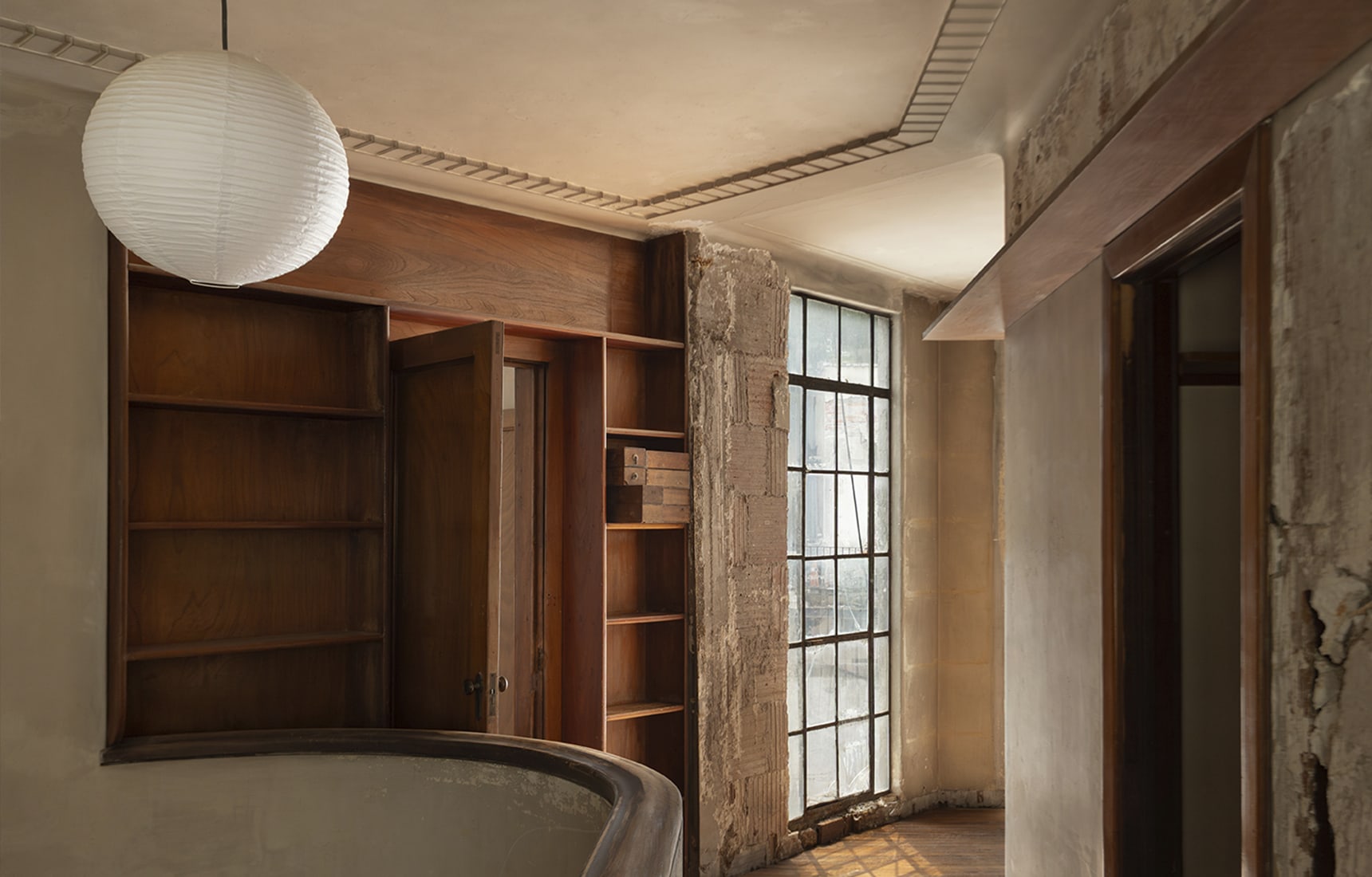
Casa Palomar was built there in 1920 and remodelled in 1932 by Carlos Obregón Santacilia — and that name is the detail worth pausing on.
Obregón Santacilia (1896–1961) trained at the Academy of San Carlos during the Mexican Revolution, and belongs to the first generation that asked whether Mexico could have a modernism of its own rather than an imported one. He took the tapered, monumental forms of pre-Hispanic Mexico and pressed them into a modern, Deco-inflected language. One of his apprentices was Juan O’Gorman, who would go on to work with Diego Rivera.
So Casa Palomar is a house that begins in the borrowed European fantasy of the Porfirian elite, and is then rebuilt, twelve years later, by an architect actively trying to invent a Mexican modern. The building contains the argument.
It was, the release notes, the home of a pioneering obstetrician-gynaecologist and his family — its rooms, staircases and courtyards a record of a family rising alongside a modernising city. It has never been open to the public. In February 2027, it will be.

The Bucareli School — the civic city
A short walk away stands the Bucareli School, on one of the oldest grand boulevards in Mexico City — laid out in the eighteenth century as a tree-lined promenade, and today lined with the landmark buildings of Mexico’s early press alongside a new generation of galleries.
Where Casa Palomar is domestic and intimate, the school is collective by design: generous classrooms, wide circulation, rooms built for groups rather than families. Alcova is explicit that the intervention will preserve each building’s stratified character and let its spatial qualities shape what is shown there — which means these two venues, minutes apart, will produce entirely different exhibitions from the same fair.
That contrast is the curatorial idea, and it is a good one.

Villa Reforma — the modernist city
The third site is the one that will draw the pilgrims.
Villa Reforma was designed in the 1950s by Francisco Artigas (1916–1999), and it is a rare thing: one of the few surviving examples of his residential work outside El Pedregal.
Artigas is among the most quietly important figures in Mexican modernism, and one of the most rewarding to discover. Largely self-taught, he educated himself through journals, travel and sustained study of Wright, Neutra, Schindler, Albert Frey and Niemeyer, and he became the most prolific architect of the Jardines del Pedregal, Luis Barragán’s development on the black lava field left by the Xitle volcano. Artigas built more than fifty houses there.
And he built them in deliberate counterpoint to Barragán. Where Barragán was introspective, massive and inward, Artigas was light, open, and glazed — floating horizontal volumes, transparent walls, and a habit of preserving the lava formations on a site rather than levelling them. The houses seem to hover above the rock.
Villa Reforma carries all of it: a low, horizontal structure on an L-shaped plan, with expansive glazing holding a continuous conversation between the interior and the landscape.
It was lived in until the 1990s, then stood empty for over a decade, before being restored to its original clarity by Lorena Vieyra. It is now home to Piacere, and sits fifteen minutes from Zona Maco. For anyone who cares about mid-century modernism, this alone justifies the trip.

What it means
Alcova treats a city as somewhere to read closely: arrive, look, listen, respond. That is what it has always done, and its choice of venues here is the proof.
By taking a Porfirian mansion remodelled by an early Mexican modernist, a school on an eighteenth-century boulevard, and a mid-century glass villa by a self-taught master, Alcova has assembled something closer to a syllabus than a floorplan. The design shown inside will be contemporary — emerging and established voices from across Latin America and beyond, deliberately outside the mainstream — but it will be shown inside a hundred-year argument about what Mexican architecture is and who it is for.
That is a remarkably generous way to arrive in a city, and a considered one. It says: we have looked at where we are.
What I find most persuasive about Alcova is that this method has never wavered. Nine years in Milan, three editions in Miami, and now Mexico City — and the discipline is the same each time. Find the building nobody can get into. Open the door. Put the future inside the past and let them argue.
Mexico City, in February 2027, will be a very good place to watch that happen.

Frequently asked questions
When is Alcova Mexico City 2027?
February 2027, during Mexico City’s Art Week, alongside Zona Maco. Specific dates are to be confirmed.
Where will it be held?
Across three sites: Casa Palomar on General Prim and the Bucareli School, both in the Juárez neighbourhood, plus Villa Reforma, fifteen minutes from Zona Maco.
What is Alcova?
A platform for independent design founded in 2018 by Valentina Ciuffi (Studio Vedèt) and Joseph Grima (Space Caviar). It stages exhibitions in forgotten or inaccessible buildings of historical significance, changing venue each year, and attracts over 90,000 visitors annually during Milan Design Week.
Has Alcova run outside Milan before?
Yes — three editions in Miami since 2023. Mexico City is its first Latin American edition.
Who designed Villa Reforma?
Francisco Artigas, in the 1950s. It is one of the few surviving examples of his residential work outside El Pedregal, where he built more than fifty houses. It was restored by Lorena Vieyra after standing empty for over a decade.
Who is Alcova’s partner in Mexico City?
Proyectos Públicos, a Mexico City platform founded by Pepe Islas, working across architecture, hospitality and culture to reactivate sites of historical value.
When is the next Alcova in Milan?
The eleventh edition runs 20–26 April 2026, at the Baggio Military Hospital and Villa Pestarini by Franco Albini.

Final thoughts
Alcova’s great insight, eleven editions in, is that a building is never neutral. Put a chair in a white booth and you have a chair. Put it in the courtyard of a house where an obstetrician raised his family in 1932, or behind the glass wall of a villa that stood empty for a decade, and you have something you have to think about.
Three buildings. Three Mexicos. One February.
I would get the flights booked!


Leave a Reply