ART & CULTURE · VENICE
Reading time: 12 minIn 2022, Anish Kapoor became the first British artist given a major exhibition at the Gallerie dell’Accademia, Venice’s oldest public gallery. He answered the honour by opening a second, stranger venue alongside it: Palazzo Manfrin, an eighteenth-century palace his own foundation had just bought, still mid-restoration, its frescoes exposed and its plaster unfinished. The two buildings did not show the same Kapoor. They showed what fifty years of his work does to a room built to be looked at, and to a room that was never meant to be public at all.
Anish Kapoor’s exhibition at the Gallerie dell’Accademia and Palazzo Manfrin ran from 20 April to 9 October 2022, timed to the 59th Venice Biennale. Around 60 works spanned four decades, from the pigment pieces of the early 1980s to sculpture made for the occasion. It was, by the Accademia’s own account, the first time a British artist had been given a major solo exhibition inside the museum in its history.
That fact alone would justify a piece. What makes the show worth returning to four years later is the second half of it, easy to treat as a footnote and not one. Palazzo Manfrin, an 18th-century palace on the Cannaregio Canal, had stood empty for years before the Anish Kapoor Foundation bought it. Kapoor did not simply borrow it for a season. He used its unfinished condition as part of the exhibition, hanging some of his darkest and most physically demanding work in rooms that were still, visibly, building sites.
The two venues were never going to read the same way, and the exhibition did not try to make them. The Accademia is a museum built for looking: sequenced rooms, controlled light, four centuries of practice in how to hang a picture. Palazzo Manfrin is a private house that happened to have a public afterlife once, then lost it, then got it back. Kapoor split his retrospective between the two, and the split is the argument.
Two venues, one retrospective
The Gallerie dell’Accademia holds Venice’s own collection: Bellini, Titian, Giorgione, Veronese, the paintings that effectively invented the way Venice looks at itself. Kapoor’s rooms there sat inside that sequence rather than beside it. Shooting into the Corner (2008 to 2009), a cannon that fires blocks of red wax at a gallery wall on a timer, occupied a room in dialogue with paintings that had hung in the building for two centuries. Pregnant White Within Me (2022), made for the show, distorted the proportions of the room itself. Internal Objects in Three Parts (2013 to 2015) and the early White Sand Red Millet Many Flowers (1982), the pigment-powder work that made Kapoor’s name in London four decades earlier, gave the museum rooms a chronology of their own.

Across the city in Cannaregio, Palazzo Manfrin held the newer and heavier material: Mount Moriah at the Gate of the Ghetto (2022), Symphony for a Beloved Sun (2013), Turning Water into Mirror, Blood into Sky (2003), Destierro (2017) and Split in Two Like a Fish for Drying (2022) among them. Taco Dibbits, the general director of the Rijksmuseum in Amsterdam, co-curated the exhibition and put the relationship between old and new plainly: “All artists, however cutting-edge and contemporary, are in debate with those who have gone before.” Kapoor, for his part, called it “a huge honour to be invited to engage with the collections at the Gallerie dell’Accademia in Venice, perhaps one of the finest collections of classical painting anywhere in the world.”

The artist Venice had never given a room to
Kapoor was born in Mumbai in 1954 and has lived and worked in London since 1973, when he arrived to study at Hornsey College of Art and then Chelsea School of Art and Design. He won the Turner Prize in 1991 and represented Britain at the Venice Biennale itself in 1990. He was knighted in 2013 for services to visual art. By the time of the 2022 show he had built some of the most recognisable public sculpture of the past thirty years: Cloud Gate in Chicago, Orbit on the Olympic Park skyline in London, Leviathan‘s inflated red chamber inside the Grand Palais in Paris. Four years later, London itself gave him a full-building retrospective at the Hayward Gallery, the institution where his British reputation first took shape in 1998.

None of that had translated into a room inside the Accademia, an institution built around the Venetian canon rather than living artists. Kapoor’s practice has circled the same handful of ideas since the 1980s: voids that appear to have no bottom, mirrors that invert or swallow the viewer, pigment and wax used the way other sculptors use bronze. Giving him the museum’s own galleries put those ideas next to the paintings that first worked out how a Venetian room handles colour and depth, rather than beside a white cube built to be neutral.
The Anish Kapoor Foundation, the body behind the Palazzo Manfrin side of the show, was established in London in 2017. Buying an empty Venetian palace a few years later was its first major act, and the 2022 exhibition doubled as that palace’s public debut.

A collector’s gallery, then decades of nothing
Palazzo Manfrin’s site has been built on since the 1520s, when the Priuli family raised a palace there, its heraldic carvings still dated 1520 on the fabric. The building was substantially reworked in the 1710s to designs attributed to the architect Andrea Tirali. Ownership passed by marriage to the Venier family, and in 1787 the Venier heirs sold the palace to Count Girolamo Manfrin, a tobacco merchant from Zadar who had made a fortune trading in a state-controlled commodity and spent a large part of it on art.

Manfrin turned the piano nobile into a private picture gallery and opened it to visitors, a genuinely unusual thing to do with a private collection in the 1790s. It became one of Venice’s set pieces: Antonio Canova, Lord Byron, John Ruskin and Édouard Manet are all recorded among its visitors. Manfrin also reworked the facade into a neoclassical front with a central balustrade and commissioned interior decoration from Giovanni Battista Mengardi, Giuseppe Zais and David Rossi. He died in 1802, and his daughter inherited the collection.
The gallery did not survive the century. Twenty-one paintings from the Manfrin collection, including Giorgione’s The Tempest and La Vecchia, works by Mantegna, Memling, Nicolò di Pietro, Girolamo Savoldo and Moretto, were transferred to the Gallerie dell’Accademia in the mid-19th century, which is how the Accademia’s own collection carries a direct trace of the building Kapoor would later buy. The palazzo itself passed through a school and long stretches of vacancy. By the time the Anish Kapoor Foundation acquired it from the state investment agency Cassa Depositi e Prestiti around 2021, it had stood empty for years, its facade described at the time as scruffy and forlorn.

Restoration was placed in the hands of Giulia Foscari and Antonio Foscari, working through the Venice-based practice FWR Associati and Foscari’s own studio, UNA. The Foscaris are longstanding scholars of Andrea Palladio, and they identified the palazzo’s double-height salon as a design of “typical Palladian conception,” ornament stripped back to structure. That the restoration architects reading Palazzo Manfrin’s proportions were Palladio specialists is a detail the exhibition never advertised, but it connects the two venues more precisely than the show’s own billing did.

A convent Palladio never finished, made into Venice’s first public gallery
The Gallerie dell’Accademia’s own building has a comparable double life, though it arrived at its present use by a very different route. The complex began as the Scuola della Carità, the oldest of Venice’s six Scuole Grandi, with a church front completed by Bartolomeo Bon in 1441. In 1561, Andrea Palladio was commissioned to build a new convent alongside it for the Canons Lateran. He never finished it. Palladio’s convent, unbuilt to its full design, sat attached to a much older religious complex for two and a half centuries.

Napoleon’s administration secularised the site and handed it to the fine arts academy in 1807, and the collection opened to the public a decade later, in 1817. The building the Accademia now occupies is, in other words, an unfinished Palladio grafted onto a medieval scuola and then repurposed by decree, not designed from the ground up as a museum. It has simply had two centuries longer than Palazzo Manfrin to settle into the job.
That is the real difference between the two venues, and it is a more useful way into the show than “old building, new art.” Both are converted structures. One conversion is two centuries old, sequenced, lit, signed off by generations of curators. The other was four years old when Kapoor’s exhibition opened, and still visibly a construction site. Kapoor built the show around that gap rather than smoothing it over.

What the Manfrin rooms actually held
Mount Moriah at the Gate of the Ghetto met visitors at the palazzo’s entrance: a mass of red wax and pigment, appearing to hang and slump from the architecture above it, frozen mid-fall like water arrested a second before it lands. Its title takes its name from the biblical mountain, traditionally identified with Jerusalem’s Temple Mount, where Abraham was stopped from sacrificing Isaac. Sited at a threshold, it makes visitors walk directly beneath a suspended weight to get into the building.

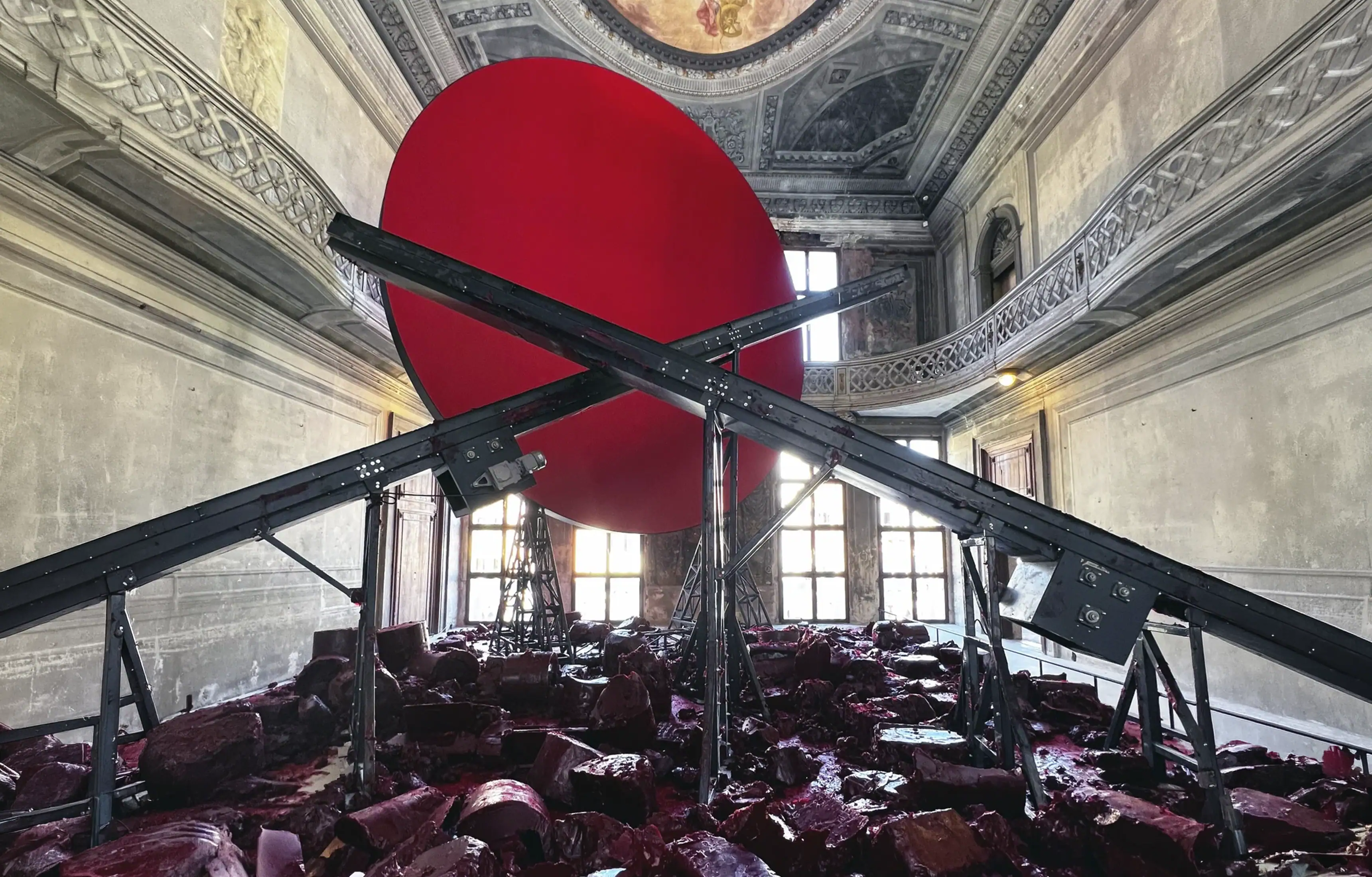
Upstairs, Symphony for a Beloved Sun filled an eighteenth-century ballroom lined with thirty-foot frescoes, itself a room built for music and dancing rather than sculpture. Two conveyor belts carried a dark red disc across the space while wax, smeared to resemble blood, built into heaps beneath it, a slow mechanical process that keeps running for as long as the room is open. Turning Water into Mirror, Blood into Sky (2003), a horizontally rotating steel vat holding a dark reflective liquid, turned continuously so that its concave surface caught the sky, the ceiling and the viewer in a single distorted circuit that never settles. Destierro (2017), 100 tonnes of earth sprayed red with a single blue-painted tractor left standing in it, was first made for Buenos Aires’s Parque de la Memoria, a park built in memory of the disappeared of Argentina’s 1976 to 1983 military dictatorship. In Venice it carried the same charge into a second, explicitly stated register: the displacement of people fleeing conflict now, in a building whose own recent history is one of enforced emptiness.
Split in Two Like a Fish for Drying (2022), a floor-based mass divided by a deep cleft, its inner surfaces worked in wax and silicone the colour and sheen of exposed tissue, took its title from the physical process of preparing a fish for a slow, open-air cure, translated at scale onto a body-like form. None of these works needed the Accademia’s sequencing to make sense. They needed a room that had not yet decided what kind of building it was, which is exactly what the Manfrin rooms still were.

A title that mirrors itself
One work in the Manfrin rooms carries a joke that most of the coverage of the show missed entirely, because it only survives if you go back to the artist’s own catalogue rather than the exhibition round-ups. A 2017 stainless steel disc, 195 by 195 by 25 centimetres, is titled Mirror ɹoɹɹᴉW: the word “Mirror” followed immediately by itself, flipped upside down, letter for letter. It is not a formatting accident. Kapoor titled the piece that way on purpose, so that the object’s own name performs the thing the object does. Look at the title and the second half of it looks back at you, inverted, exactly as the polished steel does to anyone who stands in front of it.
It is a small, precise piece of design thinking sitting inside a much larger, blunter one. The concave and convex mirror works scattered through both venues do not politely reflect a viewer back at themselves. They invert, stretch, swallow and return a distorted double, and Mirror ɹoɹɹᴉW‘s title does the same trick in twelve characters of typography before a viewer has even looked at the steel.
A companion painting shown at the palazzo is worth correcting on the record. It is a large 2021 oil-on-canvas triptych titled Diana Blackened Reddened, part of a small group of paintings, alongside Blackness from Her Womb and Shedding, that Kapoor had shown the previous year at Lisson Gallery in London. Sat next to the mirror works and the wax pieces, it gave the Manfrin rooms a fourth material, paint, working the same register of red and black as everything around it.

A gate two rooms away from the word itself
Palazzo Manfrin sits on the Cannaregio Canal, in the same sestiere as the Venetian Ghetto, the walled Jewish quarter the city’s government created there in 1516, the first of its kind in Europe and the origin of the word “ghetto” itself. Mount Moriah at the Gate of the Ghetto takes its name from that history and stands at the entrance of a building a short walk from the site the name refers to. Two rooms further into the same palazzo, Destierro carries the memory of Argentina’s disappeared and the present-day language of the refugee crisis into the same set of rooms.
No account of the show connects these two works as a pair, but shown a few doors apart inside a single building, in the district that gave the world the vocabulary for enforced enclosure, they read as one argument rather than two separate pieces about difficult histories. That the palazzo housing them was itself sitting empty and shut off from public use for decades before Kapoor’s foundation reopened it adds a third, quieter layer that the exhibition never spelled out but the building itself supplies for free.

What the palazzo became next
The 2022 exhibition closed on 9 October that year, but it was never going to be the palazzo’s only outing. The Anish Kapoor Foundation has kept using the building since, and Palazzo Manfrin returned to public view in 2026 with a further exhibition, Anish Kapoor: Space is Made, timed to the 61st International Art Exhibition of La Biennale di Venezia. Giulia Foscari’s practice, UNA, has described that later show as embedded inside an active building site rather than a completed restoration, roughly a hundred architectural models occupying rooms still mid-repair. Four years on from the 2022 debut, the palazzo is still doing the thing it did that spring: functioning as an exhibition space and a building under construction at the same time, on purpose.

Final thoughts
It would be easy to describe this as a retrospective that happened to use two buildings. That undersells what actually happened at Palazzo Manfrin. Kapoor did not wait for a finished gallery to show his most demanding work. He hung it inside a building his own foundation had bought specifically because it was unfinished, in rooms where the frescoes were being stabilised rather than restored, and let the condition of the walls become part of what the sculpture was doing.
The Accademia gave the show its history, four centuries of a city looking at pictures and, for the first time, at a living British sculptor inside that sequence. Palazzo Manfrin gave it something the Accademia by definition could not: a building still working out what it was for, hosting work that is largely about the same uncertainty, made physical in wax, steel and a hundred tonnes of red earth. Four years on, the palazzo is still doing exactly that.
Anish Kapoor in Venice
Go further from here
Add to calendar
Google CalendarApple or OutlookRead next
Miet Warlop's IT NEVER SSST fills the Belgian Pavilion with words cast in plaster, a timber stand and a sculptor carving the performance as it happens.
Venice