Art · Venice
Reading time: 13 minThe sculpture in the Giardini della Marinaressa has no curatorial theme holding it together, and it does not need one. Eighteen works by artists from a dozen countries sit on the lagoon edge for six months with no roof and no guard, and every one of them is an answer to the same engineering question. Read the labels as a specification and the garden becomes a survey of how to build something that lasts a Venice winter.
There is a bear carved from oak standing in a Venice garden with a gold chain around its chest. It was made by the Latvian artist Aigars Bikše, it is called Taming the Beast with the Heart, and the line at the bottom of its label is the most interesting sentence in the whole garden: oak wood, surface finish, birch tar.
Birch tar is what you paint a boat with. It is what the Baltic has used for a thousand years to stop water getting into timber, and it is on this bear because the bear is going to stand outdoors on the edge of a saltwater lagoon from May until November.

The Giardini della Marinaressa sit on Riva dei Sette Martiri in Castello, ten minutes east of San Marco, and during the Venice Biennale they fill with sculpture. The European Cultural Centre programmes them as the outdoor venue of Personal Structures, which in 2026 runs under the title Confluences from 9 May to 22 November, the same dates as the Biennale itself. Entry is free and the gates do not close. Venice fills with this kind of parallel programme during a Biennale, from Anish Kapoor taking two buildings at once to Daniel Arsham’s invented archaeology, and the Marinaressa is the part of it you can walk into without a ticket.
What there is not is a theme. The works arrive from Latvia, India, Ukraine, Austria, Slovenia, Australia, Turkey, Italy, Britain and the United States, and nothing in the hang argues that they belong together. What they share is a brief that nobody wrote down, and the labels give it away.
The brief nobody wrote down
Six months. No roof. Salt in the air, because the water is thirty metres away and the big ships go past close enough to read. No barrier and no attendant, so anything within reach will be touched, climbed on and leaned against. Fix it to a bed of bark chips inside a steel edging frame, or bolt it to a black plinth, and leave it.
That is a hard specification, and it is the only thing every work in the garden has in common. The material lines on the labels read like a procurement list for a marine contract: corten steel, polished stainless, brass, bronze with a black patina, fibreglass with chrome spray paint, polyester and marble powder, cold cast polychrome, verde olivia granite, carved Maine slate, oak sealed in birch tar.

Three of those are worth stopping for, because in each case the artist has chosen a material that does a job rather than one that looks the part.
Hugh Lassen chose a stone that holds its own oil
Hugh Lassen is American and his work here is called Figure, from 2023. It is carved from Maine slate, which is an unusual choice, because slate cleaves. Split it wrong and you lose the piece, which puts Lassen in the company of the makers who cannot take a decision back.

The reason to accept that risk is on the label. Slate from that formation carries oil out of its shaley origin, and the fine-grained, slightly oily texture that results is what protects the stone from weather. The thing that makes it awkward to carve is the thing that makes it last outside.
Lassen notes that carving a form with echoes of the human figure stretches back more than forty thousand years, and that asymmetry and what Rodin called bumps and hollows are what make a viewer want to walk round a sculpture. Figure reads as European in its lineage, and it is cut from the North American geological shield.
Egon Straszer carved a mobile phone out of granite
The Austrian sculptor Egon Straszer has made the most quietly radical object in the garden and you could walk past it in four seconds. cell_phone, from 2026, is a vertical block of verde olivia granite, a little over head height, its surface worked into dense horizontal striations so that from a distance it looks stacked rather than carved.

It is a telephone, rendered at the scale of a monument in the hardest material available, by the oldest method there is. Straszer begins from what he calls a hermetic block whose mass calls for subtraction, and lets figurative elements emerge in an interplay of light and shadow. The stone is never broken open. You have to move around it, and change your own position, before the whole discloses itself.
A phone is the most replaced object most people own. Here is one that will outlast the garden.
Jakob Bokulich burned the first version
Pollinator I is a rotating mechanical structure of interlocking gears, roughly three metres tall, a stack of steel cones and faceted plates that turns when you push it. Visitors are invited to touch it, which almost nothing else here allows.

Jakob Bokulich showed an earlier version of the work at Burning Man in Nevada in 2018. That one was built from wood, it was activated by the people who came to it, and it was destroyed in a controlled burn while it was still moving.
For Venice he rebuilt it in steel. Based in New York, he went back to Croatia and fabricated the new iteration with a team in Zagreb, with CNC work and support from Articulated Artworks in New York and The Midway in San Francisco. When the Biennale closes it travels to the Midway and stays there.
So the sequence is: made to be burned, remade to be permanent, and in between it spends six months turning in a Venetian garden in the rain. The material changed because the brief changed, which is the whole argument of this piece in a single object.
Paresh Maity built his to the four corners
Paresh Maity‘s Equilibrium, 2025 to 2026, is the largest commission in the gardens and the one with the most structure behind it. It is brass, weathered to a blue green, and from a distance it reads as a small building: an open frame of stacked rectangles with a disc balanced on the top like a gong.

The geometry is set to the four cardinal directions and the four cosmic corners of Indian spatial philosophy, Ishan in the north east, Agni in the south east, Nairit in the south west and Vayu in the north west. The disc crowning the structure is a head, standing for consciousness.
The part that matters in a garden is the hole. Maity leaves the centre open so that light, air and shadow pass through it, which makes the weather a participant rather than a hazard. Of all the works here, this is the one that most needs to be outdoors.
The ones that reflect, and the one that rusts
Three works use mirror finish to put the garden inside themselves. Omar Viglino‘s Fratelli, 2025, is two hammerhead sharks in polished stainless steel rising in a single vertical movement, their heads touching at the top to make the point of balance that holds the whole thing up. Anna Chekh‘s Shadow Man, Energy in Transit, 2026, is a two metre stainless figure with no face, seated, carrying a black sphere that stands for the private interior each person keeps. Olga Lomaka‘s Dreaming Miki, 2025, is a monumental golden lemon in fibreglass with chrome spray paint, out of whose luminous surface the face of a sleeping child emerges.


Steve Simmons‘s Universality of Love, 2021, presented by Georges Bergès Gallery, is a steel hourglass of two pyramids in red and crimson with a polychromatic finish, carrying the word love in eight languages: English, Italian, French, Spanish, Mandarin, Arabic, Hindi and Swahili.

And at the western entrance, Giovanni Piovan, who works as Lumier, has set a three metre arc of corten steel into the grass. Il peso dell’ascesa measures 303 by 251 centimetres and was supported by the Municipality of Venice. Corten is the one material in the garden that is supposed to change: it rusts to a stable skin and then stops, so a piece that looks weathered on day one looks the same on day two hundred. It is the same logic Richard Serra used across eight years and a thousand tonnes of steel in Bilbao, at a fraction of the scale. Piovan was born in San Donà di Piave in 2003 and raised in Eraclea, half an hour up the coast. He is twenty two.

The figures, and how they were made
The figurative work in the garden is where the fabrication stories are best.
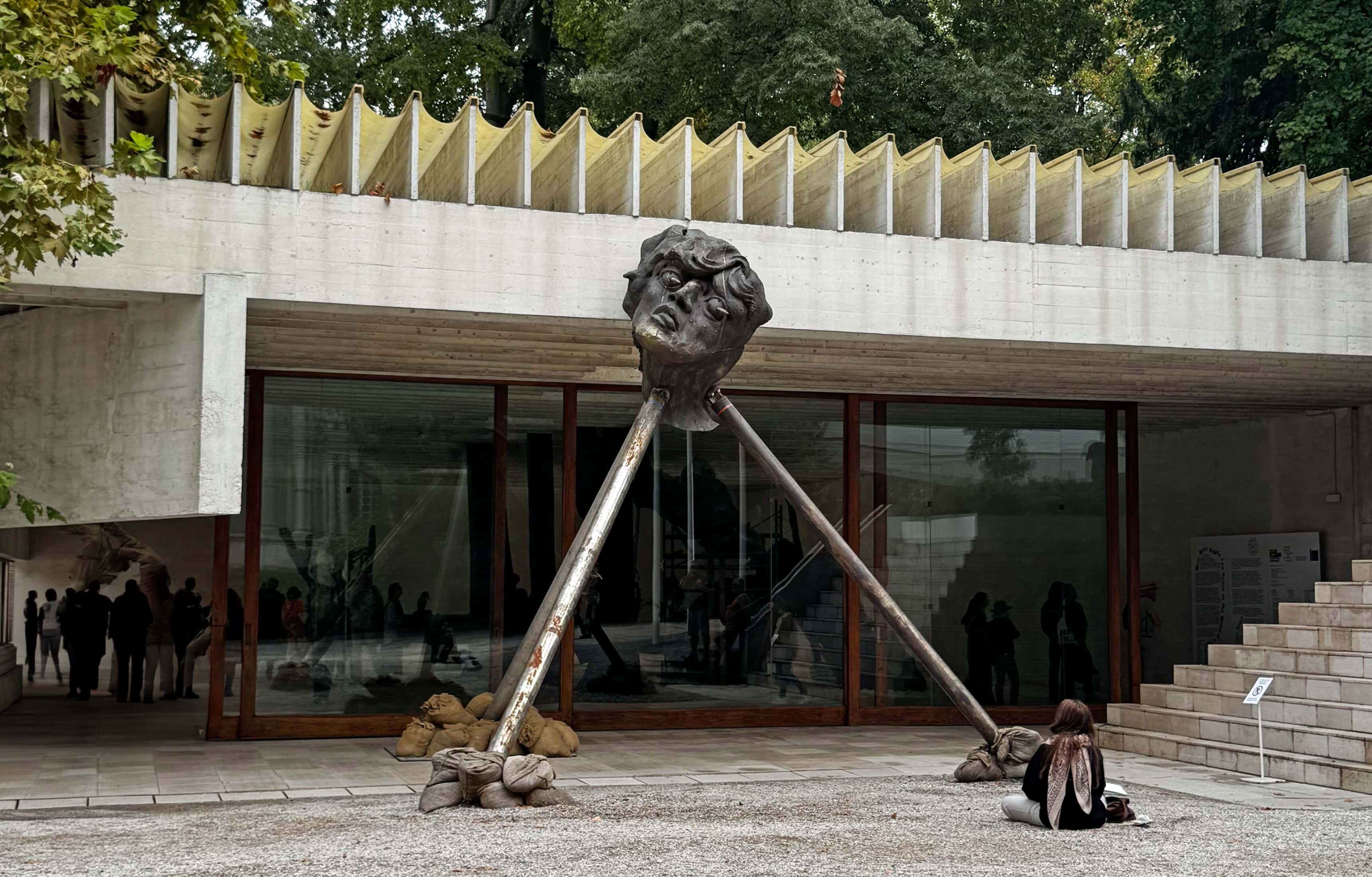
Jamie Lester has made a pair, Zeus and Aphrodite, both 2025 and both bronze, and the route they took is unusual. Lester reformulated earlier pieces, originally in Promethean clay and repurposed steel, as digital models in ZBrush, and only then cast them. Zeus is a colossal head with no neck or shoulders, a city growing out of the crown, laid on its side. Aphrodite stands, with a lotus flower hidden behind her back.


Jakov Brdar‘s She and He, 2011, is two tall bronze figures facing one another whose faces resolve into bird heads. Malisa Catalani‘s Gea, 2023, is a lost wax bronze torso opened by tensions and gaps, after the earth as a body in flux rather than a stable form. Sonia Payes‘s Emergence 1, 2021, is a two and a half metre bronze with a black patina on a bronze rock base, built by treating a flat portrait of her longtime muse as what she calls a visual DNA and stretching it into a faceted three hundred and sixty degree landscape.


Stephen Glassborow‘s White Chameleon, 2025, is cold cast polychrome, a slender pale figure with a feathered crown. Asmer Sultanova‘s Meeting Point, 2026, in polyester and marble powder, is a rabbit sitting with a pair of turtles: the hare has given up the race and is waiting, so that winning becomes arriving together.


The oldest work in the garden is Gottfried Kumpf‘s Big Panda with Cub, made between 2004 and 2006 for Schönbrunn Zoo in Vienna. The clay model was made in Pietrasanta and the bronze was cast at Venturi Arte in Bologna, 115 by 160 centimetres and 360 kilos. Kumpf was born in Annaberg im Lammertal in 1930 and died in Vienna in 2022, which gives the garden a span of nearly a century between its oldest maker and its youngest.

Rashid Al Khalifa drew a house in red mesh
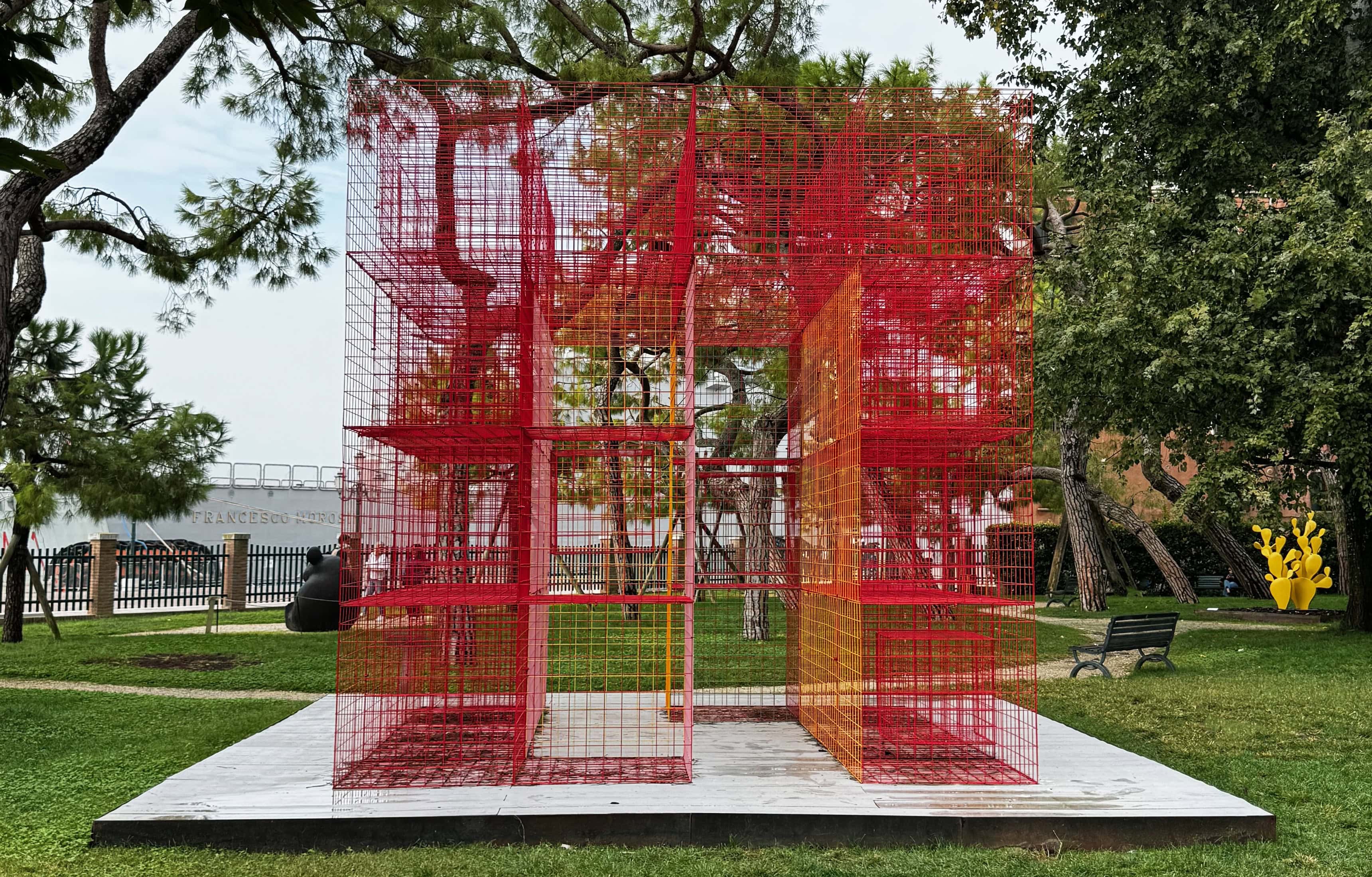
The work that organises the western garden is not solid at all. Rashid Al Khalifa‘s Inhabited Crate, 2026, is a house drawn in red steel mesh, large enough to walk into, open on every side.

Because it is mesh, everything behind it stays visible, so the lagoon and the ships moving towards the Giardini are part of the work the whole time. It is the one piece here that deals with weather by letting it straight through, and it does to the view what the other works do to the light.
How to see the Giardini della Marinaressa
The gardens are free, they are open every day, and they are open on Tuesdays, when Palazzo Mora and Palazzo Bembo are closed. That makes them the obvious Tuesday stop in a Biennale week, and they are a five minute walk from the Giardini vaporetto stop.
Allow forty minutes. Go on an overcast day if you can, because the polished steel works are unreadable in full sun and the corten and bronze are better without it. Read the material line at the bottom left of each label before you read anything else, and the garden will tell you what it is actually about. If you are walking on to the Giardini afterwards, the Nordic Pavilion is showing the opposite argument, three artists working in rag rugs, old sail fabric and raw clay, materials chosen to record the six months rather than survive them.
Frequently asked questions
What is in the Giardini della Marinaressa during the Venice Biennale?
The gardens hold an open air sculpture exhibition programmed by the European Cultural Centre as the outdoor venue of Personal Structures. In 2026 the edition is titled Confluences and the gardens hold work by artists from a dozen countries, including Paresh Maity, Rashid Al Khalifa, Aigars Bikše, Hugh Lassen, Jakob Bokulich, Sonia Payes and Gottfried Kumpf.
Where are the Marinaressa Gardens?
On Riva dei Sette Martiri in Castello, about ten minutes east of San Marco along the waterfront and five minutes from the Giardini vaporetto stop. The garden is in two halves, east and west, separated by the fifteenth century Marinaressa building they are named after.
Is it free, and when is it open?
Yes, entry is free. The gardens are open every day during the exhibition, including Tuesdays, when the European Cultural Centre’s two indoor venues, Palazzo Mora and Palazzo Bembo, are closed.
What dates does it run?
From 9 May to 22 November 2026, the same dates as Biennale Arte 2026, the 61st International Art Exhibition, which is titled In Minor Keys and was curated by Koyo Kouoh.
What are the sculptures made from?
The material list runs from corten steel, polished stainless and brass to carved Maine slate, verde olivia granite, oak sealed with birch tar, cold cast polychrome, fibreglass with chrome spray paint, and bronze cast by lost wax. Every choice is answering the same problem, which is six months outdoors on the edge of a saltwater lagoon.
Which work should I look for first?
Jakob Bokulich’s Pollinator I, because it is the only one you are invited to touch. It is a rotating structure of interlocking steel gears, and an earlier version of it was built in wood and burned at Burning Man in Nevada in 2018.
How long does it take to see?
Allow about forty minutes for both halves of the garden. An overcast day suits it better than bright sun, because the mirror finished steel works are hard to read in direct light.
Is this part of the official Biennale?
No. Personal Structures is an independent exhibition staged in parallel with the Venice Biennale, which is why entry is free and no Biennale ticket is required.
Final thoughts
The easy version of this garden is that it is a free sculpture park near the Biennale with a lot of different work in it. That is accurate and it explains nothing.
What is actually happening is that eighteen artists from a dozen countries, working with no shared theme and almost certainly no knowledge of each other’s submissions, were handed the same brief: make something that can stand on the edge of a lagoon for six months, in salt air, with no roof and nobody watching it, and still be worth looking at in November.
The answers are the exhibition. Bikše sealed his oak with the tar that Baltic boatbuilders use. Lassen picked a stone whose own oil is its weatherproofing. Straszer took the hardest granite he could find and spent the time. Bokulich swapped wood for steel because the first version was always going to burn. Piovan used the one metal that treats corrosion as a finish. Maity left a hole in the middle so the weather could come through.
Read the labels from the bottom up, material first, and the Marinaressa stops being a miscellany and becomes the most coherent show in Venice.
Project Credits
Go further from here
Add to calendar
Google CalendarApple or OutlookRead next
Miet Warlop's IT NEVER SSST fills the Belgian Pavilion with words cast in plaster, a timber stand and a sculptor carving the performance as it happens.
Venice