Belgium OCTOBER 2026
Ozanne Princen began ballet at the age of three and did not cast her first bronze until decades later. In between came a degree in Modern History and Cultural Studies, years spent teaching history and philosophy, and a move into entrepreneurship that produced the events company By Gaspard Wedding & Events and, during the pandemic, Rouge Flammes. The sculpture came last, and it arrived with the discipline of everything before it intact. Working in lost-wax bronze, the Belgian artist casts isolated parts of the leg, the calf, the knee, the thigh, rather than whole figures or dancers, each piece signed, numbered and made to order. Silhouettes Éternelles was her debut collection, Counterpoise followed with its crossed and reclining forms, and Épure, her most recent work, leaves the plinth entirely and emerges from the wall. She is presented by Galerie Agnès Dechanteloup in Paris.
In this interview, Ozanne talks about the trace that movement leaves behind, why ballet taught her to think choreographically about balance and alignment, what happens when a material built for monuments is asked to carry something fragile instead, and where the work goes next as it moves toward stone, larger scales and the architecture around it.
 Reclining forms caught in the window light of the studio, where reflection keeps altering the surface. Photography by Wim Knapen at Studio CHLOKI.
What interests me is not movement itself, but the trace it leaves behind. Bronze is traditionally associated with permanence, weight, and monumentality, yet I use it to preserve something far more fragile and transient, a tension, a gesture, a suspended moment.
Dance taught me that movement can carry emotion even after it disappears. In sculpture, I try to hold onto that residual energy. The body becomes still, but the sensation of movement continues to exist beneath the surface.
 Princen at the barre. Ballet, begun at the age of three, still shapes the way she thinks about balance and alignment. Portrait photography by Dirk Leunis.
Ballet shaped both my visual language and my relationship to discipline. It taught me precision, repetition, restraint, and an acute awareness of the body in space. Even today, I approach sculpture almost choreographically, in terms of balance, tension, alignment, and rhythm.
Beyond aesthetics, ballet gave me an understanding of how the body communicates emotion without words. That remains central to my work.
 Three works in black patina and polished bronze, the leg reduced to its essential line. Photography by Wim Knapen at Studio CHLOKI.
The leg carries an interesting duality: it is structural, but also deeply expressive. Reduced to its essential line, it becomes almost architectural, a column, a counterweight, a point of balance.
I don’t see my practice as confined to the leg itself though. It’s one entry point into a broader exploration of the body, gesture, and presence.
 Polished bronze legs reclining against sheer curtains, softness and strength held within the same form. Photography by Wim Knapen at Studio CHLOKI.
That duality is essential to the way I think about femininity. I’m not interested in representing femininity as something purely delicate or decorative, but as a balance between opposing forces. Strength and softness can coexist. Restraint can carry intensity.
I’m interested in shifting bronze away from monumentality toward intimacy. Using such a historically heavy material to express vulnerability or emotional restraint creates an interesting contradiction, it lets the work feel both grounded and fragile at the same time.
 A polished bronze reclining form in an interior, where shadow and reflection keep the work moving. Photography by Wim Knapen at Studio CHLOKI.
Light is an essential part of the sculpture. The work is never entirely fixed, it changes depending on reflection, shadow, and the surrounding atmosphere. The sculpture only fully exists once it enters a space and begins interacting with light over time.
 A single leg in black patina, reduced to the point where stillness does the work. Photography by Wim Knapen at Studio CHLOKI.
Yes, absolutely. Reduction creates space for emotional projection. Stillness can hold enormous emotional intensity precisely because it leaves room for ambiguity. Minimalism, in that sense, is not about absence, it is about concentration.
 An atelier study for Épure, working through line, tension and proportion before anything is cast. Courtesy of Ozanne Princen.
Very much so. Studying history taught me to think in terms of continuity, symbolism, and cultural memory. Even if my work isn’t overtly historical, there’s an underlying awareness of how form carries meaning across different contexts and eras.
 Crossed legs in polished bronze, support and resistance held within the same form. Photography by Wim Knapen at Studio CHLOKI.
Counterpoise emerged from an interest in balance, not only physical, but emotional as well. The intersecting legs create a sense of support and resistance simultaneously. I wanted the collection to feel suspended between control and vulnerability.
 Épure leaves the plinth altogether, emerging from the wall at 110cm. Photography by Wim Knapen at Studio CHLOKI.
I see the work evolving toward a stronger dialogue between sculpture, space, and design, moving beyond the isolated form into interiors and architectural environments. Marble increasingly interests me, and I’m drawn to larger scales and more immersive physical experiences.
 The signature at the knee. Each piece is cast by the lost-wax method, then signed and numbered. Photography by Wim Knapen at Studio CHLOKI.
I would like to thank Ozanne Princen for such a considered conversation about what it takes to hold a fleeting gesture in a material made for permanence, from the discipline that ballet left behind to the reduction that lets a single leg carry the feeling of an entire figure. Her instinct to push the work off the plinth and into the wall, and now toward stone and larger scales, suggests that the dialogue between sculpture and the spaces that hold it is only beginning.


Read next
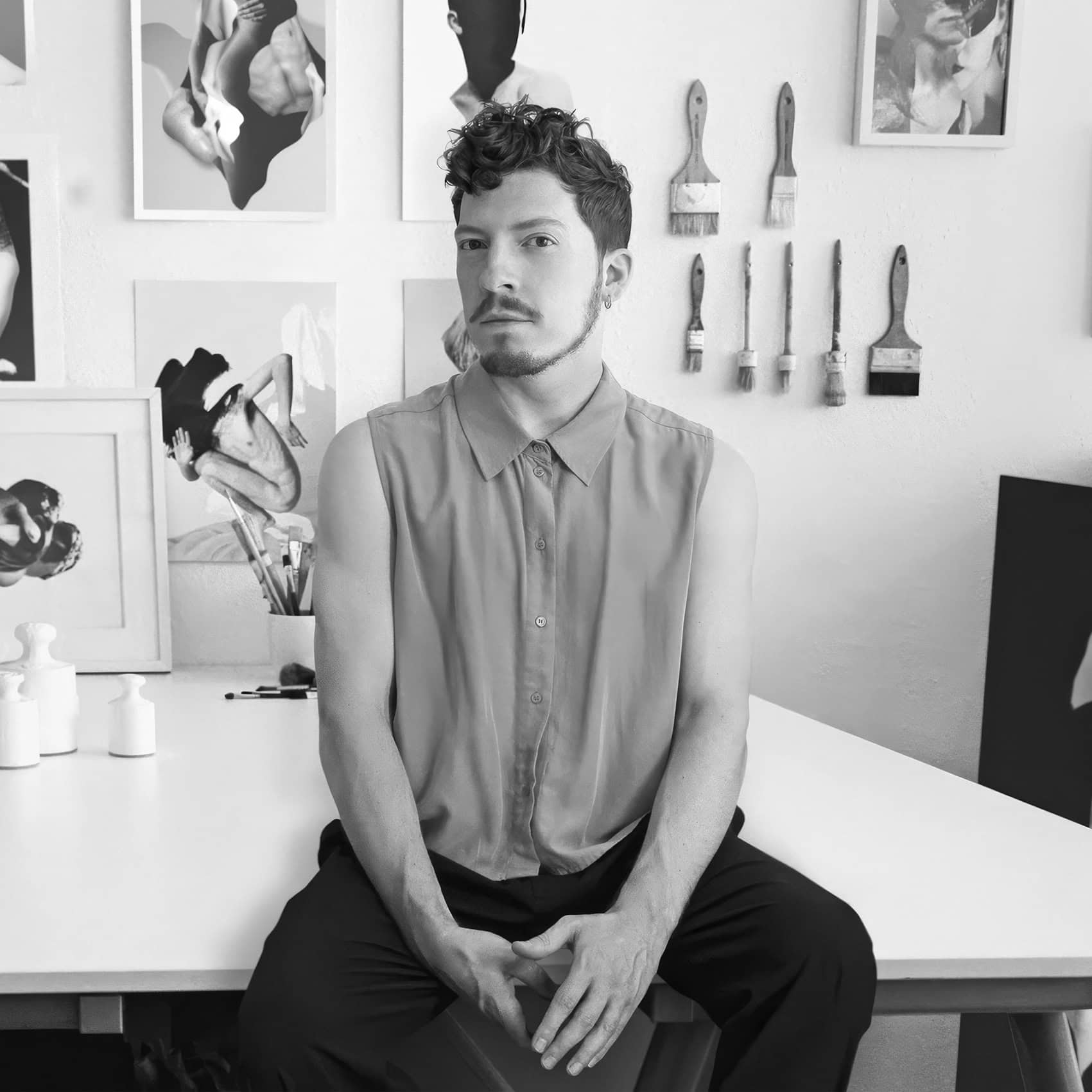
The Leipzig collage artist on the moment before understanding, why the surface is part of the content, and why he wants to take the body out of the photographic plane.