
ART & CULTURE · MIAMI
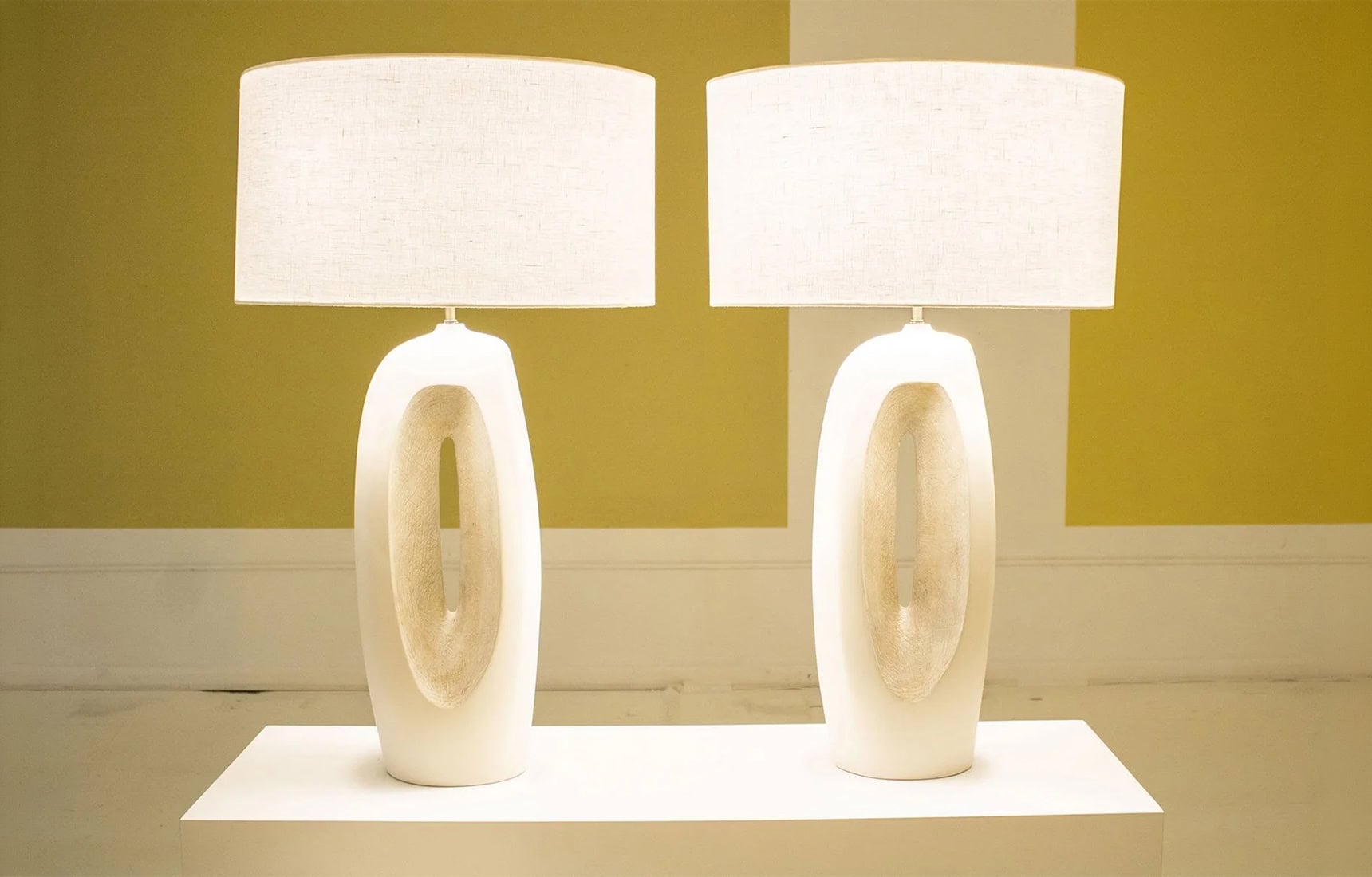
Reading time: 5 minThe walls were painted in shifting rectangles of colour. The light sculptures were red, yellow and blue. And every single object in the room was white. Ralph Pucci‘s Miami Art Week show was not a display of furniture; it was a demonstration, and Josef Albers wrote the brief.
Walk into Ralph Pucci’s Wynwood gallery during Miami Art Week for In Transitions: Miami Film Stills, and you will be shown something, which is a rich and considerably interesting proposition.
The exhibition filled 7,000 square feet with just 35 pieces of furniture and lighting. That restraint is the first clue. Every object had space around it. It was a room with an argument in it.
And the argument was about colour.


The Albers thesis, spelled out on the walls
The architect Lee F. Mindel painted the gallery’s interior and exterior walls in rectangles of transitioning colour, a palette drawn from Miami itself: the greens of palm, the blues of the sea, the particular light of a Florida afternoon. The murals pay homage to Josef Albers’ colour theory, and it is worth saying what that theory actually is, because it explains everything else in the room.
Albers — Bauhaus, then Black Mountain College, then Yale — spent the last twenty-five years of his life painting nested squares. Homage to the Square, over and over. It looked, to the impatient, like a man repeating himself.
He was proving something. His argument, set out in Interaction of Color (1963), is that colour is never fixed. A colour changes depending on what sits next to it. Put the same grey against yellow and against blue and you will see two different greys — not metaphorically, but actually, because your eye cannot help itself. Colour, Albers insisted, is the most relative medium in art.
Mindel’s transitioning rectangles are that idea, painted at architectural scale, on a building in Wynwood.
Which raises the question the exhibition then answers: if colour is relative, what happens to an object placed inside it?


The white room
Here is the move that makes the whole show cohere, and it is worth pausing on.
The largest display of Plasterglass ever mounted from the Ralph Pucci sculpture studio — the material his own workshop makes — was presented entirely in shades of white.
White objects. Coloured walls. That is not a coincidence and it is not a styling decision. It is the experiment.
A white surface has no opinion of its own. It simply reports what is happening to it. Put a white Plasterglass form in front of a wall of shifting greens and blues, and the object stops being white — it takes on the colour of everything around it, and it will do something different depending on where you stand and what time of day it is.
Pucci turned his own furniture into Albers’s grey square. The pieces are the control in the experiment. The colour is the variable. And the visitor, walking through, is the instrument.
That is a serious piece of curatorial thinking, and it is being done by a design gallery during the busiest week in the American art calendar, when a room this clear counts for a great deal.


Richard Meier, in colour
And then there is the joke.
Three primary-coloured light sculptures by Richard Meier Light.
Richard Meier is the architect of white. That is not a caricature; it is the defining fact of the practice. The Getty Center, the Jubilee Church, the Barcelona MACBA — all of it white, relentlessly, unapologetically, a whole career built on the conviction that white is the colour against which every other colour and every shadow becomes visible. He won the Pritzker in 1984 for doing it better than anyone.
So: the man who removed colour from architecture, making sculptures out of coloured light, in red, yellow and blue.
Those are the Bauhaus primaries — Albers’s primaries, the ones he taught with. And they are being emitted rather than applied: light, not pigment. In a room whose entire thesis is that colour is relative and unstable, Meier’s contribution is the one element that makes colour rather than merely wearing it.
It is a lovely piece of casting, and it closes the loop: Albers on the walls, Albers’s primaries in the light, and Albers’s method — a neutral form, observed under changing conditions — standing in the middle of the floor in white plaster.


Veritas, and the paint
Alongside, Mindel showed his Veritas collection for Pucci — the architect working in furniture, as he has for years, with the clarity you would expect of a man who has spent a career on modernist interiors.
The murals themselves were painted in a specially curated palette of Benjamin Moore colours, using their AURA line. In a show whose entire subject is what colour does, and where the paint is not decoration but the medium of the argument, the collaboration is exactly the right one. The material is doing the thinking.


Why it worked
The title is Miami Film Stills, and the more time you spend in the space the more it earns.
A film still is a moment arrested: a frame lifted out of motion, in which light and colour have been caught in one particular arrangement that will never occur again. Which is precisely what happens when you stand in this gallery and look at a white object against a coloured wall. Move two steps and it is a different picture. The show is a sequence of stills, and you make each one by moving.
Set it in the middle of Miami Art Week, alongside the fairs and the booths, and the ambition becomes clear. Pucci gave 7,000 square feet to thirty-five objects and asked people to look slowly, in the very week when the whole design world is in town.
It is the most confident thing a design gallery can do, and he has earned the right to do it. This is, after all, a man whose family business began by repairing shop-window mannequins, and who has spent fifty years arguing that the way you look at an object is the whole of its value. That same instinct crossed an ocean in 2022, when the gallery opened its first address outside the United States in Mayfair, London.


Frequently asked questions
What was In Transitions: Miami Film Stills?
An exhibition at Ralph Pucci’s Wynwood gallery in Miami, staged during Miami Art Week: 35 furniture and lighting pieces across 7,000 sq ft, with murals by Lee F. Mindel on the gallery’s interior and exterior walls.
Who designed the murals?
The architect Lee F. Mindel. His transitioning coloured rectangles draw on a Miami palette — sea, palm, Florida sun — and pay homage to Josef Albers’s colour theory. They were painted in a curated palette of Benjamin Moore AURA colours.
What is Josef Albers’s colour theory?
Set out in Interaction of Color (1963) and explored across his Homage to the Square paintings, Albers’s central claim is that colour is relative: any colour appears to change depending on the colours placed beside it.
What was shown?
Lee F. Mindel’s Veritas collection; three primary-coloured light sculptures from Richard Meier Light; and the largest display to date of Plasterglass from the Ralph Pucci sculpture studio, presented entirely in shades of white.
Where is Ralph Pucci’s Miami gallery?
In Wynwood, at 550 NW 28th Street — a former 1960s warehouse that opened as a Pucci gallery during Miami Art Week 2023.


Final thoughts
Albers spent twenty-five years painting the same square to prove that a colour is only ever the company it keeps.
In Wynwood, Ralph Pucci painted the walls, lit the room in primaries, and put white objects in the middle of it — and then let a few thousand people walk through and watch the colour move.
Thirty-five pieces. Seven thousand square feet. It was the calmest room in Miami that week, and by some distance the cleverest.


Leave a Reply