
INTERIORS · LONDON
Reading time: 10 minBurlington Arcade has employed beadles to stop people hurrying since 1819. When Atkinsons came back to Mayfair after nearly seventy years away, Christopher Jenner gave it a shop over four floors that makes hurrying impossible, which for a house that sells scent is not decoration. It is the business model.
There is a rule in Burlington Arcade, and it has been enforced by uniformed beadles since the arcade opened in 1819. You may not run. You may not hurry. You may not whistle, sing, hum or behave boisterously.
It sounds like a piece of Regency theatre, and it is, but it is also a commercial instruction. An arcade full of small, expensive shops needs people to slow down, because nothing in it can be bought at speed.
Atkinsons, the London perfume house founded in 1799, returned to Mayfair in November 2017 and took number 41. Christopher Jenner designed the interior, and the plan he drew is the most literal reading of that arcade rule anyone has attempted. The shop occupies four floors. You are met at a marble bar, taken upstairs to a room with a sofa to be consulted, and taken downstairs to a lounge to be groomed. At no point are you handed a bottle and pointed at a till.
That is the design argument, and it is a sound one. Scent is the one product that physically cannot be bought quickly, because a fragrance needs twenty minutes on skin before it tells you the truth. A shop that sells it properly has to be a building you spend time in rather than a counter you approach. Jenner built the building.

The arcade has been slowing people down since 1819
Burlington Arcade opened on 20 March 1819, commissioned by George Cavendish, 1st Earl of Burlington, and designed by the architect Samuel Ware. It runs 196 yards, from Piccadilly at the south end to Burlington Gardens at the north, and it was built for what its own founding description called the sale of jewellery and fancy articles of fashionable demand.
Two facts about it matter to what Jenner had to work with.
The first is the beadles. The arcade’s guards were originally drawn from the 10th Royal Hussars, Lord George Cavendish’s own regiment, and they still patrol in top hats and frock coats. The prohibition on whistling has a practical origin: whistling was how pickpockets signalled to each other. Over two centuries the rules have hardened into a code of Regency decorum, and the effect on the street is real. People move through Burlington Arcade at a different pace from the one they use on Piccadilly twenty metres away.
The second is the unit. The arcade was built as 72 small two-storey shops, each one room wide and one room deep, and over time some have been combined into the roughly forty that trade there now. A Burlington Arcade shop is, by original design, a box. Anyone taking one and wanting more than a box has to find the space vertically.
Atkinsons took a box and made a four-floor maison out of it.

Atkinsons came back to a street it used to own
The return has a better story behind it than the phrase “heritage relaunch” usually carries.
James Atkinson came to London from Cumberland in 1799 with a set of recipes, a pot of bear’s grease balm and, by every account of the firm’s founding, a bear. The pomade was the company’s first commercial success and stayed in production until after the First World War. The chained bear became the house emblem, and it is still on the packaging.
The rest of the history is Mayfair in miniature. James Atkinson was appointed Perfumer to the Court of St James in 1832, and the firm held a royal warrant from George IV. It made a scent for Queen Victoria’s wedding day. Its customers included the Duke of Wellington, Admiral Lord Nelson, Beau Brummell and Sarah Bernhardt, along with the Tsar of Russia and the King of Italy. Its flagship stood at 24 Old Bond Street.
Then, in 1926, the firm did something that turns out to matter a great deal to this story. It commissioned the architect Vincent Harris to build it a headquarters at 2 and 4 Burlington Gardens, on the corner of Old Bond Street. The Atkinsons Building is Gothic Revival with Arts and Crafts detailing, it is Grade II listed, and its spire holds a carillon of 23 bells cast by Gillett and Johnston. It is one of the most distinctive commercial buildings in Mayfair and it now houses a Salvatore Ferragamo store.
Burlington Gardens is the street that Burlington Arcade opens onto at its northern end.
Atkinsons left Old Bond Street in the 1950s. The name passed through Procter and Gamble, was bought by Perfume Holding in 2008 and relaunched in September 2013. Four years after that it opened at 41 Burlington Arcade, a two minute walk from the tower it built for itself in 1926 and had not occupied for two generations. That is worth stating plainly, because a house returning to the exact block it once commissioned a bell tower on is a rather better reason to be in Burlington Arcade than an available unit.

The ground floor is a bar, not a counter
Fragrance is most often sold across a counter, with the customer on one side and the stock behind glass on the other. Jenner turned that arrangement ninety degrees.
The ground floor is organised around a fragrance bar in book-matched black marble. Book-matching means the slab is sliced and opened like a book so the veining mirrors across the joint, which is a stone-cutting technique borrowed from the most expensive kind of joinery, and it produces a surface with a centre line and a symmetry. On a bar, that centre line tells you where to stand.
Above it hang thirty-one crystal pendants. The number is worth registering because it is not a round one, which means it was resolved to the bar rather than ordered from a catalogue, and the effect of that many small refracting sources over a black reflective plane is a ceiling that reads as light on water.
The stock sits on an illuminated podium with glass insets, and the shelving is drawn so that bottles can be picked up and put down easily while the run still reads as a single clean line. That is a harder brief than it sounds. A perfume bottle is beautiful on its own and busy in multiples, so open display and visual calm pull against each other, and this shelving holds both at once.
The floors are connected by a spiral staircase, which in a plan this narrow is the only move available and is also the most persuasive one. A spiral stair is slow by construction. You cannot take it two at a time.

Upstairs is a drawing room, downstairs is a club
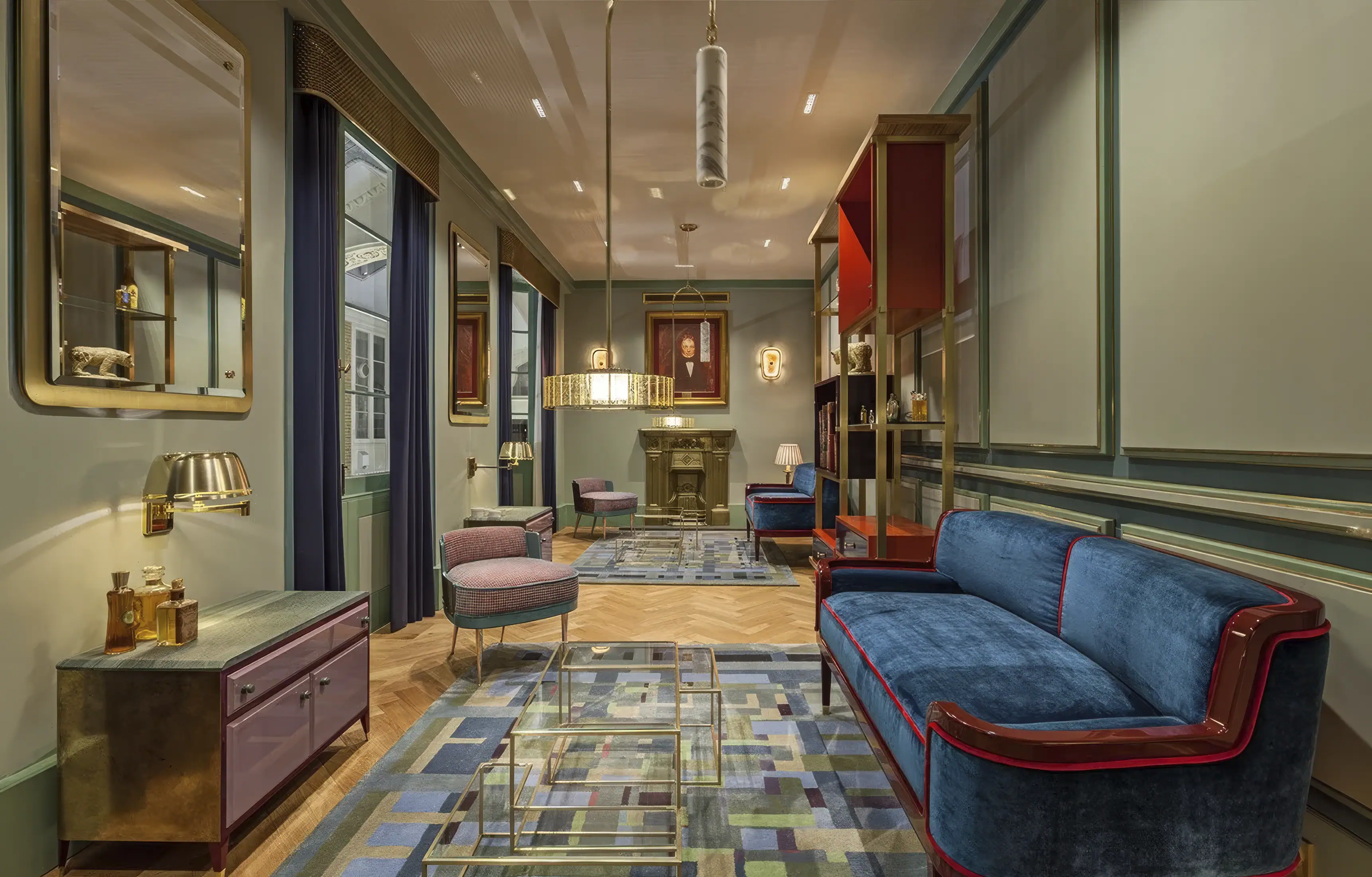
The first floor is the consultation salon, available by appointment, and it is deliberately soft. Cross-hatched metal pelmets carry the curtains, which turns the top of a window into a piece of worked metal rather than a concealed track. The lighting is bespoke, hung on pendants with marble counterbalances, so the mechanism that holds the fitting at the right height is made of the same material as the bar downstairs and is left visible rather than concealed. Pierre Frey fabrics and wallpapers do the rest.
This is the room where the four-floor argument pays off. A perfume consultation needs a sofa, a surface, quiet and about half an hour. None of those things can happen at street level in an arcade with a glass shopfront.
The lower ground floor is a gentleman’s grooming lounge, and its register changes again: browns, chocolate leather, and the house’s historic labels displayed as artefacts. Vintage packaging on a wall is a device that can easily become wallpaper, and it works here because the labels are genuinely the company’s own and because the room they are in does the thing they advertise. A barber’s chair below, a bar above, and a salon between them.
Three rooms, three social conventions, one narrow site.

The makers have names, and they are the story
The most valuable thing about this project is not on any moodboard. It is the list of people who made it, and their names are rarely the part anyone repeats.
- Paul Warren made the brass lighting
- Ruth Parker engraved the glass in gold
- Simon Hebditch made furniture for the scheme
- Studio 1718 built two beech-framed sofas with curved forms, along with cabinets and chairs, finished with brass feet and distressed copper detailing
- Couches were hand-carved in Sussex and upholstered in velvet
- The wall lights were handmade in Sheffield, and there are only two of them in existence
Jenner’s own comment on the joinery is worth quoting because it is the sort of thing designers say privately and rarely on the record: it took exemplary craftsmanship to bring the designs to life.
That list is the difference between an interior that references craft and one that commissions it. Every item on it is a specification decision that costs more, takes longer and cannot be repeated in the next store, and it is the reason the shop reads as a house rather than as a rollout.

Christopher Jenner’s method
Christopher Jenner grew up in South Africa in the final years of apartheid and trained at the Johannesburg School of Art. He has said that the appreciation of change and the respect of difference that came out of that period are values he tries to carry into his work.
His practice has become a specialism in heritage: the Eurostar ticket hall at St Pancras, Globe-Trotter luggage, silverware for E and Co, which supplied the flatware for the Titanic, the ninth century Yixing ceramic tradition in China, and Penhaligon’s, the other historic English perfume house. His own summary of the method is precise: each project starts with in-depth research to unlock brand assets, finding the balance between past and present, and avoiding pastiche.
That last word is the operative one at Atkinsons. Nothing in the shop is a reproduction. There is no Regency plasterwork, no repro apothecary cabinetry and no attempt to pretend the room is two hundred years old. What Jenner took from the archive is the behaviour of a nineteenth century perfumer’s shop, which is that you were attended to, and then built that behaviour out of contemporary marble, metal and glass made by living craftspeople.
He also names the work he is proudest of as the Rush chair, made with the craftsperson Felicity Irons, on the grounds that it brought an under-appreciated technique into view. That instinct is legible in everything at number 41.
The client understood what it was buying. Dino Pace, chief executive of Perfume Holding, described the brief as wanting the new house to be an experiential place where people can breathe the essence of the creations.

And then the shop became a perfume
The detail that closes the loop is the best one in the project.
Atkinsons names its fragrances after its addresses. 24 Old Bond Street is a perfume. 44 Gerrard Street, the road where James Atkinson first traded, is a perfume. And to mark the opening of the new maison, the perfumer Julie Pluchet composed 41 Burlington Arcade.
Think about what that means as a piece of design work. A shop was built to sell something invisible. The building was then translated back into the invisible thing, and the address on the door became a bottle on the shelf inside it. Very few interiors are ever asked to become a product. This one was, within weeks of opening.
It is also the neatest possible statement of what Jenner was doing. An interior for a perfume house is not a container for the perfume. It is another version of it.

Frequently asked questions
Where is the Atkinsons shop?
At 41 Burlington Arcade, Piccadilly, London W1.
When did it open?
November 2017, after Atkinsons had been absent from Mayfair since the 1950s.
Who designed it?
Christopher Jenner, the London designer known for heritage work including the Eurostar ticket hall, Globe-Trotter and Penhaligon’s.
How many floors does it have?
Four, connected by a spiral staircase: a grooming lounge on the lower ground floor, the fragrance bar at street level, and a consultation salon above.
What is the bar made of?
Book-matched black marble, lit by thirty-one crystal pendants.
When was Atkinsons founded?
In 1799, by James Atkinson, who came to London from Cumberland with a set of recipes, bear’s grease balm and a bear. The chained bear is still the house emblem.
Who were its customers?
The Duke of Wellington, Admiral Lord Nelson, Beau Brummell, Sarah Bernhardt, the Tsar of Russia and the King of Italy, among others. James Atkinson was appointed Perfumer to the Court of St James in 1832.
When did Burlington Arcade open?
On 20 March 1819, built for Lord George Cavendish and designed by Samuel Ware. It is 196 yards long and was originally 72 two-storey shops.
Is there really a rule against hurrying?
Yes. The arcade’s beadles, originally drawn from the 10th Royal Hussars, still enforce a ban on running, hurrying, whistling, singing and humming.

Final thoughts
Retail design is usually asked to solve for conversion, and the fastest route from door to till normally wins. Burlington Arcade has spent two centuries proving there is another model, in which the point of the room is to keep you in it.
Atkinsons at number 41 is the most complete version of that idea currently trading in the arcade. It has a bar you sit at, a salon you are taken up to, a lounge you go down to, and a spiral stair between them that will not let you rush. It commissions its metalwork from named makers in Sheffield and Sussex rather than specifying it from a catalogue. It sits two minutes from the bell tower the same company built for itself in 1926.
And it ends with the address on its own door turned into a fragrance, which is the most Mayfair sentence it is possible to write and also, on inspection, a completely serious piece of design thinking. A perfume house that cannot show you its product built a place worth staying in instead, and then bottled the place.



Leave a Reply