
Exhibitions · Miami
Reading time: 7 minIn a fluorescent, dreamlike world of airbrushed colour and cartoon tenderness, the American artist Austin Lee stages an ancient battle for the soul. His exhibition Psychomachia, presented by Jeffrey Deitch in the Miami Design District during Miami Art Week 2024, draws its title from a fourth-century poem and its imagery from a fourteenth-century chapel — then filters both through virtual-reality software. The result is one of the most quietly profound shows of the week: a study of virtue, vice and raw human feeling, rendered in pigment that seems to glow from within.
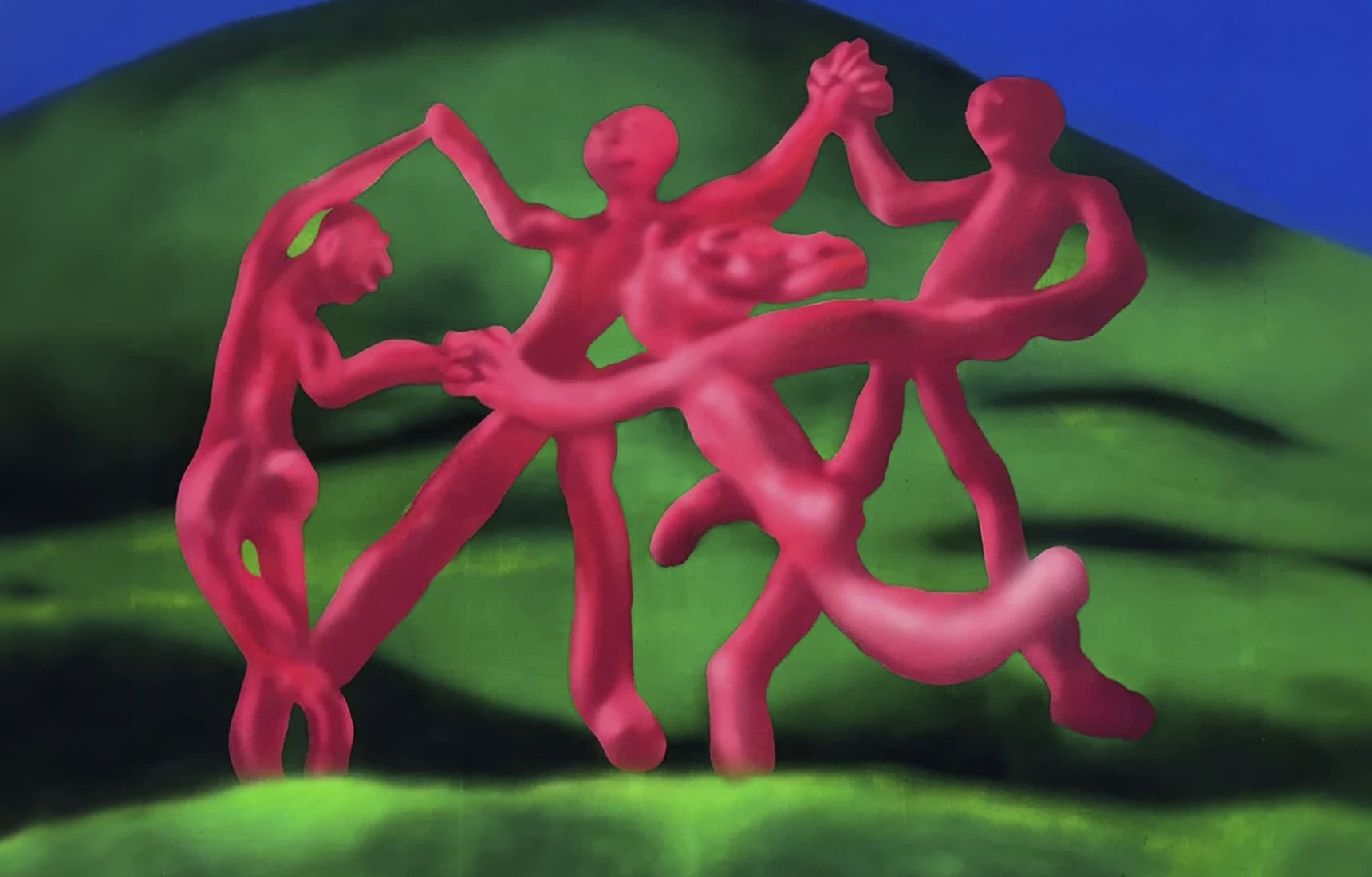
There is a particular jolt that comes from standing in front of an Austin Lee painting. The colours are impossibly saturated, the figures rounded and almost childlike, the surfaces so smooth they appear back-lit, as if the canvas were a screen. And yet the feeling that rises off them is anything but weightless. Beneath the sugar-bright palette lies a serious inquiry into how we feel, how we are watched, and how the digital age has reshaped the most intimate corners of human experience.
That tension, between the playful and the profound, the ancient and the algorithmic, was the animating force of Psychomachia in Miami, Lee’s solo exhibition presented by Jeffrey Deitch during Miami Art Week 2024. Staged in the Miami Design District and running through the busiest week of the American art calendar, it was a show that rewarded slowing down. This is the story of the artist, the ideas and the images behind it, and why it resonated so strongly across the week.

The Artist: Painting in Virtual Reality
Austin Lee was born in Las Vegas in 1983 and raised in Philadelphia, where his artistic instincts took hold early. He earned a BFA in painting from the city’s Tyler School of Art in 2006 — running, while still a student, a studio that doubled as a gallery for his creative community — before completing an MFA in painting at the Yale School of Art in 2013 and moving to New York, where he remains based.
What has made Lee one of the most distinctive painters of his generation is his refusal to treat digital tools and traditional media as opposites. His early works drew on Adobe Photoshop; more recently he adopted the Oculus Rift’s virtual-reality program, Medium, as a kind of imaginary studio, modelling forms in three dimensions before translating them back into the physical world. A drawing conceived in VR might be airbrushed onto canvas, its edges impossibly soft, or “sculpted” in resin and bronze. The technology is not a gimmick but a bridge, allowing Lee to move fluidly between the virtual and the tangible.
“The battle for the soul has not ended but merely changed venues — now fought in the glow of our devices.”

A Contemporary Heir to Pop
It is a practice that has invited comparison to the great Pop artists, and Jeffrey Deitch, who has championed Lee across a series of ambitious projects, from the 2019 New York exhibition Feels Good to presentations at The Armory Show, has drawn the parallel explicitly. Where Andy Warhol used photo-silkscreens to link painting with the image-making technologies of the 1960s, Deitch has argued, Lee fuses digital techniques with age-old painting and sculptural processes. His subject, in a sense, is the same as Warhol’s: how the images that surround us shape the way we feel. To it Lee brings a disarming emotional openness, mining his own unfiltered feelings for a body of work that is as vulnerable as it is technologically sophisticated.
Psychomachia: An Ancient Battle for the Soul
The exhibition’s title reaches back more than sixteen centuries. Psychomachia — roughly, “the battle for the soul” — is the name of an allegorical Latin poem written around AD 400 by the Roman Christian poet Prudentius. In it, personified Virtues and Vices do battle for control of the human spirit, and the work is often credited as one of the founding texts of allegory in Western literature, its influence rippling through medieval and Renaissance art for a thousand years.
Lee encountered that inheritance not on the page but on a wall. A transformative visit to the Scrovegni Chapel in Padua — where Giotto’s revolutionary early-fourteenth-century fresco cycle includes a celebrated procession of personified Virtues and Vices — set the exhibition in motion. Standing before Giotto’s figures, Lee found a centuries-old visual language for the very thing his art had always pursued: the outward depiction of inner moral and emotional states. Some works in Psychomachia borrow imagery directly from the chapel’s frescoes; others invoke its symbols more obliquely, folding them into Lee’s own hyper-saturated idiom.

Old Masters, New Emotions
The move is characteristic of Lee, who has never been shy about placing himself in a long lineage. By channelling Giotto and Prudentius, he reframes his fluorescent, screen-lit paintings not as products of internet culture alone but as the latest chapter in an ancient project — the effort to give visible form to what we feel. It is a bold gesture, and it lends the exhibition an unexpected gravity. These are not simply appealing pictures; they are, in the artist’s telling, contemporary allegories for an age in which the soul is fought over by very modern forces.
Inside the Exhibition
At the heart of the show stood Blue Fountain (2022–2024), a sculptural fountain that had previously anchored Lee’s solo museum exhibition at the Lotte Museum of Art in Seoul in 2023. Rendered in Lee’s signature palette, it functioned as both centrepiece and emotional keynote, water and colour combining into something meditative. Two further works from that Seoul presentation, Joy (2023) and Repose (2023), reappeared here, extending the through-line between the museum show and the Miami staging.
Elsewhere, the paintings gave emotion a face. Lion with Blue Eyes (2024) summoned strength and watchfulness; In Bed (2024) captured something far more tender and exposed, a study in vulnerability. Across the exhibition, Lee’s figures oscillated between comfort and unease, their cartoon softness repeatedly undercut by the sense of being observed.

The Watched Self
That sense of surveillance came to the fore in a series of new video works installed on the mezzanine. Here, animated figures gazed back at the audience from the same vantage point reflected in In Bed, collapsing the distance between viewer and viewed. The effect was pointed: in an era of screens, cameras and endless self-presentation, to look is also to be looked at. These moving-image pieces deepened the exhibition’s inquiry into the hyperreality shaped by social media and the internet — the way human connection is now refracted, and sometimes distorted, through the digital layer that mediates our lives. Lee has long built new works atop earlier ones, and the videos exemplified that method, situating familiar figures within an ever richer, multi-layered visual landscape.

Jeffrey Deitch and the Miami Design District
The exhibition also belonged to a longer institutional story. Jeffrey Deitch — the dealer, curator and former museum director whose name has been synonymous with boundary-crossing contemporary art for decades — has been mounting exhibitions and public art projects in the Miami Design District since 2003. Psychomachia in Miami extended that two-decade tradition, and continued a solo presentation that had opened at Deitch’s Los Angeles space earlier in the autumn of 2024.
The setting matters. During Miami Art Week, when Art Basel and its satellite fairs draw the international art world to the city, the Design District becomes a cultural stage in its own right, its walkable blocks of architecture, design and public art offering a slower, more considered register of their own. To encounter Lee’s work here, amid a neighbourhood built on the same fusion of art, design and commerce that defines his practice, felt entirely apt.
Deitch’s long presence in the area also speaks to how Miami has matured as an art destination. What was once a week defined almost entirely by the fairs has grown into an expansive cultural season, in which gallery exhibitions, museum shows, artist commissions and public installations command as much attention as the booths themselves. By staging a museum-calibre solo exhibition, Deitch positioned Lee’s work to be experienced on its own terms, given room to breathe, and time to be felt, in a neighbourhood built for exactly that kind of attention.

Why the Exhibition Mattered
Miami Art Week rewards work that holds the eye and the mind at once, and a show this visually seductive proved it could do both. That is a measure of Lee’s ambition. By yoking the newest of tools to some of the oldest of questions, Psychomachia made a case for painting as a still-vital way of picturing the inner life, and for the artist as someone who can hold antiquity and the algorithm in the same frame.
What lingers is that doubleness. Lee gives us worlds that look like the inside of a phone screen and feelings that would have been legible to a fourteenth-century pilgrim in Padua. In doing so, he suggests that the battle for the soul described by Prudentius has not ended but merely changed venues — that virtue and vice, joy and unease, tenderness and exposure, are being fought over now in the glow of our devices. It is a serious idea, delivered with a generous, disarming lightness, and it made this one of the most memorable exhibitions of the Miami season.

Leave a Reply