Art · Venice
Reading Time: 11 minutesAlma Allen has the whole of the US Pavilion at Venice Biennale 2026, three rooms, a rotunda and the forecourt. He designed and built his own studio, installed a bronze foundry in it and engineered the robotic arm that scales his work up from clay. The 1930 pavilion he is showing in was paid for by a co-operative of artists, on plans two architects gave them for nothing.
The US Pavilion at Venice Biennale 2026 holds a single artist, and the fit between the man and the building is closer than it first looks. Call Me the Breeze gives Alma Allen the whole of the 1930 pavilion in the Giardini, three rooms, a rotunda and the forecourt in front of it. Allen designed and built his own studio, installed his own bronze foundry in it, and engineered the robotic arm that scales his work up from clay. The building he is showing in was put up by a co-operative of artists who paid for it themselves, on plans two architects gave them for nothing. Both of them were made by the people who needed them. The Giardini is full of this question in 2026, and the rebuilt Central Pavilion asks it most directly of all, having just been rebuilt around the exhibition it then had to hold.

A pavilion that artists bought and built for themselves
Almost every building in the Giardini was commissioned by a government. This one was not. The Grand Central Art Galleries, a New York artists’ co-operative founded in 1922 by Walter Leighton Clark with John Singer Sargent among its backers, bought the land, paid for the construction and ran the pavilion itself. The 1934 catalogue records an appropriation of twenty five thousand dollars. It was the ninth building in the gardens and it is still one of the very few in private hands.
William Adams Delano and Chester Holmes Aldrich donated the plans. Delano had designed the Galleries’ own interiors in New York in 1922, so he was in effect their house architect giving them a building. He was a Beaux-Arts graduate of 1903, a distant cousin of Franklin Delano Roosevelt, the architect of the 1927 White House renovation and later of the Marine Air Terminal at LaGuardia. The firm’s signature was brick with limestone or white marble trim, and that is exactly what went up in Venice: pink brick with Istrian marble, Palladian in plan, three rooms arranged off a central rotunda, opened on 4 May 1930. the Nordic Pavilion is the other building in the gardens that an artist has to negotiate with rather than simply occupy, and Sverre Fehn’s concrete grid is just as unignorable as Delano’s axis.

The ownership has moved since. The Galleries ran it until 1954, when the Museum of Modern Art took it on, and the United States Information Agency followed. In 1986 the Solomon R. Guggenheim Foundation acquired it with funds from the Peggy Guggenheim Collection, which has organised the exhibitions there ever since. The 2026 presentation is commissioned by Jenni Parido of the American Arts Conservancy with Jeffrey Uslip as curator, supported by the State Department’s Bureau of Educational and Cultural Affairs, and it is timed to the American semiquincentennial.

Allen built the studio, the foundry and the arm that carves
Alma Allen was born in Heber City, Utah, in 1970 and taught himself to make things. For years he worked out of a studio he designed and built in the Mojave, on the edge of Joshua Tree National Park, selling directly rather than through galleries. He now works in Tepoztlán, in Morelos, Mexico, where the studio has its own bronze foundry so that a piece can be modelled, cast, chased and patinated without leaving the site.
The method is the interesting part, and it explains the surfaces in Venice. Allen works small first, handling clay maquettes over and over until a form settles. He then scales them with a robotic device he built himself. So the finished object carries two different kinds of information at once: the thumb pressure of something palm sized, and the smoothness that only a machine running for days can give a block of stone. A hand decides the shape. A machine agrees to it at twenty times the size. It is the same bargain the Belgian Pavilion strikes from the other end, where a performance vocabulary is cast into plaster so that it holds still.

He came to general notice in the 2014 Whitney Biennial, where Michelle Grabner selected three large sculptures and Time put a white marble piece among the five best works in the show. In 2025 he filled eight sites along the Park Avenue malls with ten sculptures in bronze and onyx, several of them over ten feet.
The materials are an American inventory
The stone and timber for Venice were sourced across the Americas: American walnut burl, Cantera verde, the green volcanic rock quarried in Mexico, and white Colorado Yule marble.
The Yule is the one to notice. It comes out of a single quarry above the town of Marble in Gunnison County, and it is the stone of the Lincoln Memorial and the Tomb of the Unknown Soldier. Putting it in a Palladian pavilion in the Giardini in the year of the semiquincentennial is a decision with a lot packed into it, and Allen has used it for the quietest object in the building: a thick white ring, roughly the height of a person, standing on a block of timber. It reads as a portal, a mouth, a worn pebble with the middle gone. The surface has been taken down until the marble stops looking quarried and starts looking tumbled.

The walnut burl is the opposite temperament. One piece sits low on the terrazzo like a boulder, its whole surface a field of soft lobes following the burl’s own figure, the grain swirling where the tree grew around its own damage.

The title comes from a song about keeping moving
Call Me the Breeze was written by J.J. Cale and released on his 1971 debut Naturally, then taken up by Lynyrd Skynyrd in 1974 and turned into the version most people know. Cale’s original is the better fit for this show. It is a quiet, unhurried thing built on a single idea, played by a man who recorded most of his records himself, in his own room, with his own equipment, and who spent a career declining to be the centre of attention.
That lineage matters for how the sculpture reads. Allen’s forms sit inside a biomorphic tradition that runs from Jean Arp through Isamu Noguchi, and his nearest relative is JB Blunk, the Californian sculptor who carved redwood and built his own house by hand at Inverness. Allen and Blunk were shown together at the Palm Springs Art Museum in 2018 and the pairing stuck, because both of them treat a material’s own history as part of the brief. A burl is not a neutral block. It is the record of a tree growing around an injury, and Allen leaves enough of that visible that the object keeps its biography.

Bronze that has decided to behave like something else
The rotunda holds the tallest piece: a column standing almost to the cornice, mirror polished and gold in tone, its surface pulled into deep vertical flutes that catch the light from the arched window beside it. It has the posture of a cactus and the finish of a cast bell.

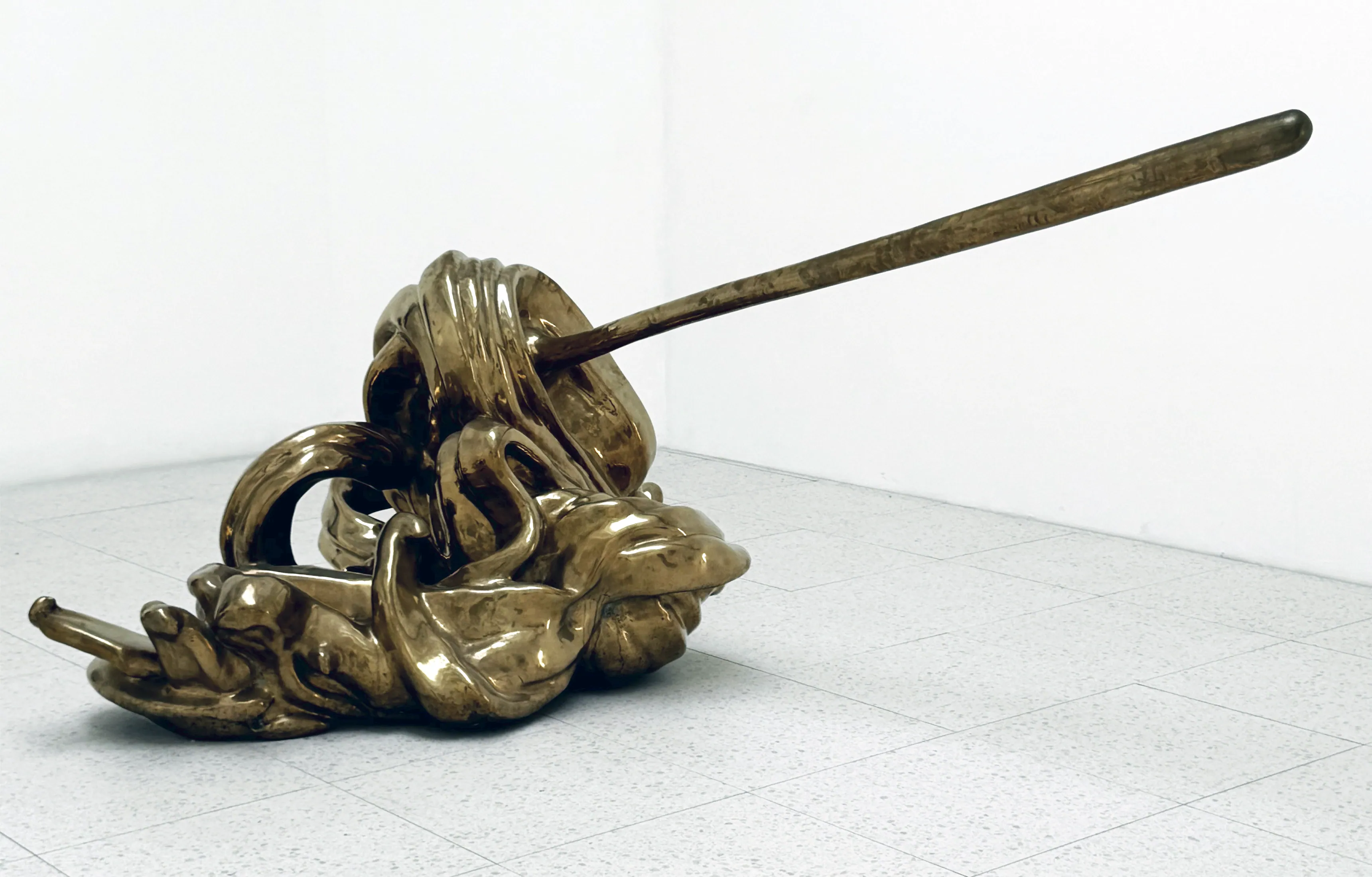
In the next room a long bronze pole leans out of a heap of bronze loops and folds collapsed on the floor, the whole thing mirror polished so the terrazzo repeats in it. Another piece sits upright and reads unmistakably as a figure in a chair, arms and legs made of the same thick tubular loops, although nothing in it is anatomical. Small gold forms knot themselves against the walls at eye level. The consistent trick is that solid bronze, several hundredweight of it, is made to look like it is still moving.

The wall pieces are the surprise in the show
There are two families of wall piece. The first is a pair of tall, narrow panels in a warm tobacco brown, grain running the full height, a dark seam down the centre of one and a small disc set into it like a knot. They flank the white marble ring in the end room and they give it a frame. The second family is where the show gets strange. Hung flat against the white walls are slabs whose surfaces run. The top third is a deep glossy black that has pooled and dripped; below it the surface breaks into gold, ochre, blue green and rust, striated as if something had been poured down it and allowed to set. The edges are torn rather than cut, and the gold runs right out to them. Seen from across the room they read as scorched planks. Standing in front of one, the surface is closer to a glaze that has crawled and settled in the kiln.

They are the most pictorial things in the building and they do the work the architecture asks for. Delano and Aldrich gave the pavilion flat wall planes between the openings. These fill them the way a painting would, and then refuse to be a painting.

Nothing in here has a title
Allen does not title his sculptures, and the labels in Venice say “Not Yet Titled”. That is not a withholding. It changes what you do in the room. Without a title to check your reading against, you are left with scale, material and surface, which is exactly what the work is made of.

Uslip has described the pieces as ciphers in a permanent state of becoming, and says the exhibition’s name suggests a weightlessness and a freedom of thought. Allen’s own account is simpler: he talks about the works as being in the act of doing something. In a building this formal, with its axis and its rotunda and its Palladian manners, objects that refuse to settle into a name are a genuinely good idea.
How to see the US Pavilion at Venice Biennale 2026
Call Me the Breeze runs from 9 May to 22 November 2026 at the US Pavilion in the Giardini di Castello. The pavilion sits in the upper part of the gardens near the German and French pavilions, a short walk from the Central Pavilion. If you are making a day of sculpture in the open air, the sculptures in the Giardini della Marinaressa are twenty minutes away along the Riva.

Start outside. There is a new sculpture in the forecourt, made for that spot, and it sets the scale before you go in. Inside, take the rotunda first and let the bronze column do its thing with the window light, then work outwards into the side rooms. Twenty minutes is enough, but go close to the wall pieces. They are a completely different object from six inches than from six feet.
Frequently asked questions
Who is representing the United States at Venice Biennale 2026?
The sculptor Alma Allen, with a solo presentation titled Call Me the Breeze. It is commissioned by Jenni Parido of the American Arts Conservancy and curated by Jeffrey Uslip, supported by the US Department of State’s Bureau of Educational and Cultural Affairs and the Peggy Guggenheim Collection, and it runs from 9 May to 22 November 2026.
Who designed the US Pavilion in the Giardini?
William Adams Delano and Chester Holmes Aldrich, who donated the plans. It opened on 4 May 1930 in pink brick with Istrian marble, Palladian in plan, with three rooms arranged off a central rotunda. Delano had designed the interiors of the Grand Central Art Galleries in New York in 1922, and it was that artists’ co-operative which paid for the pavilion and ran it.
Who owns the US Pavilion at the Venice Biennale?
The Solomon R. Guggenheim Foundation, which acquired it in 1986 with funds from the Peggy Guggenheim Collection. The Grand Central Art Galleries owned it from 1930 until 1954, when the Museum of Modern Art took it on, and the United States Information Agency ran it after that. It is one of the few privately owned pavilions in the Giardini.
What materials does Alma Allen use?
For Venice he has worked in American walnut burl, Cantera verde volcanic rock from Mexico, white Colorado Yule marble and bronze. He hand selects stone at the quarry and gathers wood near his studio, models small maquettes in clay, and scales them up using a robotic device he built himself. His studio in Tepoztlan has its own bronze foundry.
Why do none of the works have titles?
Allen does not title his sculptures, so the labels read Not Yet Titled. The curator Jeffrey Uslip describes the works as ciphers in a permanent state of becoming, and the effect in the rooms is that you read each piece by its scale, material and surface rather than against a name.
Where does the title Call Me the Breeze come from?
It is a song written by J.J. Cale and released on his 1971 album Naturally, later recorded by Lynyrd Skynyrd in 1974. Uslip has said the phrase suggests a weightlessness and a freedom of thought.
Final thoughts
The most useful thing to know before you walk in is that Alma Allen made the tools as well as the work. The studio in the Mojave, the foundry in Tepoztlán, the robotic arm that takes a thumb-sized clay study up to several tons of stone. None of that is a biographical footnote. It is why a marble ring can be machine smooth and still hold the shape somebody’s hands arrived at.
The building has the same story folded into it. A group of artists in New York decided they wanted a house in Venice, two architects gave them the drawings, and they paid for it out of their own funds and opened it in the spring of 1930. Nearly a century of institutional ownership later, that origin is still legible in the plan: it is a small, confident, well mannered building made by people who knew exactly what they wanted to hang in it.

Put those two facts next to each other and the show makes a different kind of sense. Walnut that remembers a wound, marble from the quarry that faced the Lincoln Memorial, bronze polished until it looks like it is still pouring. Every one of them is a material being persuaded, patiently, by somebody who built the equipment for the job.
Go for the rotunda. Stay for the wall pieces.
Project Credits
Go further from here
Add to calendar
Google CalendarApple or OutlookRead next
Adriana Varejão has painted a cracked tile sky into the concrete beam that runs the length of the Brazilian Pavilion, and Rosana Paulino answers it from the floor with thread,…
Venice