ART & CULTURE · UNITED ARAB EMIRATES
Reading time: 9 minWithin fourteen months the Gulf acquired three international design and art fairs. The announcements were reported as a market story, which they are. They are also a property story, and that is the more revealing one, because two of the three are moving into buildings the region had finished using.
Three things happened in close succession.
In October 2025, Abu Dhabi’s Department of Culture and Tourism announced that Frieze would launch Frieze Abu Dhabi in November 2026, absorbing Abu Dhabi Art, whose final edition ran that same month.
In November 2025, the itinerant collectible design fair NOMAD held its Middle East debut in Abu Dhabi, from 19 to 22 November.

In December 2025, Design Miami announced its first expansion into the region: a collectible design platform launching at Alserkal Avenue in Dubai in early 2027, in partnership with Alserkal.
Read as market news this is straightforward. Capital, ambition, a region building cultural infrastructure at speed. All true, all reported.
The more interesting reading is architectural, and it comes from asking a duller question: where exactly are these fairs going to happen? Because two of the three are moving into buildings that the Gulf had already finished with.
NOMAD took the best room any fair in this region has been given
NOMAD Abu Dhabi was held inside Terminal 1 of Zayed International Airport, and that sentence should stop you.
Terminal 1 was designed by the French architect Paul Andreu, who also gave the world Charles de Gaulle in Paris and Terminal 3 in Dubai. It opened in 1982, ran for more than forty years, and was decommissioned in late 2023 when the new terminal took over. Its architecture is unmistakable: a circular central rotunda, a tent-like roof, and the green mosaic-tiled columns that flare outwards at the top like mushrooms, which anyone who passed through the UAE in the 1980s, 1990s or 2000s will remember before they remember anything else about the journey.

Nicolas Bellavance-Lecompte, who founded NOMAD, put the fair’s whole premise in four words: the space itself must speak.
What he did with it was smarter than simply borrowing a handsome ruin. The fair used the terminal as a terminal. Visitors were given boarding passes and passed through check-in booths to enter. Galleries occupied the rotunda under the tiled columns. Departure gates became individual project spaces. The Departures hall carried installations, including Ali Chaaban’s carpet aeroplanes and work by AA Murakami. The long connecting corridors, the parts of an airport nobody photographs, became circulation between exhibitions, which is exactly what they already were.


That is not decoration. It is a plan that reuses the building’s own logic rather than papering over it. An airport is already a machine for moving people past things in a sequence, holding them in waiting areas, and delivering them to a gate. A fair needs precisely those functions. Andreu solved the problem in 1982 and nobody had to solve it again.
Bellavance-Lecompte has said the fair intends to return to Terminal 1 over the next four years, expanding gradually. Given how well the building performs, that is the right instinct.
Collectible design needs a room with a history
There is a reason a fair like this looks for a building rather than a hall, and it is functional rather than romantic.
A trade fair works perfectly well in a neutral shed. Its objects are catalogue items, available in quantity, and its visitors are specifiers walking with a shortlist. Speed is the point. Neutrality helps.
Collectible design is the opposite proposition. The objects are one-offs or near-enough, the buying decision is slow and personal, and the fair’s job is to make people stop. A featureless white booth in a temporary structure actively works against that, because it gives the eye nothing to slow down for. What a room with real character supplies, for free, is dwell time.


This site has already run into that argument from the other end. In 2018, Downtown Design absorbed Design Days Dubai, the region’s only collectible design fair, and turned it into a curated section called Downtown Editions. That piece made the case that a slow-looking market does its best work when it has a room of its own, and an audience that arrives through its own front door.
Seven years later, this is the answer. The category has come back at full scale, and it has come back by finding rooms of its own, in buildings nobody else was using.
Alserkal is the same move at a different scale
Which brings the Design Miami announcement into focus.
Alserkal Avenue is a former industrial compound in Al Quoz. Its warehouses were built to hold light manufacturing and storage for a city that ran on trade and hydrocarbons, and the entire cultural district that now sits there exists because galleries took sheds nobody wanted, at rents nobody was competing for. The site has spent roughly fifteen years turning that into an arts ecosystem.

Design Miami arriving there in early 2027 is the same manoeuvre as NOMAD’s, differing only in the type of building and the length of the lease. Both are collectible design markets installing themselves in the physical remains of the Gulf’s previous economy.
Jen Roberts, Design Miami’s chief executive, framed the partnership around shared values and design as a global language, and around celebrating the region’s cultural heritage alongside its appetite for innovation. Vilma Jurkute, Alserkal’s executive director, called the Middle Eastern debut a natural trajectory both for the institutions and for the cultural landscape they belong to.

The decision underneath that language is precise: Design Miami’s first expansion into this region is not into a convention centre in a new district. It is into a warehouse estate with a fifteen-year cultural memory and a set of tenants already in place. That is a bet on context mattering more than floor area, which is a designer’s bet rather than an operator’s.
Frieze makes the opposite move, into a purpose-built cultural district
The third announcement runs the other way, into a district built for exactly this.
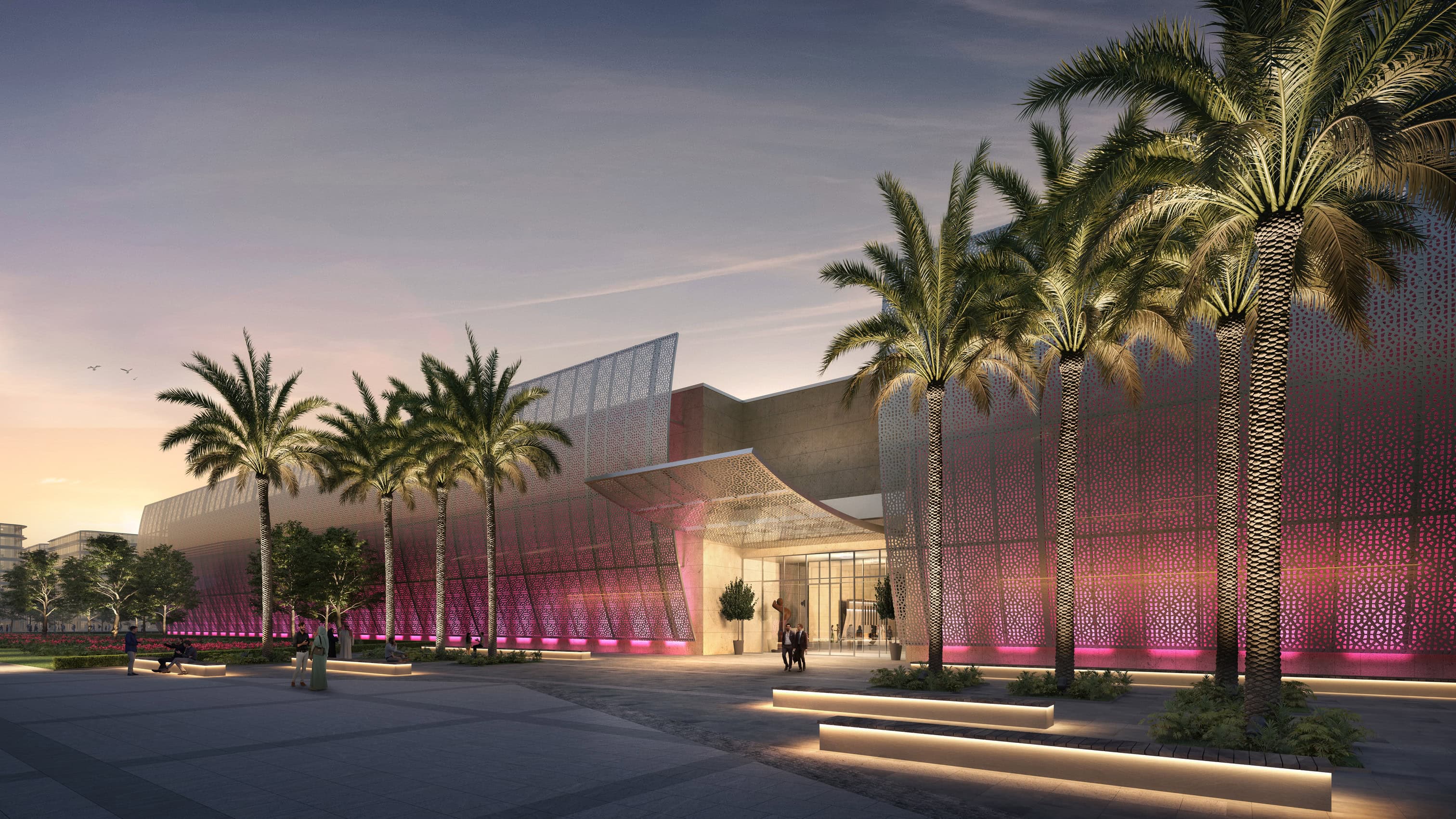
Frieze Abu Dhabi launches in November 2026 at Manarat Al Saadiyat, in the Saadiyat Cultural District, in partnership with the Department of Culture and Tourism. It does not sit alongside Abu Dhabi Art. It replaces it. The final edition of Abu Dhabi Art ran from 19 to 23 November 2025 with around 140 exhibitors, including Pace, Leila Heller and Athr.

Mohamed Khalifa Al Mubarak, DCT’s chairman, described the new fair as rooted in Abu Dhabi Art’s achievements and carrying them onto the global stage. Dyala Nusseibeh continues as director, which is the detail that matters most, because it means the institutional knowledge carries straight across into the new fair.
The shape of this is familiar. A homegrown fair, built patiently over years, joins an international brand with more reach and more machinery behind it. That is the same route Design Days Dubai took in 2018. The gains are real: distribution, gallery quality, an audience that travels. The local conversation that built Abu Dhabi Art now carries into a global one, and it carries with its director and its exhibitor relationships in place.
That is an expansion of reach rather than a change of purpose. It is worth naming as such.

How the new calendar comes together
Two details are worth drawing out.
The first is scheduling. Frieze lands in Abu Dhabi in November 2026. Dubai Design Week, Downtown Design and Editions occupy early November in Dubai. NOMAD took the third week of November. Design Miami arrives in Dubai in early 2027, with Art Dubai already holding April. The region is assembling a calendar at speed, and it now runs from early November through to the spring. Cities a hundred and forty kilometres apart, each holding its own week, give collectors a reason to plan a longer stay and to treat the two emirates as a single season.

The second is supply. Three international platforms need a great deal of work to sell, and collectible design is a scarce category by definition, because scarcity is what makes it collectible. The regional maker base is growing, and the early editions will draw on European and American galleries alongside it. That is how a first edition begins, and it is how Design Days Dubai began too. Three fairs on the calendar give makers based here a large new floor to grow into, and that is the most interesting part of the story.
Frequently asked questions
When is Design Miami coming to Dubai?
Design Miami announced in December 2025 that it will launch a collectible design platform at Alserkal Avenue in Dubai in early 2027, in partnership with Alserkal. It is the fair’s first expansion into the Middle East and North Africa, alongside its existing editions in Miami and Paris.
What was NOMAD Abu Dhabi?
NOMAD is an itinerant collectible design fair founded by Nicolas Bellavance-Lecompte. Its Middle East debut ran from 19 to 22 November 2025 inside Terminal 1 of Zayed International Airport. Exhibitors included Nilufar, Gallery Fumi, Galerie BSL, Leila Heller Gallery, Robilant and Voena, Orient 499 and Bottega Veneta.
What is Terminal 1 at Zayed International Airport?
Terminal 1 was designed by the French architect Paul Andreu, who also designed Charles de Gaulle in Paris and Terminal 3 in Dubai. It opened in 1982, served for more than forty years, and was decommissioned in late 2023. It is known for its circular rotunda, tent-like roof and green mosaic-tiled columns.
When does Frieze Abu Dhabi launch?
Frieze Abu Dhabi launches in November 2026 at Manarat Al Saadiyat, in partnership with Abu Dhabi’s Department of Culture and Tourism. It takes the place of Abu Dhabi Art, whose final edition ran from 19 to 23 November 2025 with around 140 exhibitors. Dyala Nusseibeh continues as fair director.
What is collectible design?
Collectible design covers limited edition and one-off pieces bought in the way art is bought, rather than specified from a catalogue in quantity. It sits between design and art, and it is traded through galleries and dedicated fairs rather than through showrooms.
Where can you see collectible design in the UAE?
Alongside these three fairs, Downtown Design runs Downtown Editions during Dubai Design Week, Editions launched as a standalone limited edition art and design fair in November 2024, and galleries across Alserkal Avenue and Dubai Design District show collectible work year round.


Final thoughts
One version of this story is about capital arriving and three fairs following. That version is accurate, and it is only the surface.
The version worth keeping is that a market which needs slow looking went out and found rooms that produce it. An airport terminal from 1982, with its tiled columns and its corridors and its gates, turns out to be a better fair building than anything purpose-built, because it was already designed to hold people in sequence and give them somewhere to wait. A warehouse estate in Al Quoz turns out to be a better home for collectible design than a convention centre, because fifteen years of tenants have given it something a new hall cannot have, which is a past.

In 2018 the region’s collectible design fair moved into a trade aisle. The interesting thing about 2027 is not simply that it has a front door of its own again. It is that it went looking in the buildings everyone else had finished with.
Project Credits
Go further from here
Read next
Design Miami turned twenty this December with its “Make. Believe.” edition at Pride Park. From FENDI's centenary salotto and Charles Burnand's Best-in-Show sculptures to Lasvit's frozen glass and Todd Merrill's…
Miami