
ART & CULTURE · LONDON
Reading time: 15 minDecorex returned to Olympia from 6 to 9 October 2024, and the stands that held the eye longest were almost all lighting. That is not a coincidence of taste. A lighting brand at a trade fair carries a design problem no other category has to solve, and solving it forces a stand to stop being a display and start being architecture.
Decorex ran at Olympia London from 6 to 9 October 2024, bringing 280 brands and more than 12,500 visitors into the halls across four days. It is a trade show rather than a public one, which changes what a stand is for. Nobody is buying off the floor. The audience is designers and specifiers deciding what to put into schemes that will not be built for another eighteen months, and a stand has to survive being remembered that long.

Bert Frank
Six of them are worth setting down. Cameron Design House, Bert Frank, CTO Lighting, Haberdashery and J. Adams & Co are all lighting. Kast makes concrete basins. Five out of six in one category is a lopsided list, and it is worth being straight about why it turned out that way rather than pretending it was even-handed.
The answer is structural. A lighting brand at Olympia is asked a harder question than anyone else in the building, and the good ones answer it by building a room.

Haberdashery
Why a lighting stand is the hardest brief on the floor
Most exhibitors at a fair can let the venue help them. A furniture house puts a sofa on a floor covering, dresses it, and the hall’s own light does the work. A textile house hangs fabric where daylight will cross it and the cloth is legible from thirty feet. The building is a generous host.

A lighting brand cannot work that way, because its product is not the object. Its product is the light coming out of the object, and light is only visible as a difference.
Olympia makes that difference expensive. The Grand Hall opened in 1886 under a barrel-vaulted glazed roof, and the building’s entire architectural argument is daylight: an enormous volume of it, falling from above across the whole floor. On top of that sits the organiser’s overhead rig. A pendant switched on in those conditions is competing with several thousand lux of ambient light and it loses. Its glass reads as grey. Its shade reads as a shape. The thing the brand actually sells is invisible.

So a lighting exhibitor has to build darkness, and darkness at a trade fair has to be constructed. It means solid walls instead of open frontage. It means a ceiling or a soffit to cut the spill from above. It means dark, matte surfaces so nothing bounces back, and a hard decision about how much aisle visibility to give up in exchange for control. Every one of those is an architectural choice rather than a decorative one, taken in a temporary structure that goes up in days and comes down in hours.
That is why lighting stands so often end up being the most thoroughly designed rooms at a fair. The brands are not trying harder than their neighbours. They are answering a different question, and the answer has to be a building.

Cameron Design House: the sealed room
Cameron Design House took the idea to its conclusion.
The stand was a sealed box. Heavy curtain on every wall, floor to ceiling, in a petrol blue deep enough to swallow the aisle, with carpet laid in the same tone so nothing came back off the floor either. No open frontage, no view in from the walkway, no daylight at all. Stepping through it was a change of atmosphere rather than a change of exhibitor.

Inside were two things. Overhead, a cluster of opal glass globes in graduated sizes, hung on a brass armature so they read as a bunch rather than a row, each one lit from within and holding its own weight of glow against the dark. Below it, a low oval table on a base of polished chrome tubes, each tube capped with a dome, packed shoulder to shoulder into a lobed drum, carrying a slab of cast glass shot through with trapped bubbles.

That table is the Kupoli collection, and it is the reason the stand mattered. Kupoli is Cameron Design House’s first furniture, twelve designs across dining, coffee, console and side tables, built from domed steel tubes under a glass top, priced from £2,200 and finished from a library of pigmented chrome, painted and brass options. The name is the Finnish word for dome. Ian Cameron, who founded the studio in 2014 and leads its design, describes the collection as celebrating the best in craft with a futuristic edge. In August 2024, two months before the fair opened, Kupoli was named Best Furniture Collection of the Year at the Livingetc Style Awards.

The chrome is where the room pays for itself, and not in the way it first appears. Walk close and every dome turns into a convex mirror, and each one carries a complete miniature of the fair: the aisle, the neighbouring stands, the visitors, compressed into a bright band running the whole circumference. A hundred small fisheyes of Olympia, held inside an object standing in a room that has shut Olympia out. In flat overhead light that surface would simply be glare. In a matte fabric box with the only light source hanging directly above it, the reflection becomes an image with a top, a bottom and a horizon.

The other object in the room was a chandelier built as a chain. Oval alabaster links the size of a forearm, each caught in a cradle of four slim polished straps and pinned at every junction by a turned brass boss, the run hanging in a loop against black drape. This is Koru, made to order in configurations from one to five metres, every link individually lit so the stone glows from inside and the veining becomes the pattern. It is a decorative object whose entire feasibility is a bracketry problem, and hanging it against absolute black is what lets you see the straps at all.

Bert Frank: the room that won
Bert Frank built the other kind of room, and the fair agreed with it. The studio took Best Space Only Stand at Decorex 2024, in what its managing director noted was its tenth year at the show.

Rather than a dark box, the stand was a domestic interior. A chimneypiece, pale walls, and a navy fabric ceiling swagged across the entire span, which cut the overhead rig without shutting the space in. Over the centre hung a group of pendants in aged brass, each a stepped and ribbed disc above an opal globe. Along one wall, a panel of dark scorched timber carried a grid of ten wall lights from the same family, mounted like a specimen board.

That timber panel is the shrewdest thing on the stand. Set ten identical fittings against a dark, matte, light-absorbing ground and the eye stops reading them as products in a row and starts reading the light itself: the halo on the brass, the fall-off across the board, the way the ribbing on each disc catches differently depending on where you are standing. It is a product display and a lighting demonstration in the same object, and it only works because the backing is dark.

The material list behind it is a metalworking list. Bert Frank was founded in 2013 by the designer Robbie Llewellyn and Adam Yeats, who brought the factory, and it works from Birmingham in sand-cast brass, hand-blown glass, marble and alabaster. Nothing is held in stock. Every piece is made to order. Yeats puts the position plainly: “I believe that British craftsmanship is about doing things properly. Every piece is made to stand the test of time, in both design and function.”

Sand-casting is the detail that connects the making to the staging. A sand-cast component carries a slightly soft surface and an uneven grain that catches light unpredictably, which is precisely the quality a hard downlight flattens and a low, raking light reveals. A brand whose product depends on that surface has a second reason to control the light on its own stand: the venue’s rig erases exactly the thing it has paid a foundry to produce.

CTO Lighting: plaster, stone and a low sun
CTO Lighting was founded in 1998 by Chris and Clare Turner, and the division of labour between them is unusually legible in the product. Chris is an engineer and runs the company. Clare came from fashion and directs the creative side. The work sits where those two things meet: hand-finished metal, mouth-blown glass and stone, assembled to a tolerance that reads as industrial rather than artisanal. The studio opened its first dedicated London showroom in 2016, manufactures in the United Kingdom, and its bespoke commissions have gone into the Savoy, the Dorchester, the St Pancras Renaissance and the Chiltern Firehouse. At Decorex 2024 it took the fair’s Planet Conscious Award.

The stand went in the opposite direction to the sealed box and got to the same place. Walls in warm polished plaster, curved at the corners so there was no hard junction anywhere, a seagrass floor and a single long oak bench. Nothing in the room was reflective and nothing was white, so the surfaces took light without throwing it back, and the whole space sat two or three stops below the aisle without ever reading as dark.

That decision is what made the products legible. A linear pendant hung with a fringe of cast-glass blades, each one textured like frost, was lit so the light ran down through the glass and turned the whole fringe into a sheet of broken brightness. A second linear fitting carried a close-packed row of small alabaster cylinders, and at eye level you could see the grain and cloud of each individual stone, which a brighter room would have washed to a uniform white. A wall light set a single alabaster panel into a dark bracket and let it glow like a window. A floor lamp held a dome of smoked glass on a curved black stem, tinted deeply enough that it read as a solid lens with a bright ring around a dark centre.

Warm plaster does something no black drape can. It returns a small amount of light, and it returns it warm and diffuse, so a fitting sits in a soft field rather than against a void. For a brand whose materials are stone and glass, both of which look best with something behind them, that is the more useful background.

Haberdashery: the studio that came out of film
Haberdashery is the outlier in the group and the clearest case for the argument. It was founded by Ben Rigby and Mac Cox, who worked together in the film industry, alongside the engineer Daniel Siden, and it makes light sculpture rather than light fittings.

That origin explains the stand. A film crew does not think of a light as an object to be looked at. It thinks of a light as an instrument for shaping what the camera sees: where the beam falls, what it grazes, what stays black, how a scene is built from the difference between the two. A studio carrying that training into a product company arrives already fluent in the exact skill a Decorex stand requires.

So Haberdashery built the only fully finished ceiling in the group. A flat white plasterboard soffit with recessed downlights, proper track positions, greige walls and a floor-length fluted curtain closing one side: a real room with a real ceiling plane, which is the single most expensive thing to build on a trade stand and the only way to hang a large installation at its correct height with nothing visible above it.

Three pieces hung in it. One was a shoal of curved white forms, each a shallow twisted blade with a linear light tube along its spine, arranged in a long diagonal drift across the room so the whole assembly read as movement. Another was a cascade of glass petals with a ribbed, veined surface, layered so the ones behind glowed through the ones in front. The third was a cluster of coarse-textured mineral forms, folded like collapsing cones and cast with a matte, chalky face, each one opening on a small aperture with a light sitting in it. The texture is the point: a surface that fine only exists to the eye as a rhythm of shadow, and it needs light coming across it rather than down onto it.
A white ceiling three metres up, lit deliberately, gives you exactly that. Overhead daylight would have hit those forms square on the top and left the undersides dead.

J. Adams & Co: the components on the shelf
J. Adams & Co is designed in London and manufactured at a Birmingham factory that has run continuously for more than fifty years, and its stand was built around that fact rather than around a lighting effect.

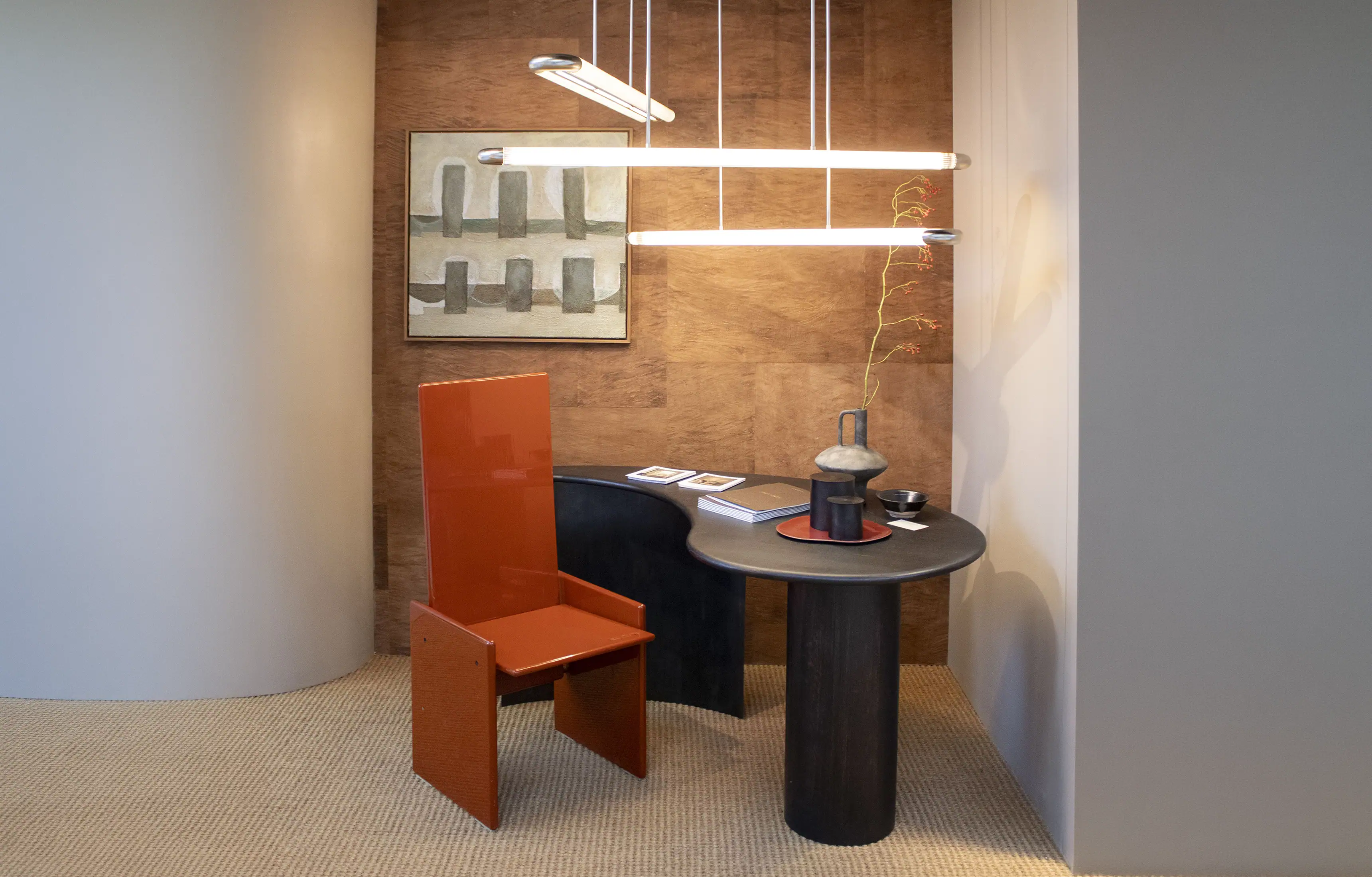
The room was warm: a wall of burnt sienna in a cork-like texture, sisal underfoot, an oak shelving unit with curved-fronted compartments running floor to ceiling. In the compartments, alongside the finished fittings, sat the parts. Raw castings, machined spun components, unfinished spun shades in dull grey metal, stacked and shelved like an ironmonger’s. It is the most direct answer to the provenance question anyone gave at the fair, and it needs no lighting design at all: you can see a sand-cast blank next to the polished thing it becomes.

The products around it were the two collections the studio extended for the show. Strata runs two slender ribbed glass tubes in parallel, joined by rounded machined brass end caps, and at Decorex 2024 it gained lengths of 1,200mm, 2,350mm and 3,150mm alongside the original 1,600mm, plus a wall version. Seen on the wall, the reeding turns a single lamp into thirty vertical filaments of light. Orbit pairs an opal glass sphere with a surround in metal or natural stone, and it gained new finishes including rough sand-cast antique brass and bronze, travertine and black, green and red marble, along with three-drop and six-drop groupings. Both come in antique bronze, bronze, satin brass and satin nickel.

One photograph from that stand contains the whole argument of this piece by accident. Standing inside the room, looking through the gap between two partition walls, you can see the warm, controlled, low-lit interior in the foreground and, behind it, the pale grey daylight of the hall and the steel of Olympia’s roof. Two lighting conditions, four feet apart, separated by a stud wall somebody chose to build.

Kast: the one that needed the light falling the other way
Kast is the exception in the group, and it is the exception that makes the case. Decorex 2024 was its first time exhibiting at the fair.
Founded around 2011 by Tim Bayes and based in Newark, Kast makes concrete basins, and in May 2023 it was acquired by Kohler, joining a luxury division that also holds ANN SACKS, KALLISTA and Robern. Bayes stayed on to lead the creative side.

A concrete basin has the opposite optical requirement to a pendant. Its qualities are surface, colour and mass: the fine texture of the cast face, the depth of a pigment carried through the body of the material rather than applied to it, the weight the eye reads before the hand confirms it. None of that survives flat, even, overhead light, which is the one condition that makes concrete look like a photograph of concrete. It needs light arriving from the side, low enough to rake across the face and pull the texture up.

So Kast and the five lighting brands share a hall and a problem, approached from opposite ends. The lighting studios have to subtract the venue’s light before their own is visible. Kast has to add light the venue does not supply, in a direction the venue never provides. Both are stand-design problems dictated by the product itself.

Kast built for it by going dark for the opposite reason to everybody else. The stand was a curved enclosure finished in a deep matte navy so flat it reads almost as a void, and the basins were placed against it in full saturation: terracotta, cornflower blue, ochre, mint, dusty pink, a green flecked terrazzo. Some sat on fluted cylindrical pedestals, the pedestal in one colour and the shelf above it in another. Others were cantilevered straight off black steel posts fixed to the wall in two vertical columns, arranged like specimens, each a different profile: rectangular, scalloped, arched, rounded, oval.

Nothing there is subtle and none of it needs to be. A matte navy ground gives up almost no reflected light, so the pigment does all the work and the colour arrives at full strength rather than washed. The shallow vertical fluting on the pedestals is the part that would have vanished under the hall’s own rig. It exists to the eye only as a rhythm of narrow highlights and shadows, which requires light arriving across it rather than down onto it. Lit properly it reads at ten paces. Lit flatly it would be a smooth cylinder.

Frequently asked questions
When was Decorex 2024?
From 6 to 9 October 2024 at Olympia London, with 280 brands exhibiting to more than 12,500 visitors.
What is Decorex?
A trade fair for the interior design industry, established in 1978 and held annually at Olympia. It is aimed at designers, architects and specifiers rather than the general public.
Who won Best Stand at Decorex 2024?
Bert Frank took Best Space Only Stand, in its tenth year at the show. Floor Story won Best Newcomer, Armac Martin won Best Product and Tori Murphy Textiles won Best Shell Scheme. CTO Lighting took the Planet Conscious Award.
What is the Kupoli collection?
Cameron Design House’s first furniture collection: twelve dining, coffee, console and side tables built from domed steel tubes under a glass top, named after the Finnish word for dome, priced from £2,200 and handcrafted in the studio’s Hertfordshire workshop. It was named Best Furniture Collection of the Year at the Livingetc Style Awards in August 2024.
Who founded Bert Frank?
The designer Robbie Llewellyn and Adam Yeats, in 2013. The studio is based in Birmingham and manufactures there, working in sand-cast brass, hand-blown glass, marble and alabaster, made to order.
Who founded CTO Lighting?
Chris and Clare Turner, in 1998. Chris is an engineer and chief executive, Clare is creative director. The company manufactures in the United Kingdom.
What does Haberdashery make?
Light sculpture. It was founded by Ben Rigby and Mac Cox, who met in the film industry, with the engineer Daniel Siden.
Where is J. Adams & Co made?
Designed in London and manufactured at a Birmingham factory that has been in continuous operation for more than fifty years. Its Strata and Orbit collections were both extended for Decorex 2024.
Who owns Kast?
Kohler, which acquired the Newark-based concrete basin maker in May 2023. Kast was founded by Tim Bayes, who continues to lead its creative direction, and made its Decorex debut in 2024.
Final thoughts
It would be easy to read a list of five lighting brands and one basin maker as a personal bias declaring itself. The more useful reading is that the fair sorted itself, and that the sorting has a cause.

Every exhibitor at Olympia is handed the same conditions: a vast daylit hall, an overhead rig belonging to somebody else, four days, and a rectangle of floor. For most categories that is a neutral starting point. For a lighting brand it is a condition that has to be designed around before the product can be seen at all, and designing around it means building a room with walls, a ceiling, a sequence and a controlled level of light.

Six answers, and no two the same. Cameron Design House sealed the room and took it to black. Bert Frank swagged a fabric ceiling over a domestic interior and won the show for it. CTO Lighting used warm plaster to sit two stops below the aisle without ever going dark. Haberdashery built a proper white ceiling and lit downward on purpose. J. Adams & Co put the raw castings on a shelf and let the making carry the stand. Kast, needing light that rakes rather than falls, arrived in the same place from the opposite direction.

What that produces, year after year, is a cluster of stands that have had to think structurally about a temporary space. It is why the aisles where the lighting sits are the ones worth slowing down in.


Leave a Reply